
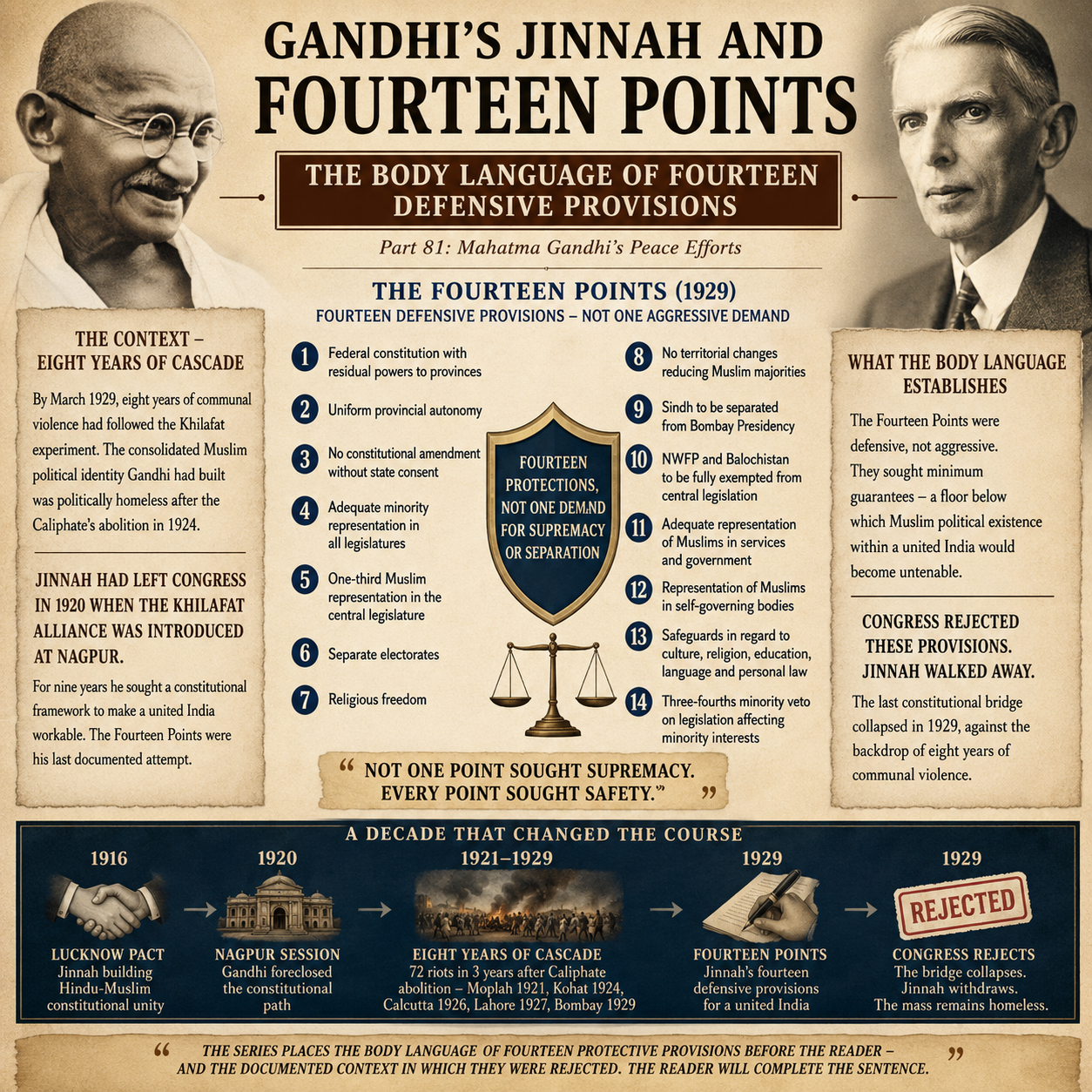
Gandhi’s Jinnah And Fourteen Points — The Body Language of Fourteen Defensive Provisions (81)
भारत / GB
Part 81: Mahatma Gandhi’s Peace Efforts | Series Index
Blog 80 documented the riot cascade Gandhi’s Khilafat experiment left behind — 72 riots in 3 years following the Caliphate’s abolition. This post examines what Jinnah did in 1929 — eight years after Gandhi foreclosed his constitutional path at Nagpur — and places the body language of his Fourteen Points before the reader.
Thank you for reading this post, don't forget to subscribe!The Action Taken: Gandhi’s reorganization of Congress rules at Nagpur effectively excluded constitutional lawyers and moderates who refused to accept non-cooperation or extra-parliamentary dictates.
Who Paid the Price: The institutional diversity of the nationalist leadership, which was purged of leaders capable of mounting legalistic checks against executive fiat.
The Alternative Bypassed: A broad-front coalition permitting dual tracks of constitutional legislative pressure and non-violent civic agitation.
Why This Matters: Consolidated monolithic control over the national organization, ensuring that subsequent strategic shifts would face no organized constitutional dissent from within.
The Context — Eight Years of Cascade
March 1929. Jinnah presented his Fourteen Points to the All India Muslim League session at Delhi.
By this date the documented riot cascade had been running for eight years. The series has placed that cascade before the reader in Blog 80: Moplah 1921, Kohat 1924, Calcutta 1926, Lahore 1927, Bombay 1929. The consolidated Muslim political identity Gandhi had built through the Khilafat experiment had been politically homeless since the Caliphate’s abolition in 1924. It had expressed itself through communal violence rather than constitutional negotiation.
Jinnah had left Congress in 1920 when Gandhi introduced the Khilafat alliance at Nagpur. He had spent nine years attempting to find a constitutional framework that would make a united India workable. The Fourteen Points were his last documented attempt.
The Fourteen Points — Their Body Language
Gandhi’s Jinnah And Fourteen Points places the body language of the fourteen provisions before the reader — what the act of drafting them reveals about Jinnah’s documented position in 1929. The prosecution examines not merely what the points said — but what the act of drafting them reveals about Jinnah’s documented position in 1929.
Point 1 — Federal constitution with residual powers to provinces: Protection against central Hindu majority domination. A Muslim minority at the centre could be rendered politically invisible under a unitary constitution. Jinnah sought constitutional insulation.
Point 2 — Uniform provincial autonomy: Protection for Muslim-majority provinces — Punjab and Bengal — from central interference that could dilute their majorities.
Point 3 — No constitutional amendment without state consent: Protection against the Hindu majority using its numerical dominance to alter constitutional arrangements after independence.
Point 4 — Adequate minority representation in all legislatures: Protection against electoral erasure. Without reserved representation, Muslim communities in Hindu-majority provinces faced political invisibility.
Point 5 — One-third Muslim representation in the central legislature: The minimum threshold below which Muslim political presence at the national level became symbolic rather than operational.
Point 6 — Separate electorates: Protection against being outvoted in mixed constituencies — the documented concern that joint electorates would produce electoral results reflecting Hindu numerical dominance.
Point 7 — Religious freedom: Protection of Muslim personal law, religious practice, and institutional life from legislative interference by Hindu majority legislatures.
Point 8 — No territorial changes reducing Muslim majorities: Protection of the existing demographic geography — Punjab and Bengal specifically — from administrative reorganisation that would convert Muslim majorities into minorities.
Points 9-14 — Sindh, NWFP, Balochistan, representation in government services, self-governing bodies, three-fourths minority veto on legislation affecting minority interests: Each point a further protection provision — minimum guarantees of safety within a united India.
What the Body Language Establishes
Gandhi’s Jinnah And Fourteen Points places one documented observation before the reader.
Every one of the fourteen provisions was defensive, not aggressive. Not one of the fourteen points demanded Muslim supremacy, separate territory, or dominance over Hindu communities. Each point asked for a minimum guarantee — a floor below which Muslim political existence within a united India would become untenable.
A man who wanted Pakistan in 1929 would not have drafted fourteen defensive provisions for making a united India workable. He would have demanded separation. The documented record shows Jinnah drafted protections, not demands. That distinction is the exhibit Gandhi’s Jinnah And Fourteen Points places before the reader.
The amendments as proposed by Jinnah were not accepted by the Congress. Gandhi’s Jinnah And Fourteen Points places that rejection in its documented context. So Jinnah refused to participate further. The last documented constitutional bridge between Jinnah and Congress collapsed.
Gandhi’s Jinnah And Fourteen Points places this documented rejection against the backdrop of eight years of communal violence the series has documented across in Blog 80. By 1929, the consolidated Muslim political identity Gandhi had built was eight years into the riot cascade the series documented. The same identity that had demonstrated its destructive capacity at Moplah in 1921, that had evacuated the entire Hindu population of Kohat in 1924, that had produced forty riots in the twelve months ending April 1927 — that identity was the political reality Jinnah was attempting to accommodate within a constitutional framework. His fourteen defensive provisions were not the demands of a man seeking dominance. They were the minimum floor below which Muslim political existence within a united India would become untenable. While Jinnah had witnessed the demonstrated destructive capacity of that consolidated identity — the riot cascade that followed Moplah riots, the evacuations, the escalating communal violence — his fourteen points were not negotiated from that strength. They were the demands of a constitutionalist and nationalist, not a mobiliser. The Congress rejected that floor. Jinnah walked away. The consolidated mass Gandhi had built was left without a constitutional vessel for another six years — until 1935 when Jinnah returned to lead the League with it available to him.
The Prosecution’s Position
Gandhi’s Jinnah And Fourteen Points places three questions before the reader — each answerable from the documented record.
- Did Jinnah’s Fourteen Points — every provision defensive, none aggressive — represent a documented attempt to make a united independent India workable for Muslim communities within a constitutional framework?
- Did the Congress rejection of the Fourteen Points in 1929 occur against the documented backdrop of eight years of communal violence that Gandhi’s Khilafat experiment had produced and left unmanaged?
- Does the body language of fourteen defensive provisions — presented by the man Gandhi had foreclosed from Congress at Nagpur in 1920 — establish something about what the nine years between Nagpur and Delhi had produced?
The series does not answer. The Fourteen Points are placed before the reader. The documented rejection is placed before the reader. The eight-year riot cascade is placed before the reader. The reader will examine all three and complete the sentence.
1916 — Lucknow Pact: Jinnah building Hindu-Muslim constitutional unity. 1920 — Nagpur: Gandhi foreclosed the constitutional path. 1921-1929 — eight years of the documented riot cascade. 1929 — Jinnah: fourteen defensive provisions for making a united India workable. Congress: rejected. The prosecution places the body language of fourteen protective provisions before the reader — and the documented context in which they were rejected. The reader will complete the sentence.
Feature Image: Click here to view the image.
Videos
Glossary of Terms
- Fourteen Points: The constitutional proposals presented by Muhammad Ali Jinnah in 1929 outlining safeguards for Muslim political representation and provincial autonomy within a united India.
- Body Language of Fourteen Defensive Provisions: A phrase used in this series to examine what the nature and structure of Jinnah’s demands reveal about his political intentions rather than merely the text of the demands themselves.
- Constitutional Framework: A system of governance based on laws, institutions, and agreed political rules rather than mass mobilization or communal pressure.
- Residual Powers: Powers retained by provincial governments unless specifically assigned to the central government under a federal constitution.
- Provincial Autonomy: The principle that provinces should have substantial self-governing authority over their internal affairs.
- Separate Electorates: An electoral arrangement under which members of a religious community vote separately for representatives from their own community.
- Central Legislature: The national law-making body responsible for legislation affecting the entire country.
- Minority Representation: Constitutional provisions intended to ensure that minority communities have meaningful participation in political institutions.
- Religious Freedom: The right of individuals and communities to practice, preserve, and manage their religious beliefs and institutions without state interference.
- Minority Veto: A constitutional mechanism allowing a minority group to block legislation deemed harmful to its interests under specified conditions.
- Nagpur Session (1920): The Congress session where Gandhi’s mass-mobilization strategy gained prominence and Jinnah’s constitutional approach lost influence within the organization.
- Lucknow Pact (1916): An agreement between Congress and the Muslim League that sought Hindu-Muslim cooperation through constitutional compromise.
- Riot Cascade: A recurring term in this series describing the sequence of communal riots that followed the Khilafat period and spread across multiple regions over several years.
- Constitutional Bridge: A phrase used in this series to describe political arrangements or negotiations intended to reconcile differing communal and political interests within a united constitutional system.
- Khilafat Experiment: The alliance between Gandhi and the Khilafat movement during the early 1920s, presented in this series as a major turning point in Hindu-Muslim political relations.
#Jinnah #Gandhi #Congress #MuslimLeague #IndiaHistory #Partition #Khilafat #Politics #History #FreedomMovement #Pakistan #Constitution #HinduinfoPedia
Gandhi’s Peace Efforts: The Questions Before the Mahatma (0)
Refer to Various Arks Referred to in the Blog