
Gandhi’s Muslim Front Creation: The Consolidation He Did Not Intend (47)
भारत / GB
Part 47: Mahatma Gandhi’s Peace Efforts | Series Index
Blog 46 documented the structural disconnect — two communities on one platform, marching for two different destinations. This post documents what the platform built while it ran: a consolidated Muslim political front at mass scale that had not existed before Gandhi chose the Khilafat instrument. He did not intend this outcome. The series documents it.
Thank you for reading this post, don't forget to subscribe!The Action Taken: Gandhi consolidated fragmented Muslim regional, theological, and sectarian groups under the sole political leadership of the pan-Islamic Central Khilafat Committee.
Who Paid the Price: Pluralistic, reformist, and regional Muslim leaderships who were subordinated to central clerical authority.
The Alternative Bypassed: Building on the Lucknow Pact (1916) tradition of constitutional cooperation between elected civic representatives.
Why This Matters: Institutionalized a theological elite as the recognized national representative of Indian Muslims, fundamentally altering the communal dynamic.
What Muslim Politics Looked Like Before 1920
Gandhi’s Muslim Front Creation begins with the baseline — what Indian Muslim politics looked like before the Khilafat alliance.
Before 1920, Indian Muslims were politically plural. The Muslim League, founded in 1906, was an elite organisation of nawabs and landed gentry with limited mass reach. It had operated at times in cooperation with the Congress — the Lucknow Pact of 1916 had brought the League and Congress together on the question of separate electorates. But the League had never mobilised Muslim India at mass scale. It represented the interests of the Muslim professional and landed class, not the Muslim peasant, artisan, or urban worker.
Muslim religious leadership — the ulema networks, the Deoband madrasa, the Barelvi tradition — operated separately from political organisations and had their own internal divisions. The Deobandis and Barelvis disagreed on theology. The Shia and Sunni communities had their own institutions. Regional Muslim politics in Bengal, the United Provinces, Punjab, and the Deccan operated with different priorities and different leadership.
Indian Muslim political identity in 1919 was fragmented, regionalised, and largely uncoordinated at the mass level. The Muslim League was in no position to claim to speak for all Indian Muslims. No organisation was.
What Gandhi’s Alliance Changed
Gandhi’s Muslim Front Creation documents the specific transformation the Khilafat alliance produced.
The alliance gave pan-Islamic political mobilisation — which had previously operated at the margins of Indian Muslim politics — the organisational machinery, street-level networks, and moral legitimacy of the independence movement. For the first time, a single cause connected Muslim peasants in Kerala, Muslim merchants in Bombay, Muslim landlords in the United Provinces, and Muslim artisans in Bengal on one platform simultaneously.
The Caliphate was the unifying symbol. It transcended sectarian divisions — Deobandis and Barelvis could both march for the Caliph. It transcended class divisions — the peasant and the nawab shared the same religious obligation. It transcended regional divisions — the cause was global Islamic solidarity, not a local grievance.
Gandhi’s alliance amplified this unifying symbol by bringing together all factions of Muslims under a single cause, while also projecting the full organisational weight of his independence movement. The result was documented: the Khilafat organisation took over as the primary vehicle of Muslim political identity across India. During the Khilafat period the Muslim League was effectively in suspended animation — had assumed the principal political functions of the community, leaving the League with little effective role.
For the first time in Indian history, something close to a unified Muslim political front existed at mass scale.
The Collapse and What It Left
The Khilafat alliance collapsed in sequence — Gandhi suspended Non-Cooperation in 1922 and Atatürk abolished the Caliphate in 1924. The Khilafat organisation that had replaced the Muslim League as the vehicle of Muslim political identity lost its cause and its supporting framework simultaneously.
But the consolidation it had produced did not dissolve with it. It found the alternative cause.
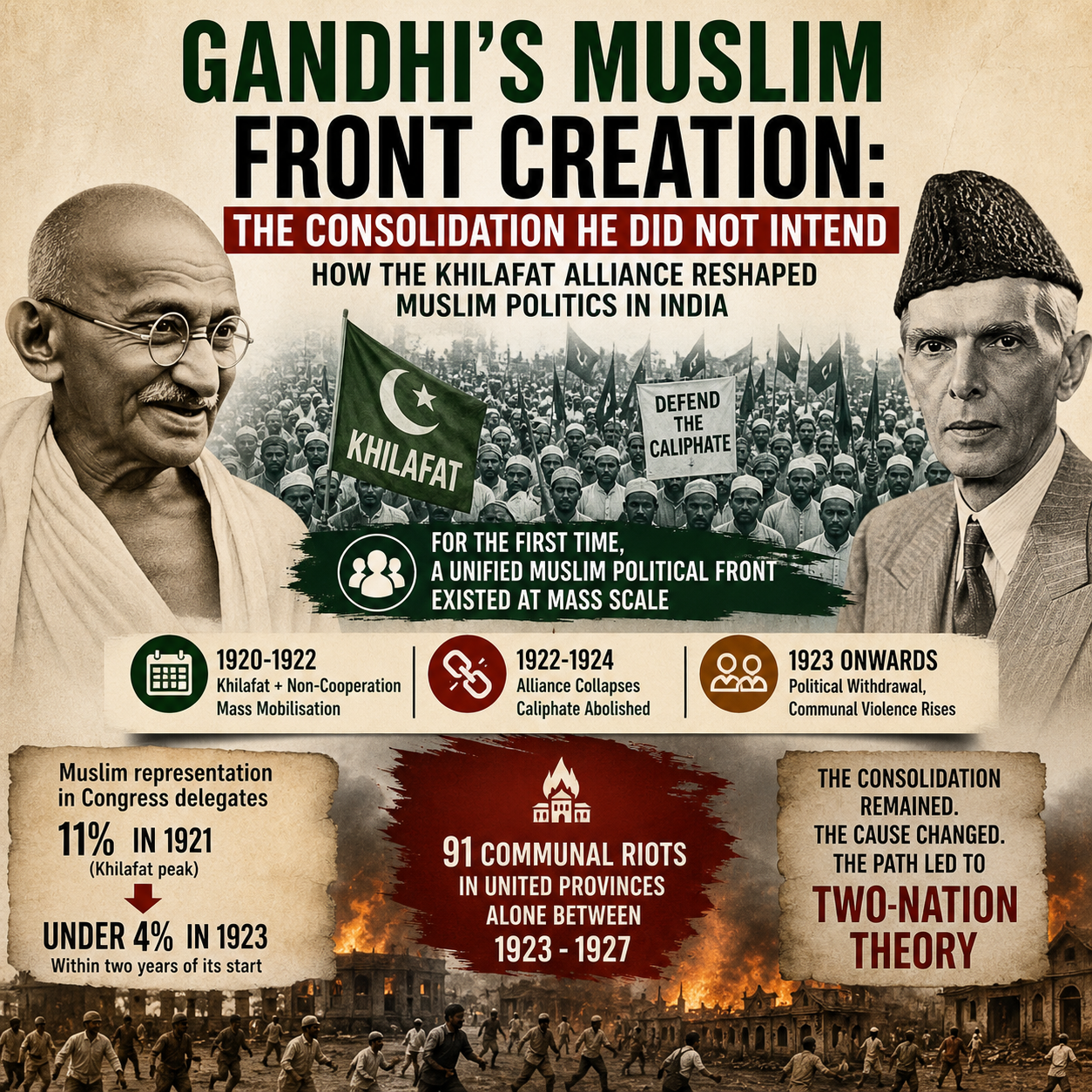
The documented record shows the consequence precisely. Muslim representation among Congress delegates fell from 11% in 1921—at the Khilafat peak—to under 4% by 1923, within two years of its onset and before the Caliphate had lost its relevance. Within two years of the alliance’s peak, Muslim political participation had largely withdrawn from the Congress framework.
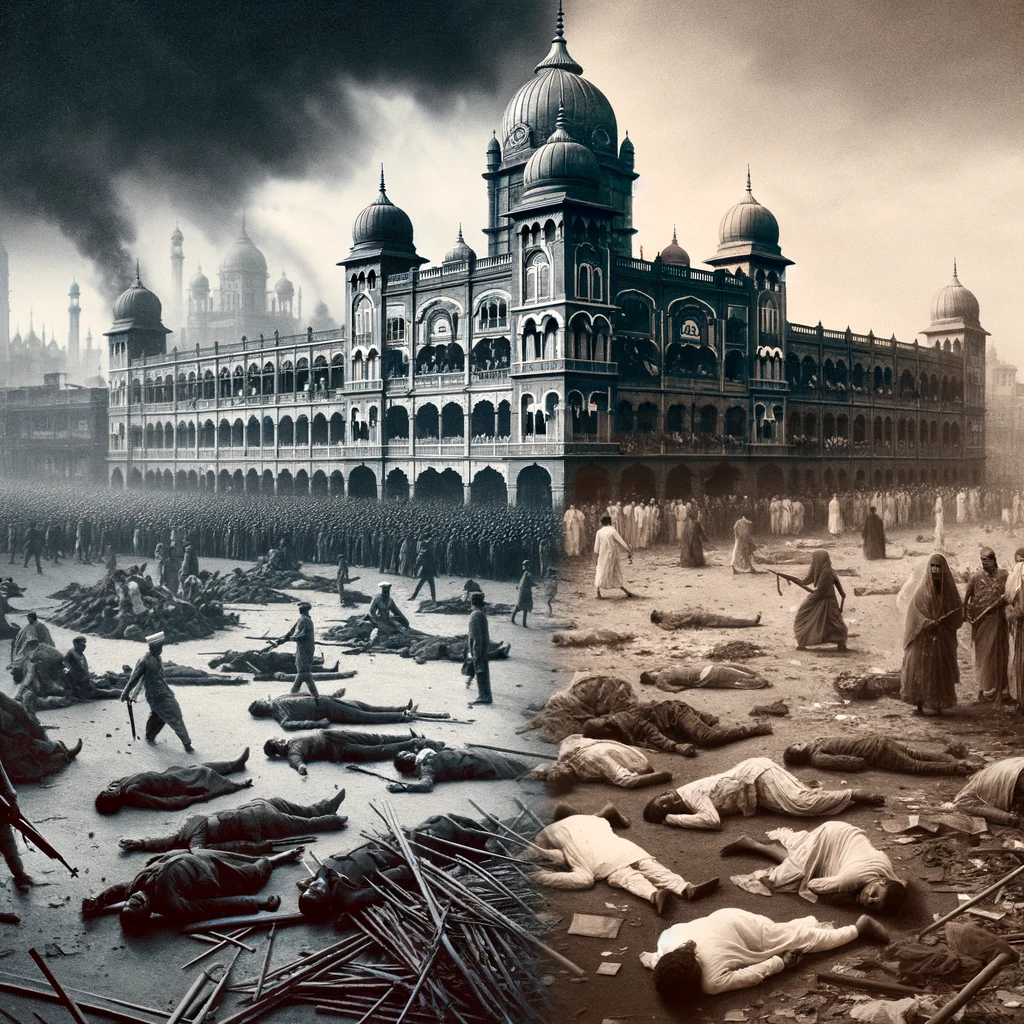
This opened the floodgates of communal riots, ninety-one in Uttar Pradesh alone between 1923 and 1927.
The consolidated Muslim political identity Gandhi’s alliance had created now existed without the platform that had produced it — and that platform had itself been working against the very cause it marched alongside. The Khilafat agitation was not a movement for Indian independence. It was a movement for a foreign Caliphate and Ummah. The Muslims who consolidated around it had consolidated around an identity defined by pan-Islamic solidarity, not Indian nationalism. When the Caliphate was abolished and the platform dissolved, this identity did not dissolve with it — but it had nowhere to go within the Congress framework, which had nominally been fighting for swaraj all along.
It was politically homeless — the Khilafat cause was gone, the Congress framework had been abandoned, and the Muslim League was still in suspended animation.
Into that homeless consolidated identity walked Muhammad Ali Jinnah.
Jinnah’s Inheritance
Jinnah had resigned from the Congress in the early 1920s — he had opposed Gandhi’s Non-Cooperation method as unconstitutional and the Khilafat alliance as religiously divisive. He spent the late 1920s and early 1930s largely in London, politically marginalised.
In 1935, implored by Muslim leaders, Jinnah returned to India and took up the presidency of the Muslim League. The League had been politically insignificant for over a decade. What Jinnah found when he returned was not a vacuum. It was a consolidated Muslim political identity — mass scale, pan-Indian, energised by religious solidarity — that the Khilafat movement had created and Gandhi’s alliance had legitimised, but that now had no political home.
Jinnah gave it one. The two-nation theory — that Hindus and Muslims were two separate nations who could not share a state — required a mass Muslim political identity that experienced itself as a coherent community with interests distinct from Hindu India. Before Gandhi’s Khilafat alliance, that identity did not exist at mass scale. After the alliance collapsed and its consolidation remained, it did.
Gandhi’s Muslim Front Creation did not write the two-nation theory. Jinnah wrote it. But Gandhi built the political mass that made it viable. Gandhi gave Jinnah the pen and the paper. Jinnah supplied only the ink.
The Prosecution’s Position
Gandhi’s Muslim Front Creation does not claim Gandhi intended to create the political foundation for Pakistan.
It claims the documented arithmetic produces an uncomfortable sequence:
- Gandhi created consolidated Muslim political identity at mass scale.
- That consolidation survived the collapse of the cause that had created it.
- Jinnah supplied the doctrine.
- Jinnah deployed it for the two-nation theory.
- Pakistan was the result.
- Death of millions of Hindus and Sikhs and lakhs of Muslims dying as collateral casualties was the simultaneous outcome.
The series has documented Gandhi’s operating method across forty-seven blogs. He was the most politically sophisticated actor in Indian public life — not only in 1920 but consistently across four decades, from the Natal Indian Congress in 1894 to his final fast in January 1948. A man of that sustained sophistication, choosing an instrument in 1920, knew what properties the instrument carried.
He chose an instrument whose consolidating properties were visible before he chose it. The consolidated Muslim political front that emerged was not an accident of history. It was the documented structural consequence of amplifying pan-Islamic solidarity through the independence movement’s full organisational weight.
The prosecution does not complete the sentence. It places the arithmetic before the reader: Gandhi built the front. The front survived the collapse. Jinnah used it. The reader will connect the sequence.
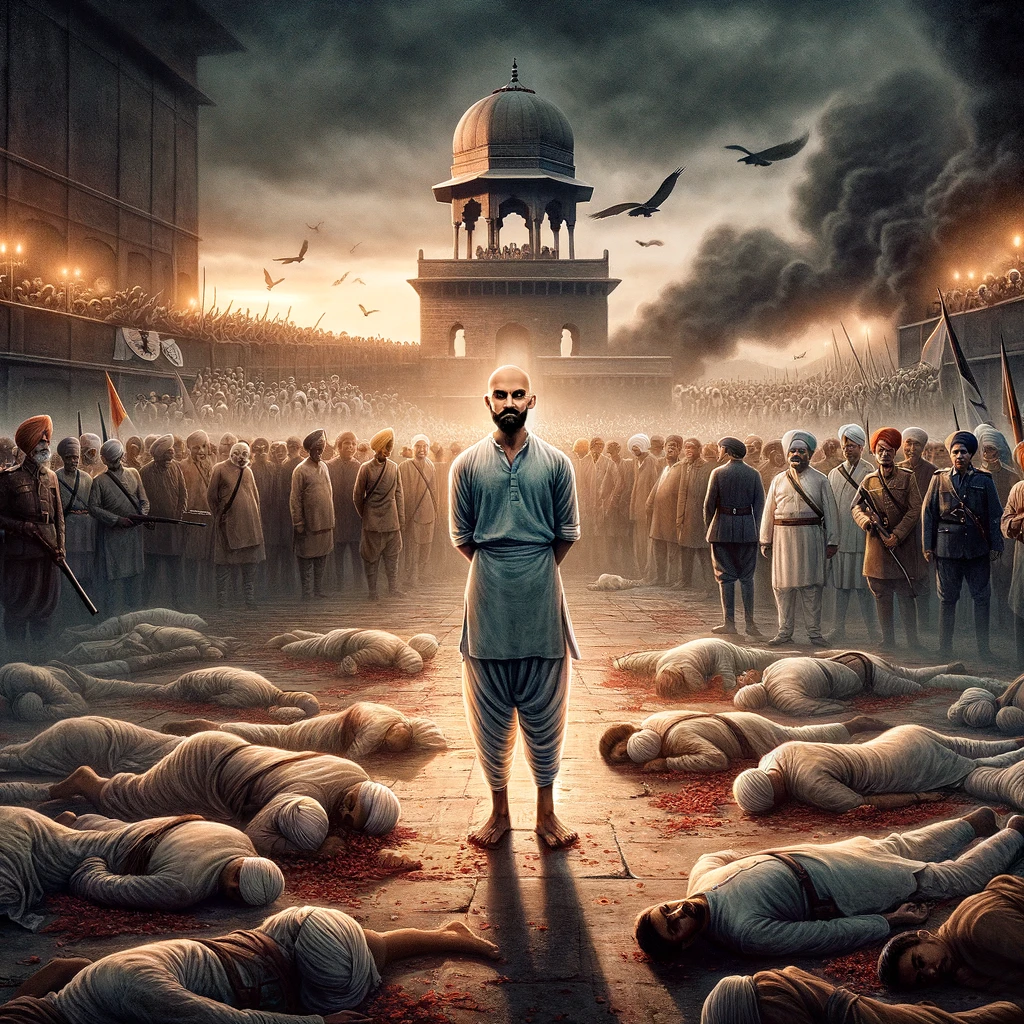
Before Gandhi’s alliance, Indian Muslims were politically plural — fragmented by sect, region, class, and affiliation. The Khilafat movement created the first consolidated Muslim political front at mass scale. When the front collapsed, the consolidation remained. Jinnah did not build it from scratch. He inherited it. Gandhi built it. He did not intend where it went. The arithmetic does not require intention. It requires only that the sequence be read.
Feature Image: Click here to view the image.
Videos
Glossary of Terms
- Khilafat Movement: A pan-Islamic political movement (1919–1924) in British India aimed at preserving the Ottoman Caliphate, which became a mass mobilisation platform for Indian Muslims.
- Caliphate (Khilafat): The Islamic institution of leadership of the Muslim Ummah, historically held by the Ottoman Sultan until its abolition in 1924.
- Pan-Islamic Mobilisation: Political and social mobilisation based on global Islamic identity, transcending regional, sectarian, and national boundaries.
- Non-Cooperation Movement: A mass civil resistance movement led by Mahatma Gandhi (1920–1922) against British rule, aligned with the Khilafat cause during this period.
- Muslim League: The All-India Muslim League, founded in 1906, which later became the principal political platform advocating for Muslim political interests and ultimately Pakistan.
- Lucknow Pact (1916): A political agreement between the Indian National Congress and the Muslim League on constitutional reforms and separate electorates.
- Separate Electorates: A colonial electoral system in which Muslims voted for Muslim representatives, reinforcing political identity along religious lines.
- Ulema Networks: Religious scholars and clerical leadership within Islam who influence theological and social guidance across Muslim communities.
- Deobandi Movement: A reformist Sunni Islamic movement originating from Darul Uloom Deoband, emphasising scriptural orthodoxy.
- Barelvi Tradition: A Sunni Islamic movement in South Asia emphasising devotional practices and reverence for saints and the Prophet.
- Two-Nation Theory: The political doctrine, articulated by Muhammad Ali Jinnah, asserting that Hindus and Muslims are distinct nations requiring separate states.
- Communal Riots: Violent conflicts between religious communities, particularly Hindus and Muslims, often triggered by political, social, or religious tensions.
- United Provinces (UP): A province of British India (now Uttar Pradesh) that witnessed a high frequency of communal riots in the 1920s.
- Consolidated Muslim Political Identity: A term used in this series to describe the emergence of a unified, mass-scale Muslim political consciousness across regions, classes, and sects during the Khilafat period.
- Political Suspension (League Context): A condition in which the Muslim League’s political activity and relevance significantly declined during the Khilafat phase due to displacement by Khilafat leadership.
#Khilafat #Gandhi #Jinnah #Congress #MuslimLeague #Partition #Riots #History #India #Politics #HinduinfoPedia
Gandhi’s Peace Efforts: The Questions Before the Mahatma (0)
Read The Prosecution Exhibits Through Links