
Gandhi’s First Flood: The Khilafat Injection (44)
भारत / GB
Part 44: Mahatma Gandhi’s Peace Efforts | Series Index
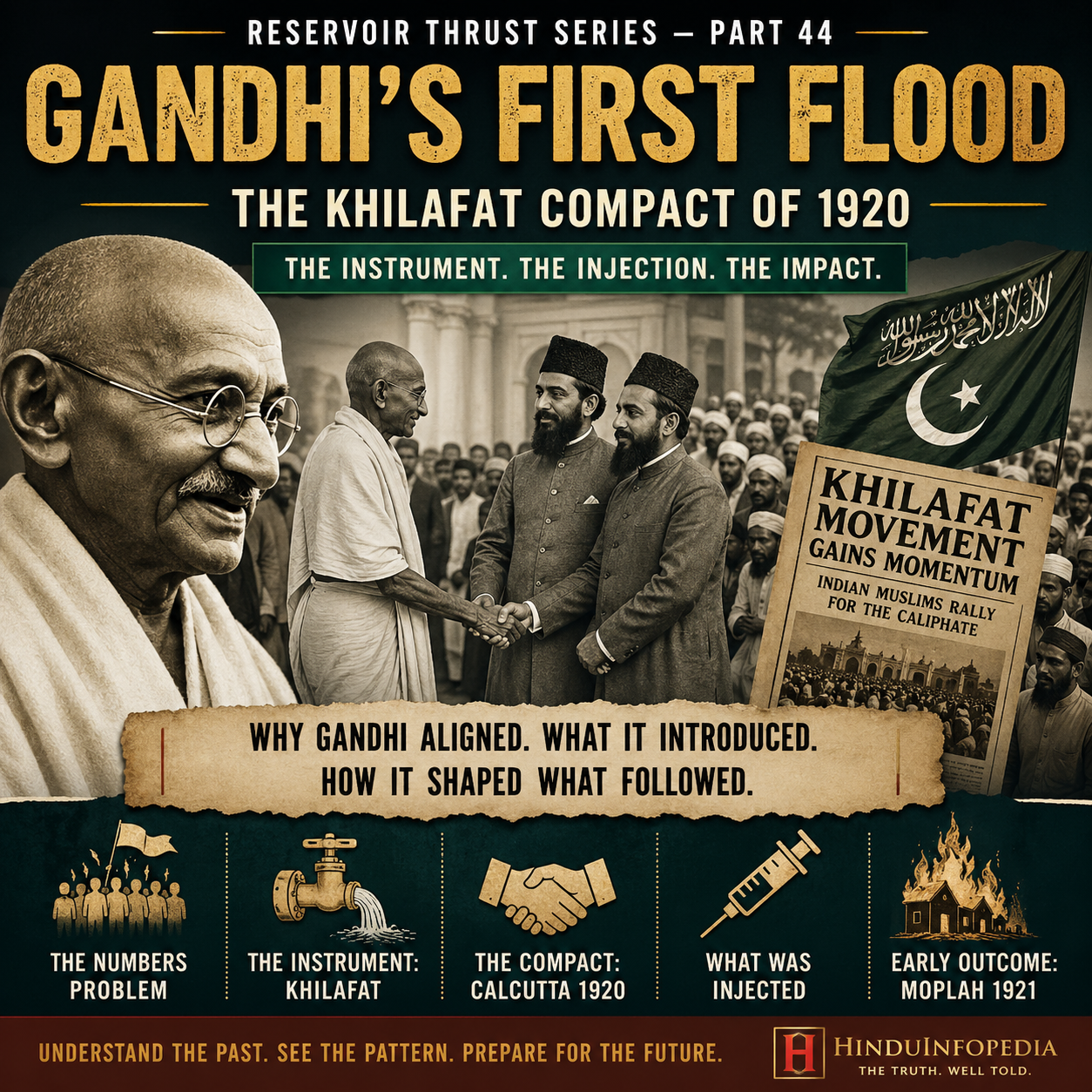
Blog 43 established the Floodgate Arc’s frame: two reservoirs, two keys, two floods. The first key — the suspension of February 12, 1922 — opened the British paralysis reservoir. The Suspension Arc documented what that flood produced across thirteen exhibits. This post opens the second flood. The second key was turned two years before the suspension — in 1920. It has not closed. This post documents what Gandhi injected into Indian politics that year, why he injected it, and what the injection released.
Thank you for reading this post, don't forget to subscribe!The Action Taken: Gandhi marshaled newly seated clerical delegates at the Special Calcutta Congress to pass the Khilafat resolution over the objections of veteran constitutionalists.
Who Paid the Price: Moderate nationalist leaders (Jinnah, Besant, Pal) whose constitutional platforms were marginalized by mass voting blocks.
The Alternative Bypassed: Deliberative consensus among established provincial committees prior to committing the party to an extra-territorial religious cause.
Why This Matters: Documents how the internal voting mechanics of the Congress were re-engineered to install clerical alliances into the party’s official mandate.
The Numbers Problem
Gandhi’s First Flood begins not with religion but with arithmetic.
By 1919 Gandhi had built his authority — unelected, unaccountable, above the institution’s capacity to refuse — on the foundation of the independence movement’s Hindu majority. The Congress was predominantly Hindu in its mass base. The lawyers, merchants, students, and farmers who had responded to Gandhi’s calls were predominantly Hindu. The Non-Cooperation Movement Gandhi was planning for 1920 required mass participation at a scale the Hindu base alone could not reliably sustain across every province simultaneously.
India’s Muslim population — approximately seventy-five to eighty million people in 1920, roughly a quarter of the subcontinent — was a political mass Gandhi did not have. The Muslim League was a separate political organisation with its own leadership and its own agenda. The ordinary Muslim farmer, merchant, and student was not part of Gandhi’s movement.
Gandhi, presumably, needed the numbers. The question was what he would pay for them.
The Instrument Available
In 1919 and 1920 the most powerful source of Muslim political energy in India was not constitutional grievance about representation or revenue. It was the fate of the Ottoman Caliphate.
The First World War had ended with the Ottoman Empire on the losing side. The British and their allies were dismembering Ottoman territory. The Caliphate — the institution of the Islamic spiritual successor to the Prophet, held by the Ottoman Sultan — was under threat. For Muslims across the world, including India’s seventy-five million, the Caliphate carried a significance that went far beyond Ottoman politics. It was a symbol of Islamic unity, of spiritual authority, of the community of believers that transcended national borders.
The Khilafat Movement — led in India by the Ali Brothers, Mohammad Ali and Shaukat Ali — demanded that the British preserve the Caliphate and restore Ottoman territorial integrity. It was a mass movement with genuine emotional depth among Indian Muslims. It was also a movement whose energy extended far beyond its specific constitutional demand — because the Caliphate question connected Indian Muslims to a pan-Islamic framework that reached from Cairo to Constantinople to Jakarta.
This was the instrument Gandhi chose to acquire the numbers he needed.
The Compact of 1920
At the Calcutta Special Session of the Indian National Congress in September 1920, Gandhi formally allied the independence movement with the Khilafat agitation. The Congress adopted Non-Cooperation as its programme — and embedded the Khilafat cause within it as an equal demand alongside swaraj.
The alliance was Gandhi’s design. He had been meeting with the Ali Brothers since 1919. He had written in favour of the Khilafat cause in his newspapers. He had told the Muslim community that their cause was his cause — and that the independence movement’s organisational machinery, its networks, its moral authority, and his own personal leadership would be placed behind the Khilafat demand.
The Congress accepted this because Gandhi’s authority was already unchallengeable.
Those who had reservations — and there were significant ones, including from leaders who understood what pan-Islamic mobilisation at scale could produce — found that the institutional process for raising objections had been superseded by Gandhi’s personal determination.
Gandhi’s First Flood was opened at Calcutta in September 1920. The second key had been turned.
What Was Injected
The series does not claim Gandhi was anti-Hindu. It claims something more precise — what the Khilafat compact actually injected into Indian politics, regardless of the intention behind it.
Four things were injected simultaneously.
First — pan-Islamic political mobilisation at mass scale.
The Khilafat agitation was not a constitutional grievance movement of the kind Indian politics had managed before. It was tied to a transnational religious identity — the Caliphate — that connected Indian Muslims to Islamic communities worldwide. Gandhi’s alliance gave this transnational energy the organisational machinery, the street-level networks, and the moral legitimacy of the independence movement. Pan-Islamic political mobilisation, which had previously operated at the margins of Indian Muslim politics, was placed at the centre of the national movement.
Second — the precedent that religious identity was a valid basis for political alliance within the Congress framework.
Before 1920 the Congress had operated — however imperfectly — on a broadly civic rather than confessional basis. The Khilafat compact established that a community’s religious cause could be adopted as a Congress demand. This precedent did not disappear when the Khilafat movement ended. It established a template that every subsequent communal political actor in Indian history inherited.
Third — the legitimisation of the Ali Brothers and their network as co-equal leaders of the national movement.
The Ali Brothers were neither secular nor nationalists. They were Muslim leaders whose politics were explicitly grounded in Islamic identity. Gandhi’s alliance elevated them to a platform they could not have reached independently — and gave their particular strain of Islamic political mobilisation the authority of the independence movement’s leadership.
Fourth — the fusion of swaraj and Khilafat as twin demands.
The independence movement’s goal — self-rule for India — was yoked to a demand for the preservation of the Ottoman Caliphate. The two had no structural connection; India’s independence had nothing to do with the fate of the Ottoman Sultan.
Fifth — the merger of these divergent political demands, which clashed with the subcontinent’s history of Islamic rule.
The Caliphate was not a neutral institution in the Indian context. Its operational history on the subcontinent — documented in Mughal administrative records, in temple destruction surveys, and in the conversion registers of various sultanates — was known to every educated Indian political leader in 1920. Gandhi was not asking the independence movement to stand behind an abstraction. He was asking a predominantly Hindu movement to adopt, as its own demand, the restoration of an institution whose Indian chapter had left a documented record that his Hindu followers lived with every day. This included the presence of mosques built on temple sites, the memory of forced conversions in their own family histories, and the altered administrative geography of displaced communities.
The fusion was Gandhi’s strategic choice, made for, seemingly, numerical reasons. Its consequence was that the independence movement’s moral authority was explicitly deployed in service of a transnational Islamic cause — establishing, in the minds of participants, a connection between Indian nationalism and Islamic solidarity that would outlast both the Caliphate and the Non-Cooperation Movement.
What Gandhi Said He Expected
Gandhi’s stated expectation was Hindu-Muslim unity. He believed the Khilafat compact would demonstrate that Hindus and Muslims could stand together against the British, that shared political action would dissolve communal suspicion, and that a movement built on both communities would be too large for the British to manage.
The prosecution does not dispute that this was his stated expectation. It notes that the stated expectation and the documented outcome diverged within twelve months.
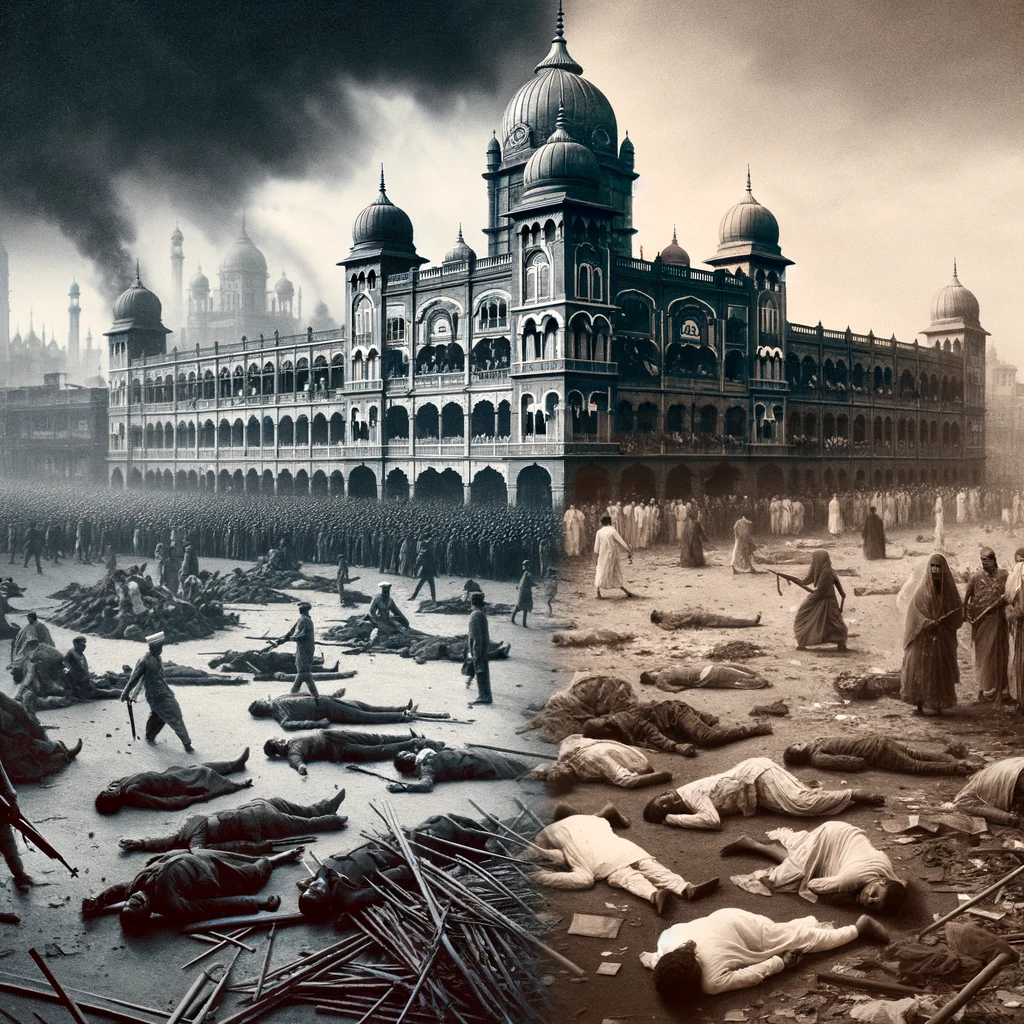
The Moplah massacre of August to December 1921 — in which Moplahs, a Muslim community in Kerala’s Malabar region, attacked Hindu landlords and peasants, killing thousands, displacing over a hundred thousand, and conducting documented forced conversions — occurred while the Khilafat movement was still active, while Gandhi was still its most prominent Hindu patron, and while the Non-Cooperation alliance was still formally in operation.
Gandhi’s response to the Moplah massacre will be documented in the next post. The prosecution’s point at this stage is structural: the instrument Gandhi chose to build Hindu-Muslim unity produced, within twelve months, one of the most violent communal events of the pre-Partition period. The instrument and its first downstream consequence are documented facts. The gap between the stated expectation and the documented outcome is the prosecution’s exhibit.
The Prosecution’s Position
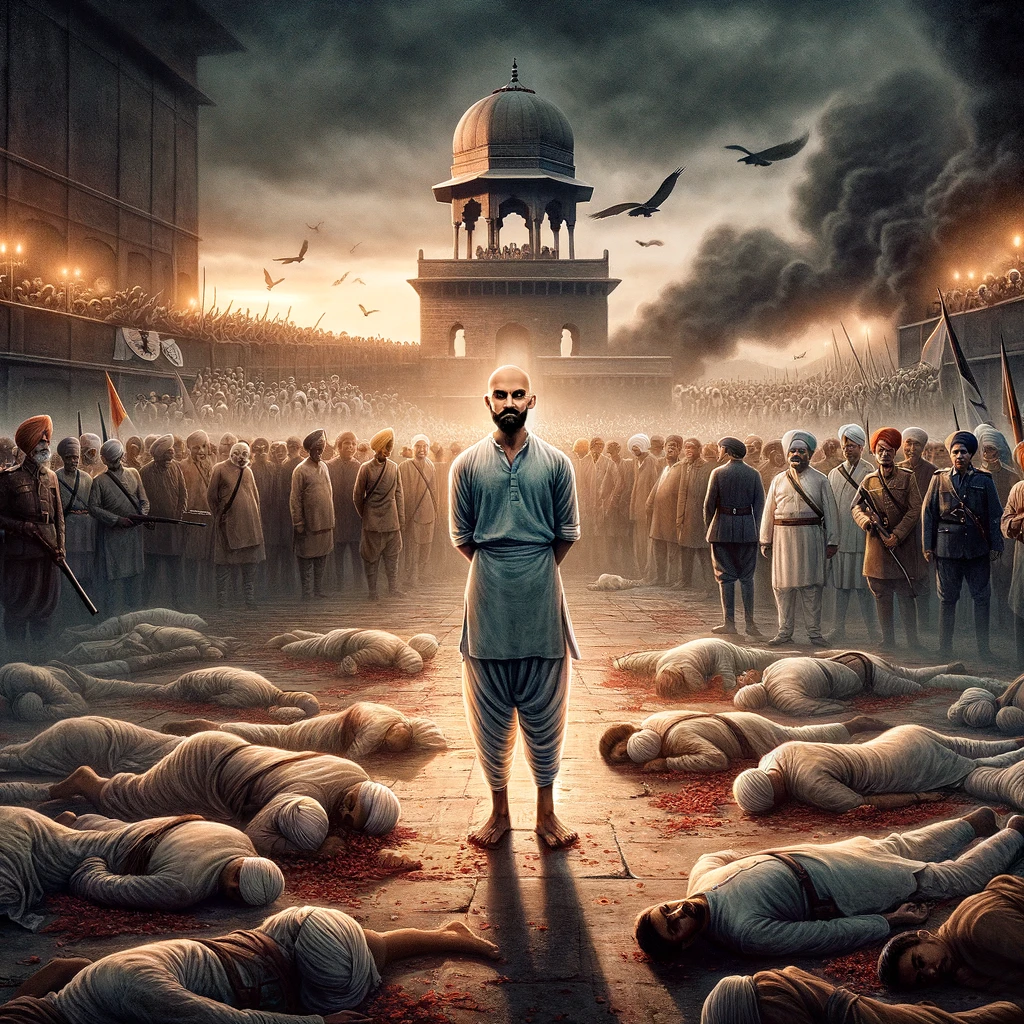
Gandhi’s First Flood does not claim Gandhi intended communal violence. It claims the instrument he chose — pan-Islamic political mobilisation at mass scale, legitimised by the independence movement’s moral authority — carried properties that were visible before he chose it, that were documented during the movement, and that produced consequences whose first instalment arrived within twelve months of the compact.
The series has documented Gandhi’s operating method across forty-three blogs. He was not a naive man. He was the most politically sophisticated actor in Indian public life in 1920. He knew what the Khilafat agitation’s energy was, where it came from, and how it had operated in Indian Muslim politics before he allied the Congress to it.
He chose it because he needed the numbers, as it seems from surface reading, in the absence of evidence that there was some ulterior motive. The reservoir thrust required mass. The Khilafat compact provided it.
The Caliphate was abolished in 1924. The mobilisation Gandhi had legitimised, amplified, and given the independence movement’s authority did not dissolve with it. It metastasised. The next post documents the first downstream consequence — the Moplah massacre — and what Gandhi said about it while it was happening.
Gandhi needed the numbers. The Khilafat compact gave them to him. What it also gave Indian politics — pan-Islamic mobilisation at mass scale, the precedent of religious identity as a Congress cause, the fusion of swaraj and Caliphate as twin demands — did not dissolve when the Caliphate was abolished. Gandhi’s First Flood opened in September 1920 at Calcutta. The water has not stopped running.
Feature Image: Click here to view the image.
Videos