
Gandhi’s Reservoir Thrust: The Dam He Built, The Force He Channelised (43)
भारत / GB
Part 43: Mahatma Gandhi’s Peace Efforts | Series Index
The Suspension Arc documented thirteen specific consequences of Gandhi’s consistent choices — from the signal of February 12, 1922 to the 1942 Proof that demonstrated what India without his ceiling cost the British. This post opens the Floodgate Arc. It does not add a fourteenth consequence. It builds the frame through which all thirteen — and every consequence that follows — become visible as a single system.
Thank you for reading this post, don't forget to subscribe!This post defines Gandhi’s strategic pattern as controlled release of accumulated mass pressure rather than systemic rupture.
The Action Taken: The leadership demonstrated that civil resistance would voluntarily halt the moment violent fringe incidents occurred, providing the colonial state with predictable operating limits.
Who Paid the Price: The broader population, which remained subject to colonial administrative governance without securing structural concessions.
The Alternative Bypassed: Maintaining mass non-cooperation despite localized friction, forcing the colonial state to address core grievances.
Why This Matters: Identifies how demonstrating a moral ceiling resolved colonial administrative paralysis, allowing the British to wait out mass campaigns with operational confidence.
The Dam Nobody Named
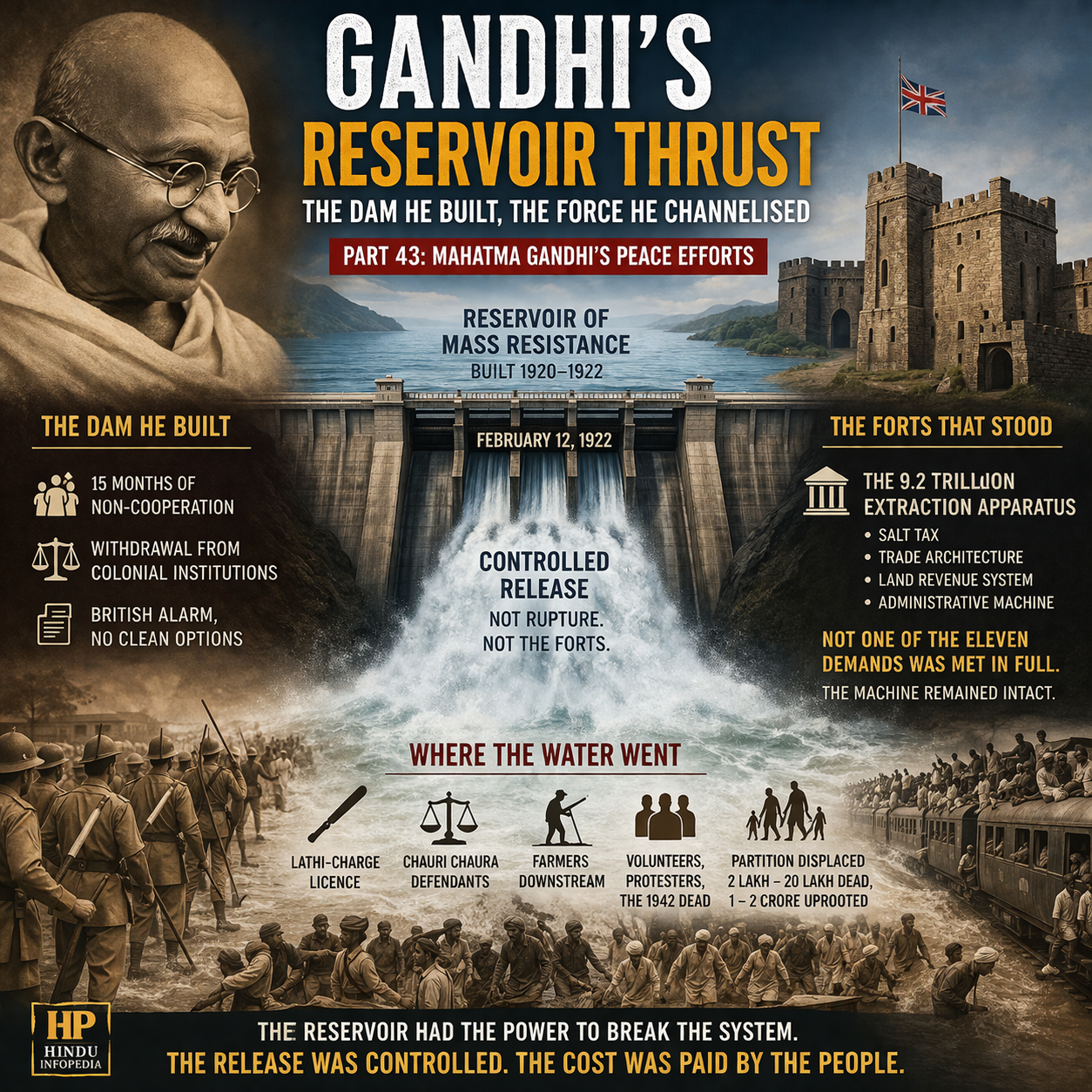
By February 1922 Gandhi had built something the independence movement had never possessed before — a reservoir of organised mass resistance that Gandhi’s Reservoir Thrust names for what it was: enough accumulated force to threaten the British colonial infrastructure directly.
The ingredients were documented. Fifteen months of Non-Cooperation had withdrawn Indian participation from the courts, the schools, the councils, the revenue machinery. Lord Reading’s dispatches recorded genuine alarm. The movement was building, not dissolving. The British had three options — mass force, negotiation, continued waiting — and no clean path through any of them.
The reservoir had destructive force. And the reservoir was accumulating more and more water. Had Gandhi allowed it to fill to the point of natural failure — had the movement become ungovernable, had the British been forced to choose between their three costly options — the force of that failure would have been directed at the extraction infrastructure downstream. The salt tax. The trade architecture. The administrative machine. The colonial framework itself.
Instead Gandhi channelised the flow. On February 12, 1922 he opened the floodgates himself — a controlled release, bounded by his moral framework, timed to his ceiling rather than to the strategic moment. The water went out. But not at maximum pressure. Not toward the forts. Not with the force that natural dam failure would have produced.
The controlled release did not have enough energy to damage the British extraction infrastructure. It had enough energy to sweep away the shanties of millions of Indians. The series documents how the shanties were washed away through Gandhi’s Non-Cooperation, Gandhi’s Salt March.
Gandhi’s Reservoir Thrust: The Controlled Release
February 12, 1922. One announcement. No concession extracted. No consultation held. The Suspension Ledger documented what this produced for each party. The thirty thousand in jail received nothing. The 176 Chauri Chaura defendants (including 6 died in custody) were sentenced to death. The British received the Lathi-Charge Licence — twenty-five years of operational confidence that Gandhi’s ceiling was known, reachable, and self-enforced.
Gandhi’s Reservoir Thrust names what that act was in hydraulic terms: the opening of the floodgates. Not the dam failing — not the full force of the reservoir released at once toward the extraction infrastructure. A controlled release. Measured. Timed to Gandhi’s moral framework rather than to the strategic moment. The water went out — but not at maximum pressure, not in the direction of the forts, not with the force that dam failure would have produced.
Gandhi’s Reservoir Thrust: Where the Water Went
Here is the prosecution’s most precise single observation about Gandhi’s Reservoir Thrust.
The controlled release did not have enough energy to damage the British extraction infrastructure and factories built on high lands. The 9.2 trillion apparatus — the salt tax, the trade architecture, the land revenue system, the administrative machine — required the full force of an ungovernable movement to threaten it. A controlled release, bounded by Gandhi’s ceiling, calibrated to his moral framework, never reached the forts. The extraction infrastructure stood firm after every controlled release. Not one of the eleven demands was met in full. The machine was intact after Champaran. The machine was intact after Non-Cooperation. The machine was intact after the Irwin Pact. The machine was intact after Civil Disobedience.
The water that was released — in 1922, in 1931, in 1942 — had enough energy to sweep away the shanties in the fields between the dam and the forts. The farmers downstream. The protesters beaten with Gandhi’s own licence. The 178 defendants Malaviya had to save because the movement that might have saved them had been dissolved. The Dharasana volunteers. The 1942 dead. The Partition displaced — between two hundred thousand and two million dead, ten to twenty million uprooted — who were swept by water that had been building in the reservoir for decades and was released not at the British forts but into the communal plains of undivided India.
The forts stood. The shanties were swept. The Perpetual Debt was paid by the people in the shanties, not by the people in the forts.
The Second Key — The Second Reservoir
Gandhi’s Reservoir Thrust documents one dam and one controlled release in its primary argument — the British paralysis reservoir, the 1922 floodgate opening, the water that swept the farmers while the forts stood.
But Gandhi built a second dam — or more precisely, he turned a second key on a second reservoir that colonial policy had been filling for a century. The Khilafat compact of 1920 allied the independence movement with pan-Islamic political mobilisation. The reservoir of communal tension — built by divide-and-rule policy, separate electorates, the administrative positioning of communities against each other — had its own floodgates. Gandhi’s moral authority and organisational capacity opened them.
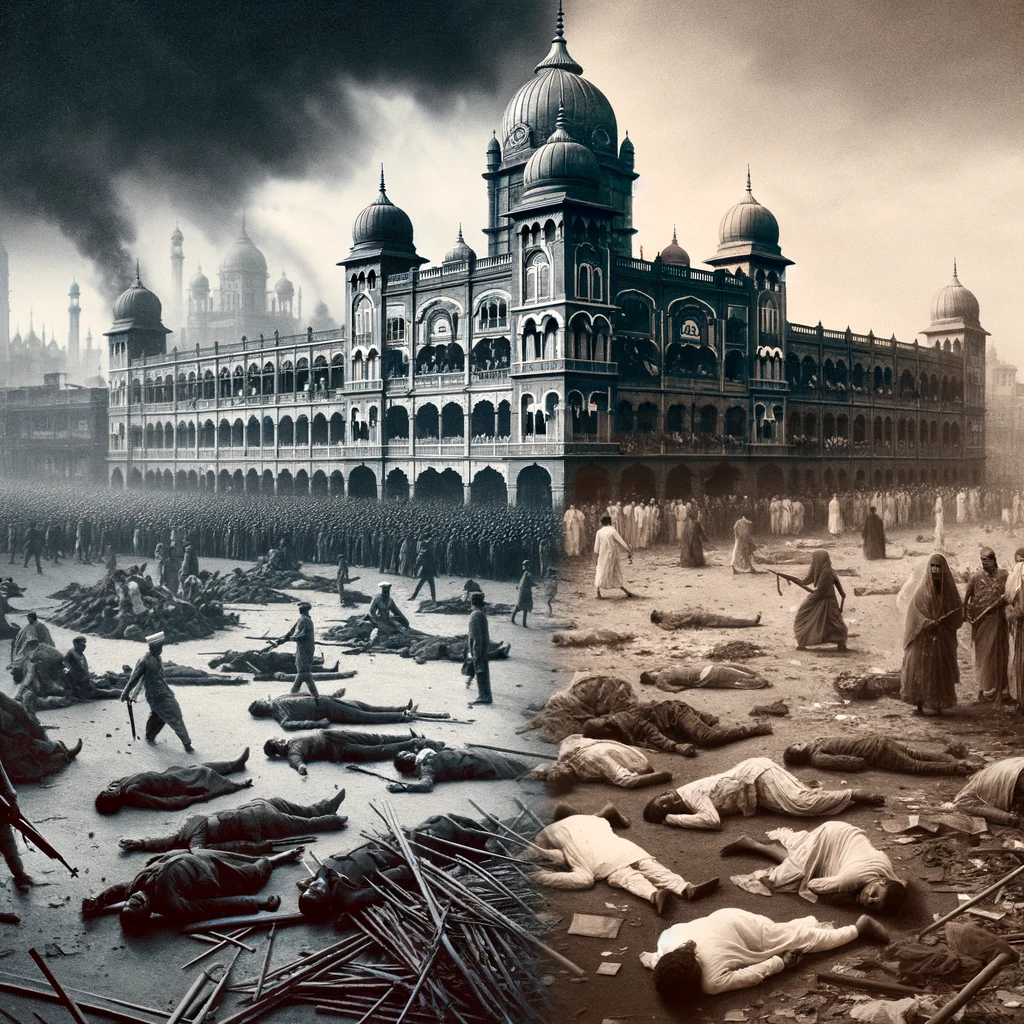
The water from the second reservoir did not go toward the British forts either. It went into the communal plains of Indian society. The Moplah massacre of 1921. The communal riots of the 1920s. Hundreds of riots post the Khilafat call. Direct Action Day 1946. Partition 1947. The downstream consequences still running today.
The first reservoir’s debt closed in 1947 when the British left. The second reservoir’s debt has not closed. The Floodgate Arc will document both floods in full. This post names the frame. The next posts fill it.
Gandhi’s Reservoir Thrust: What Prosecution Would Say
Gandhi’s Reservoir Thrust is the Floodgate Arc’s frame stated in its most precise form.
Gandhi did not find the reservoir. He built the dam — through unelected authority, through the organisational machinery of the independence movement, through twenty years of campaigns that filled the reservoir higher with each cycle.
At maximum capacity — when the water had enough force to sweep away the extraction infrastructure and the British Authority — Gandhi opened the floodgates. Not the dam. The floodgates. A controlled release, bounded by his consistent ceiling, calibrated to his moral framework, having enough force to destroy Indian freedom fighters Integrate cleanly or rephrase for parallelism.
The arithmetic was consistent across four satyagrahas, across twenty-five years, across two reservoirs. The forts stood. The machine ran. The cost crossed 1947 and kept running. The shanties were swept by water the dam-builder had collected, contained, and released at the moment and in the direction of his choosing.
The series does not claim this was the intention. It claims this was the arithmetic. The reader will complete the sentence.
The dam collected the water. The water at maximum capacity had the force to sweep the forts. Gandhi opened the floodgates — a controlled release, bounded by his ceiling, timed to his moral framework. The controlled release did not reach the forts. It swept the shanties. The farmers downstream paid the debt the dam-builder had opened. The forts stood undamaged. The extraction machine ran until 1947 — and the framework Gandhi installed in its place ran for sixty-seven years more.
Feature Image: Click here to view the image.
Videos
Gandhi’s Reservoir Thrust: Controlled Release vs System Rupture | HinduinfoPedia
Glossary of Terms
- Gandhi’s Reservoir Thrust: A conceptual framework in this series describing how Mahatma Gandhi accumulated mass resistance (the “reservoir”) and released it in controlled phases rather than allowing a system-breaking rupture.
- Controlled Release: The strategic discharge of accumulated political pressure in limited, regulated actions instead of unleashing full disruptive force against the colonial system.
- Systemic Rupture: A hypothetical scenario where mass resistance reaches uncontrollable intensity, potentially collapsing the colonial administrative and economic structure.
- Extraction Infrastructure: The British colonial economic and administrative system—taxation, trade, and governance mechanisms—used to extract wealth from India.
- Floodgate Arc: A phase in the blog series that analyses how accumulated political force was repeatedly released in controlled ways rather than directed toward systemic collapse.
- Suspension Arc: The earlier phase of the series documenting the consequences of suspending mass movements, particularly beginning February 1922.
- Gandhi’s Ceiling: A recurring concept in the series referring to the moral and strategic limits Gandhi imposed on mass movements, restricting escalation.
- Lathi-Charge Licence: A term used in the series to describe how British authorities gained operational confidence to use force after movement suspensions.
- Suspension Ledger: A framework tracking gains and losses among different stakeholders following Gandhi’s decisions to suspend movements.
- 9.2 Trillion Apparatus: A coined term referring to the scale of the British extraction system, including revenue, trade, and administrative structures.
- Reservoir of Mass Resistance: The accumulated collective political energy built through campaigns like Non-Cooperation.
- Non-Cooperation Movement: A major anti-colonial campaign (1920–22) led by Mahatma Gandhi encouraging Indians to withdraw from British institutions.
- Khilafat Compact (1920): A political alliance linking the Indian independence movement with pan-Islamic mobilisation, influencing communal dynamics.
- Communal Reservoir: A term describing accumulated inter-community tensions intensified by colonial policies and political mobilisation.
- Perpetual Debt: A series concept referring to long-term societal costs borne by ordinary people as a result of strategic decisions in the independence movement.
#Gandhi #IndianHistory #FreedomStruggle #BritishRaj #Partition #NonCooperation #ColonialIndia #History #Politics #HinduinfoPedia