
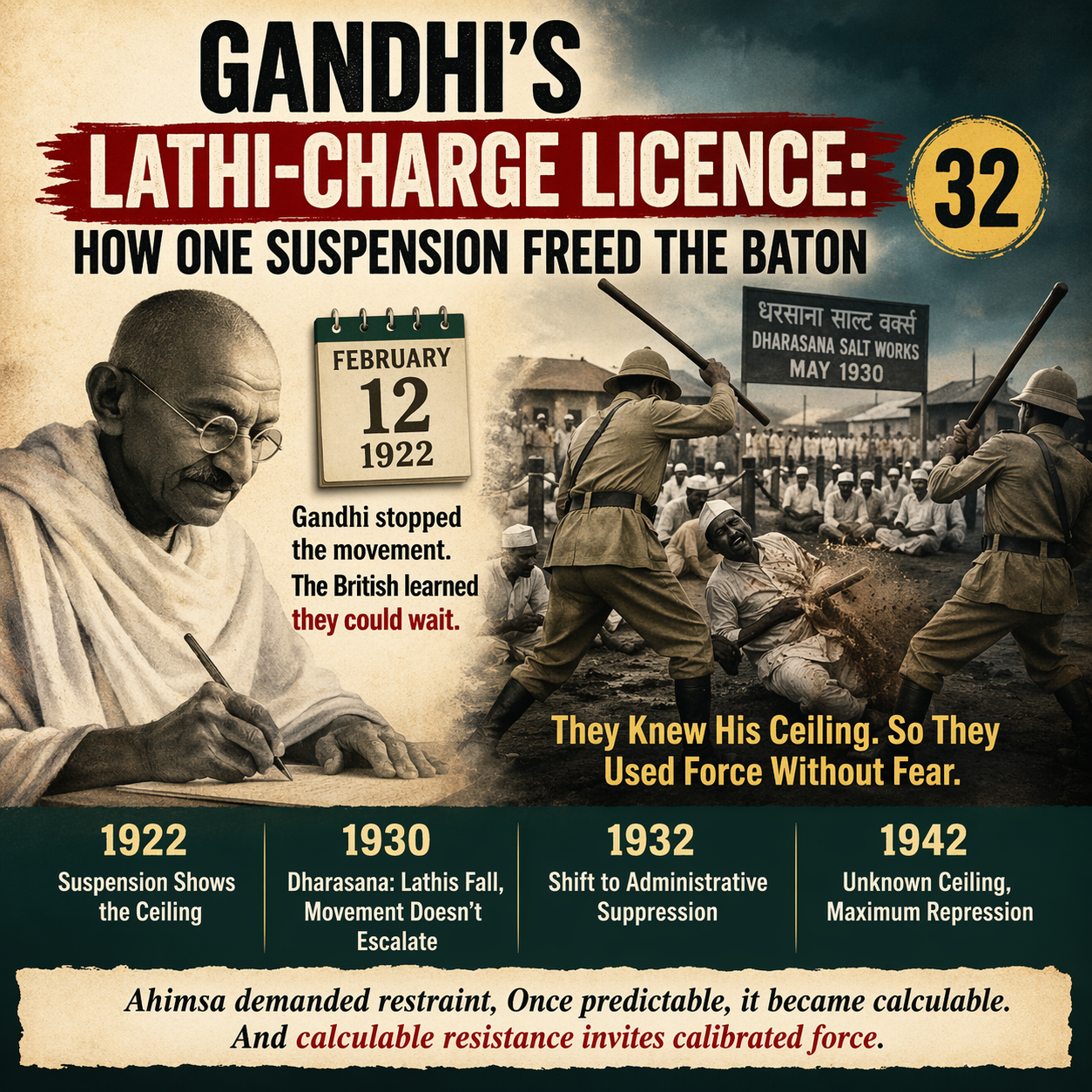
Gandhi’s Lathi-Charge Licence: How One Suspension Freed the Baton (32)
भारत / GB
Part 32: Mahatma Gandhi’s Peace Efforts
Gandhi’s Lathi-Charge Licence: How the 1922 Suspension Gave Britain Confidence to Use the Baton
Blog 30 documented what February 12, 1922 gave the British — the answer to the question they could not answer before. Gandhi’s ceiling existed, it was reachable, and Gandhi himself would enforce it. Blog 31 — Gandhi’s Unanswered Question — tested that thesis against its own weakest point: three British options, all costly, none clean. The counterfactual held. This post documents what the British did with Gandhi’s Lathi-Charge Licence once they had it — every year from 1922 to 1947.
Thank you for reading this post, don't forget to subscribe!The Action Taken: Strict enforcement of absolute non-retaliation meant columns of volunteers walked forward into repetitive physical baton strikes without defending themselves or dispersing.
Who Paid the Price: Unarmed satyagrahis across Dharasana and subsequent demonstrations who sustained severe trauma, skull fractures, and bodily injury.
The Alternative Bypassed: Organized industrial general strikes, picketing behind barricades, or asserting lawful rights of civic self-defense.
Why This Matters: Colonial police operated with complete operational confidence because the 1922 suspension had demonstrated that civil disobedience would not escalate into physical defence.
The Instrument That Required a Constrained Adversary
Gandhi’s Lathi-Charge Licence is not a document. It was not issued in a dispatch or signed in a viceregal order. It was issued on February 12, 1922 — the day Gandhi demonstrated that his movement had a ceiling he would enforce, on moral grounds, before the British needed to enforce it with force.
Blog 30 established what the suspension transmitted. This post documents the consequences. The question it answers is precise: what changed in British conduct after February 1922, and why?
The answer requires understanding what Gandhi’s ahimsa actually demanded of its adversary. Non-violent resistance as a political instrument does not work against all adversaries in all conditions. It works when the adversary has three things: a domestic audience capable of moral embarrassment, a press that will carry the images of suffering, and a political cost attached to being seen as the aggressor against the non-violent.
The British had all three in 1919 and 1920. Jallianwala Bagh had shown them the price of visible mass violence — the Hunter Commission, the parliamentary crisis, the international coverage, the damage to the moral framework through which they justified the Empire. The British public and Parliament had limits. Those limits constrained British conduct. Gandhi’s instrument worked precisely because the adversary was constrained.
What the suspension did was to remove one of those constraints. Not the audience. Not the press. The uncertainty.
Before the suspension, the British did not know whether Gandhi would let the movement become ungovernable. That uncertainty put a ceiling on British conduct. After the suspension, the uncertainty was gone. And a constrained adversary who loses one constraint behaves differently from a constrained adversary who has lost none.
Dharasana — Gandhi’s Lathi-Charge Licence in Action
The most precisely documented exhibition of Gandhi’s Lathi-Charge Licence in action is the Dharasana Salt Raid of May 1930.
By May 1930, the Civil Disobedience Movement was eight weeks old. The Salt March had ended at Dandi on April 6. Gandhi had been arrested on May 5 before he could lead a raid on the Dharasana salt works in Gujarat. The Congress continued the raid without him. On May 21, columns of volunteers — several hundred at a time — advanced on the salt works.
The British police waited. When the first column came within range, they beat them with steel-tipped lathis. The volunteers did not raise their arms. They did not resist. They fell. Those who could not stand were dragged away or lost their lives. The next column advanced. The police beat them too. Column after column. For hours.
American journalist Webb Miller was present. His dispatch was published across the world and read into the Congressional Record of the United States Senate. It is one of the most detailed eyewitness accounts in the entire documentary record of the independence movement. The columns kept walking forward. The police kept beating. Neither side broke.
That is Gandhi’s Lathi-Charge Licence visible in real time. The British administration absorbed the international coverage, the parliamentary questions, the moral damage — and continued.
They continued because they knew, from 1922, that Gandhi would not escalate beyond satyagraha.
The volunteers would walk forward. The police would beat them. Gandhi would not convert the salt raid into an armed uprising. He would not match the baton with a weapon. His ceiling was known.
In 1921, facing a movement whose ceiling was unknown, the British hesitated. In 1930, facing a movement whose ceiling had been shown eight years earlier, they beat the columns and waited for Gandhi to negotiate. He did. The Irwin Pact followed in 1931.
The Pattern — Every Major Action After 1922
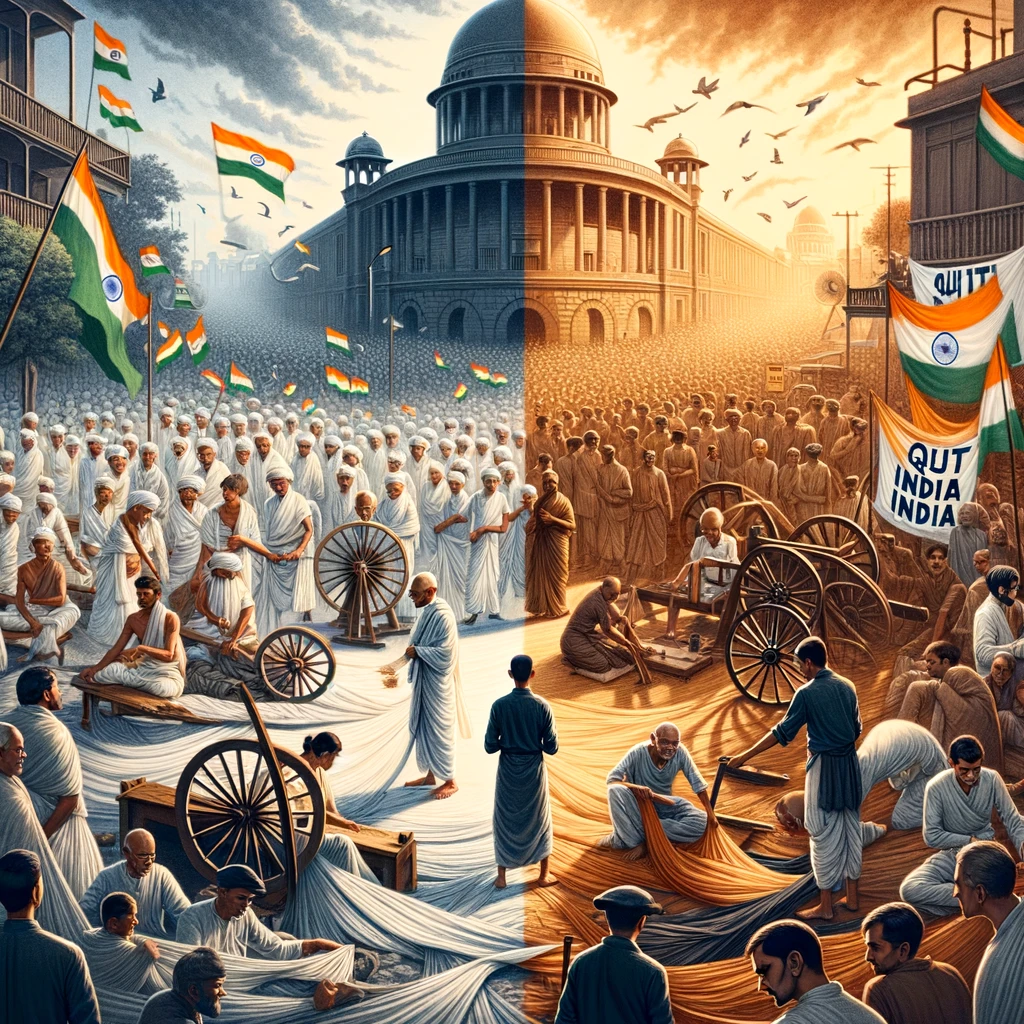
Dharasana is the most visible single exhibit. But Gandhi’s Lathi-Charge Licence was not exercised only at Dharasana. It was exercised in every significant act of British force against the independence movement from 1922 to 1947. The pattern is consistent.
The Willingdon arrest of December 1931 — Gandhi returned from London and was arrested within days. The movement had not reconstituted. The British acted when resistance was at minimum. The licence told them the movement had a ceiling; the Willingdon calculation told them the optimal moment to act was before the movement rebuilt. Both pieces of knowledge came from the same source — the suspension.
The 1932 crackdown — the Congress was banned, infrastructure dismantled through ordinances, the organisational machinery of the Civil Disobedience Movement broken through bureaucratic instruments rather than mass visible violence. No Dharasana-scale confrontation was required. The British had learned that if they dismantled the infrastructure quietly — through administrative classification, property orders, press controls — Gandhi’s movement had no answer. The instrument required mass visible suffering to produce its effect. Bureaucratic attrition produced no images. The licence extended to administrative methods as well as physical ones.
Quit India, August 1942 — Gandhi delivered his speech on August 8. He was arrested before dawn on August 9, along with the entire Congress leadership. By this time, the licensee, the British
had acquired enough knowledge and expertise to act precisely and quickly unlike in 1931. The movement that followed — spontaneous, leaderless, the most violent mass uprising since 1857 — was crushed with documented force. Over a thousand people were killed. The Viceroy called it the most serious rebellion since the Sepoy Mutiny. But the British crushed it because it had no Gandhian discipline. It had no ceiling. And without Gandhi’s ceiling, without his guarantee that the movement would stop before it became ungovernable, the British used the force the 1942 situation required.
The contrast is the argument. In 1921, facing a disciplined Gandhian movement whose ceiling was unknown, the British hesitated for seventeen months. In 1942, facing an undisciplined spontaneous uprising whose ceiling was unknown because Gandhi was in prison, the British used maximum force within weeks.
The licence applied specifically to disciplined Gandhian movements. The British had been shown the ceiling of those movements in 1922. They had not been shown the ceiling of undisciplined uprisings. They treated them differently — because the information they held was different.
The Lathi Was Not the Opposite of Ahimsa
The standard reading of Dharasana and the 1930s crackdowns is that British violence demonstrated the failure of ahimsa — that the instrument did not work because the adversary used force anyway.
This reading inverts the causation. The British use of lathi charges, arrests, and ordinances after 1922 was not evidence that ahimsa had failed. It was evidence that ahimsa had succeeded in precisely one respect — it had taught the British where the movement would stop. The lathi was the instrument the British used once they had that knowledge.
Gandhi’s Lathi-Charge Licence was not the opposite of ahimsa. It was ahimsa’s direct product.
The mechanism is not complex. A non-violent movement requires the adversary’s restraint to produce its moral effect. The adversary restrains itself when it does not know the movement’s ceiling — because the political cost of the confrontation is uncertain. Once the ceiling is known, the cost is calculable. A calculable cost can be managed. A manageable cost removes the restraint.
Before February 12, 1922: uncertain ceiling, uncertain cost, British restraint.
After February 12, 1922: known ceiling, calculable cost, British confidence.
Gandhi did not intend to give the British this knowledge. He suspended the movement because the movement had become violent at Chauri Chaura, and his commitment to non-violence required him to stop it. That commitment may have been genuine. But the effect of a genuine moral commitment applied consistently is that it becomes predictable. And a predictable ceiling is a licence.
The Cost — Who Held the Baton
Gandhi’s Lathi-Charge Licence was not paid for by Gandhi. He was beaten twice in his life — once at the Phoenix Settlement in 1908 and once at a prayer meeting in January 1948. The lathi charges at Dharasana, the beatings at the 1930 salt works, the police violence during the 1932 crackdown — these fell on the volunteers who walked forward. They fell on those who marched in protest against Gandhi’s own arrests. Not on the man whose suspension had shown the British they could beat those marchers without strategic risk.
The thirty thousand in jail in February 1922 had not been consulted about the suspension that issued it. The sixty thousand jailed in the Civil Disobedience Movement had not been consulted about the pact that suspended it. The Dharasana volunteers had not been told that the British administration beating them was operating with eight years of certainty about what Gandhi would and would not allow.
The prosecution does not claim Gandhi designed this outcome. It claims the arithmetic was consistent. Every act of British force against Gandhi’s movements after 1922 was made possible by the information the suspension had provided. Gandhi’s Lathi-Charge Licence was real, it was his, and the people who paid for it were the volunteers at Dharasana and the thousands who followed them.
What Gandhi’s consistent choices built for the British — the full picture, across three acts and three decades — is the subject of the next post.
The British did not beat the columns at Dharasana in spite of Gandhi’s ahimsa. They beat them because of what his ahimsa had demonstrated — that the movement had a ceiling, that Gandhi would enforce it, and that the columns would keep walking and falling and not fighting back until Gandhi called them home. Gandhi’s Lathi-Charge Licence was issued on February 12, 1922. It was valid for twenty-five years.
Feature Image: Click here to view the image.
Videos
Glossary of Terms
- Gandhi’s Lathi-Charge Licence: A coined analytical term in this series describing the inferred condition after 1922 where British authorities could use controlled force against non-violent protesters with predictable limits on escalation.
- Ceiling (of the Movement): The maximum level of escalation that a movement, under Mahatma Gandhi, would not cross due to commitment to non-violence.
- Predictable Adversary: An opponent whose behavioral limits are known in advance, enabling strategic calculation by the opposing side.
- Ahimsa: The principle of non-violence central to Gandhi’s political method, requiring restraint even under provocation.
- Satyagraha: Gandhi’s doctrine of non-violent resistance based on moral force and civil disobedience.
- Chauri Chaura Incident: The 1922 violent episode in Uttar Pradesh where protesters killed policemen, leading Gandhi to suspend the Non-Cooperation Movement.
- Non-Cooperation Movement: A mass protest (1920–1922) led by Gandhi urging Indians to withdraw from British institutions.
- Dharasana Salt Works Raid: A 1930 protest during the Civil Disobedience Movement where non-violent volunteers were brutally lathi-charged by British police.
- Civil Disobedience Movement: A nationwide campaign (1930–34) defying British laws, especially the salt tax.
- Gandhi–Irwin Pact: A 1931 agreement between Gandhi and the British government leading to temporary suspension of civil disobedience.
- Administrative Suppression: Use of legal and bureaucratic tools (bans, ordinances, arrests) instead of visible violence to weaken movements.
- Quit India Movement: A 1942 mass uprising demanding immediate British withdrawal, marked by widespread arrests and violent suppression.
- Calculated Repression: Controlled application of force by authorities based on anticipated limits of resistance.
- Moral Constraint: Limits imposed on state action due to fear of domestic or international backlash.
- Behavioural Inference: Analytical interpretation derived from observed patterns rather than explicit documented intent.
#Gandhi #Ahimsa #IndianHistory #FreedomStruggle #CivilDisobedience #QuitIndia #BritishRaj #History #NonViolence #ColonialIndia #HinduinfoPedia
Scan Through The Entire Series at
Gandhi’s Peace Efforts: The Questions Before the Mahatma (0)