
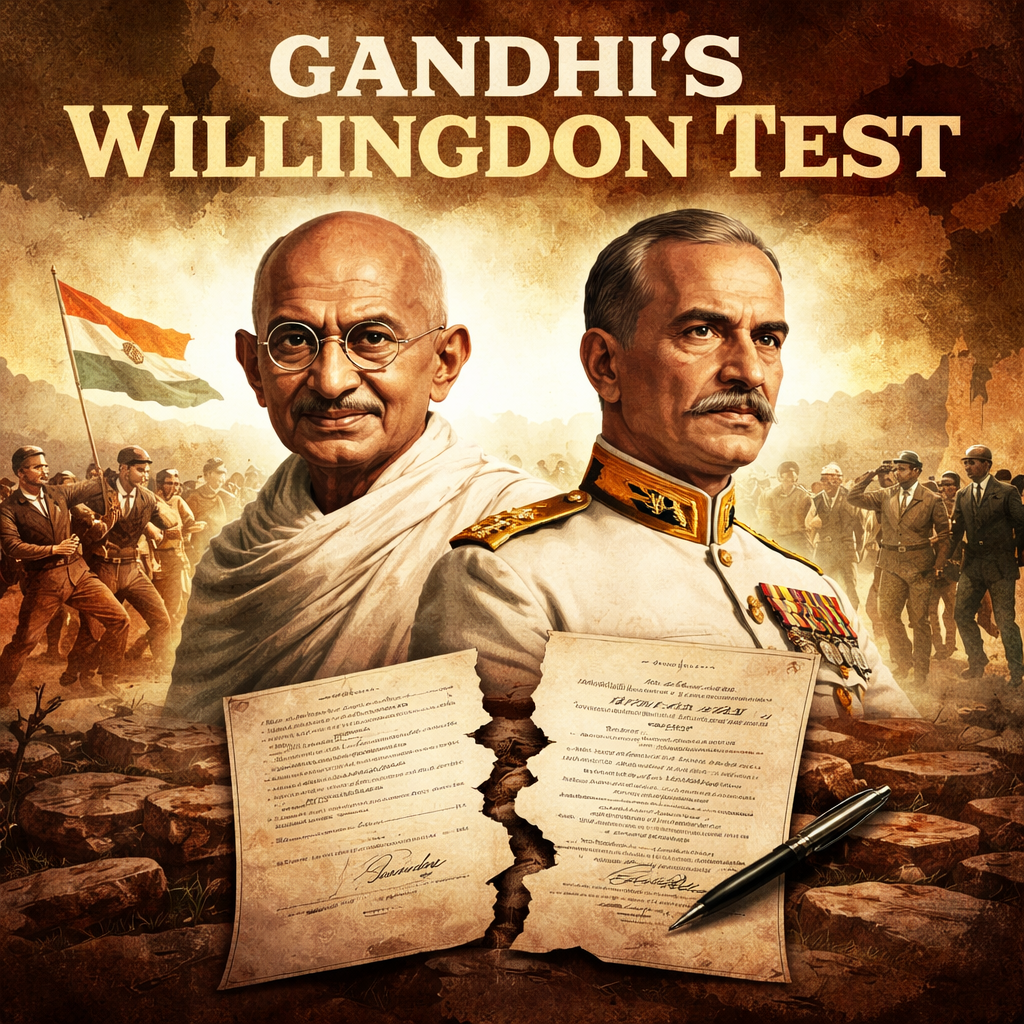
Gandhi’s Willingdon Test: The Pact That Protected Nobody (28)
भारत / GB
Part 28: Mahatma Gandhi’s Peace Efforts | Series Index
The Action Taken: Within days of Gandhi’s return from London in January 1932, the colonial government banned Congress, arrested the leadership, and enforced comprehensive emergency ordinances.
Who Paid the Price: Tens of thousands of satyagrahis arrested in early 1932 without the organizational momentum or surprise of the 1930 campaign.
The Alternative Bypassed: Treaty arbitration mechanisms or enforceable guarantees that would bind state conduct.
Why This Matters: Proved that personal understandings with colonial administrators held zero lasting deterrent value; the state resumed forceful suppression the moment political convenience dictated.
What a Signed Agreement Was Supposed to Mean
Gandhi’s Willingdon Test is the simplest measurement in the Irwin Pact Arc. It requires no balance sheet, no clause analysis, no measurement of distances between demands and deliverables. It requires only a calendar.
Thank you for reading this post, don't forget to subscribe!The Irwin Pact of March 5, 1931 was a signed agreement between two parties. On one side: the British government, represented by the Viceroy of India. On the other side stood Mahatma Gandhi. He was not even a primary member of the Indian National Congress, let alone holding any formal mandate to negotiate or represent the party. He had no authority to represent the Indian National Congress or to speak for the millions of Indians then actively participating in the freedom struggle.
A signed agreement between two recognised parties carries an implicit condition that precedes every clause: that both parties will conduct themselves in accordance with the agreement’s existence. Not merely its terms — its existence. A party that signs an agreement and then, at the first available opportunity, arrests the other party’s representative and bans the other party’s organisation has not violated a clause. It has voided the agreement entirely. It has demonstrated that the agreement was not an agreement. It was a tactical pause.
Gandhi’s Willingdon Test measures whether the British government modified its conduct toward the Congress and toward Gandhi after signing the pact, or whether the pact actually strengthened the hand of the British to take stricter action against Indians. The arrest represents that. The test has a precise result.
The Sequence — Dates Are the Evidence
Gandhi sailed to London in August 1931 as India’s representative to the Second Round Table Conference — the position the pact had created for him. The conference ran from September to December 1931. It produced nothing. Gandhi returned to India in December 1931.
Lord Willingdon had replaced Lord Irwin as Viceroy in April 1931 — one month after the pact was signed. He had not been party to the negotiations. His assessment of the Congress and of Gandhi was formed independently of the pact, and his assessment was that the pact had been a concession the British position did not require.
Gandhi landed in Bombay in December 1931 after 4 months of, presumably, royal hospitality. Within days Willingdon arrested him. The Congress was banned in January 1932. Civil disobedience was resumed — and crushed. Emergency Powers Ordinances were reapplied. Congress leaders were imprisoned across the country. The organisational infrastructure the pact had been supposed to protect was dismantled a second time.
The interval between Gandhi’s return and his arrest: days. The interval between the pact’s signing and the Congress’s second banning: ten months. The pact had been in existence for ten months when the British government chose to act as though it had never existed.
Gandhi’s Willingdon Test: The Willingdon Calculation
The arrest was not a reckless act. It was a calculation — and the calculation rested on what the twelve months since the pact’s signing had actually produced for the British position.
The incubation year of 1930 had dismantled the movement’s organisational infrastructure — press censorship, assembly bans, Congress committees declared unlawful, volunteer networks broken, civil disobedience coordination disrupted across provinces. The pact had restored the Congress’s legal standing, presumably. It had not rebuilt the infrastructure. The six months of truce between March and August 1931 — during which Gandhi was occupied with the Karachi session and then London preparations — had not produced a reconstituted movement.
When Mahatma Gandhi returned in December 1931, the movement was legally restored but organisationally weaker than it had been in November 1930. The Second Round Table Conference had consumed six months, during which the Indian National Congress leadership had been occupied with conference politics rather than ground-level reconstruction. The usefulness of the discussions and their outcomes was of little consequence, as only Gandhi’s views held veto power over every other perspective, as reflected in Gandhi’s Unchallengeable Authority: Why Nobody Could Stop.
Willingdon’s calculation was precise: the movement that had produced sixty thousand arrests in 1930 could not reproduce that scale in 1932. The infrastructure was not there. The momentum of the Salt March had been broken by the suspension, not rebuilt by the truce. The British government could act — and the Congress could not respond at equivalent force. The British had already embedded within the pact the framework and foundation upon which they could further consolidate their position.
The calculation was correct. The 1932 Civil Disobedience movement never regained the scale of 1930. The calculation proved correct.
The Precedent Confirmed — 1922 and 1931
Gandhi’s Willingdon Test is the second data point in a pattern the series has documented from the beginning.
In February 1922, Gandhi suspended the Non-Cooperation Movement at Chauri Chaura. The movement was at its peak — thirty thousand in jail, the British administration shaken across multiple provinces. Gandhi stopped it unilaterally. He extracted no concession while exposing hundreds, if not thousands, to the line of British repression and to imprisonment. He received no commitment.
What did the British do? They arrested Gandhi on March 10, 1922 — three weeks after the suspension — tried him, and sentenced him to six years.
Pattern from 1922: movement suspended at peak → no concession extracted → Gandhi arrested.
Pattern from 1931: pact signed at peak → concessions qualified and partial → Gandhi arrested on return.
Gandhi’s Willingdon Test: What the Sequence Proves
Gandhi’s Willingdon Test requires no claim about British intentions. It requires no claim about Gandhi’s motives. It requires only the dates, in order, with documented consequences attached.
March 5, 1931: pact signed. Congress recognised as legitimate political actor.
December 1931: Gandhi returns. Arrested within days.
January 1932: Congress banned. Emergency Powers reapplied. CDM crushed.
The geometry of this sequence is not ambiguous. A signed agreement between two recognised parties produced zero modification of British conduct at the moment the British calculated they could act. The agreement negotiated across eight formal meetings, signed by both parties, ratified by the Karachi Congress, and used to send Gandhi to London as India’s representative — was set aside by a new Viceroy within ten months of its signing. The organisation it had recognised was banned within eleven.
The series does not claim this was planned from the beginning. The documentary record does not establish a secret strategy. What it establishes is a result: the pact protected nobody when the British chose to act.
The extraction machine continued to run. The Willingdon arrest demonstrated that it had not touched the colonial government’s willingness to use force when force was available to it without equivalent resistance.
The Irwin Pact Arc is complete. Seven blogs. One arc. The pact negotiated at the peak of Indian leverage was signed, ratified, taken to London, and set aside within a year — when the leverage was gone, the infrastructure was dismantled, and the movement could not reconstitute at the scale that had produced the pact in the first place.
The next post moves back to November 1921 — to the height of the Non-Cooperation Movement, when the British had nearly broken and the water was at its highest before the dam held.
March 5, 1931: pact signed. December 1931: Gandhi arrested within days of return. January 1932: Congress banned. The pact had been in existence for ten months when the British government chose to act as though it had never existed. The deterrent value of a signed agreement, when one party calculates it can act without equivalent resistance, is zero. Gandhi’s Willingdon Test has a precise result.
Feature Image: Click here to view the image.
Videos
Glossary of Terms
- Gandhi–Irwin Pact: A March 5, 1931 agreement between Mahatma Gandhi and Lord Irwin that temporarily suspended the Civil Disobedience Movement in exchange for limited concessions.
- Gandhi’s Willingdon Test: The blog’s key phrase; a method of evaluating the pact based on what happened when the British chose to act—measured through sequence of dates rather than promises.
- Lord Willingdon: Successor to Lord Irwin who adopted a harsher policy, arresting Gandhi and banning Congress shortly after the pact period.
- Indian National Congress: The principal political organization leading India’s freedom struggle, temporarily legalized under the pact and later banned again in 1932.
- Civil Disobedience Movement: A mass protest movement led by Gandhi involving non-violent resistance against British laws, including the Salt March.
- Second Round Table Conference: A British आयोजित conference where Gandhi represented Indian interests but which failed to produce meaningful outcomes.
- Emergency Powers Ordinances: British legal measures allowing mass arrests, censorship, and suppression of political activities during periods of unrest.
- Organisational Infrastructure: The network of Congress committees, volunteers, communication systems, and local leadership required to sustain mass movements.
- Non-Cooperation Movement: An earlier nationwide protest led by Gandhi that was suspended at its peak after the Chauri Chaura incident.
- Deterrent Value: The ability of an agreement or action to prevent an opposing party from taking hostile steps; in this context, the pact’s inability to restrain British actions.
#Gandhi #IrwinPact #IndianHistory #FreedomStruggle #BritishRaj #CivilDisobedience #Congress #History #India #Colonialism #HinduinfoPedia
Scan Through The Entire Series at
Gandhi’s Peace Efforts: The Questions Before the Mahatma (0)