
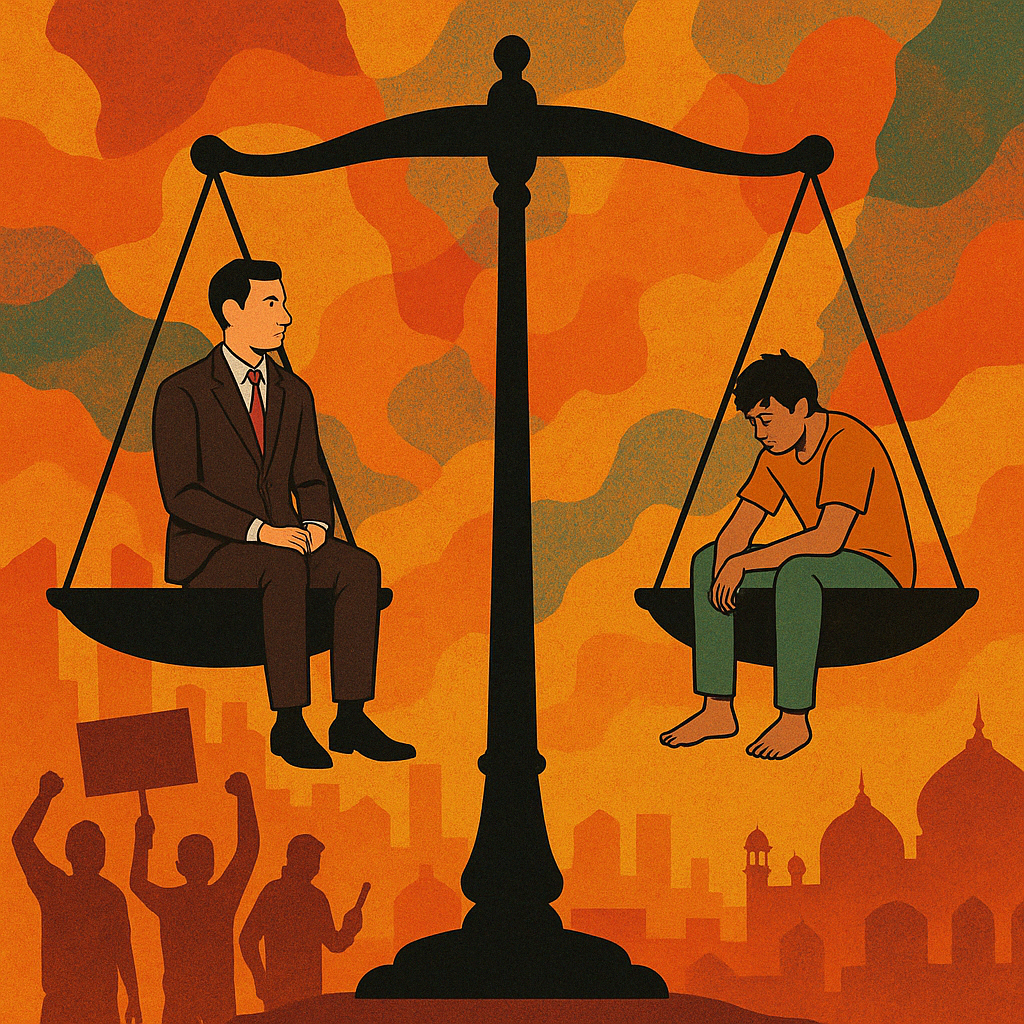
Selective judgement of Waqf act: Socio-judicial bias?
Part XI: Waqf (Amendment) Act, 2025
Selective Judgement of Waqf—A Crisis in Neutrality
In the legal aftermath of the Waqf (Amendment) Act, 2025, a deeper fault line has emerged—not just in the streets or among political ranks, but inside the judiciary itself. The phrase now echoing across public discourse is Selective judgement of Waqf. As mobs rioted and communities burned, many expected India’s courts—especially the Supreme Court—to act as impartial sentinels of the Constitution. But the court’s response, marked by erratic urgency and procedural aloofness, has raised uncomfortable questions: Why were some Waqf petitions fast-tracked while older, critical cases on temple encroachments were sidelined? Why was suo motu action absent in the face of widespread violence? This blog—the second in our legal deep-dive series—explores whether Bharat’s judiciary responded with constitutional commitment or communal caution.
Thank you for reading this post, don't forget to subscribe!From Reform Bill to Selective Judgement of Waqf
The Waqf (Amendment) Act, 2025, was designed to bring transparency and accountability to the management of nearly 8 lakh waqf properties, many undocumented and unverified under the controversial waqf by user doctrine. The Act sought to eliminate misuse, introduce fair representation, and curb unchecked religious land control. Yet, what was intended as regulatory reform exploded into violence, riots, and legal controversy.
As violence spread across West Bengal, Maharashtra, and Tripura, public attention turned to the judiciary. But rather than rising above the noise, the courts appeared to mirror the same communal calculations. The Selective judgement of Waqf became evident: while 73 petitions challenging the 2025 Amendment were listed within 11 days—many led by influential Islamic bodies—over 140 earlier petitions, mostly filed by Hindu advocates and temple boards, languished for years, redirected or dismissed by the Supreme Court without merit hearing.
The pattern was unmistakable. The courts, rather than uniting the nation under equal justice, seemed to choose caution over courage. And in doing so, they have fed the growing perception of a judiciary no longer blind to religion—but swayed by it.
Supreme Court’s Stance on Past Waqf-Related Petitions
Vishnu Shankar Jain’s Critical Observations on the Supreme Court:
1. Double Standards in Admitting Cases:
“When there is an Amendment Act which has been brought in, the matter travels to the Supreme Court and the Supreme Court entertains the matter. This is our first grievance—that the matter should have gone to the High Court.”
Criticism: Jain questions why the Supreme Court admitted the current case on the Waqf (Amendment) Act 2025 directly, while in the past, petitioners challenging the Waqf Act of 1995 were forced to go to High Courts, even when similar legal and constitutional concerns were raised.
2. Supreme Court’s Prior Rejections of Buff Act Challenges:
“When we have challenged the Buff Act 1995 in 2018 and 2020, the Supreme Court asked us to go to the High Court… I am referring to the affidavit of the Law Ministry.”
Criticism: Jain highlights inconsistency—despite presenting serious legal questions, including Ministry-backed affidavits, earlier Waqf-related challenges were not entertained by the SC. Yet, now the SC is openly engaging in the 2025 amendment debate, suggesting selective judicial activism.
3. Critique of ‘Waqf by User’ Doctrine:
“So ‘waqf by user’ was an erroneous concept… introduced in 1954, reintroduced in 2013, and rightly struck down.”
Position: Jain supports the 2025 Amendment’s abolition of the ‘waqf by user’ clause, calling it a “draconian” and legally flawed concept, which had enabled land grabs without proper documentation. He underscores that its removal was long overdue and entirely constitutional.
4. Constitutional Incompatibility of ‘Waqf by User’:
“Verb by user as a concept is in violation of Article 142, 125, as well as Article 300A of the Constitution of India.”
Legal Standpoint: Jain argues that the concept allows seizure of private or temple land without legal procedure or ownership documents, violating the right to property under Article 300A, and creating conflict with judicial authority under Article 142.
5. Discrepancy in Court’s Approach to Evidence:
“In the contest of Ram Mandir in Gyanvapi, Bangalore Eidgah Madan, etc., ‘verb by user’ was used to justify structures without documents… but in the case of a Shiva temple on Yamuna, SC asked, ‘Where is the documentation?’”
Criticism: Jain points out a hypocrisy in judicial treatment: Islamic claims based on ‘usage’ were accepted without documentation, while Hindu claims required proof of antiquity and records, even for temples demolished recently.
6. Legislative Clarity vs Judicial Confusion:
“They’re doing away with it. The present Amendment Act 2025… mandates that all WAF properties be registered by deed… the definition of ‘verb by user’ is omitted.”
Clarification: Jain applauds the amendment for finally bringing legal clarity, mandating that only deed-based waqf claims will be valid, thus nullifying vague or undocumented property claims.
Source: https://www.instagram.com/reel/DInLI87ziQ_/
Where Precedent Meets Prejudice: A Closing Reflection
The statements made by Advocate Vishnu Shankar Jain reflect a growing concern—not just about the substance of judicial decisions, but about their underlying patterns. The judiciary’s selective urgency, its inconsistent demands for documentation, and its deference to politically sensitive doctrines like “waqf by user” reveal a system struggling to remain neutral. What should be a pillar of justice is perceived, increasingly, as a gatekeeper of ideological convenience. When temples need documentation and dargahs do not, when persecuted Hindus are told to wait while others are rushed to the bench, the credibility of justice suffers—not just for one community, but for the nation.
Continue the Conversation. Defend the Truth.
If the Waqf Act unrest exposed more than just legal loopholes—if it revealed fault lines in justice, identity, and governance—it’s time to speak up. Share this blog. Start a dialogue. Let’s ensure history is not erased in silence.
Follow HinduInfoPedia for evidence-based insights into Bharat’s civilizational battles—past and present.
Larger Implications: The Cost of Judicial Hesitation
When the courts falter, the republic trembles. The judiciary is not merely an interpreter of laws—it is the last bulwark for citizens against state excess, communal bias, and institutional failure. Yet the judicial response to the Waqf Act unrest has exposed cracks in that foundation—cracks born not of incapacity, but of hesitation, delay, and selective engagement.
From the glaring contrast in case listings to the uneven burden of documentation placed on Hindu petitioners versus waqf claimants, a troubling pattern has emerged. The judiciary’s silence on post-riot violence, its refusal to take suo motu notice despite overwhelming media evidence, and its deference to procedural comfort over urgent justice, all raise a deeper question: what happens when those entrusted with upholding the Constitution choose caution over clarity?
Justice delayed is no longer just denied—it is repurposed into a weapon of silence. Survivors of Murshidabad, victims of Bhangar, and displaced families in Unakoti do not merely face bureaucratic apathy; they face a system where courts sidestep hard questions and leave healing to linger in adjournments.
The cost of this judicial hesitation is steep:
- Public trust begins to decay.
- Institutional credibility erodes.
- And the idea of constitutional equality is reduced to a ceremonial promise.
If courts do not act with urgency in moments of national unrest—when religious fault lines crack open and lives are upended—then where do citizens go? If the arbiter appears partisan, where does the balance return?
This blog is not a condemnation. It is a reckoning—a mirror held to the system that must rise above the politics of the day and uphold the dharma of justice. If not the courts, then who? If not now, then when?
Selective Judgement of Waqf—A Challenge to Constitutional Morality
The Waqf Act unrest may have subsided in public memory, but its judicial aftermath continues to reverberate. The Selective judgement of Waqf—evident in inconsistent case admissions, lopsided timelines, and the deafening silence over post-riot violence—has exposed a chilling truth: India’s courts, once seen as the last recourse for fairness, now stand accused of selective morality.
When Hindu petitioners are sent to lower courts while Muslim petitioners get constitutional benches, when FIRs go unregistered and mobs roam free until High Courts intervene, and when the apex court refuses suo motu cognizance despite mass violence—justice is not just delayed, it is dissected by bias.
This blog is not merely a critique—it is a civilizational appeal. If Selective judgement of Waqf becomes the norm, the Republic’s foundational promise of equal protection under law is reduced to parchment. Let this be a call—not to tear down institutions—but to demand their integrity.
Call to Action
The Fight for Justice Needs Witnesses, Not Spectators
If courts ignore Hindu voices while protecting undocumented claims, it’s not reform—it’s regression.
If some cases find urgent hearings and others don’t, then justice isn’t blind—it’s blinkered.
Share this blog. Question the silence.
Let the judiciary know: selective fairness is no fairness at all.
Stay with us as we move next to Blog – The Larger Game: Is This Just About Waqf?, where we go beyond the courtroom to examine the socio-political script behind these orchestrated protests and identity assertions.
Let’s connect the dots—because the Waqf Act unrest isn’t the climax. It’s a starting point.
Feature Image: Click here to view the image.
Glossary of Terms
Tripura’s Unakoti District: A district in northeastern India where protests against the Waqf Act reportedly escalated into police clashes in April 2025.
Waqf (Amendment) Act 2025: A legislative reform passed to regulate and digitize waqf properties in India, eliminating undocumented claims and enhancing accountability in religious endowment management.
Waqf by User: A controversial legal doctrine allowing properties to be declared waqf based on prolonged public or community use, often without formal documentation or title deeds.
Suo Motu Cognizance: A legal action initiated by a court on its own accord, without a formal complaint, typically used in matters of public interest or fundamental rights.
Vishnu Shankar Jain: An advocate known for representing Hindu petitioners in high-profile temple and property rights cases, and a vocal critic of judicial inconsistencies in handling waqf-related matters.
Buff Act 1995: Informal reference to the Waqf Act of 1995, which codified the structure of waqf management in post-independence India and is often cited in legal challenges concerning religious land.
Constitutional Bench: A bench of the Supreme Court comprising five or more judges that hears cases involving substantial questions of constitutional interpretation.
Article 300A of the Constitution: A constitutional provision guaranteeing the right to property, stating that no person shall be deprived of their property except by the authority of law.
Gyanvapi: A temple-mosque site in Varanasi that has been at the center of legal and religious disputes, often referenced in judicial discussions on historical encroachments and waqf claims.
Murshidabad: A district in West Bengal that witnessed significant communal unrest during the protests against the Waqf Act 2025.
Bhangar: A region in South 24 Parganas, West Bengal, noted for political and communal tensions that intensified during the Waqf Act protests.
#WaqfAmendmentAct2025 #SelectiveJudgementOfWaqf #JudicialBias #WaqfAct2025 #SupremeCourtIndia #HinduinfoPedia
References
https://www.instagram.com/reel/DInLI87ziQ_/?utm_source=ig_web_copy_link
Refer to these blogs to understand larger context
- https://hinduinfopedia.com/waqf-act-2025/
- https://hinduinfopedia.com/waqf-act-in-india/
- https://hinduinfopedia.in/waqf-amendment-act-2025-reform/
- https://hinduinfopedia.in/waqf-act-protests/
- https://hinduinfopedia.in/waqf-act-debate/
- https://hinduinfopedia.in/protests-against-waqf-act-2025/
- https://hinduinfopedia.in/waqf-act-unrest-is-this-just-about-waqf/
- https://hinduinfopedia.in/judicial-response-to-waqf-act-unrest/
- https://hinduinfopedia.in/waqf-act-and-judging-justice/
- https://hinduinfopedia.in/waqf-law-an-excuse/
Visit for related videos here
Comments are closed.