
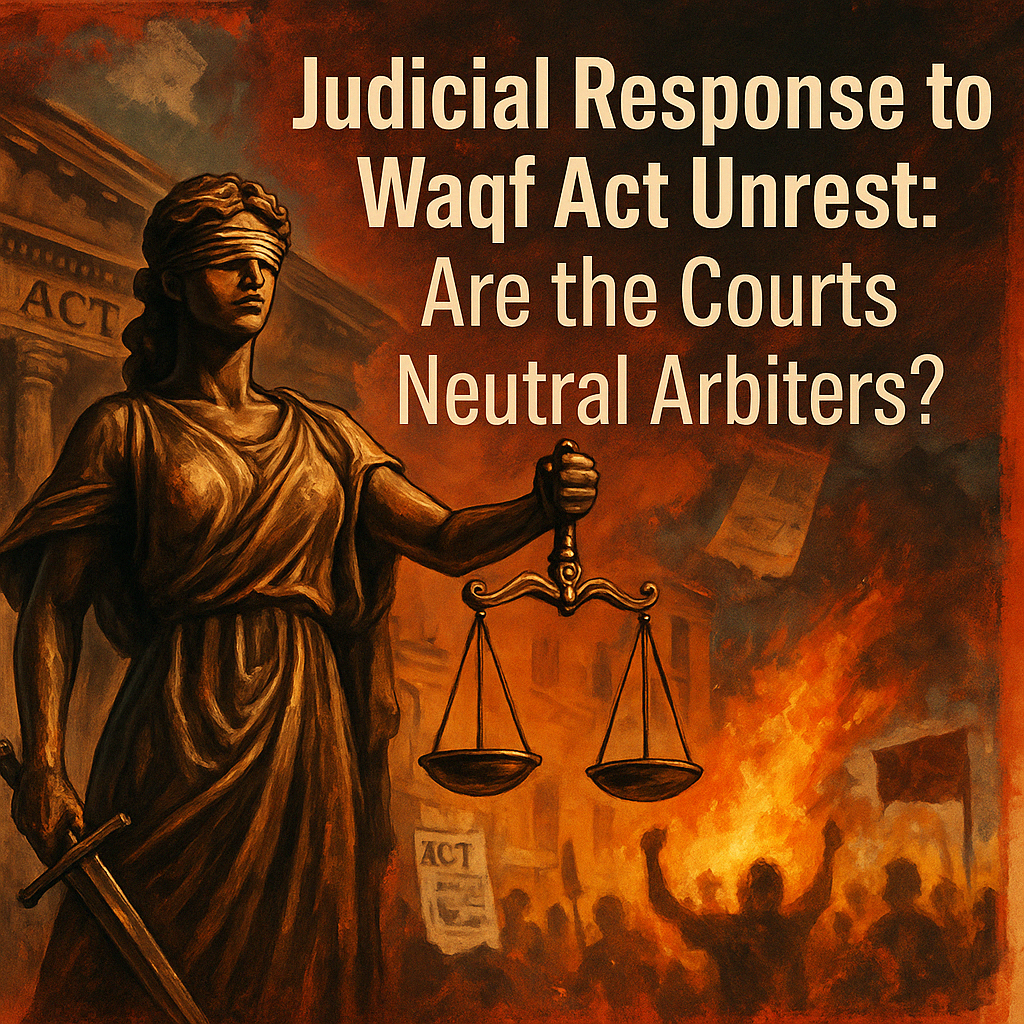
Judicial Response to Waqf Act Unrest: Are the Courts Neutral Arbiters?
Part VIII: Waqf (Amendment) Act, 2025
Do Courtroom Stand Test in Judicial Response to Waqf Act Case
The Judicial Response to Waqf Act unrest has emerged as a defining chapter in the larger struggle for institutional integrity in Bharat—not merely about land reform or street violence, but about whether our systems still command trust. As the riots subsided, police barricades fell, and headlines faded, the spotlight shifted to the courts. Would they rise where the state had failed?
Thank you for reading this post, don't forget to subscribe!The Waqf Act unrest of 2025 was not an isolated legislative backlash—it was a culmination of deeper tensions over identity, demography, and power. As vehicles burned, families fled, and mobs invoked divine slogans as justification for violence, the hope for accountability turned toward the judiciary—not just for rulings, but for reassurance that the Constitution still lived.
Yet, in a republic where selective policing is often mirrored by selective jurisprudence, the unrest exposed a parallel crisis: Waqf Act and judging justice became a national axis of scrutiny. Would the judiciary assert its independence amidst communal pressure—or retreat behind procedural shields and legal ambiguity?
This eighth blog in our ongoing series opens the legal lens on the Waqf act 2025. We begin where justice first faltered—at the grassroots—where FIRs were stalled, courts adjourned endlessly, and victims found not closure, but delay. This is where the erosion began—not through absence, but through silence.
Brief Background of Judicial Response to Waqf Act
Ground-Level Judicial Response to Waqf Act Unrest
The Judicial Response to Waqf Act unrest was expected to serve as a stabilizing force. In moments of public disorder—especially when fueled by political provocation and religious mobilization—the judiciary bears an urgent constitutional duty to rise above state inaction and protect citizens. Yet, as the flames raged across Bhangar, Murshidabad, Unakoti, and Pune, neither the Supreme Court nor the High Courts acted suo motu, even though similar precedents exist.
This silence was especially jarring given the clear build-up of tension. TMC leaders, including West Bengal Chief Minister Mamata Banerjee, openly opposed the Waqf (Amendment) Act, 2025, branding it as an attack on Islam. Their rhetoric, urging the community to “resist,” was not just inflammatory—it was predictive of violence. When judicial institutions are presented with such overt political incitement and community tension, the expectation of intervention is not just moral, but constitutional.
Who Bears the Responsibility?
On whom the primary responsibility lie when an administration behaves in a manner as happened in West Bengal? The opposition parties whose workers are being eliminated week after week? On opposition parties who share drink with the ruling party at every opportunity? On bureaucracy who is subservient to the government? On central government whose authority to impose article 356 [ as in Shri Harish Chandra Singh Rawat vs. Union of India & Others, Writ Petition (M/S) No. 795 of 2016] owing to the misuse in the past? Who is responsible?
Post facto, when large scale violence was it its peak, a social activist Advocate Priyanka Tibrewal filed a PIL in Calcutta High Court to direct the government to take appropriate action. Was it for a political motive for her being a BJP affiliate? That is how TMC has labelled the case and it became a pious defense for them in all public platforms.
Murshidabad: Violence Without Prosecution
In Murshidabad, the violence displaced entire Hindu neighborhoods. Families fled across rivers to escape mobs. Shocking reports emerged of butchering (https://www.hindustantimes.com/india-news/what-ncw-member-archana-majumdar-said-about-murshidabad-violence-over-waqf-act-dragged-out-butchered-101745062460403.html) and targeted attacks, yet FIRs remained toothless—conveniently excluding local political strongmen. Police cited “communal sensitivity” as justification. Meanwhile, multiple writ petitions seeking SIT inquiries and victim protection continue to languish in the Kolkata High Court with frequent adjournments.
Tripura: A Conflict Ignored
In Unakoti, a riot involving over 4,000 people led to curfews and injuries. Citizen groups filed a PIL for accountability and compensation—which the Tripura High Court has not yet admitted, citing procedural backlog. The absence of urgency, even after large-scale violence, reveals a judiciary reluctant to touch politically sensitive topics unless pushed.
Maharashtra: Lynching in Legal Limbo
In Pune and Nagpur Chawl, a Hindu family was lynched in a mob attack driven by communal incitement. Though the case reached the Bombay High Court, it has moved slowly—delayed by procedural red tape and the state’s half-hearted approach to prosecution. Meanwhile, no central force deployment or protective oversight has been arranged for the victims’ community.
Institutional Silence: No Commissions, No Mandate
Despite the scale of unrest, no state has constituted a judicial commission of inquiry. The NHRC has issued notices in three cases but stopped short of any enforceable orders, reflecting a broader trend: symbolic gestures over substantive justice.
No Suo Motu Action: A Missed Mandate
While searching for answers to the questions raised about the protection of the majority community in West Bengal—both in areas where they are a majority and where they are a minority—we have arrived at this point. Courts is the only agency who is responsible for taking action, not social activists like Adv Tibrewal, not a BJP activist like Adv Tibrewal, not the governor and the central government either as they are controlled by the multiple court rulings.
Despite the gravity of the violence and widespread media coverage, neither the Calcutta High Court nor the Supreme Court acted suo motu—a stark contrast to past interventions:
-
Murthal Gang-Rape Allegations (2016, Punjab & Haryana HC): The court acted on media reports of mob violence, ordering a CBI probe within days (MyAdvo.in, March 7, 2018).
-
Birbhum Gang-Rape (2014, SC): The Supreme Court intervened after a Reuters report, enhancing victim compensation and state action (Cambridge.org, August 19, 2019).
The Judicial Response to Waqf Act unrest, in contrast, did not match these past standards. This discrepancy sends a dangerous message: the justice system moves not by principle, but by convenience.
It was left to a private individual’s PIL—filed by a politically affiliated citizen—to nudge the courts into action. This inversion of roles does more than politicize justice; it erodes public faith in the judiciary as an impartial guardian of constitutional values. Worse, it fractures society along political lines and turns human suffering into a weapon—wielded cynically by politicians on both sides of the aisle.
Overstepping Yet Silent: Judiciary’s Waqf Failure
Supporting Court Cases and Logical Interpretation:
- Vineet Narain v. Union of India (1997): SC set CBI guidelines, monitored corruption probes, directing executive investigations (LiveLaw, December 12, 2018, https://www.livelaw.in/top-stories/vineet-narain-case-1997-sc-guidelines-cbi-autonomy-142345).
- Prakash Singh v. Union of India (2006): SC mandated police reforms, dictating law enforcement structure (The Hindu, September 22, 2006, https://www.thehindu.com/news/national/supreme-court-directs-police-reforms/article3058377.ece).
- Tehseen Poonawalla v. Union of India (2018): SC issued anti-lynching guidelines, setting executive policies (LiveLaw, July 17, 2018, https://www.livelaw.in/sc-issues-guidelines-to-curb-lynching-mob-violence-129876).
- Harish Chandra Singh Rawat v. Union of India (2016): SC ordered floor test, guided Governor’s actions (LiveLaw, April 27, 2016, https://www.livelaw.in/sc-directs-floor-test-in-uttarakhand-27933).
- Sambhal Masjid Survey Stay (2024): SC halted executive survey, prioritizing public order (The Indian Express, November 30, 2024, https://indianexpress.com/article/india/sc-stays-sambhal-masjid-survey-9045432/).
- Jahangirpuri Demolition Case (2022): SC stayed executive demolition post-riots (LiveLaw, April 20, 2022, https://www.livelaw.in/top-stories/jahangirpuri-demolition-supreme-court-stays-196678).
- Lokpal Filing Case Against Judge (2025): SC quashed Lokpal probe, self-regulating judicial discipline (LiveLaw, February 20, 2025, https://www.livelaw.in/top-stories/sc-quashes-lokpal-probe-against-hc-judges-248912).
- Delhi HC Judge Varma Case (2025): SC probed cash allegations, no executive FIR due to legal protections (The Hindu, March 24, 2025, https://www.thehindu.com/news/national/sc-panel-probes-varma-cash-allegations-9048765.html).
These cases demonstrate the SC’s willingness to assume executive functions—directing investigations (Vineet Narain), reforming police (Prakash Singh), setting communal policies (Tehseen Poonawalla, Sambhal, Jahangirpuri), and controlling constitutional authorities (Rawat). Its self-protection in Lokpal and Varma cases shows judges face internal inquiries, not routine executive scrutiny, due to Veeraswami (1991). Yet, the SC’s silence during Waqf unrest, despite TMC’s incitement and precedents like Tehseen Poonawalla, suggests selective intervention, prioritizing institutional interests over public safety, thus eroding trust.
Bhangar: A Case of Judicial Prodding, Not Initiative
In Bhangar (South 24 Parganas), where 18 police vehicles were torched and officers ambushed, drone footage captured the mayhem in real-time. Yet, there were no arrests for 72 hours. The Calcutta High Court had to intervene before any real crackdown was initiated. Even then, more than half the detainees secured bail within days, citing “lack of direct evidence”—despite clear visuals circulating online.
Civic Action or Political Trigger? When Courts Abdicate, Citizens Step In
It is an undeniable fact that a private citizen—Advocate Priyanka Tibrewal, a Bharatiya and a known social activist—had to approach the Calcutta High Court with a PIL to seek justice for the victims of the Waqf Act unrest in West Bengal. Now ask yourself:
Was she acting as a savior of persecuted Bengali Hindus, stepping in where the state failed? Or should she be reduced to a mere “BJP affiliate”, as labeled by political opponents?
If you choose to brand her solely by her political alignment, you are not just politicizing a humanitarian intervention—you are offering the ruling regime a convenient escape. You’re handing TMC the perfect deflection: “This was not about justice—it was about BJP vs TMC.
And in doing so, you silence the cries of the real victims.
When Silence Isn’t Neutral
In constitutional theory, silence is neutrality. But in moments of violence and displacement, silence becomes complicity. The courts—shielded by collegium autonomy and tasked with protecting the fundamental rights of every citizen—cannot outsource urgency to political activists or rely on public petitions. The Judicial Response to Waqf should have been driven by principle, not pressure.
D. Conclusion: From Silence to Scrutiny
The first layer of institutional response to the Waqf Act unrest—police stations, local courts, human rights commissions—reveals a system paralysed by discretion and fear. FIRs were delayed. Evidence was ignored. Bail was granted before inquiries began. And victims found themselves without recourse or protection.
As these cases stall in procedural quicksand, the spotlight turns to India’s highest court. Can the Supreme Court offer consistency where the lower courts have offered confusion? Or will it, too, be accused of selective urgency and ideological convenience?
In next blog, we’ll uncover how the apex court handled these tensions—what it heard, what it refused, and what Advocate Vishnu Shankar Jain’s commentary reveals about the evolving judicial conscience in India.
Call to Action
But when the lower courts stall and the police falter, the question naturally arises:
Will the Supreme Court rise to defend justice—or retreat into procedure?
In the next part of this series, we shift focus to the apex court—exploring how it handled petitions, what it chose to prioritize, and whether judicial neutrality held its ground when the law and faith collided.
Feature Image: Click here to view the image.
Glossary of Terms
- Waqf (Amendment) Act, 2025: A legislative reform aimed at digitizing waqf land records, removing undocumented claims, and abolishing the “waqf by user” provision to increase legal accountability in religious land ownership.
- Waqf by User: A now-abolished legal practice that allowed continuous religious use of land to be considered legitimate waqf property, even without documented ownership or formal registration.
- FIR (First Information Report): A written document prepared by the police in India upon receiving information about the commission of a cognizable offense. It marks the formal start of a criminal investigation.
- SIT (Special Investigation Team): A team appointed by a court or government to investigate specific serious cases, often when standard law enforcement mechanisms are deemed inadequate or biased.
- Tripura’s Unakoti District: A district in northeastern India where protests against the Waqf Act reportedly escalated into police clashes in April 2025.
- Drone Surveillance Footage: Aerial video evidence captured via unmanned aerial vehicles (drones), often used by law enforcement or media to monitor public gatherings or violent incidents.
- Judicial Commission of Inquiry: A formal investigative body constituted by a government to examine serious public issues or incidents, with the authority to summon witnesses and recommend legal or policy actions.
- PIL (Public Interest Litigation): A legal mechanism in Indian courts that allows any individual or group to file a case in the interest of the public, particularly on matters involving fundamental rights, environment, or government accountability.
- NHRC (National Human Rights Commission): A statutory body in India responsible for protecting and promoting human rights. It can investigate complaints, issue notices, and make recommendations to the government.
- Calcutta High Court: One of India’s oldest high courts, with jurisdiction over the state of West Bengal. It played a pivotal role in reviewing administrative inaction during the Waqf Act unrest.
- Kolkata High Court: An alternate name often used to refer to the Calcutta High Court; both refer to the same judicial institution based in Kolkata, West Bengal.
- Procedural Backlog: A delay in the judicial process caused by a large number of pending cases, administrative inefficiencies, or lack of judicial resources, often cited as a reason for not admitting new petitions.
- Communal Sensitivity: A term used by law enforcement or politicians to describe volatile social or religious situations that could escalate into conflict, often invoked to justify restrained or delayed action.
- Legal Limbo: A state of unresolved legal status where proceedings are stalled or inconclusive, leaving justice delayed or denied for those involved.
- Ideological Convenience: A critique of judicial or political decisions that appear to be driven by ideological alignment rather than legal or ethical standards.
#WaqfAct2025 #JudicialBias #SupremeCourtIndia #LegalAccountability #HinduinfoPedia #WaqfAmendmentAct2025
Refer to these blogs to understand larger context
Waqf Act in India: A Historical Journey and Global Perspective
Blogs Written Later To Cover Full Story
Visit for related videos here
Comments are closed.