
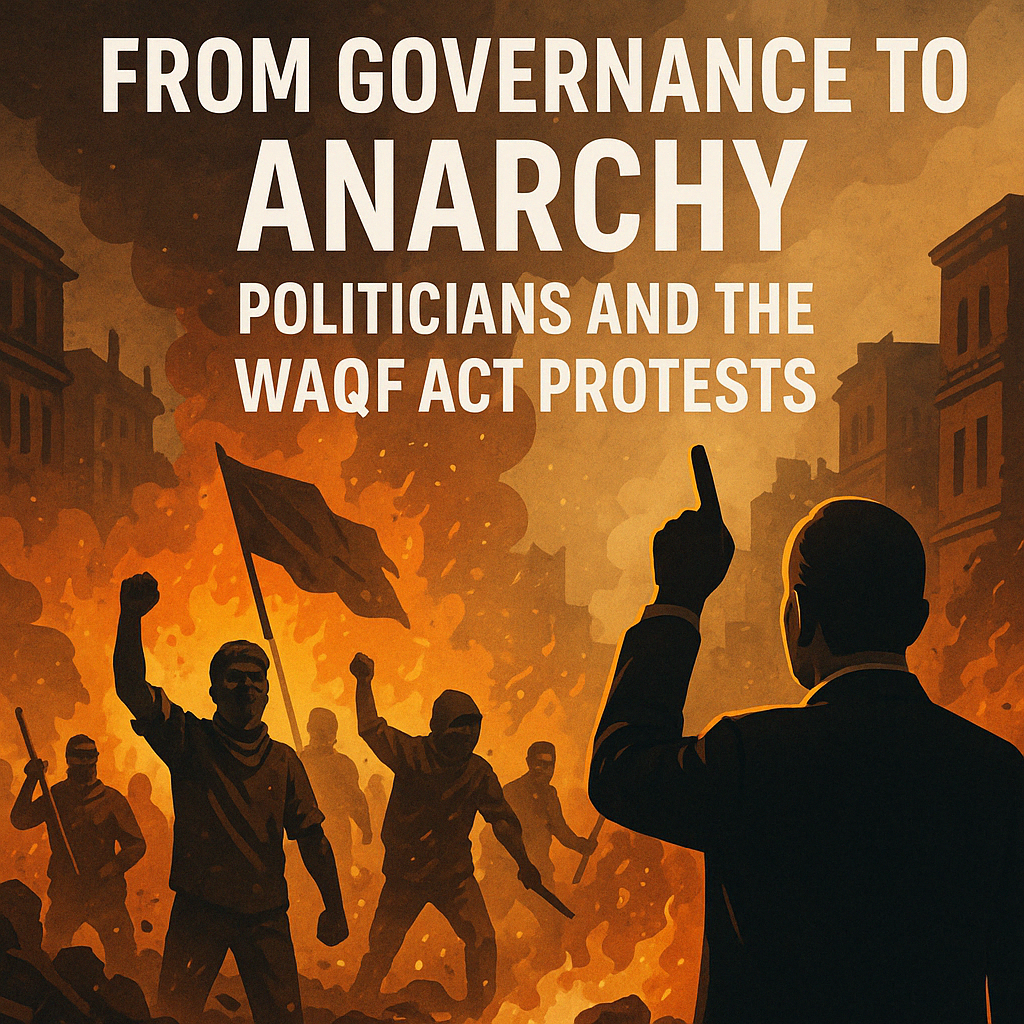
Protests Against Waqf Act 2025: From Governance to Anarchy:
Part VI: Waqf (Amendment) Act, 2025
From Governance to Anarchy
From Governance to Anarchy—this phrase aptly captures the disturbing shift observed during the Protests Against Waqf Act 2025. In this fifth blog of our ongoing series on the Waqf (Amendment) Act, we examine how political inaction, selective outrage, and appeasement strategies converted what could have been a constructive legislative response into a law-and-order crisis. With states like West Bengal slipping into chaos and Uttar Pradesh holding the line through preemptive governance, the contrast exposes how deeply political motives influence both protest narratives and their outcomes.
Thank you for reading this post, don't forget to subscribe!Brief Background
The Waqf (Amendment) Act, 2025, was envisioned as a reformative step—one aimed at transparency, accountability, and standardization of waqf land records. Its introduction followed decades of unchecked waqf board powers and rising litigation from land encroachments, many of them involving non-Muslim stakeholders. Yet, despite extensive consultations and public feedback, the Act became a flashpoint—particularly in politically sensitive states. The legislation’s intent was buried under a wave of outrage, reminiscent of the Shaheen Bagh protests during the Citizenship Amendment Act episode. Once again, the line between democratic dissent and orchestrated unrest blurred.
Rioters and Role of Politicians
The Protests Against Waqf Act 2025 exposed a stark contrast in political responses, with inaction and tacit encouragement in West Bengal enabling rioters, while proactive measures in Uttar Pradesh (UP) curbed violence. West Bengal’s Murshidabad, South 24 Parganas, became epicenters of unrest, mirroring the 2019–2020 Shaheen Bagh protests, where political failures allowed violence to escalate in Bengal in the name of Protests Against Waqf Act 2025. UP’s early intervention, leveraging legal notices and bonds, highlights how decisive governance can prevent communal flare-ups, particularly in BJP-ruled states, which saw less violence compared to others.
West Bengal’s Tacit Protest Support
In the wake of the Waqf (Amendment) Act, 2025, opposition leaders in West Bengal expressed strong dissent, which some observers argue contributed to an atmosphere where Protests Against Waqf Act 2025 escalated into violence. Notably, TMC Chief assured the Muslim community that the Act would not be implemented in the state and pledged to protect their rights and properties. While intended to reassure, critics contend that such statements may have been interpreted by certain groups as tacit approval for aggressive actions. Subsequently, on April 11–12, incidents of violence occurred in Murshidabad, leading to casualties and displacement of residents.
In the context of the TMC Government’s past political engagement in West Bengal, including instances like the 2024 Sandeshkhali unrest where allegations of inaction against miscrants and local leaders accused of misconduct sparked was starkly visibble, opposition leaders’ 2025 endorsement of Protests Against Waqf (Amendment) Act created an atmosphere of impunity. A senior West Bengal leader’s April 2025 assurances of protection for protesters, interpreted by some Muslims as a license for violence, emboldened mobs in Murshidabad, leading to deadly attacks on April 11–12, and fueled arson in South 24 Parganas’ Bhangar on April 10. Her history of prioritizing Muslim celebrations, alleged appeasement, inciting communal tensions in Hooghly, and perceived inaction during Sandeshkhali’s tensions—evoking comparisons to Noakhali’s 1946 violence—amplified unrest. This mirrors the CAA-era Park Circus sit-ins, where political enabling escalated into Howrah violence in 2020.
In the context of the TMC Government’s past political engagement in West Bengal, such as the 2024 Sandeshkhali unrest where inaction against local leaders accused of misconduct occurred, similar to its response during the 2020 CAA protests, the TMC Government’s moral and strategic support for Protests Against Waqf Act 2025, emboldened rioters. Opposition leaders’ assurances in April 2025, seen as triggers for protests, escalated into violence in Murshidabad and South 24 Parganas, as rioters, emboldened by this support, acted with impunity in Bengal’s instant case.
UP’s Early Intervention
UP, with 38.5 million Muslims compared to Bengal’s 24.6 million, acted swiftly to prevent violence. On April 4, 2025, Muzaffarnagar saw protests with Muslims wearing black bands during prayers, signaling unrest. Authorities issued legal notices to over 300 individuals, requiring ₹15,000 bonds to deter incitement, a measure that neutralized tensions in a state with a history of communal friction.
Investigating further, we note that districts like Sambhal, with a 55–60% Muslim population, exceeds districts such as Malda (51.27%), South 24 Parganas (35.57%), North 24 Parganas (25.82%). Only Murshidabad with over 60% exceeds the percentage Muslim population compared with Sambhal. This establishes that political will and effective management can help contain violence.
West Bengal’s Policing Failures
Weak law enforcement in West Bengal enabled rioters. Despite early protests in Dhulian, authorities failed to reinforce security, allowing violence to erupt in Murshidabad and Alipurduar, where fear drove community exodus. Police reportedly sought shelter during April 11–12 clashes, prompting Calcutta High Court-ordered paramilitary deployment. This mirrors CAA-era lapses in Howrah, where inadequate policing fueled riots.
Political Opportunism
Weak law enforcement in West Bengal, allegedly constrained by TMC political pressure, enabled rioters. Despite early protests in Dhulian, authorities failed to bolster security, allowing violence to erupt in Murshidabad and Alipurduar, where fear drove community exodus. Police reportedly sought shelter during April 11–12 clashes, prompting Calcutta High Court-ordered paramilitary deployment. This mirrors CAA-era lapses in Howrah, where inadequate policing enabled violence
Shaheen Bagh Parallel
West Bengal’s 2025 violence reflects the Shaheen Bagh precedent, where political inaction allowed CAA protests to escalate. In 2019–2020, unchecked Park Circus sit-ins fueled Murshidabad clashes. In 2025, UP’s legal notices contrasted with Bengal’s lapses, enabling rioters in Murshidabad and South 24 Parganas. UP’s success, despite its larger Muslim population, highlights governance over populism.
Political inaction in West Bengal created conditions in which violence escalated in regions such as Murshidabad, South 24 Parganas, and Alipurduar, while UP’s April 4 legal notices and ₹15,000 bonds curbed unrest, reflecting BJP-ruled states’ relative stability. This contrast with the Shaheen Bagh-era failures underscores the need for decisive leadership to protect Bharat’s social fabric.
Manufactured Outrage? The Shaheen Bagh Parallel
The CAA protests began in December 2019, ignited by a speech from a senior congress leader at Ramlila Maidan calling for a “this side or that” meaning “now or never” resistance. Within 24 hours, Shaheen Bagh was born that ended with Delhi riots 2020. A humanitarian law aimed at persecuted non-Muslim refugees was quickly reframed as “anti-Muslim,” without any textual basis.
Much like that, the Waqf Amendment has become a magnet for outrage, drawing protests, black badge rallies (as in Muzaffarnagar on April 4), and inflammatory sermons. Once again, facts appear to be overshadowed by strong rhetoric, and legislation is perceived by some as a form of persecution.
For context, see: Delhi Riots 2020: Unmasking the Real Causes and Greta Thunberg – Manufactured Outrage.
The Act or the Agenda?
What began as a regulatory reform quickly devolved from governance to anarchy. In states like West Bengal, political leaders used the Protests Against Waqf Act 2025 as opportunities to posture and polarize, often enabling violence through silence or subtle encouragement. Meanwhile, BJP-led Uttar Pradesh, despite having a larger Muslim population, managed to prevent chaos through early legal deterrents. The contrast reveals a chilling truth—when leadership abandons governance for appeasement, laws are no longer debated in Parliament but decided in the streets. The Waqf (Amendment) Act is not merely about land—it’s a mirror reflecting the dangerous intersection of identity politics and selective outrage.
✅ Call to Action (CTA)
Do you believe governance should bend to fear and vote banks?
Can Bharat afford another descent from governance to anarchy?
👉 Share your thoughts in the comments.
📢 Forward this blog to cut through rhetoric and reveal facts.
📰 Subscribe to HinduInfoPedia for real insights behind Bharat’s legal and political turning points.
Feature Image: Click here to view the image.
Glossary of Terms
- Waqf (Amendment) Act, 2025: A legislative reform aimed at digitizing waqf land records, increasing transparency, and curbing encroachments by providing legal clarity to property rights under Islamic endowments.
- Murshidabad: A Muslim-majority district in West Bengal that witnessed intense violence during the Waqf Act Protests in April 2025, including lynchings and mass displacement.
- South 24 Parganas: A district in West Bengal that became a flashpoint of the Waqf Act protests, with incidents of arson reported in areas like Bhangar.
- Shaheen Bagh Protests: Sit-in demonstrations held in Delhi from December 2019 to March 2020 against the Citizenship Amendment Act (CAA), which inspired protest models used again during the Waqf Act unrest.
- Park Circus Sit-in: A Kolkata-based protest during the 2020 CAA movement, modeled after Shaheen Bagh, which saw significant political backing and communal mobilization.
- Sandeshkhali Unrest (2024): A political and social crisis in West Bengal marked by alleged TMC inaction against miscreants accused of misconduct, referenced as precedent to similar failures during the Waqf Act protests.
- Noakhali Riots (1946): A series of communal massacres in Bengal that have been historically referenced to highlight the dangers of unchecked mob violence and political appeasement.
- Dhulian: A town in Murshidabad district that saw early signs of protest activity, which escalated due to weak law enforcement.
- Alipurduar: A district in West Bengal where violence erupted during the Waqf Act Protests, leading to community fear and exodus.
- Sambhal District: A Muslim-majority district in Uttar Pradesh that remained largely peaceful during the protests due to effective legal preemption by the state government.
- Tripura’s Unakoti District: A district in northeastern India where protests against the Waqf Act reportedly escalated into police clashes in April 2025.
- Black Badge Protests: A form of symbolic dissent where protestors wear black armbands—used in Muzaffarnagar on April 4, 2025, as an early protest tactic against the Act.
- Bonds and Legal Notices (₹15,000 Bonds): A legal measure used by Uttar Pradesh authorities to deter incitement during the protests, requiring individuals to pledge financial sureties for maintaining peace.
- TMC (Trinamool Congress): The ruling political party in West Bengal, led by the state’s Chief Minister, whose assurances to protestors were viewed as tacit endorsements of unrest.
- BJP (Bharatiya Janata Party): The ruling party at the national level and in Uttar Pradesh, credited in the blog for proactive governance during the Waqf Act Protests.
#WaqfAct2025 #ShaheenBagh #PoliticalViolence #BharatGovernance #HinduinfoPedia #WaqfAmendmentAct2025
Refer to these blogs to understand larger context
Waqf Act in India: A Historical Journey and Global Perspective
Blogs Written Later To Cover Full Story
Judicial Response to Waqf Act Unrest: Are the Courts Neutral Arbiters?
Comments are closed.