
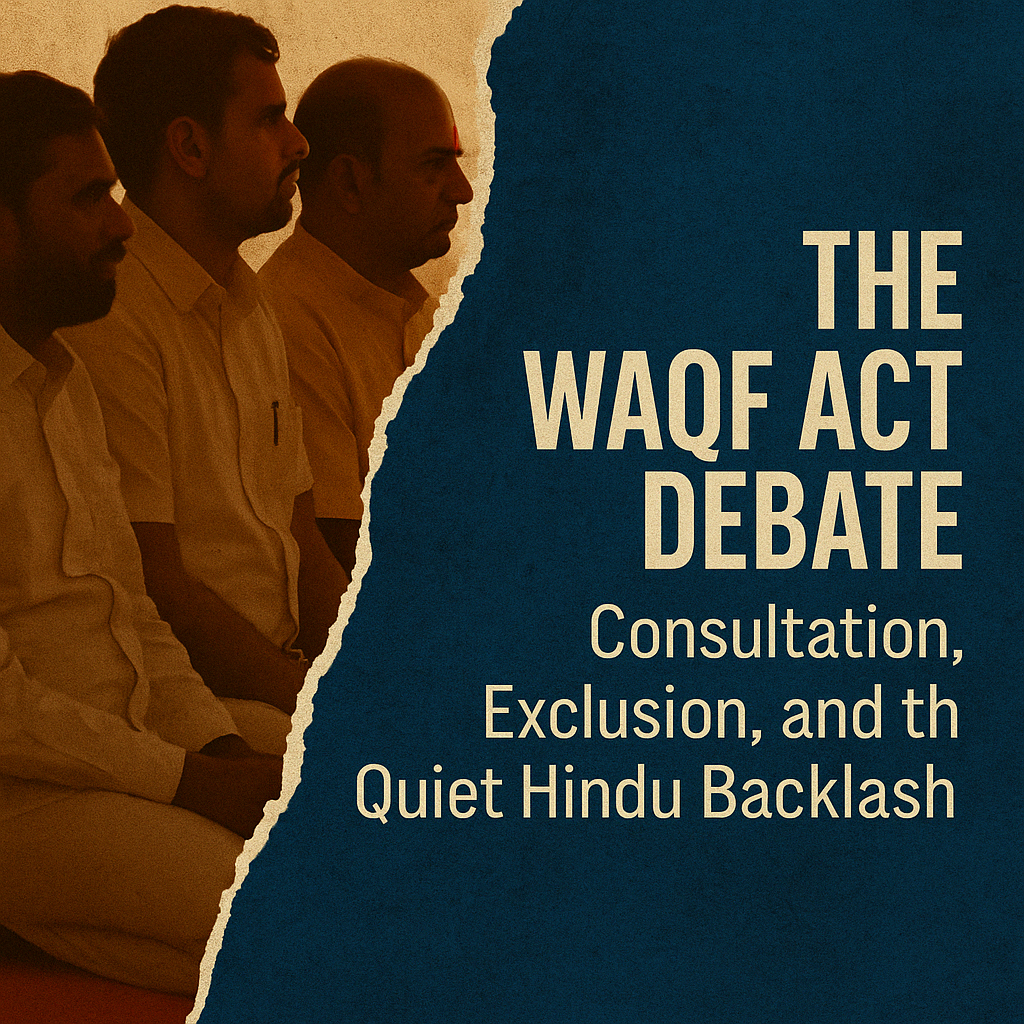
Waqf Act Debate: Consultation, Exclusion and Hindu Backlash
Part V: Waqf (Amendment) Act, 2025
Introduction
In our ongoing series on the Waqf Act Passage and Protests, this fifth installment titled “Waqf Act Debate: Consultation, Exclusion and Hindu Backlash” examines how the legislative process itself became a source of mistrust and communal polarization that discusses about the pace at which the bill was passed and how it ignored Hindu voices. While the Waqf (Amendment) Act, 2025, was introduced to fix longstanding irregularities in waqf property management, the way it was debated, passed, and communicated triggered wide-ranging concerns—both legitimate and politically motivated. As protests raged and accusations flew, the legislative journey of the Act revealed a deeper crisis: how perception, not process, often shapes public response in Bharat’s complex democracy.
Thank you for reading this post, don't forget to subscribe!Historical Context to Waqf Act Debate
Since the 1995 and 2013 amendments, waqf boards have accumulated sweeping powers, claiming lands without judicial checks and often without documentation. This unchecked authority led to rampant encroachments—even in non-Muslim-majority districts—fueling public anger. The 2025 amendment aimed to introduce transparency, digitization, and equity. However, despite extensive JPC consultations and inputs from over one crore citizens and civil stakeholders, the process was branded as hasty by critics, particularly in contrast to previous legislative norms under Congress governments. The absence of consultations with major Hindu groups and muted responses from them only deepened the perception that the Act was neither truly inclusive nor representative, thus fueling mistrust across communities.
Legislative Process: Fueling Mistrust and Polarization
The Waqf (Amendment) Act, 2025, aimed to rectify decades of mismanagement in waqf governance, but its passage triggered protests that exposed Bharat’s communal fault lines. Since the 1995 Waqf Act amendment, malpractices like opaque land dealings and unchecked board discretion have persisted, escalating after the 2013 amendment’s grant of near-unilateral powers to Waqf Boards to claim properties without judicial oversight. This led to extreme malpractices, including encroachments on non-Muslim lands, such as entire villages in Karnataka and Uttar Pradesh (Sachar Committee, 2006; The Hindu, November 7, 2024). With properties surging and litigation cases swelling, neither opposition leaders nor Muslim organizations have explained this rapid growth or the explosion of disputes, deepening public distrust in board accountability (Economic Times, February 14, 2025).
These concerns, coupled with reforms like abolishing triple talaq (2019), underscored the need for transparency and equity in waqf management.
Claims that the Act is communal or aimed at Hindu votes are undermined by opposition from Christians in Kerala, where they form a significant 18% of the population (2011 Census). Christian groups, wary of pre-amendment waqf laws’ overreach, supported reforms to curb arbitrary claims, aligning with broader demands for fairness (Kerala Kaumudi, October 10, 2024).
Political Rhetoric vs Consultation Data: Mapping the Waqf Act Debate
The Waqf (Amendment) Act’s passage, despite extensive JPC consultations engaging many stakeholders—including state officials, waqf boards, farmers, scholars, and organizations like the Zakat Foundation and Archaeological Survey of India—and over 1 crore public emails across states like Maharashtra, Gujarat, Karnataka, Telangana, and Tamil Nadu from September 26 to October 1, 2024, was widely perceived as rushed due to limited pre-legislative engagement (Hindustan Times, August 9, 2024). JPC Chairman robustly defended the process, stating, “We did our exercise thoroughly… with stakeholders across states” (ANI, September 24, 2024) and emphasizing a “national” effort to create a “comprehensive report” (The Hindu, November 7, 2024). He highlighted 34 sittings over 108 hours, consultations in cities like Mumbai, Ahmedabad, Hyderabad, Chennai, and Bengaluru, and plans for further visits to Assam, Bihar, and West Bengal, underscoring engagement with diverse groups nationwide. JPC member from BJP reinforced this, noting, “The Chairperson ensured everyone had the opportunity to express their views… consulting over 284 stakeholders” (DD News, January 27, 2025), with 42 organizations, including government officials, engaged in Hyderabad alone (Reveal Inside, September 28, 2024). Minority Affairs Minister Kiren Rijiju claimed prior consultations, citing “200 complaints regarding waqf encroachments” as input (Hindustan Times, August 9, 2024), while Home Minister Amit Shah lauded the JPC’s “extensive consultations to ensure transparency” (India Today, April 3, 2025).
Balancing Speed and Inclusion: Polarization in the Waqf Act Debate
However, critics ignored UPA 1 and UPA 2’s sluggish pace, with projects like the Delhi-Mumbai Industrial Corridor (2007–2014) and NH-8 expansions delayed by bureaucratic inertia and land acquisition issues (Economic Times, March 15, 2013), underscoring that time discipline is essential to achieve Viksit Bharat’s goals by 2047.
The dual polarization from perceived government haste and opposition rhetoric intensified communal tensions. The absence of consultations with groups like Hindu Mahasabha or RSS, reflecting their quieter stance, limited diverse input. While addressing waqf malpractices, unchecked growth, and litigation was critical, the rushed process and polarized rhetoric underscore the need for inclusive dialogue to unite Bharat’s communities.
The dual polarization—government haste and opposition statements—echoes tensions in reforms like triple talaq, where governance intent clashed with communal perceptions. Unlike Congress-era legislative processes with higher committee referrals (60–71% of Bills, PRS India), the Waqf Act’s six-month JPC timeline appeared swift, intensifying skepticism. The absence of consultations with groups like Hindu Mahasabha or RSS, reflecting their quieter stance, further limited diverse input. While tackling waqf malpractices, unchecked growth, and litigation was essential, the rushed process and polarized rhetoric highlight the need for inclusive dialogue to ensure reforms unite, rather than divide, Bharat’s diverse communities.
Yet, while communal apprehensions dominated the streets, one group remained surprisingly absent from both protest and praise: Bharat’s Hindu voices.
Do Hindu Voices Matter in Waqf Act Debate?
The Waqf (Amendment) Act, 2025, fueled protests claiming anti-Muslim bias, yet Hindu silence and government inaction challenge its “pro-Hindu, anti-Muslim” label. Hindu organizations like RSS, Vishva Hindu Parishad, and Hindu Mahasabha, unconsulted by the JPC, issued no criticism, even as tensions escalated (The Hindu, November 7, 2024). In West Bengal’s Alipurduar district (8.74% Muslim, 2011 Census), Hindu farmers faced waqf board land claims over 250 acres, sparking tension, yet VHP, RSS, HMS, and opposition parties remained silent (The Indian Express, October 20, 2024). So also, in Tamil Nadu’s Tiruchirappalli district, where Muslims constitute just 8.6% of the population (2011 Census), Hindu farmers reported significant land encroachments by waqf boards, with over 1,200 acres under dispute, exacerbating local tensions (The New Indian Express, October 15, 2024).
Similar indifference marked low-Muslim areas like Tripura’s Unakoti (2.26% Muslim), where protests injured 18 police officers (India Today, April 3, 2025). Muslim protests, alleging rights erosion, led to clashes targeting Hindus in Murshidabad, despite no clear evidence of Muslim losses (Times of India, April 13, 2025). The government, reliant on majority votes, overlooked Hindu grievances, raising questions about its secular stance compared to past vote-driven policies. This disconnect, amplified by opposition rhetoric, drove protests, underscoring the need for inclusive dialogue to ensure equitable reforms and communal harmony.
Media Gaps in Waqf Act Debate Narrative
Despite the depth and scale of the Waqf (Amendment) Act, 2025—including over one crore public responses and consultations with hundreds of stakeholders—media coverage, both national and regional, remained disproportionately focused on the protest narrative. National dailies and international platforms highlighted the rhetoric of religious leaders and opposition figures, often portraying the Act as a communal assault, while underreporting the very mismanagement and land disputes the law sought to address.
Even regional outlets in affected districts—such as Alipurduar, Tiruchirappalli, and Moradabad—echoed headlines of outrage and street demonstrations, but rarely included the voices of affected Hindu or Christian landowners. Reports from Christian organizations in Kerala supporting the reform, or Hindu farmers in West Bengal and Tamil Nadu facing encroachments, found little space in the mainstream narrative.
This selective amplification fed into a perception that the Act was anti-Muslim, even as it was designed to address systemic corruption, litigation overload, and opaque land claims. The absence of balanced coverage—especially in local media—prevented the public from seeing the amendment as a legal correction, rather than a communal provocation.
Reflections on How Waqf Act Debate Unfolded
The legislative journey of the Waqf (Amendment) Act, 2025, reveals the paradox of modern governance: even well-intended reforms can spark unrest when they are filtered through the lens of communal suspicion and political rivalry. While the government showcased data-driven consultations, opposition leaders spun the narrative of religious discrimination. Meanwhile, Hindu voices—directly affected by waqf encroachments—remained largely unheard. This dissonance between governance intent and public perception reinforces the urgent need for inclusive dialogue and transparent communication. If Bharat is to move toward true reform, every stakeholder must be heard—not just the loudest.
🔹 Call to Action (CTA)
How can Bharat legislate reforms without dividing its people?
Do Hindu voices matter in shaping laws that affect them?
👉 Join the conversation—comment below.
📢 Share this blog to cut through the noise of rhetoric.
📰 Subscribe to HinduInfoPedia for sharp insights into Bharat’s legal, cultural, and political turning points.
Feature Image: Click here to view the image.
Glossary of Terms
- Waqf: A charitable endowment under Islamic law, typically involving land or assets donated for religious or social welfare purposes, administered by Waqf Boards.
- Waqf Board: Statutory bodies established by the government to manage waqf properties in each state, empowered to oversee administration, leasing, and legal matters related to waqf lands.
- Waqf (Amendment) Act, 2025: A legislative amendment passed in April 2025 aimed at curbing waqf-related irregularities, digitizing land records, reinstating civil court appeals, and addressing unchecked land claims.
- JPC (Joint Parliamentary Committee): A special committee of Indian Parliament formed to examine proposed legislation. The JPC for the Waqf Amendment held 34 sittings and consulted over 284 stakeholders.
- Triple Talaq Reform (2019): A legal ban on the Islamic practice of instant divorce, passed by the Indian Parliament in 2019, seen as part of a broader effort to reform personal laws.
- Sachar Committee (2006): A committee formed by the Government of India to assess the socio-economic and educational conditions of Muslims in India; it also highlighted waqf management issues.
- Alipurduar District: A district in West Bengal with a small Muslim population where Hindu farmers reportedly faced waqf board land claims over hundreds of acres.
- Tiruchirappalli District: A district in Tamil Nadu with under 9% Muslim population, where Hindu farmers alleged encroachment by waqf boards on over 1,200 acres of land.
- Tripura’s Unakoti District: A district in northeastern India where protests against the Waqf Act reportedly escalated into police clashes in April 2025.
- Zakat Foundation: A Muslim charitable organization that participated in the JPC’s consultation process for the Waqf Amendment Act.
- Archaeological Survey of India (ASI): A government agency responsible for archaeological research and conservation, which was consulted for potential overlap between waqf claims and protected heritage sites.
- Viksit Bharat: A vision for a developed India by 2047, marking 100 years of independence, which underpins urgency in executing governance and infrastructure reforms.
- Reveal Inside: An Indian investigative media platform cited for reporting the stakeholder engagement process during the JPC sittings.
- PRS India: A non-profit research organization that tracks and analyzes legislation in India, including data on committee referrals and timelines.
#WaqfActProtests #WaqfAmendment2025 #HinduVoices #ReligiousLandDisputes #HinduinfoPedia #WaqfAmendmentAct2025
Refer to these blogs to understand larger context
Waqf Act in India: A Historical Journey and Global Perspective
Blogs Written Later To Cover Full Story
Judicial Response to Waqf Act Unrest: Are the Courts Neutral Arbiters?
Visit for related videos here
Comments are closed.