
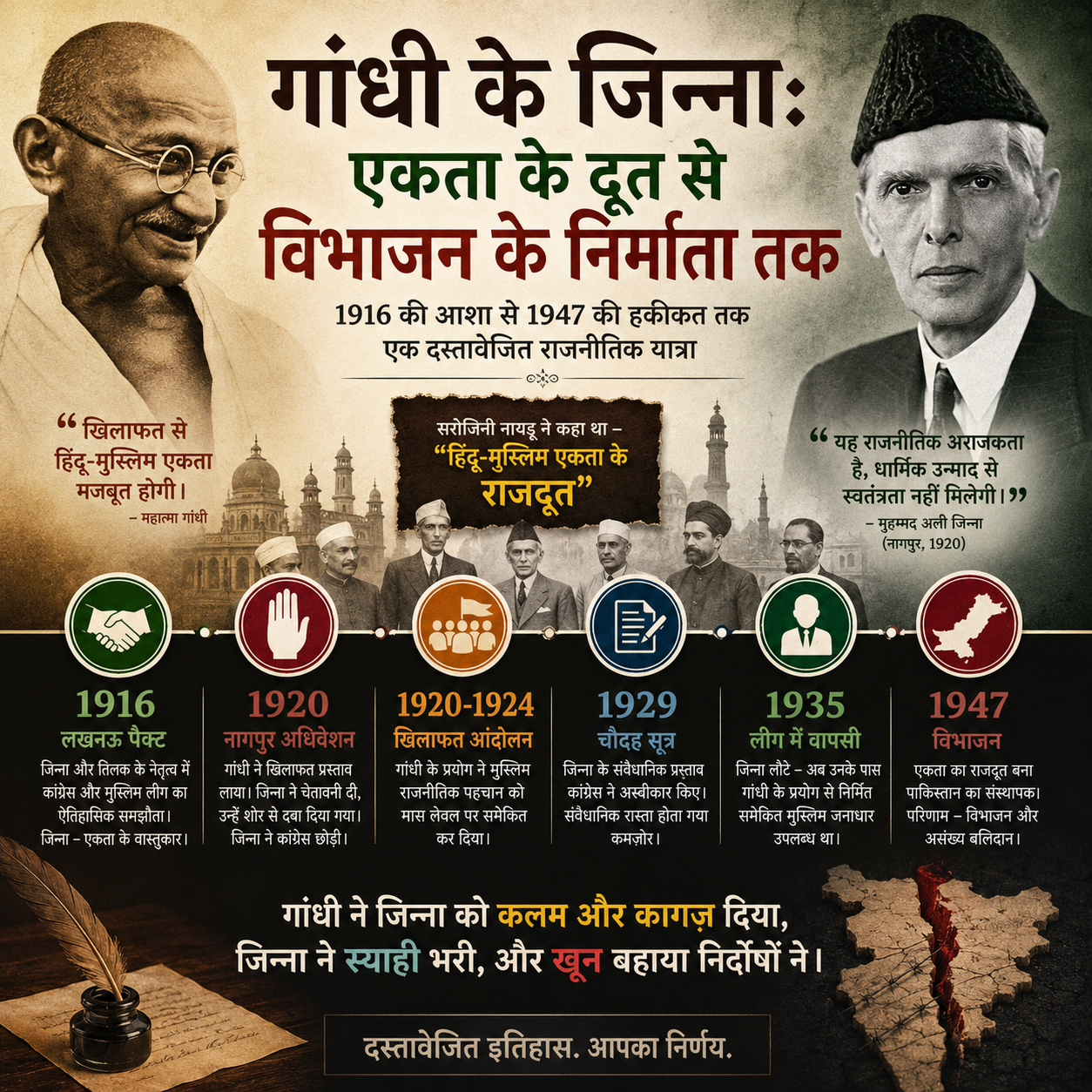
Gandhi’s Jinnah: From Ambassador of Unity to Architect of Partition (82)
भारत / GB
Part 82: Mahatma Gandhi’s Peace Efforts | Series Index
The series now moves beyond the Moplah arc to examine a documented consequence that runs across three decades — the transformation of Muhammad Ali Jinnah from the man Sarojini Naidu called the Ambassador of Hindu-Muslim Unity to the founder of Pakistan. The prosecution places the documented sequence before the reader. The reader will examine what role Gandhi’s choices played in that transformation.
Thank you for reading this post, don't forget to subscribe!The Action Taken: Having been outflanked by the Congress clerical alliance in 1920, Jinnah eventually abandoned secular constitutionalism to construct an opposing, consolidated communal platform.
Who Paid the Price: The territorial integrity of the subcontinent, which lost its foremost secular legalist to separatist communal politics.
The Alternative Bypassed: Preserving the 1916 Lucknow Pact framework of cross-community elite constitutional power-sharing.
Why This Matters: Traces the direct causal trajectory: how injecting theological passion into the national mainstream alienated secular Muslim leaders and incentivized the creation of the Muslim League mass base.
Who Jinnah Was — Before Gandhi
Gandhi’s Jinnah begins with the documented record of who Jinnah was before Gandhi entered Indian politics at scale — and what the documented record shows happened after.
Sarojini Naidu, India’s Nightingale, nicknamed Jinnah “the Ambassador of Hindu-Muslim Unity” for his attempts to bring the Congress and the League together.
The Lucknow Pact of December 1916 — which Jinnah architected — was the high point of Congress-League cooperation. He was held in high esteem in both Congress and Muslim League circles, and was popularly known as an “ambassador of Hindu-Muslim unity”. Tilak and Jinnah had already worked together in the previous decade.
Jinnah was a member of both the Congress and the Muslim League simultaneously. He believed in constitutional reform, secular nationalism, and Hindu-Muslim political cooperation achieved through negotiation rather than mass religious mobilisation. His method was Tilak’s method — two organisations, one goal, achieved through documented agreements.
What Changed — The Documented Sequence
The documented sequence of Jinnah’s transformation runs through three precise points.
August 1920 — Tilak dies: Tilak — Jinnah’s closest Congress ally, the man who had worked with him to build the Lucknow Pact — died on August 1, 1920. After Tilak’s death and growing differences with Gandhi, Jinnah quit the Congress in 1920. The death of Jinnah’s primary political ally in Congress removed the last figure who could have mediated between Jinnah’s constitutional nationalism and Gandhi’s mass religious mobilisation.
December 1920 — Nagpur: Gandhi introduced the Khilafat resolution at the Nagpur Congress session. In 1920, Jinnah resigned from the Congress when it agreed to follow a campaign of satyagraha, which he regarded as political anarchy. Jinnah warned at Nagpur that bringing pan-Islamic religious mobilisation into the independence movement was a category error. He was shouted down by the Muslim majority Gandhi’s alliance had activated at the session. He left.
1920-1935 — Fifteen years in the wilderness: After leaving Congress, Jinnah attempted multiple times to negotiate a constitutional settlement. His Fourteen Points of 1929 were a documented attempt to preserve Muslim political rights within a united India framework — fourteen specific constitutional provisions designed to make a united independent India workable for Muslim communities. They were presented to the Congress. They were not accepted. Each rejection of Jinnah’s constitutional framework pushed the consolidated Muslim identity Gandhi had created further toward a separatist conclusion. By 1935, Jinnah returned to lead the Muslim League — now with a consolidated Muslim political identity available to him, built by Gandhi’s Khilafat experiment.
What Gandhi’s Khilafat Experiment Gave Jinnah
Gandhi’s Jinnah places one precise observation before the reader — documented in Blog 48’s analysis of the Muslim front creation.
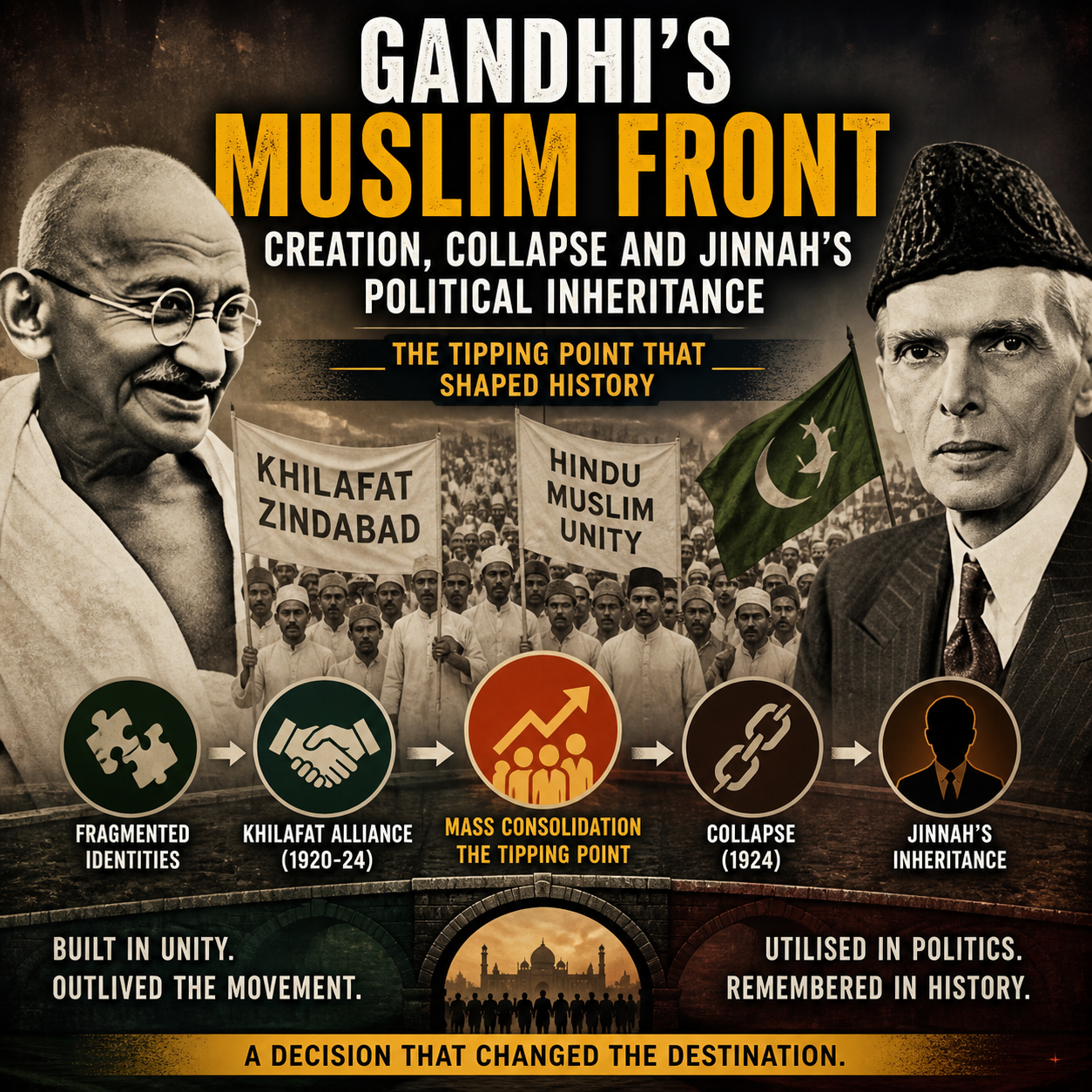
When Jinnah left Congress in 1920, the Muslim League was a small organisation with limited mass following. The Muslim political landscape was fragmented — Deobandi, Barelvi, Shia, Sunni, regional variations, no unified mass political identity.
Gandhi’s Khilafat experiment consolidated that fragmented landscape into a mass pan-Islamic political identity. When the Khilafat movement collapsed after 1924, that consolidated identity was politically homeless. It needed a vessel.
Blog 48 documented this precisely — Gandhi gave Jinnah pen and paper. Jinnah supplied the ink. The blood was paid by those who had no role in either transaction.
The Documented Alternative — What Jinnah Represented
Gandhi’s Jinnah places one further documented observation before the reader — what Jinnah’s path represented before it was foreclosed.
The Lucknow Pact of 1916 was built on a documented foundation: two separate political organisations working toward one constitutional goal through negotiated agreement. Jinnah’s method required no pan-Islamic theological framework. It required no Caliphate. It required no dar-ul-harb declaration. It required two organisations, two sets of lawyers, and one documented pact.
The pact had limitations — it conceded separate electorates, which later critics documented as institutionalising communal politics. But it produced a documented agreement between Congress and the League at a moment when both organisations were working toward the same constitutional goal.
Gandhi’s method — mass religious mobilisation through the Khilafat alliance — bypassed the constitutional path Jinnah represented. It produced a larger movement with a faster mobilisation. It also produced, as the series has documented across eighteen Moplah arc blogs, consequences that the constitutional path would not have produced.
When Jinnah returned to lead the League in 1935 with the consolidated Muslim mass Gandhi’s experiment had created, the constitutional path was no longer available to India — it had been foreclosed by the pan-Islamic mobilisation that had replaced it.
The Prosecution’s Position
Gandhi’s Jinnah does not claim Gandhi intended Partition. It places the documented sequence before the reader and asks the reader to examine it.
- Did Jinnah in 1916 represent a documented path toward Hindu-Muslim unity through constitutional negotiation — the Lucknow Pact being the documented evidence?
- Did Gandhi’s choices in 1920 — overriding Jinnah at Nagpur, introducing pan-Islamic religious mobilisation into the independence movement — remove from Congress the one Muslim leader who had built the most successful documented Congress-League agreement in history?
- Did Gandhi’s Khilafat experiment consolidate the Muslim political mass that Jinnah inherited when he returned to lead the League in 1935?
- What does it mean that the man Sarojini Naidu called the Ambassador of Hindu-Muslim Unity became the founder of Pakistan — and that the documented turning point in that transformation was Gandhi’s Nagpur session of 1920?
Gandhi’s Jinnah does not answer. The documented sequence — 1916 Lucknow Pact, 1920 Nagpur, 1935 Jinnah returns to League with consolidated mass, 1947 Partition — is placed before the reader. The reader will examine Gandhi’s role in that sequence and complete the sentence.
1916 — Jinnah: Ambassador of Hindu-Muslim Unity, architect of the Lucknow Pact. 1920 — Gandhi introduced the Khilafat alliance at Nagpur. Jinnah warned it was a category error. He was shouted down and left. 1920-1924 — Gandhi’s Khilafat experiment consolidated Muslim political identity at mass scale. 1935 — Jinnah returned to lead the League with that consolidated mass available to him. 1947 — Pakistan. The prosecution places the documented sequence before the reader. The reader will identify Gandhi’s documented role in the transformation — and what the Lucknow Pact of 1916 tells us about what was possible before Gandhi’s choices made it impossible.
Feature Image: Click here to view the image.
Videos
Glossary of Terms
- Lucknow Pact: A landmark 1916 agreement between the Indian National Congress and the Muslim League, negotiated with significant input from Muhammad Ali Jinnah and Bal Gangadhar Tilak, aimed at securing constitutional reforms through cooperation.
- Ambassador of Hindu-Muslim Unity: The title given to Muhammad Ali Jinnah by Sarojini Naidu in recognition of his efforts to foster political cooperation between Hindus and Muslims before 1920.
- Nagpur Session (1920): The Congress session where Mahatma Gandhi’s programme of Non-Cooperation and support for the Khilafat Movement was formally adopted, leading to Jinnah’s departure from Congress.
- Khilafat Movement: A pan-Islamic political campaign launched after World War I to preserve the Ottoman Caliphate, which Gandhi incorporated into the Indian freedom movement.
- Constitutional Nationalism: A political approach that seeks reform and self-government through laws, negotiations, representative institutions, and constitutional agreements rather than mass agitation.
- Fourteen Points: The constitutional proposals presented by Muhammad Ali Jinnah in 1929 to safeguard Muslim political rights within a united Indian framework.
- Pan-Islamic Mobilisation: Political mobilisation based on a broader Islamic identity that transcends regional, ethnic, and sectarian divisions.
- Muslim Political Consolidation: A key concept in this series describing the process through which diverse Muslim communities increasingly came to act as a unified political bloc.
- Muslim Front Creation: A series-specific term referring to the consolidation of Muslim political identity during the Khilafat period, creating a mass political constituency later available to the Muslim League.
- Politically Homeless Identity: A series-specific phrase describing the consolidated Muslim political base that remained after the collapse of the Khilafat Movement and sought a new political vehicle.
- Separate Electorates: An electoral system in which members of different religious communities vote separately for their own representatives.
- Dar-ul-Harb: A classical Islamic political term referring to territories not governed under Islamic rule.
- Congress-League Cooperation: The period and process in which the Indian National Congress and the Muslim League worked together toward constitutional reforms and self-government.
- Documented Sequence: A key phrase in this blog referring to the chronological chain of recorded historical events presented for analysis.
- Prosecution’s Position: A recurring analytical framework used in this series that presents historical evidence and documented events while leaving the final judgment to the reader.
#Jinnah #Gandhi #Partition #Pakistan #Congress #History #India #Khilafat #MuslimLeague #HinduinfoPedia
Gandhi’s Peace Efforts: The Questions Before the Mahatma (0)