Gandhi’s Moplah Response: The Brave God-Fearing Moplahs (58)
भारत / GB
Part 58: Mahatma Gandhi’s Peace Efforts | Series Index
Blog 57 placed the arithmetic side by side — 2,500 Hindus killed at Moplah, 22 policemen at Chauri Chaura, two responses, one pattern. This post carries Gandhi’s own documented statements during the massacre in full. The words are Gandhi’s. The reader will decode what they mean.
Thank you for reading this post, don't forget to subscribe!The Action Taken: Gandhi publicly characterized the Moplah rebels as “brave, God-fearing Muslims who were fighting for what they consider as religion and in the manner they consider as religious.”
Who Paid the Price: The massacre victims and displaced refugees, whose suffering was qualified by public praise for the religious zeal of their attackers.
The Alternative Bypassed: Clear, unconditional moral and political condemnation of sectarian atrocities committed under the movement’s banner.
Why This Matters: Refused to sever the Khilafat alliance or condemn perpetrators, establishing the precedent that political alliances would be protected even after severe communal massacres.
The Statement That Defined Gandhi’s Response
Gandhi’s Moplah Response is built on one documented quote — Gandhi’s own words, spoken while the massacre was in progress.
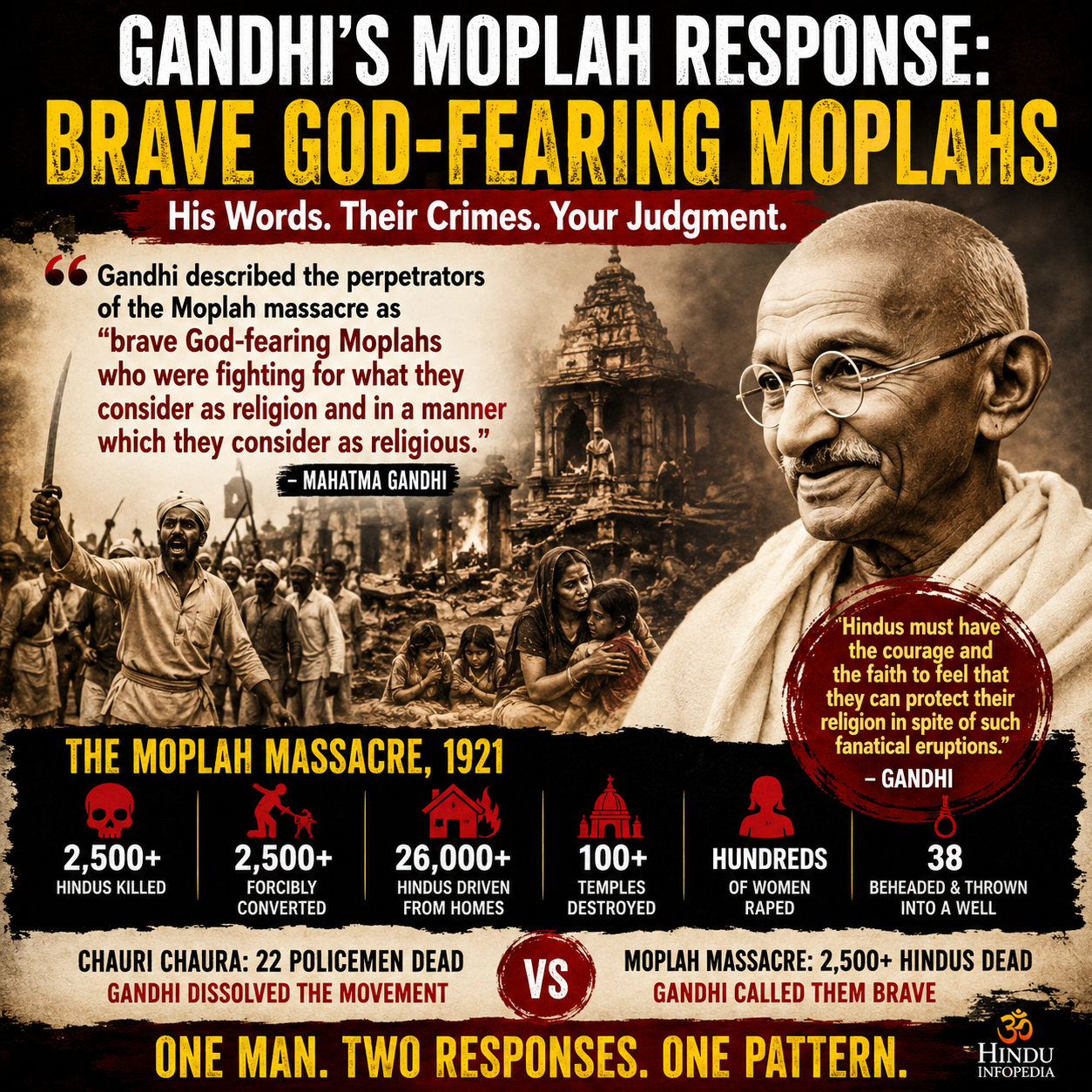
Gandhi described the perpetrators of the Moplah massacre as the “brave God-fearing Moplahs who were fighting for what they consider as religion and in a manner which they consider as religious.”
The prosecution places this statement before the reader without characterisation. The reader will supply the word.
The statement was not a private communication. It was Gandhi’s public characterisation of men who had killed at least 2,500 Hindus, forcibly converted 2,500 more, driven 26,000 from their homes, destroyed 100 temples, raped hundreds of women, and beheaded 38 people and thrown them into a well.
Gandhi called them brave.
He called them God-fearing.
He characterised their killing of Hindus as fighting for religion — in a manner they considered religious.
What the Statement Did Not Say
Gandhi’s Moplah Response documents what Gandhi said. The prosecution requires equal precision about what he did not say.
He did not condemn the killing of Hindus.
He did not condemn the forced conversions.
He did not condemn the destruction of temples.
He did not condemn the rape of Hindu women.
He did not call the Moplah actions a violation of his ahimsa principle.
He did not demand that the Khilafat leadership — the Ali Brothers, the ulema networks he had elevated to co-equal leadership of the national movement — publicly condemn the massacre.
He did not withdraw his support for the Khilafat alliance on the grounds that the instrument he had chosen had produced mass violence against Hindus within twelve months of his deploying it.
The prosecution does not claim Gandhi approved of the violence. It claims he characterised its perpetrators as brave and God-fearing while it was happening — and said nothing that would have placed the same moral weight on the Moplah killing of Hindus that he placed on Indian violence against British authority at Chauri Chaura five months later.
The Ambedkar Documentation
Blog 54 cited Ambedkar’s characterisation of the massacre as indescribable. Ambedkar went further — he documented Gandhi’s response specifically, in terms the prosecution can carry without modification.
Ambedkar wrote: “This attitude to excuse the Muslims any wrong, lest it should injure the cause of unity, is well illustrated by what Mr. Gandhi had to say in the matter of the Moplah riots. The blood-curdling atrocities committed by the Moplahs in Malabar against the Hindus were indescribable. All over Southern India, a wave of horrified feeling had spread among the Hindus of every shade of opinion, which was intensified when certain Khilafat leaders were so misguided as to pass resolutions of congratulations to the Moplahs on the brave fight they were conducting for the sake of religion.”
Ambedkar’s documentation establishes two things simultaneously. First: the massacre produced horror across Hindu India — it was not a contested or ambiguous event. Second: Gandhi’s response was to excuse Muslim conduct to protect the cause of Hindu-Muslim unity — the same unity whose structural impossibility Blog 46 documented as proximity mistaken for purpose.
The Ahimsa Asymmetry — Applied to Moplah
Blog 40 documented the ahimsa asymmetry — Gandhi’s principle of non-violence activating selectively, against Indian violence, while remaining silent on British violence. Gandhi’s Moplah Response extends that documentation into a third category: Muslim violence against Hindus.
The documented record across the series now shows three applications of Gandhi’s ahimsa framework:
British violence against Indians: At least 489 documented dead at Jallianwala Bagh including Hassan Mohammad, nine years old. Gandhi did not fast. The movement continued.
Indian backlash to British provocation at Chauri Chaura: Police fired first. Freedom fighters who trusted Gandhi’s call retaliated. Twenty-two policemen died. Gandhi dissolved the entire Non-Cooperation Movement — thirty thousand freedom fighters who had trusted his call received nothing.
Muslim violence against Hindus at Moplah: At least 2,500 Hindus killed, 2,500 forcibly converted, 26,000 displaced, 100 temples destroyed. Gandhi called the perpetrators brave and God-fearing. No fast. No satyagraha. No dissolution of the Khilafat alliance. Yet to be covered topics including the Great Calcutta Killings, the Noakhali and the Bihar Riots will reveal reconfirmation of this pattern.
The pattern is now documented across three domains. The principle activated against Indian violence against British authority — and dissolved movements, sentenced thirty thousand to nothing. The principle did not activate against British violence against Indians. The principle did not activate against Muslim violence against Hindus. The prosecution places the three-column record before the reader without assertion. The reader will identify the pattern.
The prosecution places the three-column record before the reader without assertion. The reader will identify the pattern.
Gandhi’s Instruction to Hindus
Gandhi’s Moplah Response also contains a second documented statement — directed not at the Moplahs but at the Hindus of Malabar. Gandhi told the Hindus: “The Hindus must have the courage and the faith to feel that they can protect their religion in spite of such fanatical eruptions.” The prosecution places this statement before the reader without characterisation — and asks the reader to apply it to the documented conditions in Malabar in October 1921. Was the courage Gandhi prescribed:
- To watch your temple destroyed without fighting back?
- To face your family being killed with non-violent acceptance?
- To see your daughter raped and have faith that your religion will survive?
- To watch your neighbour beheaded and his body thrown into a well — and find, in that moment, courage and faith rather than resistance?
Did Gandhi’s prescription of faith imply:
- That religion can protect itself without Hindus defending it?
- That the God who watches a six-month-old child cut into two pieces in front of his mother will intervene on behalf of those who submit rather than resist?
- That passive acceptance of mass atrocity is the higher spiritual path?
Did he imply that? The prosecution does not answer.
It places Gandhi’s prescription — courage and faith — alongside the documented conditions: 2,500 killed, 2,500 forcibly converted, women raped, temples destroyed, bodies in wells. The reader will determine what courage and faith meant in that specific geography, in that specific month, to the people receiving Gandhi’s instruction. Gandhi told those people to have courage. He told their killers they were brave and God-fearing. The asymmetry is documented in Gandhi’s own words — not in the prosecution’s characterisation.
The Prosecution’s Position
Gandhi’s Moplah Response does not claim Gandhi celebrated the massacre. It claims the documented record of what he said — and what he did not say — is inconsistent with the stated principles he applied selectively across three domains.
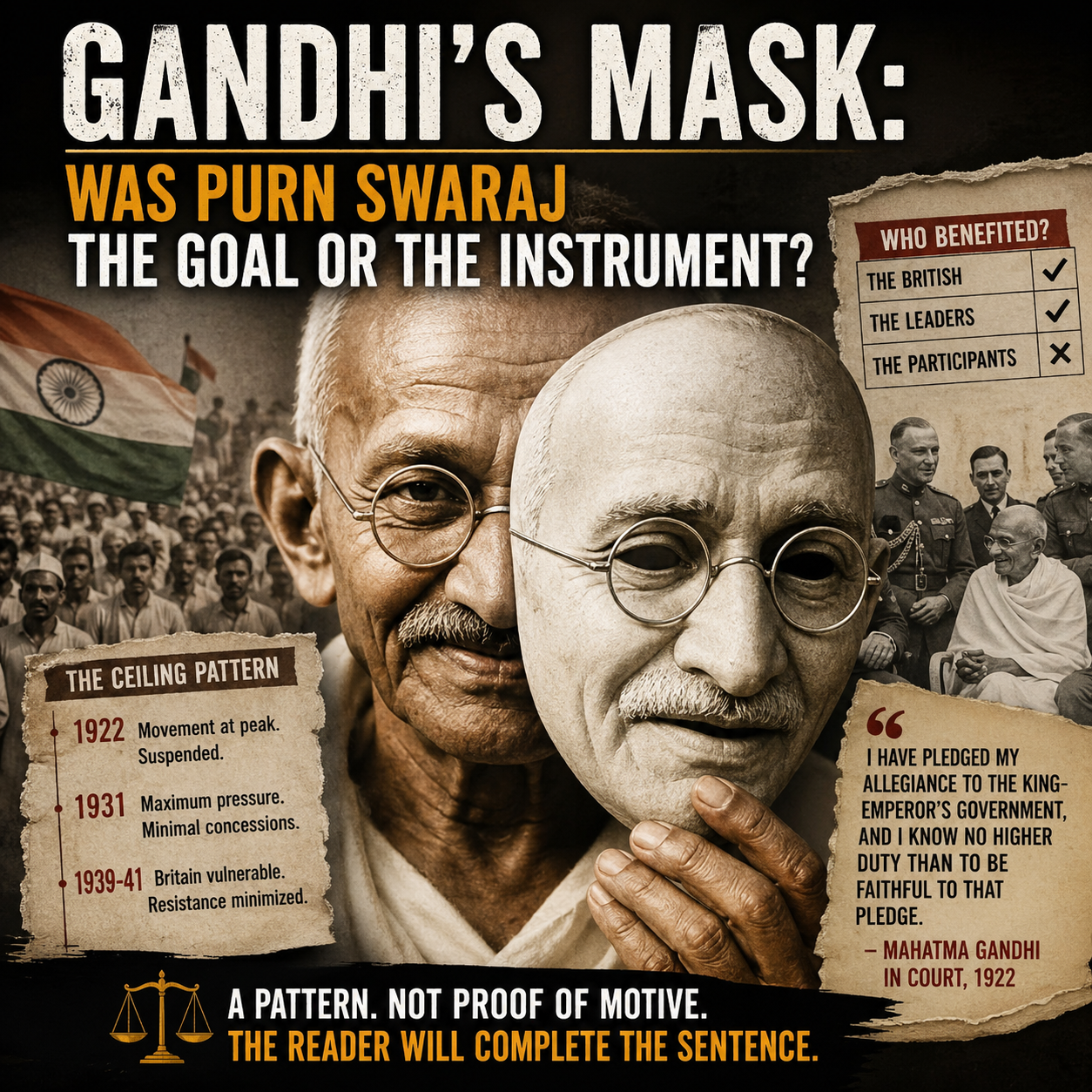
The brave God-fearing Moplahs were fighting for what they considered religion while indulging into fanatical acts. Twenty-two policemen died at Chauri Chaura as a backlash of attack on protesters— and the movement that thirty thousand had built was dissolved overnight. The ceiling had a precise trigger. The Moplah massacre did not trigger it.
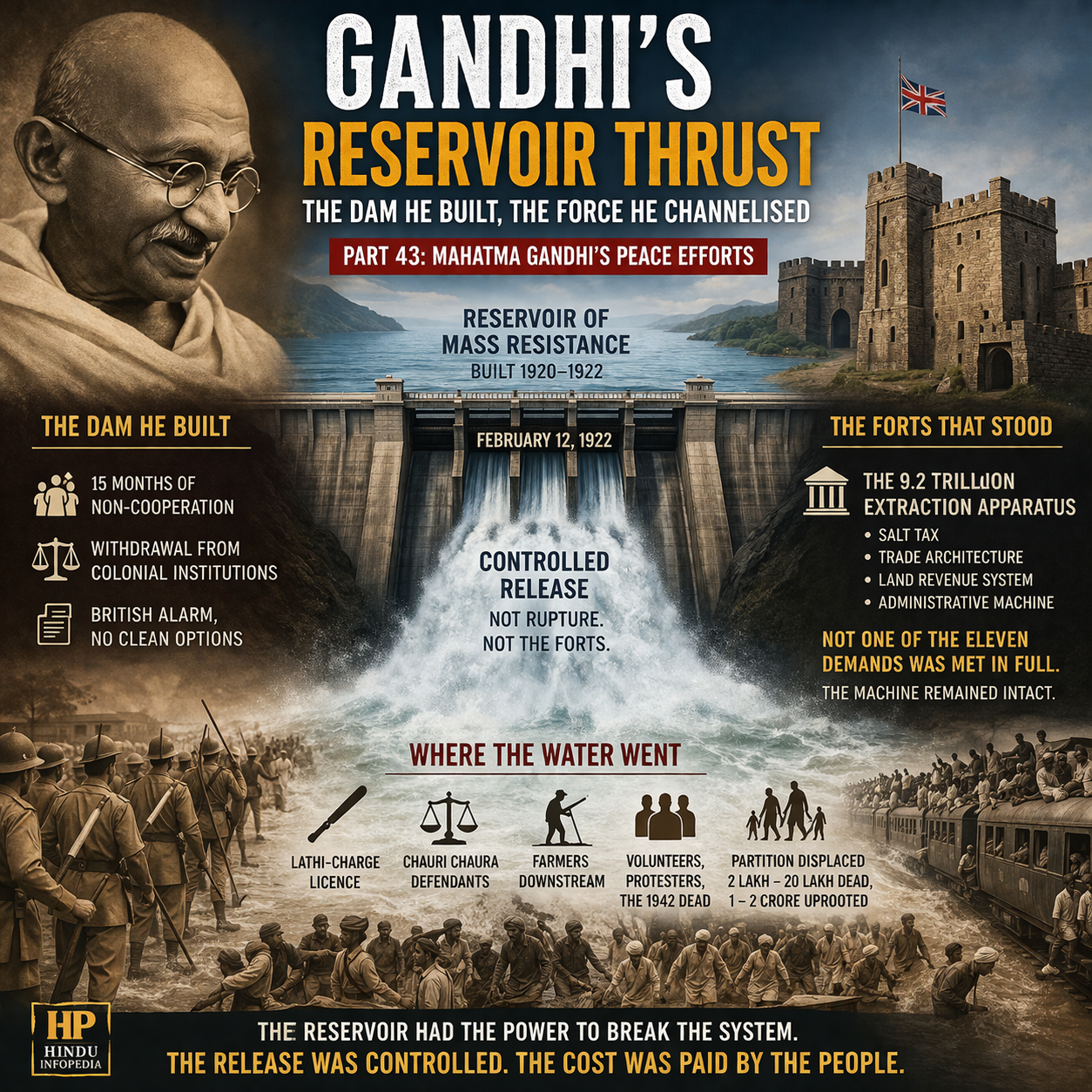
Ambedkar documented the reason: Gandhi excused Muslim conduct to protect the cause of unity. The prosecution’s observation on that reason is precise: the cause of unity Gandhi was protecting was the proximity he had built — the numerical alliance the reservoir required. Condemning the Moplahs would have fractured that alliance. Gandhi chose the alliance over the Hindus of Malabar.
The arithmetic is consistent. The beneficiary column reads the same. The next post documents what the silenced critics had warned — and how the Moplah massacre confirmed every warning within twelve months of Gandhi overriding them.
Gandhi called the Moplah killers brave and God-fearing. He told the Hindus of Malabar — whose temples were destroyed, whose women were raped, whose families were killed and converted — that they must have courage and faith. He did not condemn the killing. He did not condemn the rape. He did not condemn the forced conversions. Five months later he dissolved the Non-Cooperation Movement because twenty-two policemen had been killed at Chauri Chaura. Courage and faith for Hindus facing massacre. Movement dissolution for Indians whose backlash to British provocation killed policemen. The ceiling had a trigger. The Moplah massacre was not it. The prosecution places the documented asymmetry before the reader. The reader will identify what the asymmetry means.
Feature Image: Click here to view the image.
Videos
Glossary of Terms
- Moplah Massacre: A large scale outbreak of violence in Malabar in nineteen twenty one in which thousands of Hindus were reportedly killed, forcibly converted, displaced, and subjected to atrocities during the Khilafat period.
- Malabar: A historical region in present day Kerala that became the center of the Moplah uprising and communal violence in nineteen twenty one.
- Khilafat Movement: A political and religious movement launched in British India to support the Ottoman Caliphate after the First World War, later aligned with Gandhi’s Non Cooperation Movement.
- Non Cooperation Movement: A mass political movement launched by Mahatma Gandhi against British rule in nineteen twenty, encouraging Indians to withdraw cooperation from colonial institutions.
- Chauri Chaura Incident: A nineteen twenty two event in Uttar Pradesh where protesters clashed with police, leading to the death of twenty two policemen and the immediate withdrawal of the Non Cooperation Movement by Gandhi.
- Ahimsa Asymmetry: A phrase used in this series to describe the selective application of Gandhi’s principle of non violence across different forms of violence and political actors.
- Reservoir Thrust: A conceptual phrase in this series referring to Gandhi’s strategy of building a large political coalition by channeling Hindu Muslim numerical unity into the national movement.
- Beneficiary Column: A recurring analytical phrase in this series referring to the side that repeatedly appeared to gain political or moral protection within Gandhi’s responses to major events.
- Ali Brothers: Prominent Khilafat leaders, Mohammad Ali and Shaukat Ali, who worked closely with Gandhi during the Khilafat and Non Cooperation alliance.
- Forced Conversions: The coercive conversion of Hindus to Islam reported during the Moplah violence in Malabar.
- Jallianwala Bagh: The site of the nineteen nineteen massacre in Amritsar where British troops fired upon unarmed Indians gathered in a public meeting.
- Dr. B. R. Ambedkar: Indian jurist, social reformer, and principal architect of the Indian Constitution who critically documented Gandhi’s response to the Moplah violence.
- Great Calcutta Killings: Large scale communal violence in Calcutta in nineteen forty six referenced in the series as part of a continuing pattern of communal conflict.
- Noakhali Riots: Communal violence in Bengal in nineteen forty six involving attacks, killings, forced conversions, and displacement of Hindus.
- Prosecution’s Position: A recurring narrative structure in this series where documented statements, actions, and consequences are presented before the reader for interpretation.
#HinduinfoPedia #Gandhi #Moplah #Khilafat #Malabar #Ambedkar #History #India #Kerala #Congress
Scan Through The Entire Series
Gandhi’s Peace Efforts: The Questions Before the Mahatma (0)