Gandhi’s Suspension Signal: The Day the British Read the Map (30)
भारत / GB
Part 30: Mahatma Gandhi’s Peace Efforts | Series Index
Blog 29 documented what the British faced in November 1921 — multi-provincial compliance failure, revenue shortfalls, enforcement under documented strain, a royal visit that had demonstrated the movement’s reach. The water was at its highest. This post documents what happened to that water on February 12, 1922 — and what the British learned from watching it drain.
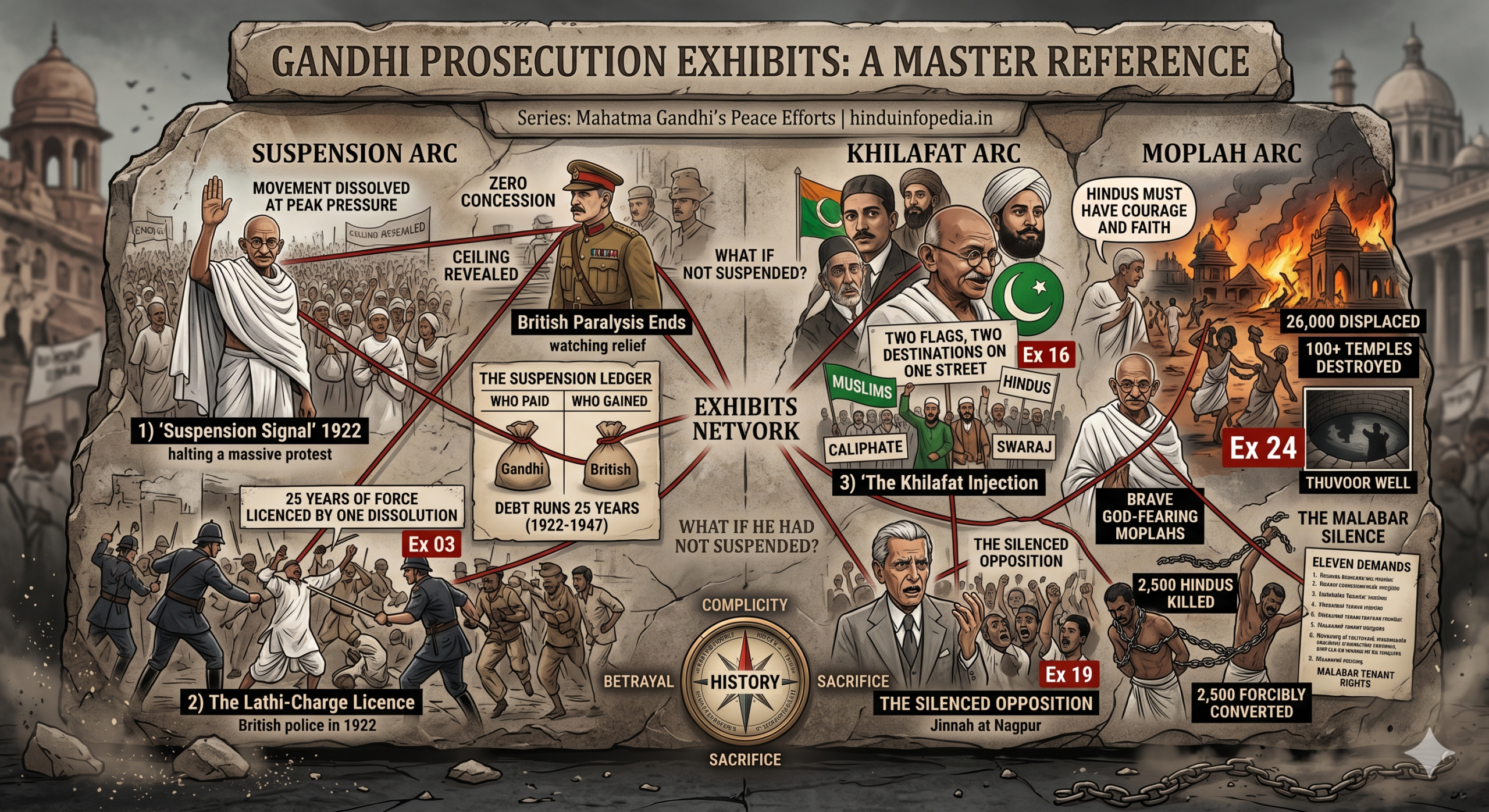
Thank you for reading this post, don't forget to subscribe!The Action Taken: Gandhi unilaterally dissolved the nationwide Non-Cooperation movement following the Chauri Chaura incident without consulting imprisoned Working Committee members.
Who Paid the Price: The nationwide movement, which saw its accumulated organizational pressure discharged without securing any political or constitutional concessions.
The Alternative Bypassed: Consulting the imprisoned national leadership (Nehru, Das, Lajpat Rai) or convening an emergency AICC session before standing down.
Why This Matters: Demonstrated to colonial authorities the precise moral limit at which the leadership would voluntarily halt mass resistance, fundamentally altering British administrative calculations.
The Question the British Could Not Answer
Before February 12, 1922, Gandhi’s Suspension Signal had not yet been sent. The British colonial administration faced a question for which it had no reliable answer, and even the framing felt alien to their model of governance: if we do not crush this movement with force, where does it end?
Blog 29 documented the conditions of November 1921 — the British were facing something their governance model had not been designed to manage. Mass non-compliance could not be shot. The administration could arrest individuals. It could not arrest a population that had collectively decided to stop participating in the mechanisms of its own governance. It could beat the columns at Chauri Chaura. It could not beat the idea out of thirty thousand people simultaneously across multiple provinces.
The British had a ceiling of their own — the moral and political cost of mass visible violence against a non-violent population. Jallianwala Bagh in 1919 had shown them that ceiling. The international outrage, the Hunter Commission, the damage to British credibility — all of it told the administration that the 1857 model of direct suppression carried a cost that 1921 Britain could not absorb at the same scale. So they waited. They hesitated. They arrested selectively. They did not send troops into crowds.
But waiting was not a strategy. It was the absence of one. The British were hesitating because they did not know Gandhi’s ceiling. They did not know whether he would let the water reach the forts.
February 12, 1922 answered that question.
The Signal — February 12, 1922
On February 5, 1922, a crowd at Chauri Chaura in the United Provinces attacked and burned a police station. Twenty-two policemen died. The incident was local, specific, and — in the context of a movement involving millions of people across the entire subcontinent — numerically isolated.
Gandhi suspended the entire Non-Cooperation Movement seven days later. He did not consult the Congress Working Committee. He did not issue conditions to the British. He did not extract a concession, demand a negotiation, or use the incident as leverage.
He announced the suspension at Bardoli on February 12, 1922, and the movement — thirty thousand people in jail, fifteen months of building, the British administration at documented strain across multiple provinces — stopped.
No concession was extracted. No British commitment was secured. The movement that had brought Lord Reading to documented alarm and the colonial administration to its most difficult year since 1857 was ended by one man’s announcement, in response to one incident, without any institutional consultation.
This was not a diplomatic move. It was not a tactical pause. It was the answer to the question the British had been unable to answer: Gandhi’s ceiling existed, it was reachable, and Gandhi himself would enforce it before the British needed to.
The British Recalibration — Three Weeks
The speed of the British response to Gandhi’s Suspension Signal tells the story more precisely than any analysis can.
On March 10, 1922 — twenty-six days after the suspension — Gandhi was arrested. He was tried and sentenced to six years’ imprisonment. He served two years before release on health grounds.
Consider what this sequence means. For the entirety of 1920 and 1921 — seventeen months — the British had not arrested Gandhi. The movement was building. The pressure was rising. The administration was hesitating. And throughout this period, the man whose arrest would have made him a martyr, whose imprisonment would have poured fuel on the movement, whose removal from the scene carried the risk of making the movement ungovernable — that man was not arrested.
The British hesitation was not admiration. It was calculation. Arresting Gandhi while the movement was at peak pressure carried a cost the administration was not willing to pay.
Twenty-six days after the suspension, they arrested him. The movement was dissolved. The pressure was gone. The cost had dropped to zero. The administration that had hesitated for seventeen months acted in twenty-six days once the signal had been received. The movement was not defeated. It was surrendered. The man who surrendered it was Gandhi — and the price he accepted for the surrender was zero.
The signal was received, processed, and acted upon within a month.
What the Signal Contained
Gandhi’s Suspension Signal transmitted four pieces of information to the British administration simultaneously — none of which required a document, a dispatch, or a formal communication.
The first:
Gandhi’s movement had a ceiling, and it was below the point at which the British would need to use mass force. The movement could be built to the level that threatened governance. It would not be built to the level that required suppression equivalent to 1857.
The second:
Gandhi would enforce the ceiling himself. The administration did not need to find it through confrontation. It did not need to test where the movement would break. Gandhi would stop it before it reached that point — as he had demonstrated at Chauri Chaura, where the trigger was twenty-two deaths in one incident, not the cumulative cost of the movement’s pressure.
The third:
The ceiling was enforced on moral grounds, not strategic ones. Gandhi suspended the movement because the movement had become violent, not because he had extracted maximum advantage. This meant the ceiling was predictable — it would be enforced whenever violence occurred within the movement, regardless of where the movement was in its strategic arc.
The fourth:
The institution — the Congress — could not override the ceiling. Motilal Nehru and C.R. Das had opposed the suspension. Their opposition changed nothing. The ceiling was Gandhi’s, not the movement’s. The British did not need to worry about the movement escalating past Gandhi’s decision. The decision was final.
The Calculation That Changed
Before February 12, 1922, every British decision about the Non-Cooperation Movement was made under uncertainty. The administrators did not know whether Gandhi would let the water reach the forts. That uncertainty was itself a form of deterrence — the possibility that the movement might become ungovernable constrained British conduct.
After February 12, 1922, that uncertainty was gone. The signal had answered the question. The movement had a ceiling. Gandhi would enforce it. The institution could not override him.
Every subsequent British calculation — the incubation year of 1930, the Willingdon arrest of 1931, the crushing of Quit India in 1942 — was made by an administration that had received this signal nine years, ten years, and twenty years earlier. The uncertainty that had produced the hesitation of 1921 had been removed. The hesitation ended with the signal.
The 1930 movement built to sixty thousand arrests and the British signed the Irwin Pact — not because they were forced to, but because the pact suspended the movement at a cost lower than the signal had shown Gandhi’s ceiling to be. The 1932 crackdown came when the movement could not reconstitute. The 1942 arrest came within hours of Gandhi’s speech, before the movement could build.
Each of these decisions was made with the knowledge February 12, 1922 had provided. The deterrent value of Gandhi’s restraint was zero — not because the British were indifferent to Indian pressure, but because Gandhi had shown them precisely where the pressure would stop.
The Cost to the Thirty Thousand
The thirty thousand people who were in jail when Gandhi’s Suspension Signal was sent had not been consulted. The students who had left their schools, the lawyers who had left their practices, the farmers who had stopped paying revenue — none of them had been asked whether the movement should be suspended.
They came out of jail to a movement that had been dissolved. The sacrifice that had produced Gandhi’s Peak Pressure produced nothing the suspension preserved for them. Nine years later, when a different movement produced a different pact, their names were not in its clauses either.
The signal ended the British uncertainty. It did not end the cost to the people who had built the pressure. That cost — and what the signal enabled the British to do with the knowledge it gave them — is the subject of the next post.
For seventeen months the British hesitated. They arrested selectively, held the lathi back, watched the movement build, because they did not know Gandhi’s ceiling. February 12, 1922 answered that question. Twenty-six days later they arrested him. The hesitation of seventeen months ended in twenty-six days. Gandhi’s Suspension Signal had been received.
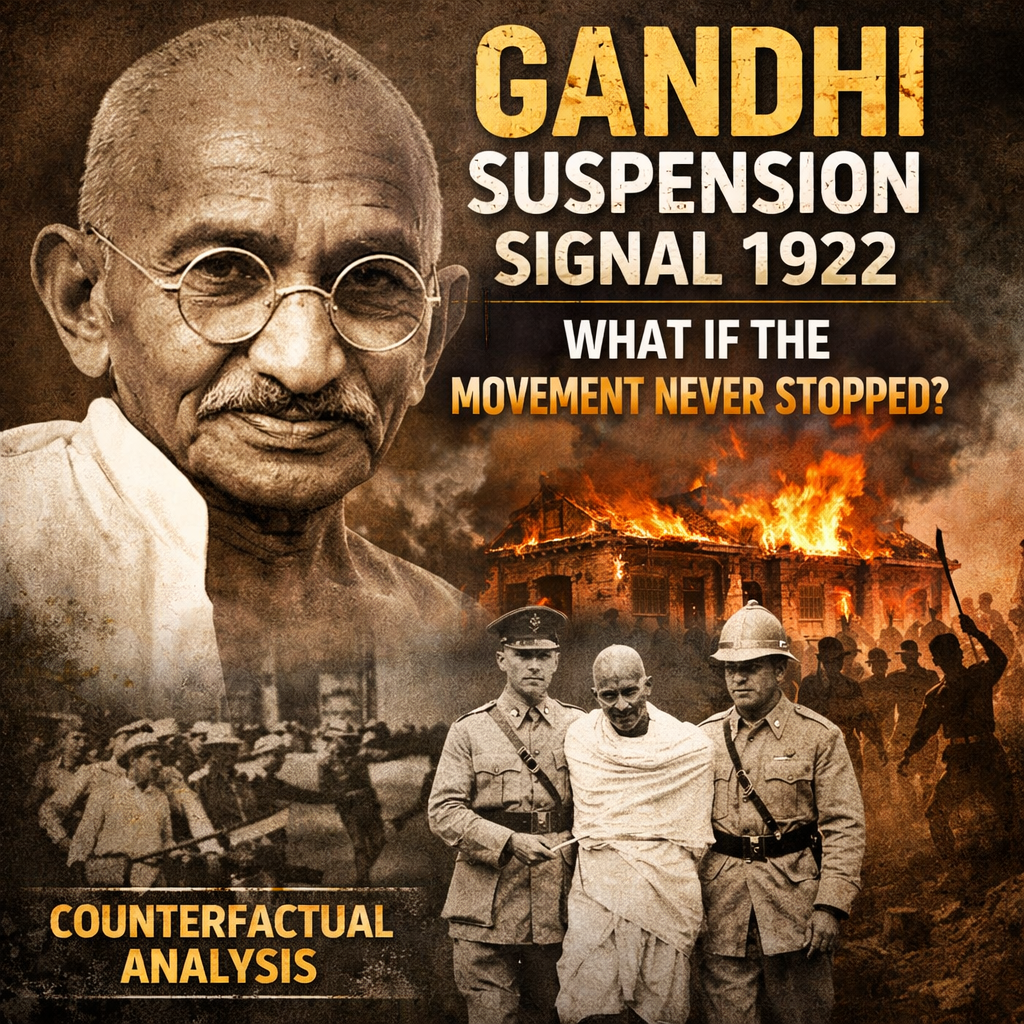
Feature Image: Click here to view the image.
Videos
Glossary of Terms
Scan Through The Entire Series
Gandhi’s Peace Efforts: The Questions Before the Mahatma (0)
Read The Prosecution Exhibits Through Links