
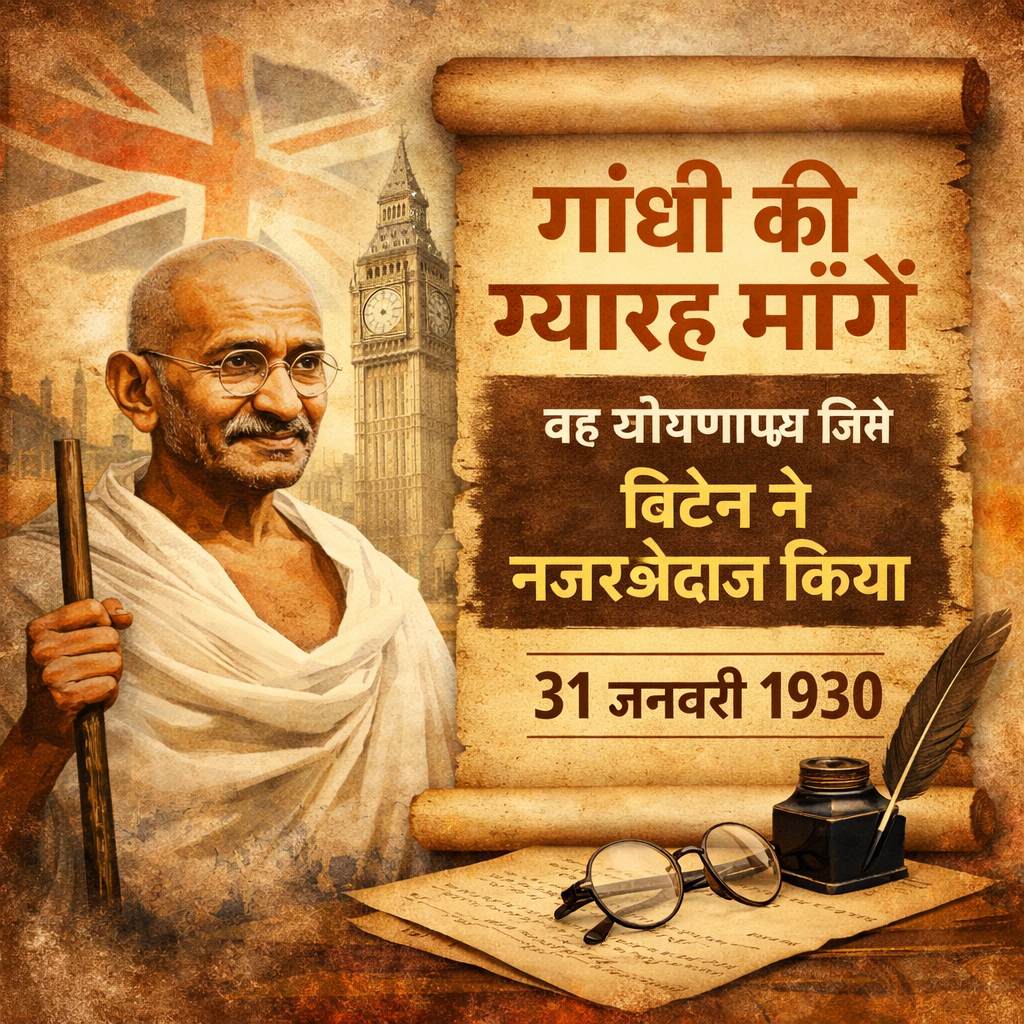
Gandhi’s Eleven Demands: The Charter Britain Ignored (11)
भारत / GB
Part 11: Mahatma Gandhi’s Peace Efforts | Series Index
Ten posts have established the method, the mass, the chemical bomb, the ledger of four acts. Before the series examines what the movement was traded for, it pauses at the document that defined the trade — the Gandhi’s Eleven Demands presented on January 31, 1930, and which Irwin chose to ignore.
Thank you for reading this post, don't forget to subscribe!The Action Taken: Gandhi formulated an 11-point national ultimatum integrating industrial protection and currency demands alongside peasant tax relief, presenting it as the nation’s baseline.
Who Paid the Price: The broader national movement, whose core mandate of complete independence (the 1929 Lahore Purna Swaraj resolution) was subordinated to a specific 11-point checklist.
The Alternative Bypassed: Adherence to the unqualified Purna Swaraj mandate as the sole basis of engagement.
Why This Matters: Established the documented standard against which the subsequent bilateral pact must be audited: an explicit baseline presented before the march began.
The Letter Before the March
Gandhi’s Eleven Demands were not an afterthought. They were a precisely constructed document — a national charter written ten days before the Salt March began, delivered to Viceroy Lord Irwin through a personal emissary, and ignored.
The deadline Gandhi set was March 11, 1930. If the Viceroy did not respond, civil disobedience would begin the following day. Irwin sent a polite acknowledgement and nothing else. The march began on March 12.
What Irwin ignored — and what 60,000 Indians went to jail for — deserves to be read carefully. Gandhi’s Eleven Demands were not a list of grievances. They were a structured manifesto, covering three distinct constituencies simultaneously: the general public, the merchant and commercial class, and the peasant. Every layer of Indian society had something on the table. That was the design.
The Eleven Demands — Decoded
Six Demands of General Interest
1. Total prohibition of intoxicants and alcohol. The liquor and drug revenue was colonial India’s second largest excise source — and it was extracted almost entirely from the poor. Gandhi had long argued that the British deliberately maintained the liquor trade because it sapped the foundations of health and morals among those least able to resist it. Prohibition would have wiped a significant revenue line from the colonial budget.
2. Reduction of military expenditure by at least 50%. India was paying for its own occupation. The Indian budget financed a military establishment calibrated to British imperial needs — not Indian defence. A 50% reduction would have returned crores to Indian civil expenditure.
3. Reduction of civil service salaries by at least 50%. Gandhi’s letter to Irwin had made this viscerally specific — the Viceroy was earning over Rs. 700 per day against India’s average income of less than two annas. The civil administration was the most expensive in the world, financed by the people it was administering against.
4. Abolition of the Criminal Investigation Department (CID) or its subjection to popular control. The CID was the surveillance arm of colonial governance — monitoring nationalists, infiltrating organisations, and maintaining a file system on anyone who dissented. Its abolition or popular accountability would have dismantled the intelligence architecture of repression.
5. Changes in the Arms Act — licences for self-protection. The 1878 Arms Act had disarmed India. An Indian could not own a firearm without a licence that the colonial state had every incentive to deny. Gandhi described this as a spiritual degradation — a people rendered cowardly helpless by deliberate disarmament.
6. Release of all political prisoners not convicted of murder. Thousands of Indians were in colonial jails for political activity. Their release was not an amnesty request — it was a statement that political dissent was not a criminal act.

Three Commercial and Bourgeois Demands
7. Change the rupee-sterling exchange rate to 1s 4d. The exchange ratio had been manipulated to drain India of revenue. Every remittance to Britain, every government transaction, every import payment was conducted at a rate that systematically transferred wealth from India to Britain. Changing it was a structural economic demand — not a symbolic one.
8. Impose a protective tariff on foreign cloth. Indian weavers and textile workers had been systematically destroyed by British mill goods imported without tariff. A protective tariff would have revived the Indian textile industry and ended the economic logic of khadi as the only alternative available to the Indian poor.
9. Reserve coastal shipping for Indian vessels. The coastal trade of India was dominated by British shipping companies. Indian goods moved between Indian ports on British ships at British rates. Reservation for Indian vessels would have transferred a significant commercial revenue stream to Indian enterprise.
Two Peasant Demands
10. Reduce land revenue by 50% and subject it to legislative control. Land revenue was the heaviest burden on the Indian peasant — collected regardless of crop failure, drought, or market price. A 50% reduction combined with legislative oversight would have transformed the material conditions of rural India more fundamentally than any other single measure.
11. Abolish the salt tax and the government monopoly on salt manufacture. Gandhi called this the most iniquitous tax the ingenuity of man had devised. The salt tax fell heaviest on the poorest Indian — because the poor ate proportionally more salt than the rich, and because salt as a share of daily expenditure was highest at the bottom of the income ladder. The British salt monopoly meant that every grain of salt an Indian consumed had been taxed by a foreign power.

On Order and Priority
The sequence of these eleven demands was not incidental. They have been presented here in the same order in which Gandhi himself placed them before Viceroy Lord Irwin on January 31, 1930. This ordering reflects not an arbitrary listing, but a structured progression shaped by Gandhi’s own sense of priority.
Read in sequence, the demands move from questions of moral and administrative conduct of the state, through economic and commercial restructuring, and finally to the material burdens borne by the peasant—ending with salt, the most universal of impositions. The arrangement itself is therefore part of the document’s design, and must be read as such.
On Strategic Intent
What these eleven demands were meant to achieve admits of two readings. They can be read as a negotiating charter—an attempt to secure concrete administrative, economic, and political concessions from the colonial state under the authority of Mahatma Gandhi. In this view, each demand represents a substantive claim placed for acceptance.
They can also be read as a calibrated political instrument—constructed with the awareness that refusal was likely, and that such refusal would furnish both justification and momentum for a wider campaign of civil disobedience. In this reading, the demands function not only as ends, but as triggers.
The document itself does not resolve this ambiguity. It places a complete claim before the state, but leaves open whether its primary purpose was settlement or escalation. That distinction—between negotiation and mobilisation—forms a central question for the analysis that follows.
The Architecture of the Charter
Read together, Gandhi’s Eleven Demands were a masterstroke of political construction. By grouping constitutional demands with commercial ones and peasant ones, Gandhi ensured that no Indian — from the Gujarati merchant to the Bihar tenant farmer to the Punjabi political prisoner — lacked a personal stake in the movement. This was not a list of grievances assembled in haste. It was a national manifesto designed so that every layer of Indian society could read their own name in it.
Irwin’s response was silence.
The march began. Sixty thousand went to jail. A year of the most sustained civilian pressure in colonial history followed. The British, by early 1931, were desperate to stop it.
They met Gandhi. They talked for eight days. On March 5, 1931, they signed a pact.
Gandhi’s Eleven Demands were the full measure of what was on the table. The next post opens the pact — and measures it, line by line, against every item on this list.
Eleven demands. A nation’s full accounting placed before an empire. The empire’s response was silence. What came after silence is the subject of the next post.
Feature Image: Click here to view the image.
Videos