

Sharia, Safety and Stark Realities
A Statement That Demands Examination, Not Outrage
When Uttar Pradesh Chief Minister Yogi Adityanath remarked, “A Muslim family is the safe among 100 Hindu families. But can 50 Hindus be safe among 100 Muslim families?” the reaction was swift and predictable—accusations of communalism, headlines of hate, and loud political condemnations. Yet beneath the uproar lies a deeper, uncomfortable truth tied not just to demographics, but to the ideological landscape shaped by Sharia law. His statement was not a blanket indictment of communities—it was a caution rooted in history, scripture, and observable patterns wherever Sharia law has influenced social dynamics.
Thank you for reading this post, don't forget to subscribe!For those familiar with Islamic jurisprudence, particularly the framework of Sharia law, and with the demographic patterns of the subcontinent, the statement deserves more than outrage. It demands investigation. Because in many instances across South Asia and beyond, the answer to Yogi’s rhetorical question is grimly empirical.
This blog does not aim to provoke fear. It aims to decode the religio-legal ecosystem of Sharia law—not merely as theology, but as a lived civilizational structure— and to assess its impact on religious coexistence through contemporary observations, we explore whether the concern voiced by Yogi Adityanath stems from prejudice—or from pattern recognition that society must confront with honesty.
The next blog offers an in-depth analysis of whether Yogi Adityanath’s statement holds up historically.
What is Sharia Law? A System of Supremacy, Not Pluralism
To understand the asymmetry in religious safety across communities, one must begin with Sharia law—not as a cultural abstraction, but as an enforceable system of governance in Islamic thought.
Sharia (literally “the path to water”) is not merely a spiritual code. It is a comprehensive socio-political and legal framework derived from three principal sources:
- The Quran (the holy text of Islam)
- Hadiths (sayings and actions of Prophet Muhammad)
- Ijma and Qiyas (juristic consensus and analogical reasoning by Islamic scholars)
Some scholars, like Asghar Ali Engineer, cite Surah 2:256 (“There is no compulsion in religion”) to promote a pluralistic interpretation of Sharia. However, such views remain marginal, as reflected in the limited Muslim criticism of Hamas compared to the widespread Jewish critiques of Israel—reinforcing Yogi Adityanath’s concerns about Sharia’s rigidity.
Progressive Muslims argue that groups like Muslims for Progressive Values condemn Hamas and support pluralism. However, they represent a minuscule minority compared to the significant numbers who supported or celebrated the Hamas attacks on Jewish civilians on October 7, 2023—further reinforcing longstanding criticisms of Islamic doctrine. Organizations making such conciliatory claims cannot always be taken at face value; it remains unclear whether they are genuine proponents of reform or if their rhetoric is a strategic facade, potentially aligned with the Islamic principle of taqiyya—the practice of concealing true beliefs for self-preservation or strategic advantage.
Sharia is not confined by national borders—it envisions a unified religious order that often supersedes allegiance to any specific nation-state, with loyalty directed first and foremost to the ummah, or global Islamic community.
Together, these sources shape a worldview that divides society into rigid categories based on belief and submission.
Core Features of Sharia Law That Undermine Pluralism
- Binary Division of the World:
Sharia divides humanity into two geopolitical zones—Dar al-Islam (the land ruled by Islam) and Dar al-Harb (the land of war, where Islamic law is not yet established). Peace with non-Muslims is not final; it is temporary until Islam dominates. - Hierarchical Status Based on Religion:
Muslims enjoy full civic and religious rights. Non-Muslims—especially idol worshippers (mushrikeen) like Hindus—are considered spiritually impure, legally inferior, and socially marginal.
Christians and Jews may be tolerated as “People of the Book” under the dhimmi status, but with legal and financial subjugation through Jizya (a humiliating tax that affirms their subordination). - Suppression of Non-Islamic Worship:
Idol worship is strictly forbidden in Islamic law. The building of temples, public rituals, or propagation of non-Islamic faiths is restricted or penalized in Sharia-compliant societies. This explains the absence—or destruction—of temples in Islamic regions. - Punishment for Apostasy and Blasphemy:
Leaving Islam (apostasy) is punishable by death in classical Sharia. Criticizing Islam or the Prophet is often met with harsh penalties, from imprisonment to execution. Such legal intimidation creates a chilling effect on dialogue and peaceful dissent. - Legal Double Standards:
Testimony of a non-Muslim may be considered invalid in Sharia courts. In matters of marriage, custody, and inheritance, non-Muslims are given fewer rights. Interfaith harmony is discouraged by explicit verses like Surah 5:51, which forbids taking Jews and Christians as friends or allies—let alone Hindus.
Practical Implications in Mixed-Demography Areas
When Muslim populations are small, pluralism often appears intact—not because of doctrinal endorsement, but due to demographic limitations. However, as Sharia-influenced values become dominant in regions with higher Muslim populations, observable shifts in social dynamics begin to emerge:
- Hindu festivals face increasing restrictions or targeted backlash.
- Temple bells fall silent to avoid “offending” dominant sentiments.
- Jizya-like pressure surfaces—not as official tax, but as informal extortion.
- Social intimidation, market boycotts, and migration pressures have been noted in several regions with shifting religious majorities.
Yogi Adityanath’s comment reflects this demographic asymmetry: when Hindus are the majority, others live safely; but when roles reverse, safety becomes uncertain.
This isn’t hate speech—it is historic and contemporary pattern recognition.
Events in Kairana and Mewat in recent years—and Sambhal in the 1980s—serve as clear illustrations of the underlying pattern this analysis seeks to highlight.
Beyond Bharat: The Western Mirror
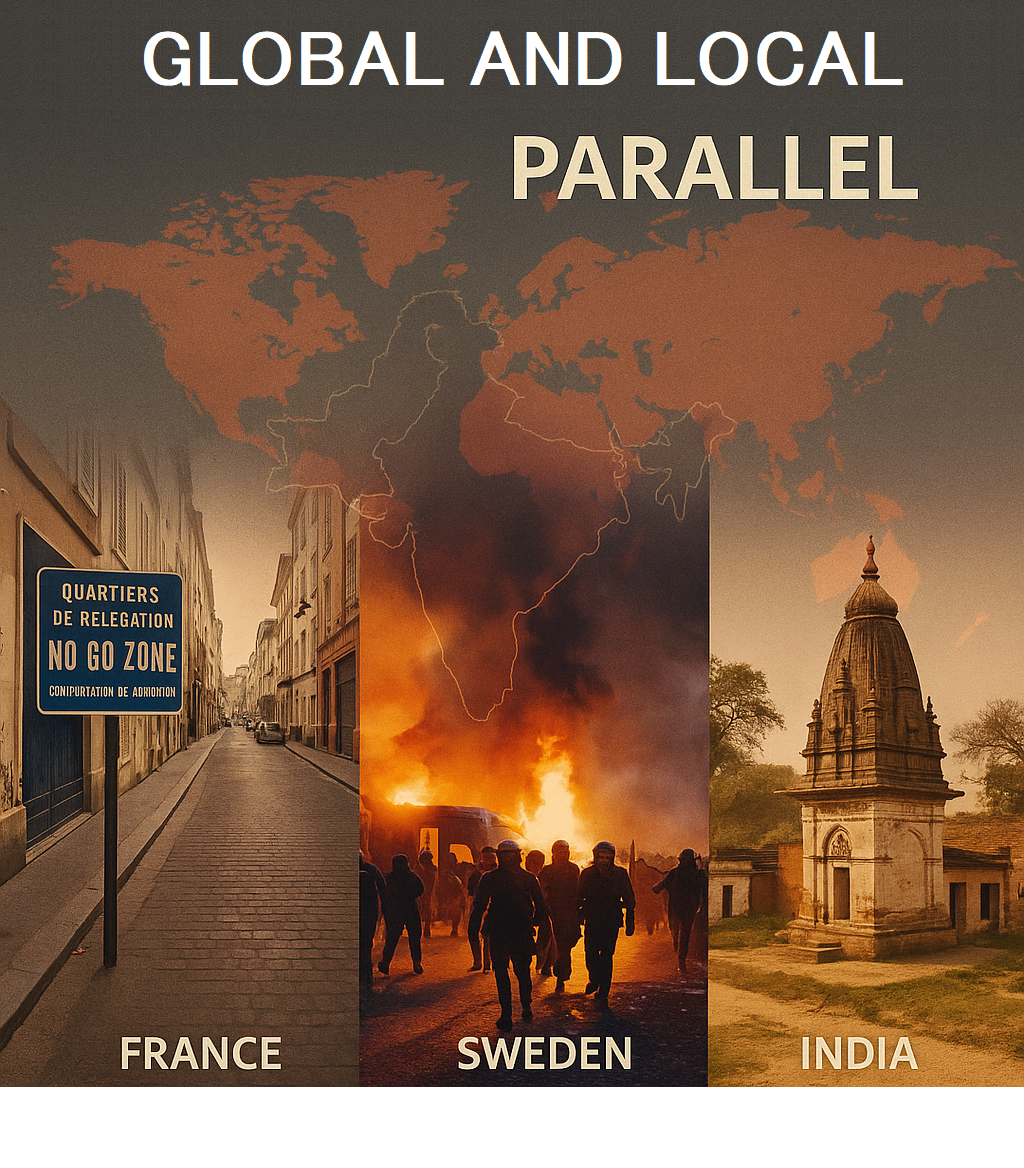
While this discussion centers on Bharat, similar—and in some cases, more pronounced—patterns exist across Western democracies. In countries like France, Sweden, Belgium, and the UK, localized Sharia-aligned norms have shaped parallel societies, leading to cultural ghettos, legal tensions, and incidents of religious intimidation.
In France, areas such as Seine-Saint-Denis (Paris suburbs) have seen growing Islamist influence, where calls to prayer replace school bells, and hostility to secular values is evident. The Charlie Hebdo attacks and repeated violence over cartoons underscore the challenge of upholding free expression.
In Sweden, Rinkeby and Rosengård are now internationally known as no-go zones due to police withdrawal, rising Islamic radicalism, and violent crime linked to ideological networks.
In the UK, neighborhoods like Tower Hamlets (London) and Sparkbrook (Birmingham) have witnessed Sharia courts issuing rulings outside British law, and grooming gang scandals in Rotherham exposed deep-rooted communal intimidation and political hesitancy.
In Canada, areas of Mississauga and Scarborough (Greater Toronto Area) have seen increasing segregation in schools, gender-separated public events, and pressure on moderate Muslims from local imams.
In the U.S., cities like Dearborn (Michigan) and parts of Minneapolis (Minnesota) have drawn attention for promoting halal zoning, prayer calls in public institutions, and resistance to cultural integration.
Even in Australia and New Zealand, suburbs like Lakemba (Sydney) and Mount Roskill (Auckland) have faced controversy over Islamic dress codes, religious policing, and mosque-linked ideological radicalization.
These aren’t isolated occurrences—they reflect a global pattern where demographic change combined with doctrinal rigidity creates friction with liberal democratic norms. The experience of these Western societies echoes the very concern raised in the Bharat’s context: that pluralism is not always preserved when ideological supremacy becomes dominant.
Case Study: Kerala and the Illusion of Harmony
Some narratives portray Muslim-majority regions like Malappuram, Kerala, as examples of interfaith harmony. However, incidents like the 2016 case involving four Kerala women—three Christians and one Hindu—who were converted and later joined ISIS in Afghanistan, point toward deeper issues of radicalization. These are not isolated anomalies but suggest the presence of ideological currents beneath the surface.
Critics argue that ‘love jihad’ is a politicized concept aimed at vilifying Muslims, citing a 2018 NIA investigation that found no evidence of an organized conspiracy in Kerala. However, recurring reports of religious conversion tied to extremist influences—and high-profile cases such as Shraddha Walkar’s murder—suggest that such concerns cannot be entirely dismissed. These developments reflect a regional socio-religious tension, distinct from isolated criminal behavior and warranting closer scrutiny of ideological undercurrent.
Scriptural Basis: Why Sharia Law Undermines Mutual Security
The challenge posed by Sharia law is not born from personal bias or prejudice—it stems directly from the scriptural foundation of Islam. The Quran is not merely a spiritual guide; under Sharia, it is a source of codified legal authority. Its verses are interpreted as prescriptive commands, especially when they pertain to the treatment of non-Muslims.
Unlike the Hindu tradition, where scriptures are often allegorical or context-specific, Quranic verses carry permanent legislative weight in Islamic jurisprudence (fiqh). These are not fringe interpretations—they are mainstream rulings across the Hanafi, Hanbali, Shafi’i, and Maliki schools of Sunni Islam, which collectively govern over 90% of the global Muslim population.
Below is a non-exhaustive table of core verses that form the basis of exclusionary, and at times militant, legal frameworks:
| Surah | Verse | Directive Under Sharia |
| 2:98 | “Indeed, Allah is an enemy to the disbelievers.” | Divinely sanctioned enmity towards non-Muslims. |
| 3:28 | “Let not the believers take the disbelievers as allies…” | Forbids friendship and political alliance with non-Muslims. |
| 3:85 | “Whoever seeks a religion other than Islam—it will never be accepted of him.” | Declares other religions invalid, erasing spiritual coexistence. |
| 8:12 | “Strike upon the necks of those who disbelieve…” | Justifies violent action against non-believers. |
| 9:5 | “Then kill the polytheists wherever you find them…” | Known as the ‘Sword Verse’, it overrides earlier peaceful verses (abrogation principle). |
| 9:29 | “Fight those who do not believe… until they pay the jizya…” | Institutionalizes economic subjugation of non-Muslims. |
| 9:123 | “Fight those disbelievers who are near you…” | Calls for regional cleansing of non-Islamic beliefs. |
| 33:61 | “Cursed they are… wherever found, they shall be seized and massacred.” | Lays theological ground for collective violence against idolaters. |
Legal Relevance in Sharia:
These verses aren’t interpreted in isolation. In Sharia law, they are supported by Sahih Hadiths and expanded into enforceable rulings through classical commentaries (Tafsir). Scholars like Ibn Kathir, Al-Tabari, and Al-Qurtubi treat these verses as directives, not poetic metaphor.
They govern real-world rules on:
- The invalidity of non-Muslim testimony in Islamic courts
- Prohibition on temple construction in Islamic regions
- Severe restrictions on non-Muslim inheritance and custody rights
- Obligatory warfare (jihad) against non-believers in certain contexts
Even in secular constitutional frameworks like Bharat, these principles can exert significant informal pressure. In towns where Sharia-aligned values influence local Muslim-majority neighborhoods, informal enforcement replaces legal mandate: loudspeakers announce moral policing, community elders dissuade interfaith interaction, local shops avoid selling items deemed “un-Islamic,” and social shunning targets those who celebrate non-Islamic festivals. Though not legally binding, such pressures function as de facto Sharia—shaping behavior through custom, intimidation, and the fear of communal retaliation.
Taqiya: Peaceful Coexistence or Strategic Silence?
In areas where Muslims form a numerical minority, one may observe gestures of tolerance and public coexistence. But does this reflect genuine pluralism—or is it a tactical necessity backed by Islamic jurisprudence?
Enter Taqiya, a principle sanctioned primarily in Shi’a theology but historically practiced across sects. It is often misunderstood as “deception”; in fact, it is strategic concealment—permitted when a Muslim feels endangered or when speaking the truth would harm the cause of Islam.
Scriptural Anchor: Surah 3:28
“Let not the believers take the disbelievers as allies instead of the believers, and whoever does that has nothing to do with Allah—except when taking precautions against them in prudence.”
This exception clause (“except in prudence”) forms the doctrinal foundation for the principle of Taqiya, which permits Muslims to conceal their beliefs or intentions when under threat or in a weak position. Scholars across schools of Islamic jurisprudence have interpreted this to mean that friendliness toward non-Muslims can be strategic—not ideological.
Implications of Taqiya in Society:
Taqiya is not merely about concealing belief—it is a jurisprudential strategy to manage relations with non-Muslims when Islam is not dominant. It provides the theological basis for public moderation during minority status, while reserving full ideological expression for majority scenarios. Rather than repeat demographic dynamics already discussed, what Taqiya explains is the internal justification for such tactical behavior. It is not a response to external threats, but a doctrine enabling selective openness, designed to safeguard Islam’s long-term primacy even in pluralistic societies.
Taqiya is not merely a historical curiosity; it provides theological cover for gradual socio-religious inversion. What seems like peaceful coexistence at first can become asymmetric assertion as Sharia-oriented values gain dominance.
Critics Responded with Labels, Not Counter-Evidence
Following Yogi Adityanath’s remark, the media erupted with outrage. Words like “communal,” “divisive,” and “fear-mongering” were liberally deployed by political opponents and liberal commentators.
But amidst all the emotional condemnation, not one factual rebuttal was offered. Let us examine the inconvenient questions critics failed to address:
- Why did Pakistan’s 15% Hindu population in 1947 shrink to under 2% today?
- Why did 400,000 Kashmiri Pandits flee their homeland in the 1990s practically overnight?
- Why does the concept of Jizya—a tax on non-Muslims—still get echoed in Islamist speeches in Bharat?
- Why did the Noakhali riots of 1946, marked by mass violence and forced conversions, take place just one year before Partition?
- Why are Hindus in post-Hasina Bangladesh facing open threats and attacks—despite having fed, sheltered, and stood by their neighbors during times of war and famine?
Instead of engaging with these uncomfortable realities, the discourse was reduced to attacking the messenger.
This is not simply political cowardice—it is an intentional denial of ideological asymmetry. The dominant secular narrative in Bharat refuses to accept that Sharia law-based societies often do not operate on the principles of equal coexistence. When applied in spirit or in social expectation—even without formal state enforcement—Sharia creates a framework where non-Muslims are, by design, lesser.
This Isn’t Islamophobia. It’s Pattern Recognition.
These interpretations originate in the Hanafi, Hanbali, Shafi’i, and Maliki schools of Sunni Islam, which govern over 90% of the global Muslim population. Yet, it must be noted that alternative expressions—such as Sufism, Ahmadiyya theology, and liberal Islamic jurisprudence—do exist and advocate for greater interfaith engagement and coexistence. While not dominant, these interpretations represent a class within Islam committed to pluralism, and their limited influence is itself a reflection of the challenges reformist voices face in Sharia-dominant environments.
Yogi Adityanath’s statement echoes:
- Documented demographic collapses of Hindu communities in Islamic societies
- Theological instructions under Sharia law that discourage equal treatment of non-believers
- Lived experiences in parts of Bharat where religious balance has tipped and Hindus are now the vulnerable minority
This isn’t hate. It’s historical pattern recognition grounded in theology and data. But mere recognition is not enough.
If Bharat is to remain a pluralistic democracy, it must:
- Demand accountability from all religious ideologies—not just majority ones.
- Reinforce constitutional supremacy over informal theocratic pressures.
- Promote intra-religious reform that aligns faith with human dignity.
Silencing conversations about Sharia’s real-world effects is not tolerance—it is denial. True peace will come not through avoidance, but through a willingness to engage even the most uncomfortable doctrines with intellectual honesty. Sharia law cannot be treated as sacred ground exempt from debate.
Let us stop cloaking silence as tolerance. True peace comes from truth—even when that truth challenges our comfort zones.
Feature Image: Click here to view the image.
Glossary of Terms
- Sharia Law: An Islamic legal system derived from the Quran, Hadith, and juristic interpretations. It governs religious, civil, criminal, and social behavior within Islamic contexts.
- Dar al-Islam: Literally “the house of Islam”; refers to regions where Islamic law is in force and Muslims are in the majority.
- Dar al-Harb: Literally “the house of war”; refers to territories not under Islamic rule, often considered areas to be brought under Islam.
- Dhimmi: A non-Muslim (typically Jew or Christian) living under Muslim rule with protected but inferior legal status, often required to pay a tax called Jizya.
- Jizya: A per capita tax historically levied on non-Muslims in Islamic states as a condition for their protection and limited rights.
- Mushrikeen: A Qur’anic term referring to polytheists or idol worshippers; often applied to Hindus in classical Islamic jurisprudence.
- Taqiya: A concept in Islamic jurisprudence that permits a Muslim to conceal their faith or intentions when facing persecution or in a position of weakness.
- Ijma: Consensus of Islamic scholars on legal and religious matters; one of the sources of Islamic law.
- Qiyas: Analogical reasoning used by Islamic jurists to derive legal rulings in situations not explicitly addressed in the Quran or Hadith.
- Surah: A chapter of the Quran. The Quran is divided into 114 surahs, each containing multiple verses (ayahs).
- Hadith: Recorded sayings, actions, and approvals of Prophet Muhammad; a foundational source of Islamic law and theology alongside the Quran.
- Malappuram: A district in the state of Kerala, often cited in discussions about religious demographics and social integration.
- Kairana: A town in Uttar Pradesh, Bharat, referenced in debates around religious migration and communal demographic shifts.
- Rinkeby: A suburb in Stockholm, Sweden, known for its high immigrant population and often cited in debates about radicalization and no-go zones.
- Rosengård: A neighborhood in Malmö, Sweden, associated with social segregation and Islamist influence in public discourse.
- Tower Hamlets: A borough in East London with a significant Muslim population, often mentioned in discussions on multiculturalism and Sharia councils.
- Sparkbrook: A neighborhood in Birmingham, UK, referenced in public debates about religious segregation and parallel legal systems.
- Mississauga: A city in Ontario, Canada, with large immigrant communities; sometimes mentioned in cultural integration debates.
- Dearborn: A city in Michigan, USA, with one of the highest percentages of Arab-American residents, often referenced in U.S. discussions about Sharia law influence.
- Lakemba: A suburb of Sydney, Australia, noted for its large Muslim community and references in public discourse around religious conservatism.
- Mount Roskill: A suburb of Auckland, New Zealand, with significant immigrant and Muslim populations, sometimes discussed in integration policy circles.
- Muslims for Progressive Values: A global organization that advocates for inclusive and reformist interpretations of Islam, including gender equality and religious freedom.
- Asghar Ali Engineer: An Bharat’s Islamic scholar and social reformer known for advocating progressive interpretations of Islam and interfaith harmony.
- Surah 2:256: A Quranic verse often cited in discussions of religious freedom: “There is no compulsion in religion…”
- Shraddha Walkar Case: A high-profile 2022 murder case in Bharat involving interfaith relationship dynamics, often cited in debates around ‘love jihad’.
#ShariaLaw #ReligiousFreedom #DemographicShift #CivilizationalDebate #HinduinfoPedia
Read more on related topic
Waqf Act in India: A Historical Journey and Global Perspective
Next Related Blog
References
Pew Research Center – The Future of World Religions: Population Growth Projections
European Parliament Research Service – Sharia Law and European Law: Clash or Compatibility?
Comments are closed.