
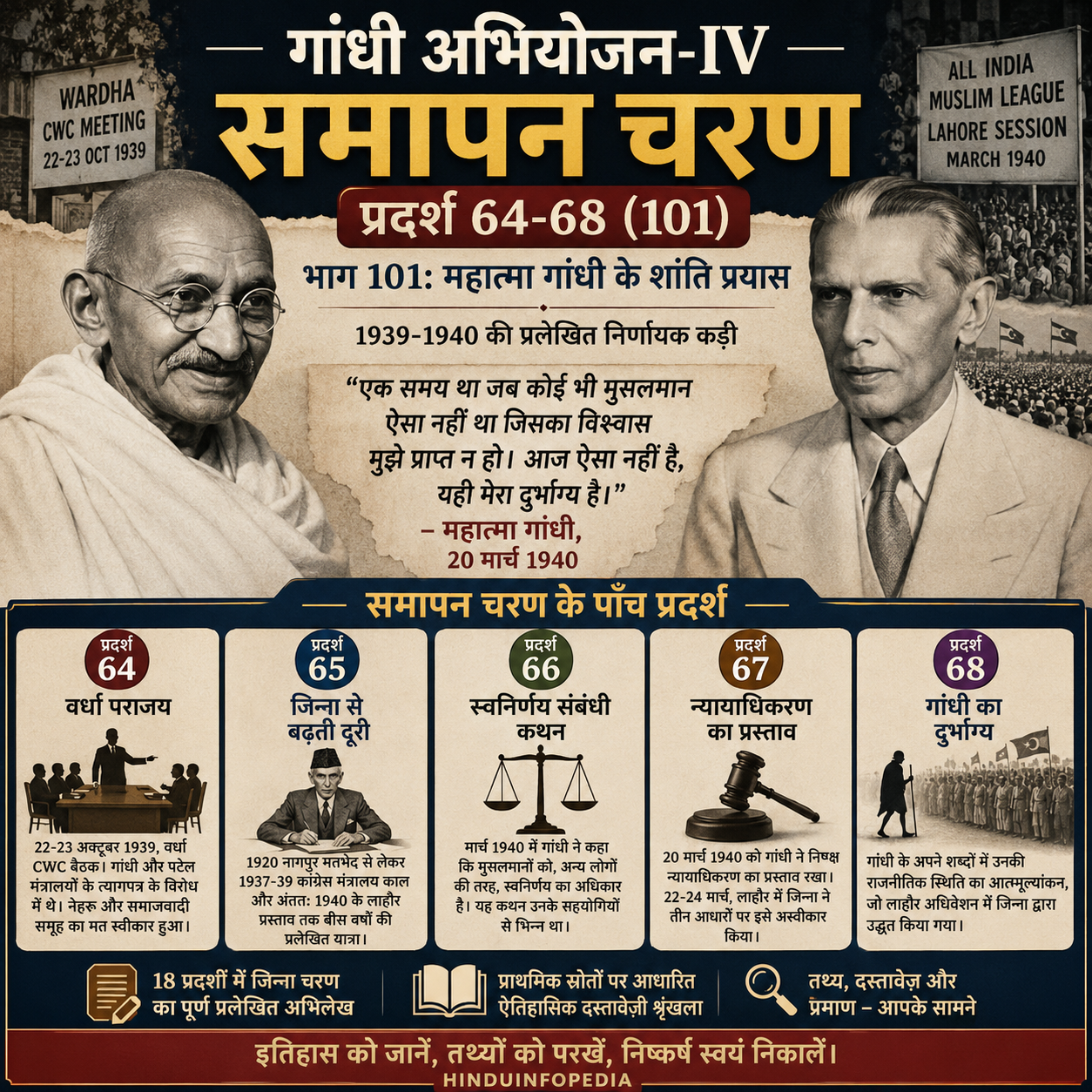
Gandhi’s Prosecution-V: The Closing Arc — Exhibits 64-68 (101)
भारत / GB
Part 101: Mahatma Gandhi’s Peace Efforts | Series Index | Exhibits Master Table
Blog 100 compiled the Congress Ministry Arc — Exhibits 56-63, the documented 1937-1939 sequence. This post compiles the Closing Arc — five exhibits across Blogs 94-98 — the documented 1939-1940 sequence ending with Gandhi’s own self-assessment on March 20, 1940. Structured for direct compatibility with the Gandhi Prosecution Exhibits Master Table.
Thank you for reading this post, don't forget to subscribe!The Action Taken: The prosecution compiled the comparative balance sheet of eighteen years of engagement with Jinnah: from shouting down a secular legalist in 1920 to conducting bilateral talks with the Quaid-i-Azam in 1944.
Who Paid the Price: The unity of India, which was negotiated away as the price of failing to institutionalize minority safeguards early.
The Alternative Bypassed: Holding a consistent constitutional policy rather than alternating between exclusion and bilateral appeasement.
Why This Matters: Audits the final harvest of two decades of policy: Jinnah began in 1920 as an ambassador of unity pleading against religious politics, and ended in 1944 holding an effective veto over Indian independence.
Closing Arc — Exhibits 64-68
| Exhibit | Blog No. | Exhibit Name / Key Details | Blog Link / Status |
|---|---|---|---|
| CLOSING ARC | Exhibits 64-68 | Blogs 94-98 | 1939-1940 | |||
| Ex 64 | 94 | The Wardha Defeat — October 22-23 1939 CWC meeting at Wardha. Gandhi and Patel opposed ministry resignations. Nehru, leading the push within the Working Committee, and the Congress socialist bloc prevailed. Documented as a genuine factional vote Gandhi lost — not a unilateral Gandhi decision. Documented outcome: the Viceroy pleased, Jinnah pleased, the League strengthened — the precise outcome Gandhi had warned against. A documented exception within the series: the one instance where the Working Committee’s vote prevailed against Gandhi’s position. | Blog 94 |
| Ex 65 | 95 | Divergence With Jinnah — The documented twenty-year arc: 1920 Nagpur objection to Khilafat alliance and resignation from Congress. 1928-1929 constitutional track: fourteen points, four amendments, four rejections, parting of ways. 1930-1934: Jinnah in England, League dormant. 1935: return. 1937-1939: Congress ministry period — coalition terms, Mass Contact, broken assurance. 1940: Lahore. The full documented sequence placed before the reader as one arc. | Blog 95 |
| Ex 66 | 96 | The Self-Determination Statement — Gandhi’s documented reaction to the Lahore Resolution, March 1940: called it “baffling,” but told his disciples that Muslims, in common with other people of India, had the right to self-determination. Placed against the documented Congress conduct of 1937-1939: coalition terms requiring League dissolution, Mass Contact Programme, broken coalition assurance. Gandhi’s words conceded a principle; the organisation he led had spent three years acting against the body built to exercise it. Nehru: “fantastic proposals.” Rajagopalachari: “diseased mentality.” Gandhi’s register measurably different from his own colleagues. | Blog 96 |
| Ex 67 | 97 | The Tribunal Offer — March 20 1940: Gandhi proposed an impartial tribunal of the highest character to decide minority disputes if minorities were not satisfied by the Constituent Assembly process. March 22-24 1940, Lahore: Jinnah’s presidential address quoted Gandhi’s offer by date and rejected it with three documented objections — who appoints the tribunal, who enforces the award, “Can we trust them any more?” Primary source: Jinnah’s full Lahore address at franpritchett.com. A tight three-day documented exchange. | Blog 97 |
| Ex 68 | 98 | Gandhi’s Misfortune — Gandhi’s own March 20 1940 words, quoted verbatim by Jinnah at Lahore: “There was a time when I could say that there was no Muslim whose confidence I did not enjoy. It is my misfortune that it is not so today.” Placed against the documented Jinnah profile: primarily a barrister, part-time in politics and religious identity, went to England 1930, League dormant 1930-34, returned 1935 at age 58 with no mass organisation. By 1940: mobilised Muslim premiers of Punjab, Bengal, Sindh, and Assam behind Lahore Resolution; 100,000 at Minto Park. Gandhi’s own self-assessment closes the twenty-year arc. Primary source: franpritchett.com. | Blog 98 |
What the Closing Arc Established
Gandhi’s Prosecution places five documented exhibits before the reader across Blogs 94-98 — its third and final compilation of the Jinnah arc. Gandhi’s Prosecution closes the arc on Gandhi’s own words. The arc established the documented 1939-1940 closing sequence: the one factional vote Gandhi lost (Wardha), the twenty-year documented divergence placed in full sequence, Gandhi’s self-determination concession set against his organisation’s documented conduct, a specific tribunal offer and its specific documented rejection, and Gandhi’s own words on March 20 1940 naming the outcome as his misfortune.
Gandhi’s Prosecution’s primary source for Exhibits 67 and 68: Jinnah’s own Lahore presidential address at franpritchett.com — quoting Gandhi’s March 20 statement verbatim and responding to it by date and by name.
The Jinnah Arc — Complete Record
The three Gandhi’s Prosecution compilation blogs — Exhibits 51-55 (Blog 99), Exhibits 56-63 (Blog 100), Exhibits 64-68 (Blog 101) — together place the full Jinnah arc before the reader. Eighteen exhibits. Blogs 81-98. The documented record runs from Jinnah’s 1920 objection at Nagpur to Gandhi’s own self-assessment on March 20 1940. Gandhi’s Prosecution places the complete record before the reader. The reader will examine the eighteen-exhibit documented sequence and complete the sentence.
1920: objection and resignation. 1928: parting of the ways. 1929: four amendments, four rejections. 1935: return with nothing. 1937-1939: eight provinces, dissolution terms, Mass Contact, broken assurance, Pirpur, Day of Deliverance. March 20 1940: “it is my misfortune.” March 22-24 1940: Lahore, 100,000, two nations. Eighteen documented exhibits. The prosecution places the complete Jinnah arc before the reader. The reader will complete the sentence.
Feature Image: Click here to view the image.
Videos
Glossary of Terms
- Closing Arc: The final compilation of the Gandhi’s Prosecution series covering Exhibits Sixty-Four to Sixty-Eight, documenting events from Nineteen Thirty-Nine to Nineteen Forty.
- Gandhi’s Prosecution: A documented historical blog series that examines Mahatma Gandhi’s political decisions through primary sources arranged as numbered exhibits.
- Exhibits: Individually documented historical episodes presented as evidence within the Gandhi’s Prosecution series.
- Wardha Meeting: The Congress Working Committee meeting held on Twenty-Second and Twenty-Third October Nineteen Thirty-Nine, where Gandhi’s position on Congress ministry resignations was defeated.
- Congress Working Committee (CWC): The highest executive decision-making body of the Indian National Congress responsible for major political decisions.
- Congress Ministry Period: The period from Nineteen Thirty-Seven to Nineteen Thirty-Nine when the Indian National Congress governed several provinces under the Government of India Act Nineteen Thirty-Five.
- Mass Contact Programme: A Congress campaign intended to build direct political support among Muslims during the Congress ministry period.
- Self-Determination Statement: Gandhi’s March Nineteen Forty declaration recognizing that Muslims, like other people of India, possessed the right to self-determination.
- Tribunal Offer: Gandhi’s proposal of Twentieth March Nineteen Forty recommending an impartial tribunal to resolve minority disputes if constitutional arrangements proved unsatisfactory.
- Lahore Resolution: The resolution adopted by the Muslim League during its Lahore session in March Nineteen Forty, advocating separate political arrangements for Muslims in northwestern and eastern India.
- Jinnah Arc: A unique term in this series describing the documented political sequence tracing Muhammad Ali Jinnah’s evolution from the Nagpur disagreement of Nineteen Twenty to the Lahore Resolution of Nineteen Forty.
- Day of Deliverance: The observance announced by Muhammad Ali Jinnah in December Nineteen Thirty-Nine following the resignation of Congress ministries.
- Pirpur Report: A report prepared by the Muslim League alleging discrimination against Muslims during the Congress ministry period.
- Minto Park Session: The Muslim League’s Lahore session held in March Nineteen Forty where the Lahore Resolution was adopted before a massive public gathering.
- Primary Source: Original historical material, including speeches, official documents, letters, or records used as direct documentary evidence.
#Gandhi #Jinnah #Congress #History #India #Pakistan #Lahore #Freedom #Politics #HinduinfoPedia
Gandhi’s Peace Efforts: The Questions Before the Mahatma (0)