
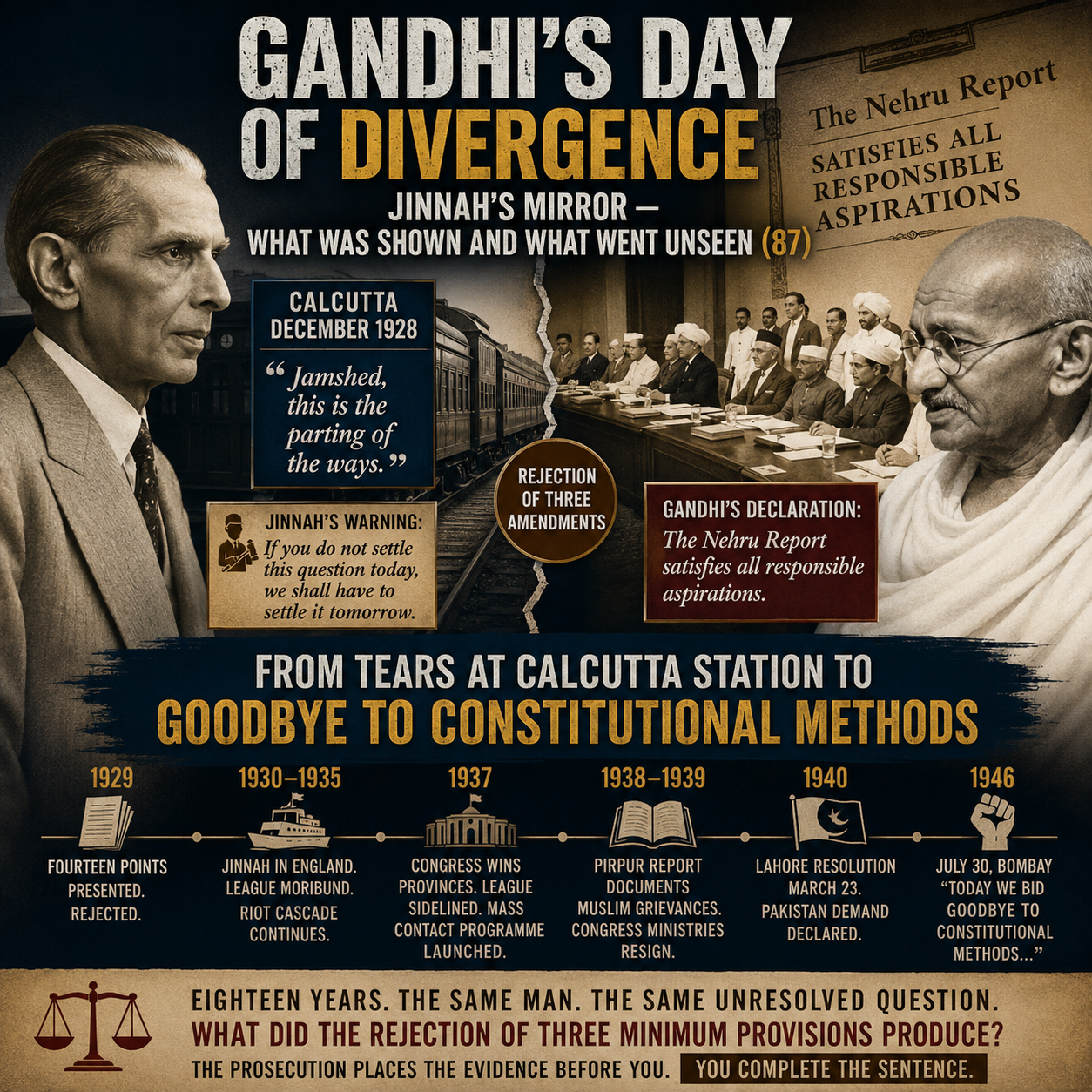
Gandhi’s Day of Divergence: Jinnah’s Mirror — What Was Shown and What Went Unseen (87)
भारत / GB
Part 87: Mahatma Gandhi’s Peace Efforts | Series Index
Blog 85 documented Gandhi’s declaration that the Nehru Report satisfied all responsible aspirations — made after Jinnah’s three amendments were rejected at Calcutta in December 1928. This post examines what Jinnah said as he left Calcutta that morning — and what he said eighteen years later.
Thank you for reading this post, don't forget to subscribe!The Action Taken: Gandhi launched an unconditional fast unto death against separate electorates for the Depressed Classes (Dalits), while explicitly accepting statutory separate electorates for Muslims, Christians, and Sikhs without protest.
Who Paid the Price: Dr. B.R. Ambedkar and the Depressed Classes, who were coerced into surrendering their independent constitutional award under threat of nationwide retaliation.
The Alternative Bypassed: Conceding equal constitutional protection to Dalits while organizing social reform to eradicate untouchability without coercion.
Why This Matters: The ultimate demonstration of the asymmetric moral veto: the weapon of the fast was unleashed against the most vulnerable indigenous community to strip away their legal safeguards.
The Morning of December 1928 — Documented
The All Parties Conference at Calcutta had concluded. Jinnah’s three amendments had been put to a formal vote and rejected. Gandhi had declared the Nehru Report as satisfying all responsible aspirations.
The next morning, Jinnah left Calcutta by train. His friend Jamshed Nusserwanjee Mehta (often referred to in historical texts as Jamshed Nusserwanjee) came to see him off at the railway station. The documented account — recorded by Jamshed and cited in multiple historical sources — describes what followed.
Jinnah was standing at the door of his first-class compartment. He took Jamshed’s hand. He had tears in his eyes.
He said: “Jamshed, this is the parting of the ways.”
Gandhi’s Day of Divergence places this documented moment before the reader. The man Sarojini Naidu had called the Ambassador of Hindu-Muslim Unity — the man who had built the Lucknow Pact of 1916, who had opposed the Simon Commission alongside Congress, who had reduced his demands to three minimum provisions to find common ground — was weeping at a railway station in Calcutta in December 1928.
What the Mirror Showed — 1928
Gandhi’s Day of Divergence places the precise mirror Jinnah held in 1928 before the reader — directed at Gandhi, at Congress, and at the Hindu Mahasabha simultaneously.
At the same Calcutta session, a Hindu Mahasabha leader had questioned whether Jinnah even represented Muslim opinion. Jinnah’s documented response:
“Do you want Muslim India to go along with you? If you do not settle this question today, we shall have to settle it tomorrow.”
Gandhi’s Day of Divergence places this documented statement alongside what the nine preceding years had produced — the riot cascade documented in Blog 80: 72 communal riots in three years following the Khilafat collapse, 197 deaths in one twelve-month period, 1,598 injured. This works out to to be about 32 times annual riots increase compared to pre- Khilafat Movement consolidation of Muslim community ( Sarvapalli. Gopal). Calcutta 1926. Kohat 1924. Lahore 1927. The consolidated Muslim political identity Gandhi had built was demonstrating daily what it was capable of without constitutional direction.
Jinnah was showing Congress the mirror. He was pointing to the documented consequences of leaving his minimum provisions unsatisfied. The question he asked — if you do not settle this today, we shall settle it tomorrow — was a constitutional warning from the most accommodating Muslim political leader available to Congress.
Gandhi declared the framework that rejected those provisions as satisfying all responsible aspirations.
What Went Unseen — 1928 to 1946
Gandhi’s Day of Divergence documents what followed across eighteen years.
1929 — Jinnah presented the Fourteen Points — fourteen defensive provisions documented in Blog 81. Rejected.
1930-1935 — Jinnah left for England to practise at the Privy Council. The Muslim League was moribund. The consolidated Muslim political mass Gandhi had built through the Khilafat experiment was leaderless — the riot cascade of Blog 80 had been running for nine years without constitutional direction.
1935 — Jinnah returned. The League revived.
1937 — Congress won eight provinces. The League sought coalition participation. Congress offered terms requiring the League’s dissolution — documented in Blog 86. Abul Kalam Azad’s own documented assessment: acceptance would have merged the League into Congress for all practical purposes. The League declined. Congress launched the Mass Contact Programme to bypass the League entirely. Jinnah’s documented response: an attempt to destroy the Muslim League as a political organisation.
1938-1939 — The Pirpur Report documented Muslim grievances under Congress ministry rule.
1939 — Congress ministries resigned. Jinnah called it a Day of Deliverance.
1940 — Lahore Resolution, March 23. Pakistan demand formally declared. The man who had wept at Calcutta station in 1928 asking for three minimum constitutional provisions now formally demanded a separate nation.
1946 — July 30. Muslim League Council at Bombay. Jinnah spoke:
“Today we bid goodbye to constitutional methods. Throughout, the British and the Congress held a pistol in their hand, the one of authority and arms and the other of mass struggle and non-cooperation. Today we have also forged a pistol and are in a position to use it.”
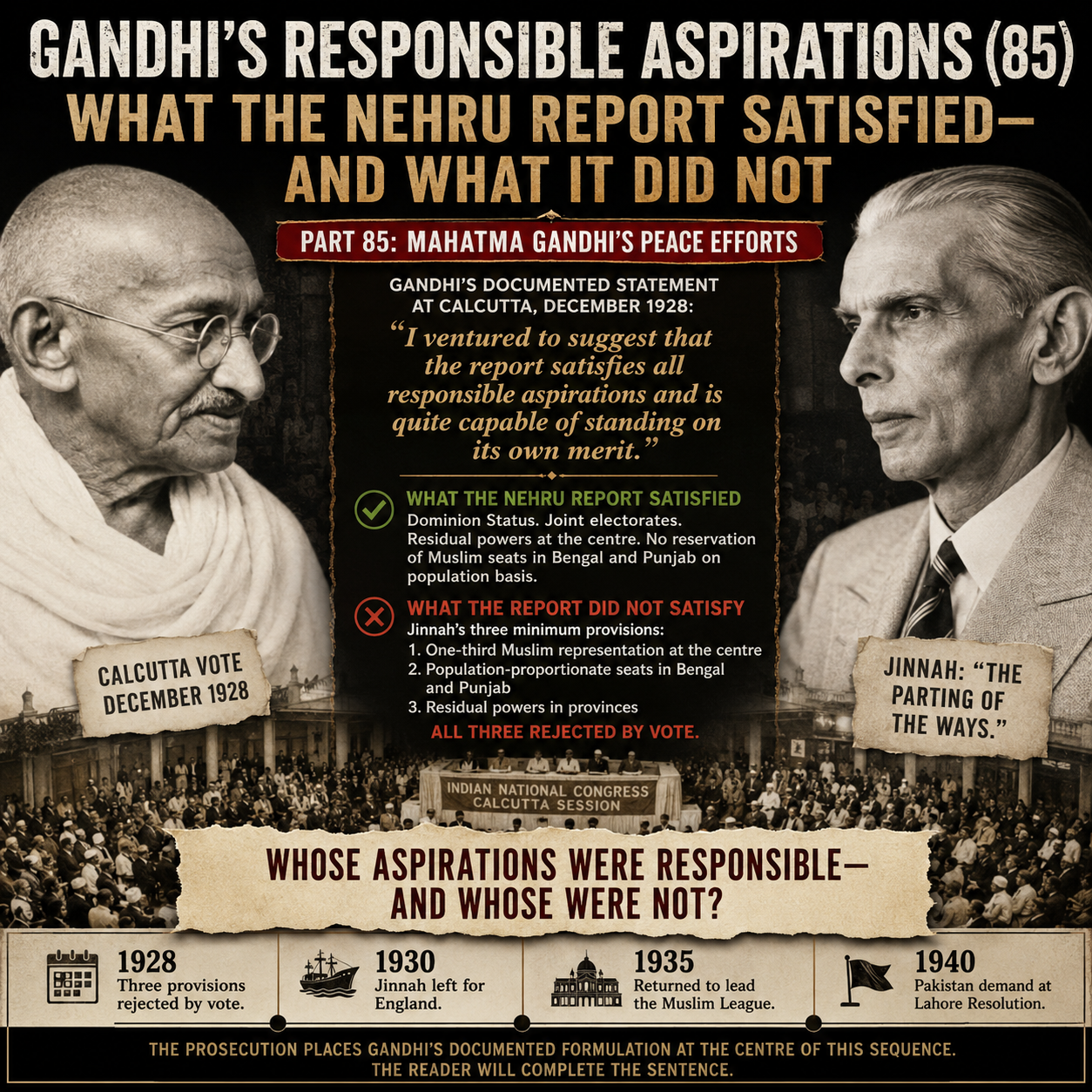
The Prosecution’s Position
Gandhi’s Day of Divergence places three questions before the reader.
- Did Jinnah’s documented 1928 statement — “if you do not settle this question today, we shall have to settle it tomorrow” — constitute a documented constitutional warning placed before Gandhi, the Hindu Mahasabha, and Congress simultaneously?
- Did Gandhi, who held unchallengeable authority over Congress and declared the framework that rejected Jinnah’s provisions as satisfying all responsible aspirations, deploy that documented authority to address the warning?
- Does the documented arc from Jinnah’s tears at Calcutta station in December 1928 to his statement “today we bid goodbye to constitutional methods” in July 1946 — eighteen years, the same man, the same unresolved question — establish something about what the rejection of three minimum provisions produced?
The series does not answer. The two documented Jinnah statements are placed before the reader — 1928 and 1946. Gandhi’s documented declaration that the framework satisfying zero Muslim demands satisfied all responsible aspirations is placed between them. The reader will examine the eighteen-year arc and complete the sentence.
December 1928, Calcutta railway station. Jinnah: Jamshed, this is the parting of the ways. July 30 1946, Bombay. Jinnah: Today we bid goodbye to constitutional methods. We have also forged a pistol and are in a position to use it. Between those two documented statements: Gandhi’s declaration that the Nehru Report satisfied all responsible aspirations. The prosecution places the eighteen-year arc before the reader. The reader will complete the sentence.
Feature Image: Click here to view the image.
Videos
Glossary of Terms
- Gandhi’s Day of Divergence: The key phrase of this blog and a series-coined term describing the moment in December 1928 when Gandhi endorsed the Nehru Report after Jinnah’s amendments were rejected, presented as a turning point in Hindu-Muslim constitutional negotiations.
- All Parties Conference: A series of political meetings held in 1928 to formulate a constitutional framework for India, culminating in debates over the Nehru Report and Jinnah’s amendments.
- Nehru Report: The 1928 constitutional proposal drafted under Motilal Nehru’s leadership, intended as a framework for self-government and central to the constitutional dispute examined throughout this series.
- Jinnah’s Three Amendments: Three constitutional safeguards proposed by Muhammad Ali Jinnah at Calcutta in December 1928, presented in this series as his minimum conditions for Muslim political participation within a united India.
- Parting of the Ways: Jinnah’s documented statement to Jamshed Nusserwanjee Mehta at Calcutta railway station after the rejection of his amendments, symbolizing the breakdown of constitutional consensus.
- Jamshed Nusserwanjee Mehta: A prominent public figure and close associate of Jinnah who recorded the famous railway-station conversation cited in this blog.
- Ambassador of Hindu-Muslim Unity: The title famously used by Sarojini Naidu to describe Jinnah during the period when he advocated constitutional cooperation between Hindus and Muslims.
- Constitutional Warning: A key phrase used in this series to describe Jinnah’s statement that unresolved constitutional disputes would return with greater force if not settled immediately.
- Fourteen Points: Jinnah’s 1929 constitutional programme outlining safeguards for Muslims after the rejection of his Calcutta amendments, discussed extensively in earlier parts of the series.
- Mass Contact Programme: Congress’s 1937 initiative to reach Muslim voters directly, interpreted in this series as an effort to bypass the Muslim League as the principal Muslim political organisation.
- Pirpur Report: A Muslim League-sponsored investigation published in 1938 alleging discrimination against Muslims under Congress provincial ministries.
- Day of Deliverance: The term used by Jinnah after the resignation of Congress ministries in 1939, marking what he described as relief from Congress rule.
- Lahore Resolution: The Muslim League resolution passed on 23 March 1940 that formally advanced the demand for separate Muslim-majority states, later associated with Pakistan.
- Constitutional Methods: Political negotiation, legislative action, elections, and legal processes used to pursue political objectives; the methods Jinnah declared abandoned in his July 1946 speech.
- The Prosecution’s Position: A recurring series phrase presenting historical evidence in a courtroom-style format, inviting readers to examine documented events and draw their own conclusions.
#Gandhi #Jinnah #Congress #Pakistan #Partition #History #India #Freedom #MuslimLeague #NehruReport #Politics #Independence #HinduMuslim #Historical #HinduinfoPedia
Gandhi’s Peace Efforts: The Questions Before the Mahatma (0)