Gandhi’s Pietermaritzburg Test: The Standard He Applied to Himself (61)
भारत / GB
Part 61: Mahatma Gandhi’s Peace Efforts | Series Index
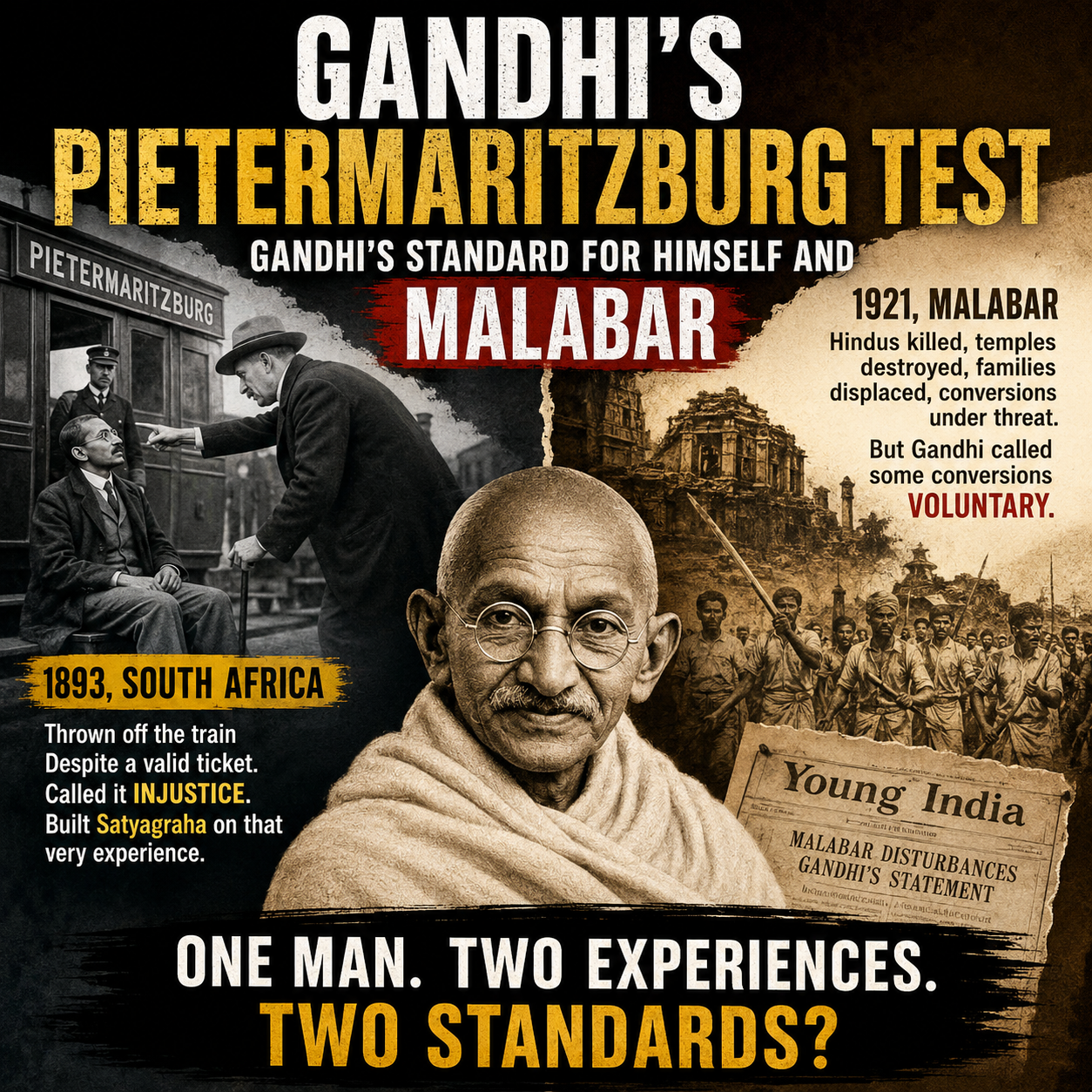
Blog 60 examined Gandhi’s voluntary conversion statement against three external standards — legal, moral, and Islamic jurisprudence. All three contradict his formulation. This post applies a fourth standard — Gandhi’s own documented biographical standard, drawn from the founding moment of his political career. The standard Gandhi applied to force experienced by himself at Gandhi’s Pietermaritzburg Test. The standard he refused to apply to force experienced by Hindus in Malabar.
Thank you for reading this post, don't forget to subscribe!The Action Taken: Gandhi characterized his ejection from a first-class railway carriage at Pietermaritzburg as systemic racial oppression requiring decades of resistance, while framing religious conversion under blade-point in Malabar as an individual spiritual failure.
Who Paid the Price: The victims of forced conversion in Malabar, who were judged by a standard of heroic martyrdom that the leadership did not apply to its own civil rights advocacy.
The Alternative Bypassed: Applying a uniform standard of human dignity that recognizes physical violence and duress as absolute negations of voluntary consent.
Why This Matters: Demonstrates the asymmetric biographical standard: personal indignity under colonial railway codes was treated as intolerable tyranny, while lethal coercion against rural villagers was minimized as an individual moral test.
The Pietermaritzburg Night — June 7, 1893
Gandhi’s Pietermaritzburg Test begins with the documented facts of the founding moment of Gandhi’s political career — as Gandhi himself recorded them.
Gandhi boarded the train at Durban with a first-class ticket. He was travelling to Pretoria on legal business. At Pietermaritzburg station, a white passenger complained about sharing a compartment with a coloured man. A railway official came and told Gandhi to move to the van compartment. Gandhi refused — he held a first-class ticket. A constable came and threw him off the train with his luggage. It was winter. The station waiting room was cold. Gandhi sat through the night.
Gandhi documented what happened in that waiting room in his autobiography: “It was winter, and winter in the higher regions of South Africa is severely cold. My overcoat was in my luggage, but I did not dare to ask for it lest I should be insulted again, so I sat and shivered.”
He considered returning to India. He decided not to. He decided to fight.
Gandhi called that night the most creative experience of his life. He called the force applied to him injustice. He built his entire political method — Satyagraha, the force of truth — from the experience of that one night of being forcibly removed from a train he had a right to be on.
What Gandhi Called That Experience
Gandhi did not call being thrown off the train a voluntary change of compartment.
He called it racial injustice. He called it humiliation. He called it the wound that would not close. He called it the moment he decided that force applied unjustly must be resisted — not accepted, not called voluntary, not reframed as the victim’s choice.
Satyagraha — the entire method Gandhi built — rests on this foundational claim: force applied unjustly to a person does not produce voluntary conduct. It produces injustice. The victim who submits to force under compulsion has not chosen. He has been compelled. The compulsion must be named, resisted, and overcome.
This is the doctrine Gandhi drew from Pietermaritzburg. This is the doctrine on which his entire political career was built. This is the doctrine he claimed as his own founding principle.
The Malabar Contrast — 1921
Gandhi’s Pietermaritzburg Test places the 1921 Malabar conditions alongside the 1893 Pietermaritzburg conditions — and asks the reader to apply Gandhi’s own documented standard to both.
At Pietermaritzburg in 1893: Gandhi was thrown off a train. He was cold. He was humiliated. He was not threatened with death. He was not given the choice of changing his religion or being beheaded. His family was not harmed. His place of worship was not destroyed. He shivered in a waiting room through a cold winter night.
Gandhi called this injustice. He called the force applied to him the founding wound of his career.
In Malabar in 1921: Hindus were presented with the documented choice of conversion or death — Koran or sword. Those who refused were killed. Some were beheaded and thrown into wells. Women were raped. Children were killed. Temples were destroyed. Families who had farmed the same land for generations were driven from their homes.
Gandhi called this a voluntary change of faith.
The force Gandhi experienced at Pietermaritzburg was incomparably lesser than the force Hindus experienced in Malabar. Gandhi called his lesser experience injustice and built a career on fighting it. He called Hindus’ greater experience voluntary choice.
The Satyagraha Irony
Satyagraha — the force of truth — was Gandhi’s documented answer to unjust force. Its foundational premise: force applied to a person does not produce voluntary conduct. The person who submits to unjust force has not chosen. The submission must not be called voluntary. It must be named, resisted, and overcome through truth-force.
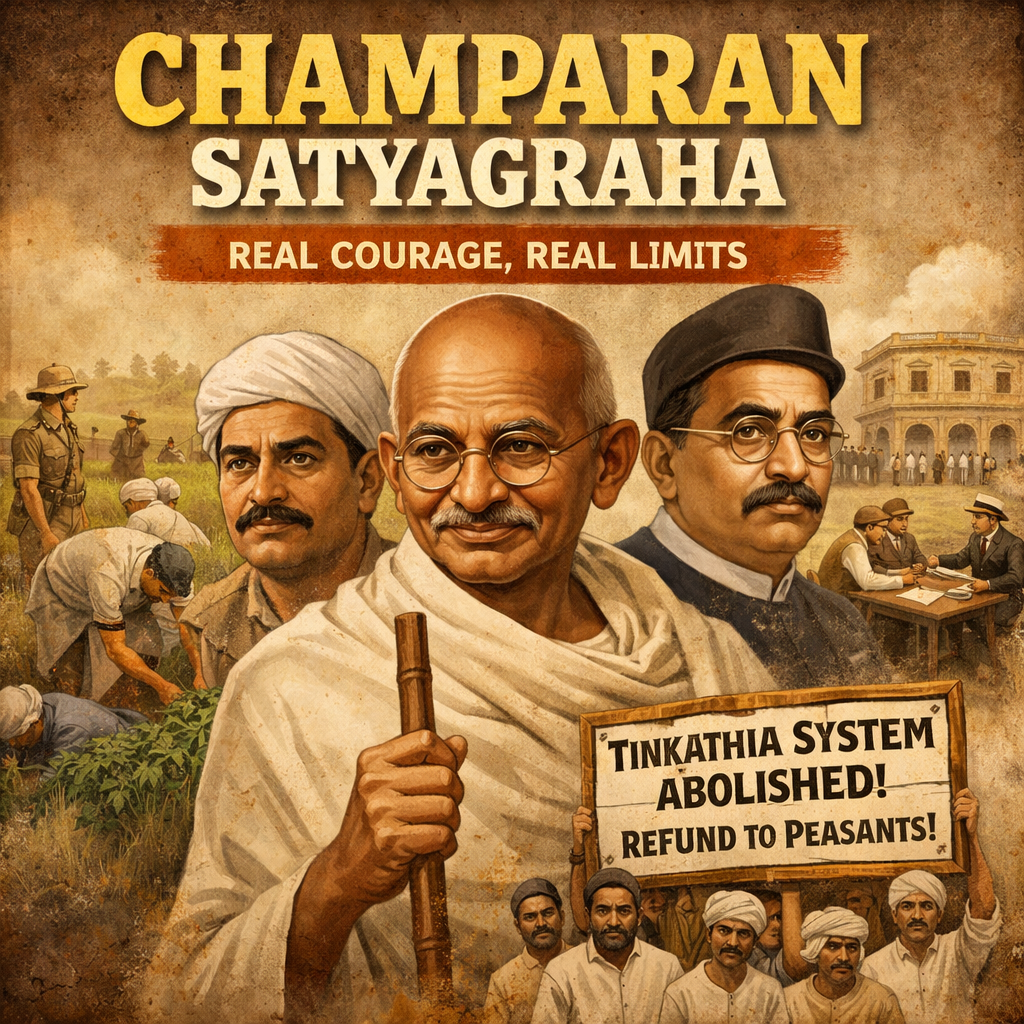
Gandhi applied Satyagraha to fight the force applied to Indians by the British — in South Africa, in Champaran, in the Non-Cooperation Movement, in the Salt March.
He did not apply Satyagraha to fight the force applied to Hindus in Malabar by the Moplah uprising his Khilafat experiment had produced. He did not call the force unjust. He did not call the submission involuntary. He called it voluntary choice — the precise opposite of Satyagraha’s foundational premise.
Gandhi’s Pietermaritzburg Test makes this visible precisely: the method Gandhi built from his own experience of force he refused to deploy for Hindus experiencing a devastating force. The doctrine that named his Pietermaritzburg experience as injustice he refused to apply to the Malabar massacres.
The 1922 Sedition Trial Connection
Gandhi’s Pietermaritzburg Test carries one additional documented connection — placed before the reader without characterisation.
The Malabar court records documenting the conditions of forced conversion were produced by the British colonial administration’s own judicial proceedings — the same authority Gandhi would publicly submit to and honour in his 1922 sedition trial, documented in Blog 50.
Gandhi used British courts as the authority for his guilty plea in 1922. British courts were the authority whose records documented the knifepoint conversions he called voluntary in 1921. The authority Gandhi honoured for his own submission he refused to honour for the Hindus whose forced submissions were recorded in its own proceedings.
The Prosecution’s Position
Gandhi’s Pietermaritzburg Test does not claim Gandhi was indifferent to suffering. It places his own documented biographical standard alongside his documented Malabar statement — and asks the reader to examine the gap between them.
- Did Gandhi apply one standard of voluntariness to force experienced by himself — calling it injustice, the founding wound, the birth of Satyagraha — and a different standard to force experienced by Hindus in Malabar — calling it voluntary choice?
- Was the force Gandhi experienced at Pietermaritzburg greater or lesser than the force Hindus experienced in Malabar in 1921?
- Did the doctrine of Satyagraha — born from Gandhi’s refusal to accept unjust force as legitimate — apply to Hindus experiencing unjust force in Malabar?
- If Gandhi’s own standard, applied to his own experience, would have called Malabar conversions involuntary — what explains his documented choice to call them voluntary?
The series does not answer. Gandhi’s 1893 experience is documented in his own autobiography. His 1921 statement is documented in Young India. The gap between them is the prosecution’s fourth standard — drawn not from law, not from morality, not from Islamic jurisprudence, but from Gandhi’s own life.
June 7, 1893 — Gandhi thrown off a train in Pietermaritzburg. Cold. Humiliated. Not threatened with death. He called it injustice. He built Satyagraha from it. August-December 1921 — Hindus in Malabar given the choice of conversion or death. He called it voluntary. The force applied to him: the founding wound of his career. The force applied to them: a voluntary change of faith. The prosecution places both documented facts before the reader. Gandhi’s own standard is the fourth exhibit. The reader will apply it.
Feature Image: Click here to view the image.
Videos
Glossary of Terms
- Pietermaritzburg Incident: The June 7, 1893 railway incident in South Africa where Mahatma Gandhi was forcibly removed from a first-class train compartment despite holding a valid ticket, an event Gandhi later described as the turning point of his political life.
- Satyagraha: Gandhi’s doctrine of nonviolent resistance, meaning “truth-force” or “soul-force,” developed from his belief that unjust coercion must be morally resisted rather than accepted.
- Malabar Massacres: The violent events during the 1921 Moplah uprising in the Malabar region of present-day Kerala, involving killings, forced conversions, displacement, and attacks on Hindu communities.
- Moplah Uprising: Also called the Moplah Rebellion of 1921, a violent agrarian and religious uprising in Malabar involving sections of the Muslim Moplah community during the Khilafat and Non-Cooperation movements.
- Khilafat Movement: A pan-Islamic political movement launched after World War I to defend the Ottoman Caliphate, strongly supported by Gandhi as part of his Hindu-Muslim unity strategy.
- Young India: Gandhi’s English-language weekly journal in which many of his political statements, including comments on the Malabar events, were published.
- Pietermaritzburg Test: A unique phrase coined in this blog series referring to the standard Gandhi applied to coercion experienced by himself in 1893 and whether he consistently applied the same standard to coercion faced by Hindus in Malabar.
- Voluntary Conversion Statement: The controversial characterization attributed to Gandhi in relation to certain Malabar conversions, examined throughout this blog sequence against legal, moral, and historical standards.
- Non-Cooperation Movement: Gandhi-led mass political movement launched in 1920 against British colonial rule, which became politically intertwined with the Khilafat agitation.
- Champaran Satyagraha: Gandhi’s 1917 movement in Bihar against exploitative indigo plantation practices, often regarded as the first major application of Satyagraha in India.
- Pretoria Journey: Gandhi’s 1893 legal-business trip in South Africa during which the Pietermaritzburg railway incident occurred.
- Sedition Trial of 1922: The British colonial court case in which Gandhi pleaded guilty to charges of sedition and publicly acknowledged the legitimacy of the judicial process against him.
- Truth-Force: English rendering of “Satyagraha,” emphasizing resistance through moral conviction rather than physical violence.
- Founding Wound: A key phrase used in the blog to describe the Pietermaritzburg humiliation that Gandhi himself treated as the formative emotional and political experience behind Satyagraha.
- Prosecution’s Fourth Standard: A unique phrase coined in this series referring to the evaluative framework that compares Gandhi’s treatment of coercion against himself with his characterization of coercion faced by Hindus during the Malabar events.
#Gandhi #Moplah #Malabar #Khilafat #Satyagraha #Congress #History #Colonialism #SouthAfrica #HinduinfoPedia
Scan Through The Entire Series
Gandhi’s Peace Efforts: The Questions Before the Mahatma (0)