
Gandhi’s Kanpur Silence: The Police Watched — What Gandhi Did Not Ask (73)
भारत / GB
Part 73: Mahatma Gandhi’s Peace Efforts | Series Index
Blog 72 documented Vimla Vidyarthi’s testimony and Gandhi’s Young India tribute. This post examines what the documentary record establishes about British conduct during the Kanpur riots of March 1931 — and what Gandhi’s documented response addressed and did not address.
Thank you for reading this post, don't forget to subscribe!The Action Taken: The official Congress Kanpur Inquiry Report—which documented organized communal mobilization and police negligence—was suppressed from general public circulation by the central leadership.
Who Paid the Price: The public understanding of organized riot mechanics and the memory of the Kanpur casualties, who were denied transparent institutional accounting.
The Alternative Bypassed: Publishing the full investigative findings and holding organized instigators publicly accountable before the nation.
Why This Matters: Demonstrates the systematic suppression of uncomfortable communal evidence to preserve the political narrative of spontaneous fraternity.
What Vidyarthi Documented — His Own Words
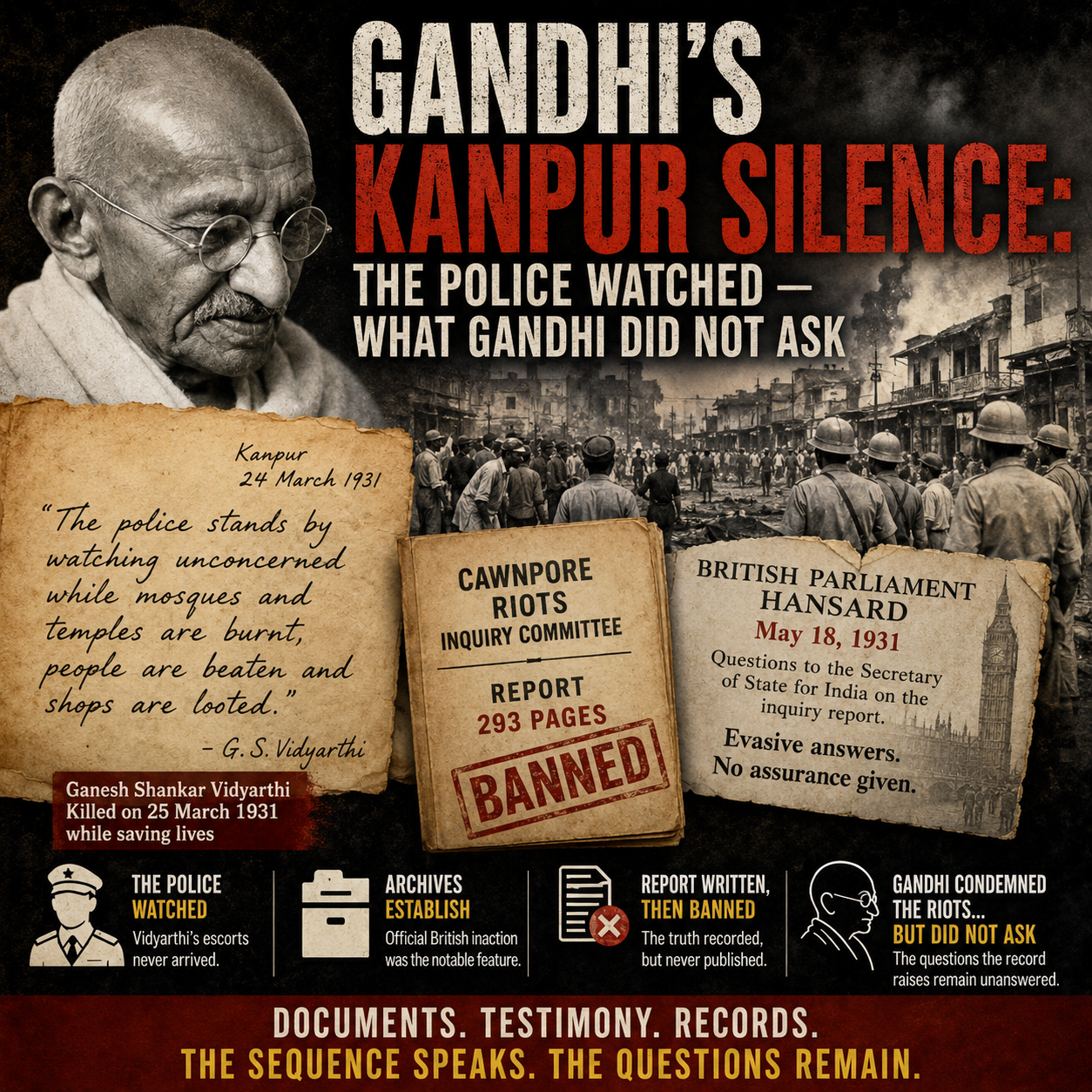
Gandhi’s Kanpur Silence begins with Ganesh Shankar Vidyarthi’s own letter written the night before his death. The letter is a primary source. It states: “The police stands by watching unconcerned while mosques and temples are burnt, people are beaten and shops are looted.”
He wrote this on the night of March 24, 1931. He went out the next morning anyway. He was killed.
The letter is not an allegation about British conduct. It is an eyewitness observation written by a man who had been in the riot-stricken areas across multiple days. He had personally requested a deputy collector to provide him with escorts. The deputy collector promised. The escorts did not arrive.
What the National Archives Established
Gandhi’s Kanpur Silence places the National Archives finding before the reader. Research conducted at the National Archives of India and the Nehru Memorial Museum and Library — drawing on testimonies of British officials involved in the riots — established one documented conclusion: official British inaction was the notable feature of the Kanpur Riots.
This is not the Congress Inquiry Committee’s conclusion. It is the finding drawn from British official testimony — the administration’s own documented record of its own conduct during the six days of riots.
The Leader and The Statesman — newspapers consulted at NMML — both documented the atrocities committed and the ineffectiveness of police forces to quell the riots.
The Timing — Documented
The timing is documented. The Kanpur riots began on March 24, 1931 — the day after Bhagat Singh, Rajguru, and Sukhdev were hanged on March 23.
The riots began when Muslim shopkeepers refused to observe the Hindu hartal called to mourn the executions. The worst phase of the riots followed the hangings directly.
Vidyarthi had been released from jail on March 9 under the Gandhi-Irwin Pact. He was the most prominent Congress organiser in Kanpur — with the organisational capacity and mass base to lead the largest protest against the executions in the city. The riots that began the day after the executions neutralised that capacity entirely. Vidyarthi spent his last two days in the riot-stricken areas instead of organising the protest movement. He was killed on March 25.
The Report — Written, Then Banned
Gandhi’s Kanpur Silence places the report sequence before the reader. The Indian National Congress organised the Cawnpore Riots Inquiry Committee. The Committee produced a 293-page report documenting Hindu-Muslim relations and the riots’ causes.
The report was subsequently banned by the colonial administration.
British Parliament Hansard records — May 18, 1931 — document the questions put to the Secretary of State for India about when the inquiry report would be published. The Secretary of State gave evasive answers each time. Members pressed for assurance that the report would be published. No assurance was given.
The report that documented British official inaction during the riots was the report the administration would not publish and then banned.
What Gandhi’s Documented Response Addressed
Gandhi’s Kanpur Silence places Gandhi’s documented responses alongside the National Archives finding. His responses to the Kanpur riots are on record.
On March 27, 1931 — two days after Vidyarthi’s death — Gandhi made a public plea condemning the riots. The Arizona newspaper headline that day: “Gandhi Makes New Plea for End of Revolt — Hindu Leader Condemns Riots by Youth League.”
Gandhi’s Young India tribute to Vidyarthi — documented in Blog 72 — framed the death as blood that would bind two communities.
What Gandhi’s documented responses did not address: the police watching while Vidyarthi’s escorts failed to arrive. The British official inaction documented in the National Archives. The banning of the report that documented that inaction. The timing of the riots relative to the executions Gandhi had not made a condition of his Pact. Gandhi condemned the riots. He did not ask why the police watched. He did not ask why the report was banned. He did not connect the timing to the executions his Pact had not prevented.
The Prosecution’s Position
Gandhi’s Kanpur Silence places the documented sequence before the reader as four questions.
- Did Vidyarthi document in his own letter the night before his death that police watched unconcerned — and did he still go out the next morning without the escorts the administration had promised?
- Did British official testimony in the National Archives establish that official inaction was the notable feature of the Kanpur Riots?
- Was the Congress Inquiry Committee Report that documented this inaction subsequently banned by the colonial administration — and did British Parliament receive evasive answers when pressing for its publication?
- Did Gandhi’s documented public responses address the British official inaction that his own ally had documented in his last letter — or did they redirect toward a discourse of communal unity?
Gandhi’s Kanpur Silence does not answer. The documented sequence is placed before the reader. Vidyarthi’s letter. The National Archives testimony. The Hansard record. Gandhi’s documented tribute. The reader will examine all four and complete the sentence.
Vidyarthi wrote the night before his death: the police watched unconcerned. He requested escorts. They did not come. He went out anyway. He was killed. British official testimony in the National Archives documented that inaction as the notable feature of the riots. The Congress report documenting it was banned. Gandhi’s response: his blood is the cement that will bind two communities. The prosecution places the documented sequence before the reader.
Feature Image: Click here to view the image.
Videos
Glossary of Terms
- Ganesh Shankar Vidyarthi: Freedom fighter, journalist, and Congress leader from Kanpur who was killed while attempting to rescue victims during the Kanpur riots of March 1931.
- Kanpur Riots (1931): Communal disturbances that erupted in Kanpur shortly after the executions of Bhagat Singh, Rajguru, and Sukhdev, resulting in significant loss of life and property.
- Vimla Vidyarthi: Family member of Ganesh Shankar Vidyarthi whose testimony and recollections form part of the documentary record examined in this series.
- National Archives of India (NAI): India’s principal archival institution preserving government records and historical documents used by researchers.
- Nehru Memorial Museum and Library (NMML): Major research institution and archive containing newspapers, manuscripts, and historical records relevant to modern Indian history.
- British Official Inaction: The documented claim, examined in this blog, that colonial authorities failed to act effectively during the Kanpur riots despite the ongoing violence.
- Cawnpore Riots Inquiry Committee: Congress-appointed committee that investigated the Kanpur riots and produced a detailed report on their causes and course.
- Hansard: The official record of debates and proceedings in the British Parliament.
- Gandhi-Irwin Pact: Agreement signed in March 1931 between Mahatma Gandhi and Lord Irwin that temporarily eased tensions between the British Government and the Indian National Congress.
- Young India: Influential journal associated with Mahatma Gandhi in which many of his political and social views were published.
- Hartal: A form of mass protest involving the voluntary closure of shops, businesses, and public activity.
- Documented Sequence: A recurring phrase in this series referring to the chronological presentation of primary sources, testimonies, official records, and public statements before drawing conclusions.
- The Prosecution’s Position: A series-specific analytical framework that presents evidence and questions for examination without directly delivering a final verdict.
- Communal Unity Discourse: The emphasis on Hindu-Muslim harmony and reconciliation that Gandhi highlighted in his public responses to communal violence.
- Kanpur Silence: A series-specific phrase referring to the argument that Gandhi’s public responses did not address certain documented questions regarding colonial administrative conduct during the riots.
#Gandhi #Kanpur #Vidyarthi #BhagatSingh #Congress #History #India #Riots #BritishRaj #FreedomStruggle #HinduMuslim #Colonialism #Archives #Hansard #HinduinfoPedia
Gandhi’s Peace Efforts: The Questions Before the Mahatma (0)