
Gandhi’s Prosecution-III: The Jinnah Constitutional Arc and Exhibits 51-55 (99)
भारत / GB
Part 99: Mahatma Gandhi’s Peace Efforts | Series Index | Exhibits Master Table
Blog 81 compiled the prosecution’s record through the Moplah and Vidyarthi-Shraddhananda arcs — Exhibits 24-50. This post compiles the Jinnah Constitutional Arc — five exhibits across Blogs 81-85 — documenting the documented offers, reductions, and rejections of 1928-1929. It is structured for direct compatibility with the Gandhi Prosecution Exhibits Master Table.
Thank you for reading this post, don't forget to subscribe!The Action Taken: The series compiled the sequence of constitutional conferences, compromises, and rejections that marked the eighteen-year transition from constitutional cooperation to separatist polarization.
Who Paid the Price: The assumption that the rise of Pakistan was an overnight imperial conspiracy, confronted by the documented record of domestic constitutional rejections.
The Alternative Bypassed: Treating constitutional negotiations as isolated, unconnected episodes.
Why This Matters: Assembles the foundational exhibits of the constitutional arc, demonstrating how bypassing minority safeguards in 1928 and rejecting power-sharing in 1937 dismantled the middle ground.
Gandhi’s Prosecution-III: Jinnah Constitutional Arc — Exhibits 51-55
| Exhibit | Blog | Exhibit Name / What It Established |
|---|---|---|
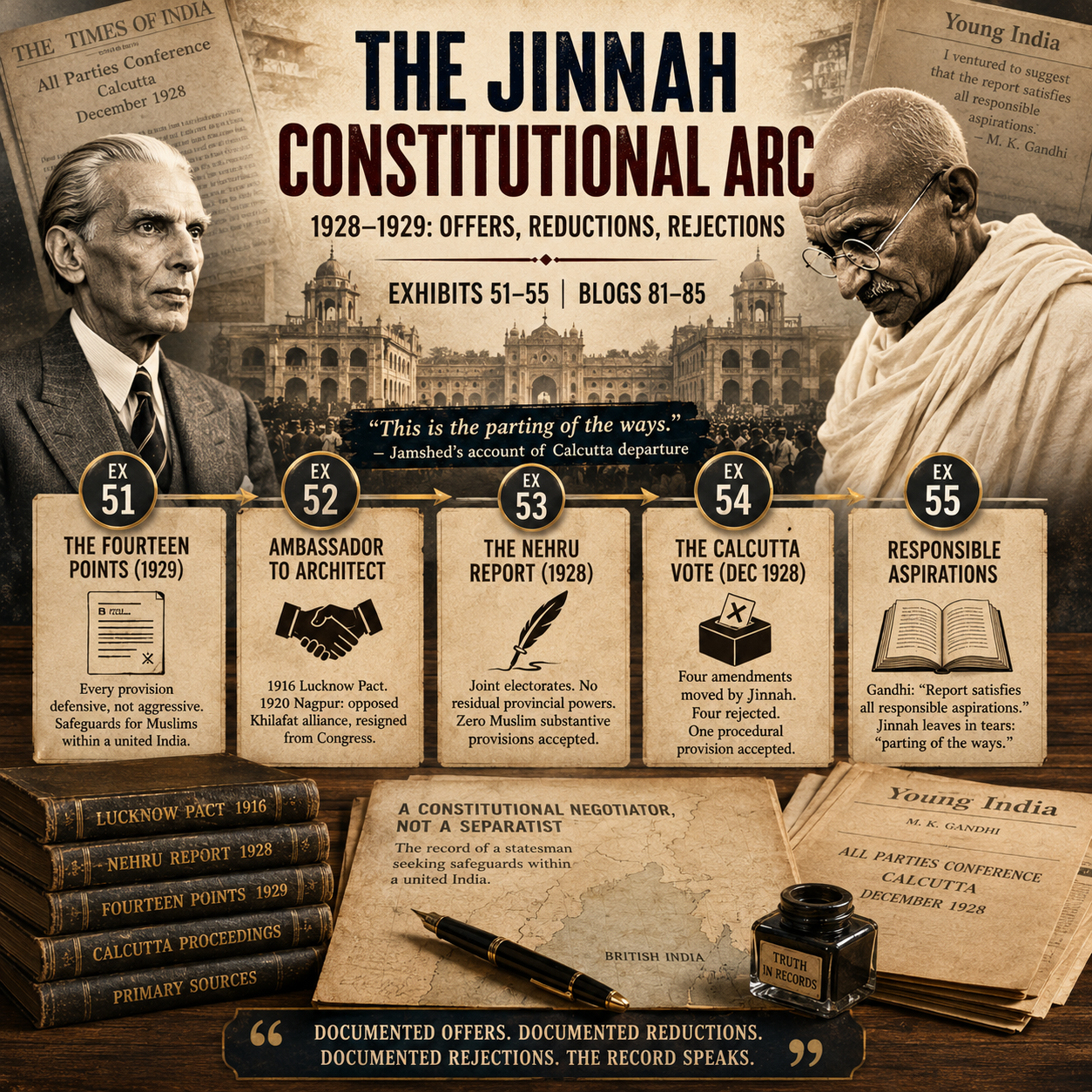
| Ex 51 | Blog 81 | The Fourteen Points — Jinnah’s 1929 Fourteen Points: every provision defensive, not aggressive. Residual powers to provinces, separate electorates, religious freedom protections, Sind as a separate province. The body language of a constitutional negotiator seeking protections within a united India — not a separatist demand. |
| Ex 52 | Blog 82 | Ambassador to Architect — Jinnah’s documented transformation: 1916 Lucknow Pact, called Ambassador of Hindu-Muslim Unity by Sarojini Naidu. 1920 Nagpur: objected to Khilafat alliance, shouted down by the Muslim majority Gandhi had mobilised, resigned from Congress. The 1920 decision as the documented origin of the divergence — eight years before the 1928 parting of ways. |
| Ex 53 | Blog 83 | The Nehru Report — The 1928 constitutional framework produced by Congress, reversing the Madras 1927 agreements. Joint electorates in place of separate electorates. No residual provincial powers. Hindu Mahasabha pressed for rejections. Gandhi held documented unchallengeable authority. Zero substantive Muslim constitutional provisions accepted. Lebanon National Pact 1943 parallel: a more fractured society produced structural protections; the Nehru Report produced none. |
| Ex 54 | Blog 84 | The Calcutta Vote — December 1928. Jinnah reduced his demands to four specific amendments, put to formal vote at the All Parties Conference. All four rejected. One procedural provision accepted. The four amendments were a deliberately diluted version of the Fourteen Points — Jinnah had met Congress more than halfway. The documented arithmetic: zero substantive provisions. |
| Ex 55 | Blog 85 | Responsible Aspirations — Gandhi’s documented declaration: “I ventured to suggest that the report satisfies all responsible aspirations and is quite capable of standing on its own merit.” Placed against zero Muslim substantive provisions accepted. Jinnah’s documented departure from Calcutta station: tears, Jamshed’s account, “this is the parting of the ways.” The word “responsible” placed alongside what the framework had produced for Muslim constitutional standing. |
What the Constitutional Arc Established
Gandhi’s Prosecution places five documented exhibits before the reader across Blogs 81-85.
Gandhi’s Prosecution established that Jinnah was the most accommodating Muslim political leader available to Congress at the point of the 1928-1929 negotiations. He opposed the Simon Commission alongside Gandhi. He reduced his demands from fourteen to four — each reduction documented, each reduction rejected. He left Calcutta station in tears. Gandhi’s own documented declaration placed the framework that had produced zero Muslim substantive provisions as satisfying all responsible aspirations.
Gandhi’s Prosecution did not establish Gandhi’s intent. It placed documented choices alongside documented outcomes and asked the reader to examine what “responsible aspirations” meant in practice against the documented record of what was accepted and what was rejected.
What the Constitutional Arc Did Not Establish
The arc documents the 1928-1929 negotiation and its documented outcome. It does not establish what would have happened if the four amendments had been accepted. It places the documented decision before the reader — the documented authority Gandhi held, the documented framework produced, the documented outcome named by Gandhi as satisfying responsible aspirations — and asks the reader to examine the record.
Gandhi’s Prosecution-III: The Arc’s Evidentiary Foundation
Gandhi’s Prosecution: the Constitutional Arc rests on strong primary sources: the documented text of the Fourteen Points, the documented proceedings of the All Parties Conference December 1928, Gandhi’s own documented declaration (Young India), and Jamshed’s documented account of Jinnah’s departure from Calcutta station. The arc’s exhibits carry Grade A evidentiary weight — primary sources directly attributable to named individuals on documented dates.
What the Next Compilation Adds
Gandhi’s Prosecution continues: Blog 100 compiles the Congress Ministry Arc — Exhibits 56-63, Blogs 86-93. Eight exhibits: what Congress did with power when it held it in eight provinces 1937-1939, and what the documented sequence of exclusions, programmes, and broken assurances produced. The prosecution places that arc alongside this one and asks the reader to examine the twenty-year documented sequence in full.
1929: Fourteen Points. 1928: Four amendments. Four rejections. One procedural provision. Gandhi: the report satisfies all responsible aspirations. Calcutta station: Jamshed, this is the parting of the ways. Five documented exhibits. The prosecution places the Constitutional Arc before the reader alongside the twenty-seven exhibits that preceded it and the eighteen that follow it. The reader will examine the complete record and complete the sentence.
Feature Image: Click here to view the image.
Videos
Glossary of Terms
- Jinnah Constitutional Arc: A unique thematic phrase coined in this series to define the specific chronological sequence between 1928 and 1929 documenting Muhammad Ali Jinnah’s constitutional offers, systemic reductions, and subsequent rejections by the Congress leadership.
- Gandhi’s Prosecution: A unique narrative framework coined in this blog series that presents historical data, documented choices, and primary source exhibits in the structured format of a legal prosecution.
- Exhibits Master Table: A unique indexed database compiled within this series to catalog, grade, and organize primary historical sources chronologically for objective evaluation.
- The Fourteen Points: A definitive series of defensive constitutional provisions proposed by Muhammad Ali Jinnah in 1929, focusing on provincial residual powers and religious freedom protections within a united India.
- Ambassador of Hindu-Muslim Unity: A historical title conferred upon Muhammad Ali Jinnah by Congress leader Sarojini Naidu to honor his efforts in bridging communal constitutional gaps during the early nationalist era.
- Lucknow Pact of 1916: A historic constitutional agreement executed between the Indian National Congress and the All-India Muslim League that established joint electoral demands.
- Nehru Report: A 1928 constitutional framework produced by a Congress-led committee that reversed prior separate electorate agreements and omitted residual provincial powers.
- The Calcutta Vote: The formal voting proceedings at the All Parties Conference in December 1928 where Jinnah’s diluted structural amendments were systematically rejected.
- Responsible Aspirations: A key phrase drawn from Mahatma Gandhi’s documented declaration in Young India asserting that the 1928 Nehru Report satisfied all legitimate political demands.
- Parting of the Ways: The historical phrase used by Jinnah at the Calcutta railway station to mark the definitive breakdown of constitutional reconciliation between himself and the Congress.
- Moplah Arc: A thematic sequence of exhibits within this series documenting the historical impact and handling of the 1921 Malabar agrarian and communal violence.
- Vidyarthi-Shraddhananda Arc: A specific sequence of exhibits within this series tracking the historical developments surrounding the deaths of Ganesh Shankar Vidyarthi and Swami Shraddhanand.
- Congress Ministry Arc: A upcoming sequence of exhibits in this series documenting the administrative actions, exclusions, and programs of the Congress provincial governments between 1937 and 1939.
- GB: An abbreviation utilized within this blog series to denote Great Britain, representing the imperial governance and legal framework of pre-independence India.
- Ex: An abbreviation utilized throughout the tables and text of this series to denote an explicit historical “Exhibit” entered into the evidentiary record.
#Gandhi #Jinnah #History #Congress #NehruReport #CalcuttaVote #FourteenPoints #HinduinfoPedia
Gandhi’s Peace Efforts: The Questions Before the Mahatma (0)