
Gandhi’s Congress Ministries: What Congress Did With Power — 1937-1939 (86)
भारत / GB
Part 86: Mahatma Gandhi’s Peace Efforts | Series Index
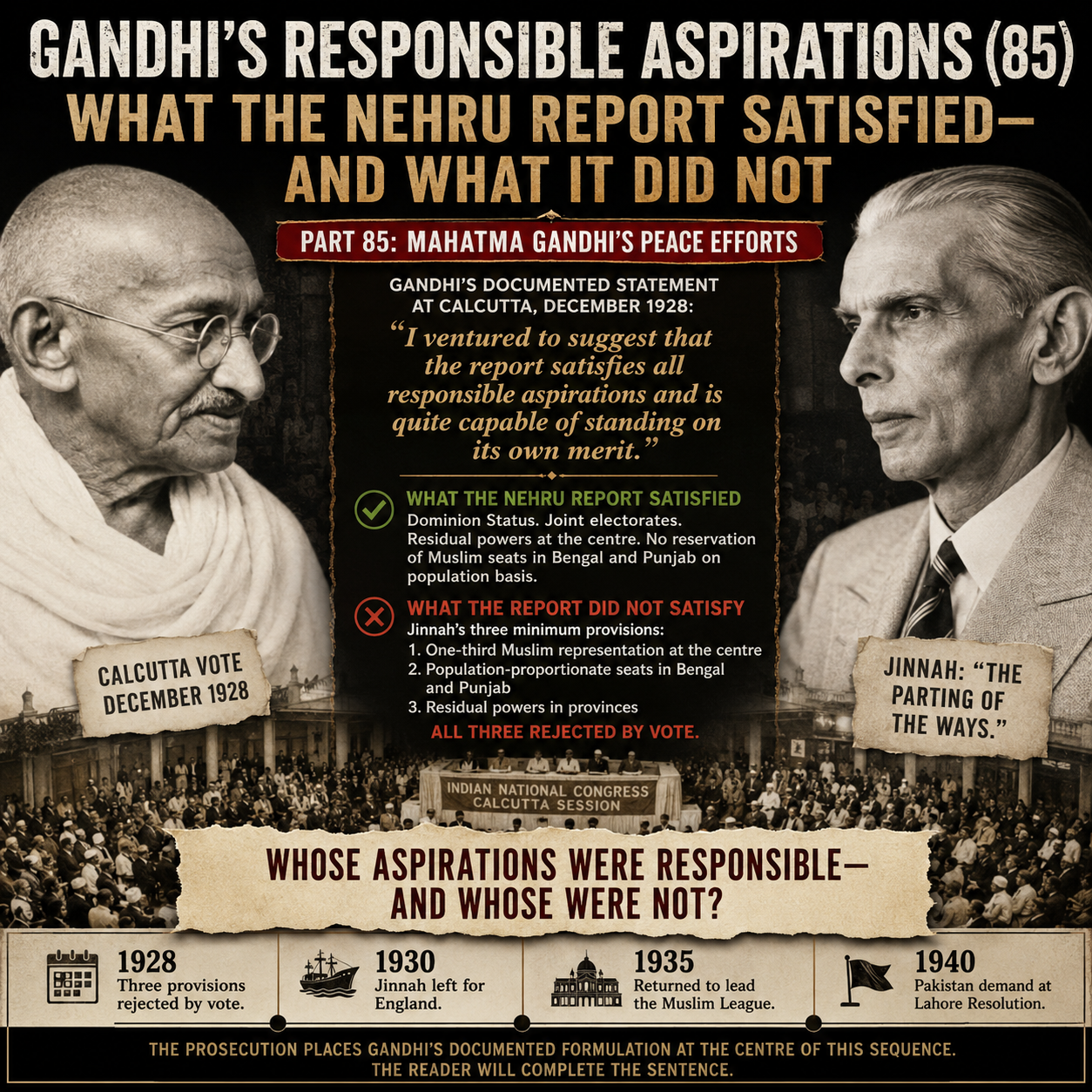
Blog 85 documented Gandhi’s declaration that the Nehru Report satisfied all responsible aspirations. This post examines the next documented chapter — what Congress did when it actually held power in eight Indian provinces from 1937 to 1939 — and what that exercise of power produced for Muslim political participation.
Thank you for reading this post, don't forget to subscribe!The Action Taken: Exploiting the deadlock resulting from the London negotiations, British Prime Minister Ramsay MacDonald imposed the Communal Award, granting statutory separate electorates across religious and caste lines.
Who Paid the Price: Indian national political unity, which was structurally partitioned into fourteen separate statutory electoral categories.
The Alternative Bypassed: An indigenous, negotiated communal pact agreed upon between Indian leaders before leaving London.
Why This Matters: The direct harvest of the London refusal: by failing to negotiate directly with minority and Dalit leaders, Gandhi handed the imperial state the authority to legally fragment the electorate.
The 1937 Elections — Documented Results
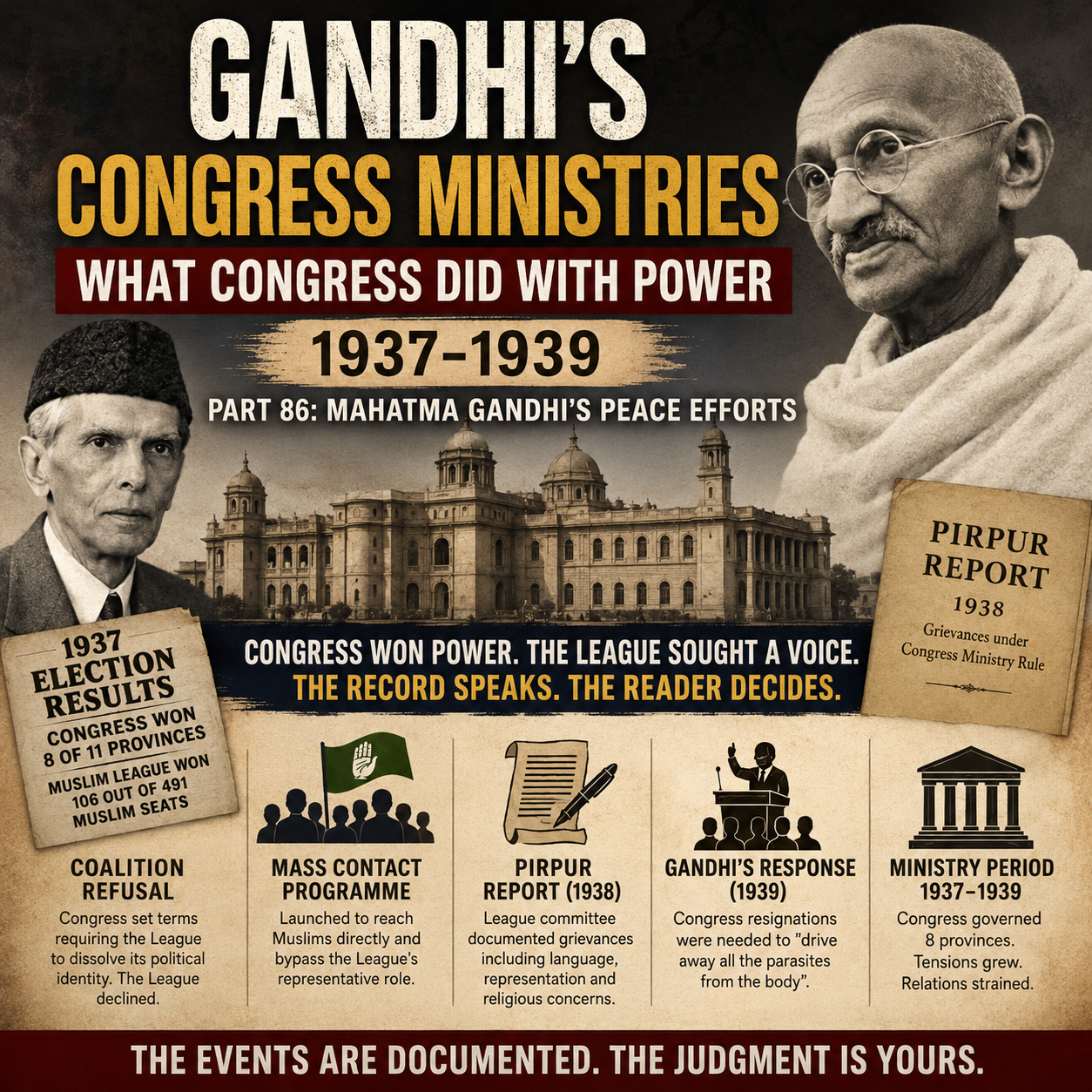
The Government of India Act 1935 introduced provincial autonomy and elections. The 1937 elections were held under its provisions. Congress secured a majority in five provinces — Bihar, Orissa, Madras, United Provinces, and Central Provinces — and formed coalition ministries in three more. Congress ruled eight of eleven provinces.
The Muslim League performed poorly. Out of 491 Muslim seats, the League captured 106. Congress won 26 Muslim seats. The League could not form a government in any Muslim-majority province outright.
Gandhi’s documented intervention at this moment: he urged Congress to accept office, overcoming the hesitation of those who did not want to participate in British-designed constitutional structures. Gandhi held documented unchallengeable authority over Congress — established across Blogs 21–22. His urging was decisive. Congress formed ministries in July 1937. The organisation Gandhi had built and dominated for seventeen years now held power in eight of eleven Indian provinces.
The Coalition Refusal — Documented
The Muslim League had won seats in several provinces and sought coalition representation in Congress ministries. The documented terms Congress laid down for the League to join were recorded in contemporary accounts: the League’s parliamentary board was to be dissolved and League members joining ministries were to function as Congress members under Congress command rather than as League representatives.
The League rejected these terms. Congress formed solo ministries.
Gandhi’s Congress Ministries places this documented sequence before the reader: the League sought coalition participation. Congress offered terms that required the League to dissolve its political identity as a condition of joining. The League declined. Congress governed alone.
The Mass Contact Programme
Simultaneously with forming ministries, Congress launched its Muslim Mass Contact Programme — a documented attempt to reach Muslim voters directly and build Congress support among Muslims without the mediation of the Muslim League. The programme’s explicit aim was to demonstrate that Congress, not the League, represented Indian Muslims.
Gandhi’s Congress Ministries places one documented observation before the reader: the Mass Contact Programme was launched at the same time Congress refused coalition terms to the League. Congress governed without the League and simultaneously attempted to bypass the League’s representative role.
Jinnah’s documented response: the Mass Contact Programme was an attempt to destroy the Muslim League as a political organisation.
What the Ministries Produced
The Muslim League established the Pirpur Committee in 1938 to document grievances under Congress ministry rule. The Pirpur Report alleged interference in Muslim religious practices, suppression of Urdu in favour of Hindi, denial of Muslim representation in government appointments, and economic discrimination.
Gandhi’s Congress Ministries notes the evidentiary status of the Pirpur Report precisely — it was compiled by the League’s own committee and carries the League’s political interest. The prosecution does not carry its specific allegations as established facts. It carries the documented fact of the report’s existence and its documented political consequences.
Gandhi’s Documented Response
Gandhi’s documented statement on the Congress ministry resignations in 1939, written to Rajagopalachari: the resignations were needed to “drive away all the parasites from the body” of Congress — referring to those who had joined Congress for the benefits of office rather than genuine commitment.
Gandhi did not address the Muslim League’s documented grievances about the ministry period in his documented public statements. Gandhi’s Congress Ministries places this documented non-response alongside the Pirpur Report’s existence and asks the reader to examine the pattern the series has documented across earlier blogs.
The Prosecution’s Position
Gandhi’s Congress Ministries places three questions before the reader.
- Did Congress, when offered the opportunity of coalition governance with the Muslim League in 1937, set terms that required the League to dissolve its political identity as a condition of participation?
- Did Congress simultaneously launch the Mass Contact Programme — an attempt to reach Muslims directly and bypass the League’s representative role — while governing without League participation?
- Did Gandhi, who held documented unchallengeable authority over Congress and had urged the party to accept office in 1937, address the documented Muslim League grievances about the ministry period — or did his documented response focus on internal Congress concerns?
The series does not answer. The documented election results, the documented coalition terms, the documented Mass Contact Programme, and Gandhi’s documented statement on the resignations are placed before the reader. Gandhi held documented unchallengeable authority over Congress throughout the 1937-39 period — established across Blogs 21–22. The full documented sequence of elections, coalition refusal, Mass Contact Programme, and the complete ministry period are placed before the reader. The reader will complete the sentence.
The prosecution notes one further documented fact: the Cambridge University Press academic source on Congress-Muslim League Relations 1937-39 confirms that the Muslim League did not fare well in the 1937 elections, especially in Muslim-majority provinces. This means the League that sought coalition participation in 1937 was a weakened organisation. Congress refused coalition terms to a weakened League — not a dominant one. The documented effect of that refusal is in the record that follows.
1937 — Congress won eight provinces. The Muslim League sought coalition participation. Congress offered terms requiring the League to dissolve its political identity. The League declined. Congress governed alone and launched the Mass Contact Programme simultaneously. 1938 — the Pirpur Report documented grievances. 1939 — Congress resigned. Gandhi: needed to drive away the parasites. The prosecution places the documented sequence before the reader. The reader will complete the sentence.
Feature Image: Click here to view the image.
Videos
Glossary of Terms
- Government of India Act 1935: The constitutional framework enacted by the British government that introduced provincial autonomy and provided the basis for the 1937 provincial elections in British India.
- Provincial Autonomy: A system under which elected provincial governments received authority over specified administrative subjects while the British central government retained ultimate sovereignty.
- Congress Ministries: The provincial governments formed by the Indian National Congress after its electoral victories in 1937, governing eight of eleven provinces between 1937 and 1939.
- Muslim League: The political organization led by Muhammad Ali Jinnah that claimed to represent Muslim political interests in British India and later became the principal advocate of Pakistan.
- Coalition Ministry: A government formed by two or more political parties sharing executive power and administrative responsibility.
- League Parliamentary Board: The Muslim League’s organizational body responsible for coordinating legislative activities and candidate selection; Congress reportedly required its dissolution as a condition for coalition participation.
- Mass Contact Programme: A Congress initiative launched in 1937 to directly mobilize Muslim voters and expand Congress influence among Muslims without relying on the Muslim League as an intermediary.
- Representative Role: The claimed authority of a political organization to speak and negotiate on behalf of a particular community or electorate.
- Pirpur Committee: A committee established by the Muslim League in 1938 under the Raja of Pirpur to investigate and document complaints regarding Congress ministry rule.
- Pirpur Report: A Muslim League-sponsored report alleging discrimination against Muslims under Congress provincial governments, including concerns regarding language policy, representation, and religious practices.
- Congress-Muslim League Relations (1937–39): The political interaction, negotiations, disputes, and competing claims to representation between the Congress and the Muslim League during the ministry period.
- Unchallengeable Authority: A recurring phrase in this series referring to Gandhi’s documented dominance within Congress decision-making structures, as established in earlier installments of the series.
- Responsible Aspirations: Gandhi’s phrase describing political demands he considered reasonable and legitimate, used in his endorsement of the Nehru Report.
- Political Identity: The distinct organizational character, leadership structure, and policy platform through which a political party represents its supporters.
- Ministry Period (1937–39): The phase between the formation of Congress provincial governments in 1937 and their resignation in 1939, frequently examined in debates over Hindu-Muslim political relations.
#Gandhi #Congress #MuslimLeague #Jinnah #IndiaHistory #BritishIndia #CongressMinistries #1937Elections #NehruReport #Partition #Politics #HinduinfoPedia
Gandhi’s Peace Efforts: The Questions Before the Mahatma (0)
Refer to Various Arks Referred to in the Blog