
Gandhi’s Alliance Maintained (66): What the Continuation Documents
भारत / GB
Part 66: Mahatma Gandhi’s Peace Efforts | Series Index
Blog 65 documented Gandhi’s prescription of brave death to Hindus facing Muslim violence — applied consistently across twenty-six years. This post examines one documented fact that the Moplah arc has approached from multiple directions but not yet placed as a standalone exhibit: the Khilafat alliance continued after the Moplah massacre. The prosecution places the documented timeline before the reader without characterisation.
Thank you for reading this post, don't forget to subscribe!The Action Taken: The Congress Working Committee and AICC reaffirmed their full institutional alliance with the Central Khilafat Committee at Ahmedabad, refusing to suspend the pact despite the ongoing massacres in Malabar.
Who Paid the Price: The secular credibility of the national movement and the victim populations, whose plight was subordinated to maintaining the political coalition.
The Alternative Bypassed: Severing or suspending the Khilafat alliance pending an unconditional repudiation of violence by the clerical leadership.
Why This Matters: Proves that the alliance was preserved with full institutional knowledge of its violent consequences on the ground, signaling that sectarian escalation carried no political penalty.
The Timeline — Stated Precisely
Gandhi’s Alliance Maintained begins with the documented dates.
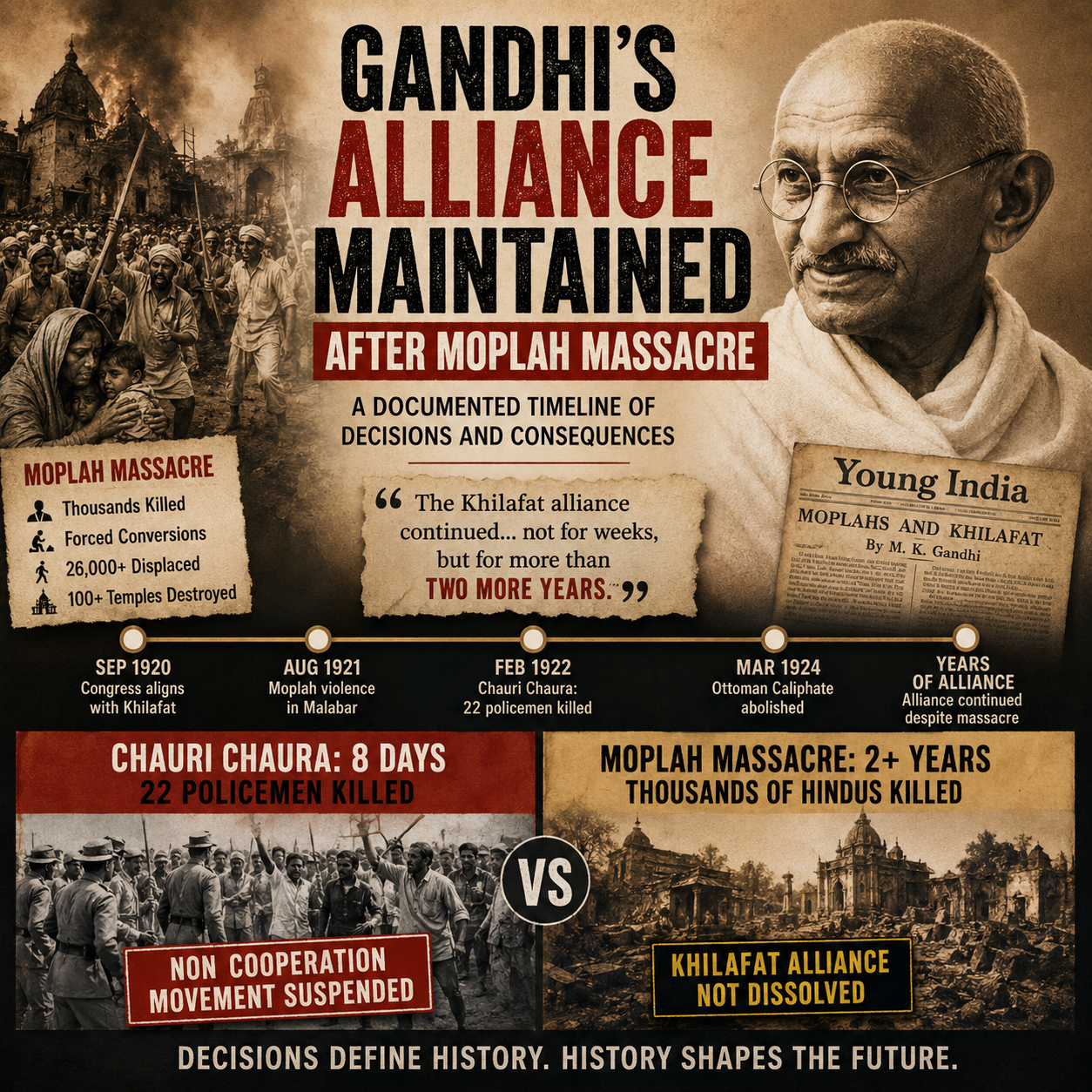
September 1920 — Gandhi formalised the Khilafat alliance at the Calcutta Special Session of the Indian National Congress overruling all objections from senior members of Congress. Documented in Blog 44.
August 20, 1921 — The Moplah uprising began in Malabar. At least 2,500 Hindus were killed, 2,500 forcibly converted, 26,000 displaced, more than 100 temples destroyed. Documented in Blog 54.
December 1921 — The Congress Working Committee passed a resolution minimising the massacre to three documented cases of forced conversion. The Khilafat alliance continued.
February 12, 1922 — Gandhi suspended the Non-Cooperation Movement following Chauri Chaura. Twenty-two policemen had died. The movement was dissolved in eight days. Documented in Blog 30.
The Khilafat alliance was not dissolved after Chauri Chaura. It was not dissolved at any point by Gandhi’s decision.
March 1924 — The Turkish Grand National Assembly abolished the Ottoman Caliphate. The Khilafat cause ceased to exist. The alliance dissolved — not because Gandhi withdrew, but because the institution the alliance had been built around no longer existed.
The Khilafat alliance outlasted the Moplah massacre by two years and four months. It ended when the Turks abolished the Caliphate — not when Gandhi chose to end it.
The Khilafat movement continued — as it was always intended to, toward its declared dar-ul-harb objective. When the Turks abolished the Caliphate, the instrument ended. The objective did not.
The Dissolution Trigger — Documented
Gandhi’s Alliance Maintained places two dissolution decisions side by side.
Non-Cooperation Movement — dissolved February 12, 1922:
Trigger: twenty-two policemen killed at Chauri Chaura. Decision: Gandhi’s unilateral dissolution in eight days. Thirty thousand in jail received nothing.
Khilafat Alliance — not dissolved after Moplah massacre:
Trigger absent despite: at least 2,500 Hindus killed, 2,500 forcibly converted, 26,000 displaced, 100+ temples destroyed, Khilafat leaders congratulating the perpetrators. Decision: alliance maintained. No dissolution.
The prosecution does not assert what this asymmetry means. It places the two documented decisions before the reader — one dissolution triggered by the death of twenty-two policemen, no dissolution triggered by the deaths of at least 2,500 Hindus — and asks the reader to examine the difference.
The contrast in the series’ documented record is precise. At Chauri Chaura, Gandhi dissolved a movement that had brought the British administration to documented alarm — thirty thousand in jail, seventeen months of British paralysis, the strongest hand any Indian leader had held. The trigger was twenty-two deaths. The dissolution was unilateral, immediate, unconditional. At Malabar, the trigger was at least 2,500 Hindu deaths, 2,500 forced conversions, 26,000 displaced, and a Khilafat leadership network that had congratulated the perpetrators. The alliance continued. No condition was placed on its continuation. No demand for accountability was made of the alliance’s leadership.
The contrast has a third documented point. In November 1921 — three months after the Moplah massacre — Congress workers and Khilafat volunteers attacked Parsis and minorities in Bombay during the Prince of Wales visit. Fifty-eight died. Gandhi fasted within forty-eight hours and broke it only when normalcy was restored. At Malabar, the scale of violence, killings, forced conversions, and displacement was vastly greater and a Khilafat leadership network that had congratulated the perpetrators. Gandhi did not fast. The alliance continued.
Gandhi’s Alliance Maintained is not a claim about Gandhi’s intentions. It is the documented arithmetic of two decisions placed side by side. The movement Gandhi dissolved over twenty-two deaths had brought thirty thousand Indians to jail and the British administration to documented alarm. The alliance Gandhi maintained had produced at minimum 2,500 Hindu deaths, the forced conversion of 2,500 more, and the displacement of 26,000 people. The decision to dissolve and the decision to maintain are both documented. The reader will examine both.
What the Alliance’s Continuation Produced
Gandhi’s Alliance Maintained documents what the continuation of the alliance after the massacre produced — in Gandhi’s own documented words and in the documented conduct of the alliance’s leadership.
Gandhi published in Young India that there was only one case of forced conversion in Malabar — while his own Muslim contacts informed him the documented number was far higher. He did not correct the published statement. Documented in Blog 62.
Gandhi told Hindu victims they were not without blame for the massacre. Documented in Blog 59.
On the other hand:
- He did not blame the Moplah perpetrators for what they did.
- He did not blame the British for Jallianwala Bagh. [Writing in Young India, he explicitly stated, “We do not want to punish General Dyer… We cannot punish them.”]
- He did not blame the British for firing against unarmed Non-Cooperation participants.
- He did not blame the British for properties confiscated and disposed of under Non-Cooperation.
Gandhi stated that verbal disapproval from Muslims was not a test of Muslim friendship — removing condemnation of the massacre as a requirement for maintaining the alliance.
The Khilafat leaders whose network had congratulated the Moplah perpetrators remained Gandhi’s political partners. No demand for condemnation was made of them. No condition was placed on the continuation of the alliance. The alliance continued on the same terms it had been formed.
The Prosecution’s Position
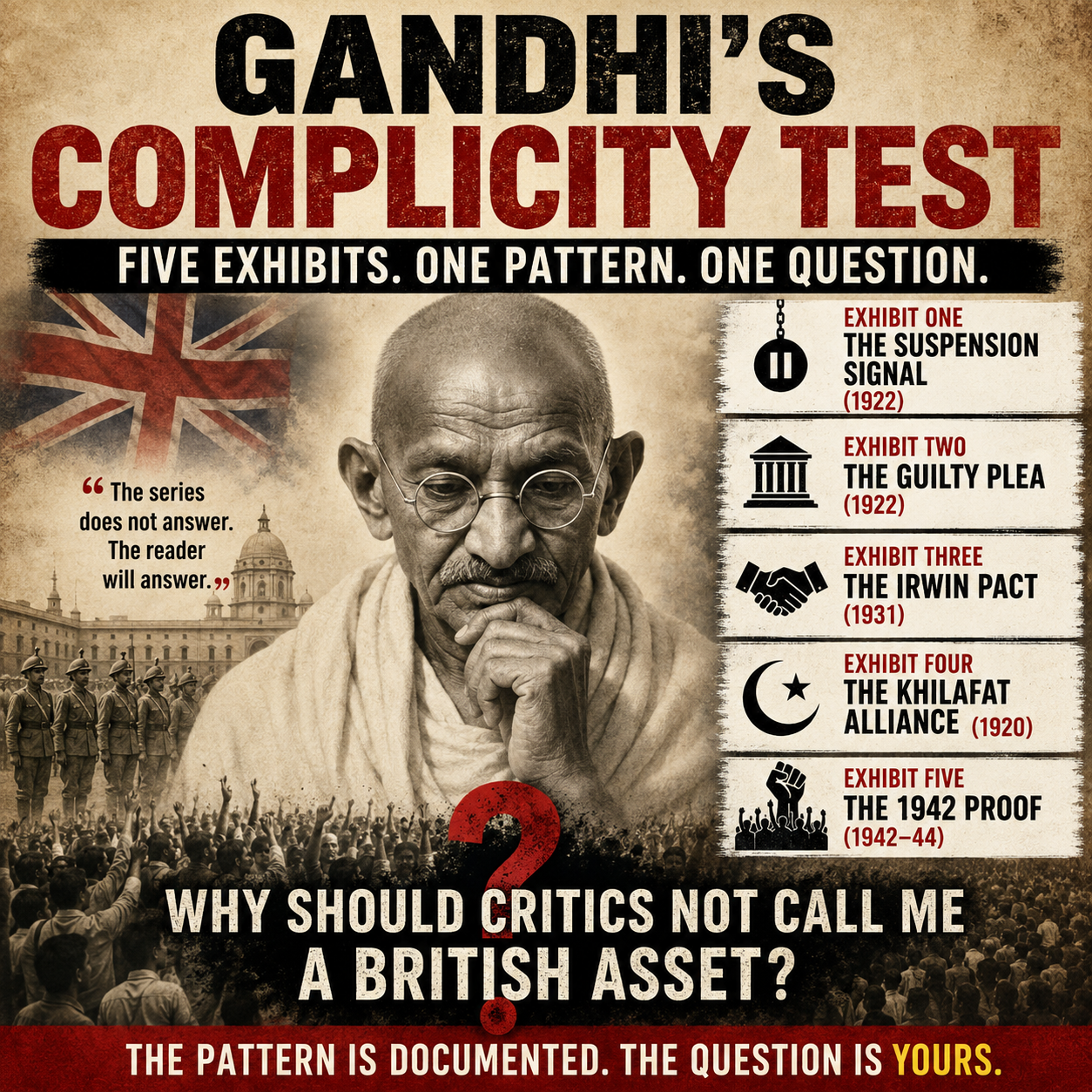
Gandhi’s Alliance Maintained does not claim Gandhi approved of the Moplah massacre. It places one documented sequence before the reader — alliance formed, massacre occurred, alliance continued, Turks dissolved it. It places the documented timeline before the reader — the alliance formed in September 1920, the massacre beginning August 1921, the alliance continuing until the Caliphate was abolished by the Turks in March 1924 — and asks the reader to examine what the continuation documents. The instrument of Khilafat movement ended but the instrument of dar-ul-harb embedded in the movement continues till date in one form or the other.
- Did Gandhi dissolve the Non-Cooperation Movement when twenty-two policemen died at Chauri Chaura — but not dissolve the Khilafat alliance when at least 2,500 Hindus died in Malabar?
- Did the alliance end because Gandhi withdrew it — or because the institution it was built around ceased to exist?
- Did Gandhi place any condition on the continuation of the alliance after the massacre — demanding condemnation from Khilafat leaders, withdrawing the independence movement’s moral authority, or requiring any accountability from the alliance’s leadership?
- What does the documented answer to these three questions mean for the prosecution’s beneficiary column — who received what from Gandhi’s documented choices?
The series does not answer. The timeline is documented. The dissolution decisions are documented. The reader will examine the pattern and complete the sentence.
September 1920 — alliance formed. August 1921 — 2,500 Hindus killed. December 1921 — alliance maintained. February 1922 — Non-Cooperation dissolved over twenty-two policemen. March 1924 — alliance dissolved by the Turks abolishing the Caliphate. Not by Gandhi. The prosecution places the documented timeline before the reader. The reader will identify what the continuation documents.
Feature Image: Click here to view the image.
Videos
Glossary of Terms
- Khilafat Movement: A pan-Islamic political movement launched in British India after World War I to preserve the Ottoman Caliphate, later aligned by Gandhi with the Non-Cooperation Movement.
- Ottoman Caliphate: The Islamic caliphal institution ruled by the Ottoman Turks, abolished by the Turkish Grand National Assembly in March 1924.
- Moplah Massacre: The 1921 Malabar violence during the Moplah uprising in which thousands of Hindus were reportedly killed, forcibly converted, displaced, and subjected to large-scale attacks on property and temples.
- Non-Cooperation Movement: Gandhi-led mass agitation launched in 1920 against British rule through boycott of British institutions, courts, schools, and goods.
- Chauri Chaura Incident: A violent 1922 confrontation in Gorakhpur district where protesters killed twenty-two policemen, after which Gandhi suspended the Non-Cooperation Movement.
- Dar-ul-harb: An Islamic jurisprudential term historically referring to territories considered outside Islamic political authority and therefore part of a civilizational conflict zone.
- Dar-ul-harb Objective: A phrase used in this series to describe the alleged long-term political and civilizational trajectory that the author argues emerged from sections of the Khilafat movement and later communal mobilisations.
- Congress Working Committee (CWC): The principal executive decision-making body of the Indian National Congress responsible for major organisational and political resolutions.
- Young India: Gandhi’s English-language journal used to communicate political positions, responses, and ideological arguments during the freedom movement.
- Forced Conversion: Religious conversion carried out under coercion, intimidation, violence, or threat rather than voluntary choice.
- Kohat Riots: The 1924 communal violence in Kohat, North-West Frontier Province, resulting in the evacuation of the Hindu population from the town.
- Beneficiary Column: A recurring analytical phrase in this series referring to the examination of which political or communal group gained advantage from specific decisions or events.
- Prosecutorial Framework: The documentary narrative style used in this series where timelines, statements, and decisions are placed before readers in a manner resembling evidentiary presentation.
- Malabar: A historical region in present-day Kerala that became the epicentre of the 1921 Moplah uprising and communal violence.
- Noakhali Violence: The large-scale communal violence in Bengal in 1946 marked by killings, forced conversions, displacement, and attacks on Hindu communities.
#Gandhi #Khilafat #Moplah #Malabar #Congress #Partition #Caliphate #Hindus #History #India #Noakhali #Kohat #IslamicHistory #FreedomMovement #HinduinfoPedia