
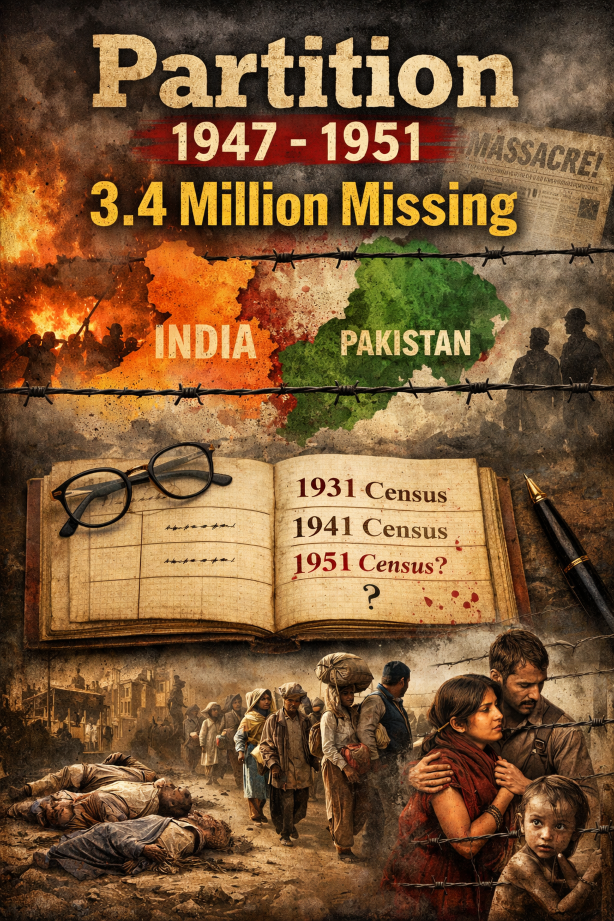
Partition Genocide Census Evidence: 3.4 Million Missing from 1947-1951
Series: Demographic Reckonings: When Population Data Exposes Hidden Agenda
The Census Doesn’t Lie: Demographic Analysis Proves What Official Narratives Hide
Seventy-seven years ago today, on February 28, 1948, the 1st Battalion, Somerset Light Infantry departed Bombay harbor—the last British troops to leave India. As they sailed for England with neatly filed reports and carefully documented handover procedures, they left behind something their archives never properly recorded: a genocide still unfolding across Punjab, Bengal, and Sind. Official British and Indian histories would later cite conservative death tolls of “200,000 to 1 million” across all communities, framing the violence as “unfortunate communal riots” rather than systematic religious cleansing. But Partition genocide census evidence tells a different story—one grounded not in interpretive narratives or political reconciliation, but in raw demographic mathematics that cannot be dismissed. When British troops departed on this day in 1948, trains filled with corpses still arrived in Punjab stations, 400,000 Sindhi Hindus were desperately fleeing westward, and the Kashmir war raged with the siege of Skardu entering its third week. The census data from districts across the subcontinent would eventually reveal what British officials sailing home that day chose not to document: 3.4 million people “missing” between calculated outflows and documented inflows—the largest unrecognized genocide of the 20th century, hidden in plain sight within government records.
Thank you for reading this post, don't forget to subscribe!Using rigorous census gap analysis pioneered by economists Prashant Bharadwaj, Asim Khwaja, and Atif Mian in their groundbreaking 2008 study “The Partition of India: Demographic Consequences,” the evidence reveals 3.4 million people “missing” between calculated outflows and documented inflows during the immediate Partition period (1946-1951). This isn’t speculation—it’s arithmetic from comparing 1931, 1941, and 1951 census data across 400+ districts.
Partition genocide census evidence forces us to confront uncomfortable truths: the scale of elimination was far larger than official narratives admit, the violence was asymmetrically targeted against religious minorities (particularly Hindus and Sikhs in areas becoming Pakistan), and the death toll—when subjected to the “acid test” of demographic science—reveals systematic cleansing that meets the UN definition of genocide.
The Census Gap Methodology: Evidence-Based Analysis
Partition genocide census evidence emerges from comparing what demographic projections predicted versus what actually occurred. The methodology is straightforward and transparent:
Step 1: Calculate Expected Outflows
Using 1931 census data (chosen because 1941 data was incomplete due to WWII and suspect due to potential political/communal inflation), researchers identified minority populations in districts that would become religiously hostile territory:
- Hindus and Sikhs in areas designated for Pakistan
- Muslims in areas designated for India
Applying standard population growth rates (1.3-1.5% annually based on historical regional patterns), they projected what these populations should be in 1951, then calculated how many would need to flee as religious minorities facing targeted violence.
Result: 17.9 million people expected to migrate (leave their homes due to Partition-related religious targeting)
Step 2: Count Documented Inflows
The 1951 censuses of India and Pakistan included a specific question: “Did you move due to Partition?” This captured documented refugee arrivals:
- 7.3 million Hindus/Sikhs arriving in India from Pakistan
- 7.2 million Muslims arriving in Pakistan from India
Result: 14.5 million documented arrivals
Step 3: Calculate the Gap
Simple subtraction reveals the shortfall:
- Expected migrants: 17.9 million
- Actual arrivals: 14.5 million
- Missing: 3.4 million people
This isn’t a vague estimate—it’s the direct mathematical output of census comparisons. These 3.4 million people were projected to migrate based on 1931 baselines and expected growth, but they never appeared in 1951 arrival counts.
Where Did 3.4 Million People Go? Breaking Down the Evidence
Partition genocide census evidence doesn’t just reveal the gap—it quantifies what happened to these missing people through cross-verification with multiple data sources.
Primary Attribution: Deaths (2.5-3 Million)
The vast majority of the shortfall—approximately 70-85% or 2.5-3 million people—represents deaths during the Partition chaos:
Direct Violence Deaths (1-1.5 Million):
- Targeted killings in riots and organized attacks
- Massacres of entire villages
- Ambushes on refugee trains and convoys
- Documented atrocities like train massacres where entire carriages arrived filled with corpses
Transit Deaths (1-1.5 Million):
- Disease outbreaks in overcrowded refugee camps (cholera, typhoid, dysentery)
- Starvation during weeks-long marches across hostile territory
- Exposure deaths during monsoon season migrations
- Calculated 15-16% mortality rate among migrants based on survival data
The research shows regional asymmetries: in West Punjab (becoming Pakistan), the missing population was disproportionately Hindu and Sikh, while in East Punjab (India), Muslims bore heavier losses. This regional variation proves systematic religious targeting rather than random communal chaos.
Forced Conversions and Abductions (100,000-500,000)
Official recovery operations documented 75,000-100,000 women abducted across borders during Partition, many forcibly converted to Islam or Christianity. But the census religious composition shifts in districts suggest broader conversion patterns:
- Women and children abducted and converted were enumerated under their new religion in 1951 censuses
- They appear “missing” from minority counts but not from total population
- District-level analysis shows religious percentage changes inconsistent with pure migration/death patterns
- Upper sustainable estimate: up to 500,000 forced conversions, though documentation is incomplete
Data Residuals (200,000-500,000)
A small portion of the gap reflects unavoidable census limitations in a pre-digital era:
- Incomplete enumeration due to destroyed district records
- Displaced census officials unable to conduct complete counts
- Temporary camp populations not fully captured
- 1941 baseline uncertainties due to WWII disruptions
The researchers explicitly acknowledge these limitations, making their findings more credible, not less. They used multiple cross-validation methods to minimize these errors.
Hindu and Sikh Specific Losses: The Disproportionate Toll
Partition genocide census evidence reveals that while Muslims also suffered tremendously (approximately 1.3 million missing, primarily in East Punjab), the pattern of elimination differed fundamentally.
For Hindus and Sikhs in West Pakistan:
- Pre-Partition population: ~5-7 million (15-20% of population)
- Expected 1951 population with growth: ~6-8 million
- Actual 1951 population: ~530,000-540,000 (1.6%)
- Refugees who reached India: ~4.7 million
- Missing: ~800,000-1 million
This represents near-total elimination of Hindu and Sikh presence in West Pakistan through a combination of:
- Direct killings: 500,000-800,000 (based on district-level shortfalls after refugee counts)
- Forced conversions: 100,000-300,000 (primarily women and children)
- Transit deaths: 100,000-200,000 (disease, starvation during flight)
Sustainable upper limit for Hindu/Sikh deaths and conversions: 1-2 million
This figure emerges directly from census mathematics, not from inflating eyewitness accounts or political advocacy. It represents the highest defensible estimate when cross-checking multiple data sources.
Why This Matters: Genocide Recognition
Partition genocide census evidence meets the UN Genocide Convention definition which requires “acts committed with intent to destroy, in whole or in part, a national, ethnical, racial or religious group.”
The evidence shows:
Intent: Religious targeting was deliberate and systematic. The Two-Nation Theory explicitly demanded religious separation. Direct Action Day 1946 was called specifically to force Pakistan’s creation through violence.
Scale: 3.4 million missing, with 1-2 million Hindus/Sikhs killed or forcibly converted, represents partial destruction of religious groups in their ancestral territories.
Systematic Nature: Census data shows near-total elimination of minorities in specific regions (e.g., West Punjab Hindu/Sikh population dropping from 20% to 1.6%), achieved through organized violence, not random riots.
State Involvement: While not always directly state-orchestrated, the violence was enabled and legitimized by political demands for religious states, with authorities often passive or complicit.
Yet Partition genocide census evidence remains unrecognized internationally. The Holocaust (6 million deaths) receives universal acknowledgment, memorialization, and educational prominence. Partition (3.4 million missing, 1-2 million Hindu/Sikh deaths) is dismissed as “communal violence” with “both sides” responsible, as documented in Western media manipulation patterns.
Who Bears Responsibility? The Question Official History Won’t Answer
Partition genocide census evidence documents what happened, but who is responsible for 3.4 million missing people and 1-2 million Hindu/Sikh deaths?
Was it Jinnah, who demanded Pakistan and called for Direct Action Day that killed thousands before Partition even occurred?
Was it the British, who implemented divide and rule policies for centuries, then drew hasty Radcliffe Line boundaries ignoring demographic realities?
Was it Nehru, who as documented in his writings, later minimized religious persecution in official histories to maintain his “secular synthesis” narrative?
Was it Hindus themselves, for not resisting more vigorously, for maintaining tolerance principles (as explored in civilizational vulnerability analyses) that made them vulnerable to aggressive ideologies?
But there’s a question that cuts deeper: Was it Gandhi, the man who transformed a marginal Muslim League from 4.4% of Muslim votes in 1937 to the dominant voice of Indian Muslims through continuous appeasement and legitimization?
Gandhi opposed Subhas Chandra Bose’s militant nationalism, refused to challenge British-Muslim League collusion, accepted Pakistan rather than risk Hindu-Muslim unity through strength. His policy of “ahimsa at any cost” left Hindus and Sikhs defenseless when religious violence erupted. He fasted to force Indian government to pay Pakistan money during active war, but never fasted to stop massacres of Hindus in Noakhali or Punjab.
Did Gandhi’s appeasement create the monster that consumed 3.4 million lives? Did his legitimization of religious separatism enable the genocide Partition genocide census evidence now proves? The census data cannot answer this—but it forces us to ask questions official histories have avoided for 78 years.
Conclusion: Why Census Evidence Cannot Be Dismissed
Partition genocide census evidence represents the most rigorous accounting of 1947’s human catastrophe because it relies on the one source that cannot be dismissed through narrative manipulation: arithmetic.
The Bharadwaj, Khwaja, and Mian study used 400+ district datasets, cross-verified with refugee registries, and applied transparent mathematical projections. Their finding—3.4 million missing people—isn’t an estimate that can be negotiated down through political reconciliation or “both sides” rhetoric.
The breakdown withstands scrutiny:
- 2.5-3 million deaths (direct violence + transit hardships)
- 100,000-500,000 forced conversions
- 200,000-500,000 data residuals from census limitations
For Hindus and Sikhs specifically: 1-2 million killed or converted represents the sustainable upper limit when applying the acid test of demographic science.
This isn’t victimhood narrative or communal point-scoring. It’s facing the mathematical reality that official histories have hidden behind conservative “200,000-1 million total deaths” figures that fail the census gap test.
The Holocaust killed 6 million Jews and receives universal recognition as genocide. Partition eliminated 3.4 million people, with 1-2 million Hindu/Sikh deaths, yet remains dismissed as “communal violence.”
Partition genocide census evidence proves this double standard is unsustainable. The numbers don’t lie. The question is: when will official histories finally tell the truth?
Share this article if you believe demographic science should override political narratives. The 3.4 million missing people of Partition deserve recognition equal to that given to Holocaust victims. Evidence-based history demands it.
Feature Image: Click here to view the image.
Videos
Glossary of Terms
- Census Gap Analysis: A demographic method comparing projected population based on pre-Partition baselines (e.g., 1931 census with growth rates) against actual post-Partition counts and documented refugee inflows to identify “missing” people, as used in the Bharadwaj, Khwaja, and Mian study.
- Missing Population: Individuals projected to exist or migrate in 1951 based on 1931 census data and natural growth but absent from documented refugee arrivals or censuses, estimated at 3.4 million during Partition (1947-1951), largely attributed to deaths, conversions, or census limitations.
- Involuntary Migration: Forced large-scale population movement due to violence or threat, as in the 1947 Partition, involving 14.5-17.9 million people crossing borders along religious lines between India and Pakistan.
- Two-Nation Theory: The ideological basis for Partition, positing that Hindus and Muslims constituted separate nations requiring distinct states (India and Pakistan), leading to religious separation and targeted violence.
- Direct Action Day: August 16, 1946, Muslim League-called protest in Calcutta that escalated into communal killings (thousands dead), seen as a precursor to Partition violence and systematic religious targeting.
- Genocide: Acts committed with intent to destroy, in whole or in part, a national, ethnical, racial, or religious group (per UN Convention), argued here to apply to Partition’s systematic elimination of minorities (e.g., Hindus/Sikhs in West Pakistan).
- Forced Conversions: Coercive change of religious identity during Partition, often involving abductions (especially women/children), with estimates of 100,000-500,000 affected, leading to religious composition shifts in censuses.
- Transit Deaths: Mortality during migration due to disease (cholera, typhoid), starvation, exposure, or hardships in refugee camps/convoys, contributing 1-1.5 million to the missing gap (15-16% migrant mortality rate).
- Radcliffe Line: The hastily drawn 1947 boundary by Cyril Radcliffe dividing Punjab and Bengal, ignoring demographic realities and enabling chaos, massacres, and cleansing.
- Communal Violence: Riots and killings along religious lines, framed in official narratives as mutual but argued here as asymmetrically targeted against minorities (particularly Hindus/Sikhs in Pakistan areas).
#Partition1947 #HinduGenocide #SikhGenocide #IndiaPartition #MissingMillions #HinduinfoPedia
Annexure
Why the 1931 census was chosen as the baseline (important qualification):
To ensure demographic accuracy in estimating Partition-era “missing” populations, the Bharadwaj, Khwaja, and Mian (2008) study — widely cited for its rigorous census-gap analysis — deliberately uses the 1931 census as the reliable baseline rather than 1941. The authors describe the 1941 census as having “suspect” quality and incomplete tabulation, noting wartime disruptions from World War II (covering only limited regions like parts of the Indus and Ganges systems) and political/communal biases. The 1941 Census introduction itself states: “There was a tendency in the more communal quarters to look on the census enumerators as the ready tools of faction.” The 1951 Pakistan census further notes efforts by communities to “inflate their figures for political purposes.”
This is corroborated by historical growth trends: Muslim population growth was balanced at ~13.0% from 1921–1931 (vs. Hindus ~10.6%, overall ~10.9%), but spiked anomalously to ~18.5% from 1931–1941 (vs. Hindus ~6.5%, overall ~10–15%), consistent with manipulation claims amid pre-Partition negotiations over religious representation and the Two-Nation Theory. Post-Partition trends revert to expected natural patterns (e.g., Muslims +32.7% vs. Hindus ~+20–21% in India 1951–1961), with no similar anomalies, reinforcing the validity of preferring 1931 projections for unbiased outflow estimates.
Sources for verification:
• Bharadwaj, Khwaja, and Mian (2008): Abstract & download (or direct PDF: here)
• Related migratory flows paper (data choices discussion): EPW version
• Census growth trends & religious composition: Pew Research; Wikipedia Demographics of India (tables)
• 1941 Census original report reference: Archived PDF
https://hinduinfopedia.in/?p=25243