
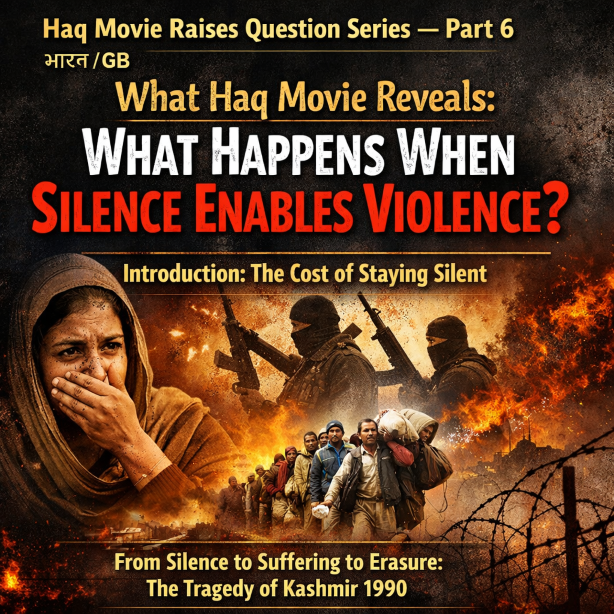
What Haq Movie Reveals: What Happens When Silence Enables Violence?
Haq Movie Raises Question Series — Part 6
भारत/ GB
What Haq Movie Reveals: The Cost of Staying Silent
The Haq movie showed Shazia Bano’s silence enabling her abuse—serving tea to her husband’s second wife, enduring community mockery, watching her children suffer. The film’s dramatic arc turns on her decision to break that silence and challenge the system through courts. What Haq Movie Reveals about the consequences of silence applies far beyond one woman’s personal struggle.
Thank you for reading this post, don't forget to subscribe!When Hindus stayed silent about systematic violence against their community, the results weren’t personal humiliation—they were genocide. What Haq Movie Reveals through its narrative structure (silence → suffering → erasure) became reality for 400,000 Kashmiri Hindus in 1990. The difference: Shazia’s silence lasted months before the Supreme Court heard her. Hindu silence about Kashmir has lasted 35 years, and the perpetrators still haven’t faced justice and still counting.
This blog examines what happens when an entire civilization stays silent while violence eliminates its presence from ancestral lands—and how even the language used to describe that elimination becomes part of the denial.
January 19, 1990: The Night That Changed Kashmir Forever
The Organized Elimination
What Haq Movie Reveals about accumulated humiliations turning into systematic oppression found its darkest expression in Kashmir. On the night of January 19, 1990, mosques across the Kashmir Valley used loudspeakers to issue ultimatums to Kashmiri Hindus (Pandits): convert to Islam, leave Kashmir, or face death.
The slogans broadcast that night weren’t metaphorical threats:
- “Raliv, Tsaliv ya Galiv” (Convert, Leave, or Die)
- “Kashmir mein agar rehna hai, Allah-O-Akbar kehna hai” (If you want to live in Kashmir, you must say Allah-O-Akbar)
- “Asi gachchi Pakistan, Batao roas te Batanev san” (We want Pakistan, without Pandit men but with their women)
According to documented testimonies compiled by the Kashmiri Pandit Sangharsh Samiti, these weren’t isolated incidents—they were coordinated announcements across the Valley’s mosque network, reaching every Hindu household simultaneously.
The pattern of using religious infrastructure for violence parallels Lebanon’s transformation, where similar coordination eliminated Christian majorities from entire regions.
🔍 Historical Context
Guru Arjan Dev Martyrdom: Consequence of Islamic Fundamentalism
The pattern of religious violence followed by institutional denial began centuries earlier—Sikh history documents identical cycles of persecution, silence, and erasure that What Haq Movie Reveals about consequences of not speaking up.
Genocide Without the Name: Testing Kashmir 1990 Against the UN Definition
How Language Enables Denial
What Haq Movie Reveals about narrative framing becomes critical when examining how the events of 1990 in Kashmir are described. The Indian government, sections of the media, and even some historians frequently use the term “exodus”—a word that suggests voluntary migration, as if nearly 400,000 people simply chose to leave their homes simultaneously.
The documented record presents a different picture: a pattern of violence, intimidation, and forced displacement directed at a specific religious community.
Evidence of Systematic Targeting
Targeted killings: According to the NHRC 1999 report, the months preceding the displacement saw systematic assassinations of prominent Hindus in Kashmir. These killings created a climate of fear across the entire community.
- Tika Lal Taploo (BJP leader) – September 14, 1989
- Justice Neelkanth Ganjoo – November 4, 1989
- Lassa Kaul (Director, Doordarshan Kendra) – February 1990
- Numerous other killings of civilians between late 1989 and early 1990
Systematic Terror
Eyewitness accounts documented by KPSS
describe widespread intimidation directed specifically at the Hindu minority in the Valley.
Eliminating prominent community figures signaled that members of the group were being singled out for violence.
Systematic terror: Eyewitness accounts documented by KPSS describe widespread intimidation directed specifically at the Hindu minority in the Valley.
- Threats broadcast from mosques warning non-Muslims to leave
- Homes marked to identify Hindu residents
- Kidnappings, sexual violence, and intimidation of women
- Temple desecrations and religiously motivated threats
These actions created conditions under which remaining in the Valley became impossible for much of the community.
Applying the Legal Test for Genocide
1. Killing Members of the Targeted Group
The months preceding the mass displacement were marked by targeted assassinations of prominent Pandits. Among those killed were political leader Tika Lal Taploo, retired judge Neelkanth Ganjoo, and broadcaster Lassa Kaul. These killings were widely interpreted as signals to the broader community that they had become targets.
Documented killings of community members during this period established a climate of fear that preceded the large-scale flight of the population.
2. Causing Serious Bodily or Mental Harm
Numerous survivor testimonies describe threats, kidnappings, assaults, and sexual violence directed at members of the Pandit community. Beyond physical attacks, psychological terror played a critical role. Threatening slogans broadcast from mosque loudspeakers across the Valley created a pervasive sense of imminent danger.
Such acts fall within the Genocide Convention’s category of causing serious bodily or mental harm to members of the group.
3. Creating Conditions That Made Survival Impossible
On the night of January 19, 1990, survivor testimonies describe slogans interpreted as demanding that Hindus convert, leave the Valley, or face violence. These ultimatums were widely reported by survivors and journalists documenting the events.
The result was a rapid and near-total displacement. Estimates suggest that between 300,000 and 400,000 Kashmiri Hindus fled the Valley within months. A community that had lived in the region for centuries was effectively removed from its homeland.
In genocide law, intent is rarely proven through written orders. International tribunals instead infer intent from patterns of conduct: systematic targeting of a protected group, coordinated threats, and actions that make continued existence impossible within a territory. The combination of targeted killings, public threats demanding that Hindus leave, and the rapid disappearance of the community from the Valley constitutes a pattern from which genocidal intent can reasonably be inferred.
4. Resulting Demographic Elimination
Although the Genocide Convention does not explicitly list expulsion, scholars often treat forced demographic removal resulting from targeted violence as a form of ethnic cleansing closely linked to genocidal intent.
By the early 1990s, the Hindu population of the Kashmir Valley had collapsed from hundreds of thousands to only a few thousand individuals. This demographic transformation represented the near-elimination of a distinct religious community from the region.
Why the Term “Genocide” Was Avoided
Despite these parallels with the convention’s criteria, official institutions rarely used the term genocide. Even India’s National Human Rights Commission of India described the events only as “akin to ethnic cleansing.”
Several factors explain this linguistic restraint. Recognizing genocide carries international legal implications, including obligations for investigation and prosecution. It also raises politically sensitive questions about the role of militant groups and the failure of state institutions to protect citizens.
The result has been a persistent gap between the legal definition of genocide and the language used to describe the events in Kashmir.
The Institutional Gatekeepers: A Pattern of Opposition
What happens when silence is finally broken? The resistance to the films Haq, The Kashmir Files, and The Kerala Story (including its sequel) reveals a consistent pattern: those who benefited from or maintained the silence are often the first to lead the charge against the new narrative.
The Four-Film Pattern of Suppression
- Haq (The Shah Bano Story): This film faced legal hurdles and social protests aimed at preventing its release. The opposition mirrored the 1986 legislative move to nullify the Supreme Court’s ruling on individual rights in favor of institutional “reputation”.
- The Kashmir Files: Depicting the 1990 genocide, this film was met with intense attempts at delegitimization. Critics and political sections utilized labeling—such as “propaganda” and “inflammatory”—to prevent the mainstreaming of survivor testimonies.
- The Kerala Story & The Kerala Story 2: These films encountered state-level bans and coordinated physical disruptions. In 2026, screenings of The Kerala Story 2 were forcibly cancelled in districts across Kerala by activist groups.
- The Common Strategy: In all four instances, the opposition used a combination of Public Interest Litigation (PIL), State-sponsored bans, and Social intimidation to argue that “communal harmony” is more important than the “civilizational truth”.
The Breaking of Civilizational Silence
While the film Haq explores a woman breaking her personal silence to escape abuse, a critical civilizational breaking of silence arrived with the release of The Kashmir Files. The film forced a mainstream confrontation with the “Systematic Terror” that official terminology like “exodus” had successfully buried for over 35 years.
The Defiance of Unparalleled Resistance The subsequent silence of the Kashmiri Pandit community was not a sign of surrender. Their resistance has been unparalleled—not through retaliatory violence, but through the stubborn preservation of their ancient culture, intricate rituals, and civilizational memory. Living in exile, their refusal to disappear from the historical record is the ultimate act of defiance against genocidal intent.
📖 Related Reading
Black September: The Forgotten War That Changed the Arab World
When Jordan’s King Hussein finally broke silence about Palestinian militias creating parallel authority, it required military action—What Haq Movie Reveals about delayed response costs applies to every conflict where silence enables violence to become normalized.
Government Complicity Through Classification
The NHRC Finding vs. Official Denial
What Haq Movie Reveals about institutional betrayal became reality when India’s own National Human Rights Commission investigated Kashmir—then watched the government ignore its findings.
The NHRC 1999 Report stated: “The full facts about the mass migration of Kashmiri Pandits from the valley has not been independently investigated so far. The exodus of the Kashmiri Pandits from the valley constituted a humanitarian disaster of enormous proportions. What happened to Kashmiri Pandits in 1989-90 was akin to ethnic cleansing.“
Note the careful language: “akin to ethnic cleansing”—not genocide, not even “is ethnic cleansing,” but “akin to.” Yet even this heavily qualified finding got buried.
Official government classification remains:
- “Migrant Kashmiri Pandits” (not refugees, not genocide survivors)
- “Exodus” (not expulsion, not genocide)
- Compensation packages labeled “relief for migrants” (not reparations for genocide victims)
Legal Classification Analysis
Evidence from Human Rights documentation suggests that using the term “Exodus” instead of “Genocide” serves specific bureaucratic goals:
- Admissions: Avoids acknowledging state failure to protect citizens.
- Investigations: Prevents international legal intervention.
- Remedies: Denies survivors appropriate legal restoration.
- Narrative: Maintains a fictional “communal harmony” in records.
According to analysis by the Jammu Kashmir Study Centre, this classification serves multiple purposes:
- Avoids admitting state failure to protect citizens
- Prevents international genocide investigation
- Denies survivors appropriate legal remedies
- Maintains fiction of “communal harmony” in official records
This pattern of institutional denial after violence mirrors how India’s judicial system investigates itself—perpetrators controlling the investigation produces predictable results.
Institutional Analysis
HinduinfoPedia Exclusive
This pattern of institutional denial after violence mirrors how India’s judicial system investigates itself—perpetrators controlling the investigation produces predictable results.
The Numbers: 400,000 Eliminated in 6 Months
Demographic Erasure
What Haq Movie Reveals about consequences becomes stark in numbers:
1990 Census (pre-genocide):
- Kashmiri Hindu population: ~400,000-500,000
- Percentage of Valley population: ~15%
- Concentrated in: Srinagar, Anantnag, Baramulla
1991 (post-genocide):
- Remaining Hindus in Valley: ~3,000-4,000
- Percentage: <0.1%
- Living in: Refugee camps in Jammu (over 60,000+ still in camps today)
According to official government data from the Ministry of Home Affairs, 62,000+ families (approximately 250,000-300,000 individuals) registered as “migrants” from Kashmir Valley. Independent estimates place the actual number closer to 400,000.
35 years later (2025):
- Hindus still living in Valley: ~3,000-5,000
- Return rate: <1%
- Families still in refugee camps: 40,000+
- Generations born in exile: 2-3
The complete demographic elimination achieved through violence gets classified as “migration.” The demographic strategy playbook operating in Kashmir mirrors patterns across the globe where violence precedes demographic replacement.
🌍 Global Pattern
Palestinian Refugees: Why No Muslim Country Will Take Them
While Palestinian “refugees” 75 years later receive UN agencies and global sympathy, Kashmiri Hindu genocide survivors get labeled “migrants”—What Haq Movie Reveals about selective compassion based on theological classification explains the differential treatment.
Survivor Testimonies: The Human Cost of Silence
Voices From the Camps
What Haq Movie Reveals about accumulated trauma manifests in survivor accounts that remain largely unheard:
Sushil Pandit, survivor and activist: “We were told to leave or die. We left with whatever we could carry. 35 years later, we’re still in one-room tenements, our children born in exile, and the world calls it ‘migration.'”
Girja Tickoo case (March 1990): A laboratory assistant was abducted, gang-raped, and murdered—her body brutally murdered after abduction and rape. No convictions. Official classification: Isolated incident, not systematic genocide.
Sarla Bhat testimony (documented by KPSS): “They came at night, shouting slogans. My husband was a teacher—they shot him in front of our children because he refused to convert. The government gave us ₹1 lakh compensation and called us ‘migrants.'”
These aren’t isolated stories. The Kashmir Pandit Genocide Database documents over 1,000 verified killings with names, dates, locations. Yet mainstream discourse continues using “exodus.”
The parallels to how violence against Hindus gets systematically downplayed while manufacturing outrage over Hindu defensive responses reveals the classification hierarchy explored in Part 2 of this series.
⚖️ Legal Dimension
Public Order and Protests: Supreme Court’s Shaheen Bagh Failure
When courts delay accountability for blockading national highways but provide instant relief to protesters, What Haq Movie Reveals about institutional bias becomes operational reality—the same pattern that let Kashmir genocide perpetrators evade justice for 35 years.
The Pattern: Silence Brings Erasure, Not Peace
Lessons the Haq Movie Teaches
What Haq Movie Reveals through its narrative arc applies to civilizational survival:
In the film:
- Shazia stays silent → abuse continues
- Community pressures silence → isolation deepens
- Legal system offers recourse → she must speak to access it
- Breaking silence → path to justice (even if incomplete)
In Kashmir:
- Hindus stayed silent about threats → violence escalated
- Government pressured silence (“maintain communal harmony”) → genocide planning continued
- International community ignored warnings → ethnic cleansing proceeded unchecked
- 35 years of silence → perpetrators unpunished, survivors erased from narrative
The film showed: One woman’s voice could challenge patriarchal authority
Kashmir proved: An entire community’s silence enabled their elimination
The systematic bias in how India’s institutions handle Hindu grievances versus minority demands creates incentive structures where silence becomes survival strategy—until silence enables complete erasure.
🎯 Series Navigation
Previous Blogs:
• Part 1: Haq Movie Raises Question – Hindu Haq Is the Answer
• Part 2: Haq Movie and Kafir Classification
• Part 3: Hindu Haq Is Denied – Theological Foundation
• Part 4: Where Did This Contempt Get Manufactured?
Next: Part 6 – What Haq Movie Reveals: Is This New, Or Part of Something Older?
Conclusion: The Imperative to Speak
What Haq Movie Reveals isn’t just film analysis—it’s civilizational warning. The same narrative arc that makes Shazia Bano’s story compelling (silence → suffering → voice → justice) applies to Hindu communities facing systematic violence.
Kashmir 1990 proved that staying silent to “maintain peace” doesn’t prevent violence—it enables genocide. The linguistic manipulation that converts “genocide” into “exodus,” “ethnic cleansing” into “migration,” and “survivors” into “refugees” continues only because silence allows it.
- The government won’t correct the classification.
- The media won’t change the framing.
- The perpetrators won’t confess.
- The international community won’t investigate.
What Haq Movie Reveals is that justice requires voice—and that voice must break through institutional silence, media manipulation, and governmental complicity. The next blog examines whether Kashmir 1990 was unprecedented or part of a centuries-long pattern that Hindu silence has enabled to continue unchallenged.
Because if What Haq Movie Reveals about consequences of silence is true, then examining historical patterns becomes survival necessity, not academic exercise.
What comes next: The Historical Pattern Questions: Is This New, Or Part of Something Older
Feature Image: Click here to view the image.
Videos
Glossary of Terms
- Haq Movie: A film narrative used in the blog series as an analytical framework to explore themes of silence, injustice, and resistance against systemic oppression.
- Shazia Bano: The central character referenced from the Haq movie whose silence in the face of abuse symbolizes how prolonged silence can enable continued injustice.
- Kashmiri Pandits: A Hindu ethnoreligious community native to the Kashmir Valley who were forced to flee the region during the violence of 1989–1990.
- Kashmiri Pandit Genocide: A term used by many scholars, activists, and survivors to describe the targeted killings, threats, and forced displacement of Kashmiri Hindus from the Kashmir Valley around 1990.
- January 19, 1990: The night widely remembered by Kashmiri Pandits as the turning point when mass threats and intimidation across the Kashmir Valley triggered large-scale displacement.
- Raliv, Tsaliv ya Galiv: A Kashmiri slogan translated as “Convert, Leave, or Die,” reportedly broadcast during the 1990 intimidation campaign against Kashmiri Hindus.
- Kashmiri Pandit Sangharsh Samiti (KPSS): A community organization representing Kashmiri Pandits that has documented testimonies, displacement records, and historical evidence related to the 1990 events.
- Ethnic Cleansing: A process in which a particular ethnic or religious group is forcibly removed from a geographic area through intimidation, violence, or systemic discrimination.
- Genocide: Under the United Nations Genocide Convention, acts committed with intent to destroy, wholly or partly, a national, ethnic, racial, or religious group.
- UN Genocide Convention (1948): An international treaty that legally defines genocide and obligates nations to prevent and punish acts intended to destroy protected groups.
- NHRC 1999 Report: Findings by India’s National Human Rights Commission describing the displacement of Kashmiri Pandits as a humanitarian disaster and acknowledging elements similar to ethnic cleansing.
- Ethnic Demographic Erasure: A long-term process in which a community disappears from a region due to violence, forced migration, or systematic pressure.
- Kashmiri Hindu Refugee Camps: Temporary settlements established mainly in Jammu and other regions to house displaced Kashmiri Pandits following the 1990 crisis.
- Girja Tickoo Case: A widely cited case from 1990 involving the brutal killing of a Kashmiri Pandit woman, often referenced in discussions of violence during the displacement period.
- Sushil Pandit: A Kashmiri Pandit activist and commentator who has publicly spoken about the experiences and struggles of displaced Kashmiri Hindus.
- Institutional Narrative: The official framing or interpretation adopted by governments, media institutions, or academic discourse regarding controversial historical events.
- Linguistic Framing: The process by which the choice of words (such as “exodus” instead of “genocide”) shapes public perception and historical interpretation.
- Demographic Replacement: A geopolitical or sociological concept referring to population changes in a region caused by migration, displacement, or conflict-driven removal of communities.
#Kashmir #KashmiriPandits #KashmirGenocide #Kashmir1990 #HinduHistory #HinduRights #EthnicCleansing #GenocideHistory #HumanRights #HinduinfoPedia
External Supporting Links
- A. Ministry of Home Affairs – displacement data: According to India’s Ministry of Home Affairs, 64,827 Kashmiri Pandit families left the Kashmir Valley during the early 1990s due to militancy.
- B. Parliamentary reply in Lok Sabha: In a written reply in the Lok Sabha, the Ministry of Home Affairs stated that over 64,000 Kashmiri Pandit families were displaced from the Valley during the militancy period.
- C. Alexander Evans (Oxford academic research): Political scientist Alexander Evans documented how targeted killings and militant intimidation contributed to the departure of Kashmiri Pandits during the insurgency.
- D. Rahul Pandita – survivor account: Journalist Rahul Pandita’s memoir Our Moon Has Blood Clots documents the lived experience of Kashmiri Pandit families who fled the Valley in 1990.
- E. Human Rights Watch: International human rights groups documented targeted assassinations and intimidation during the insurgency period in Kashmir.
- F. Amnesty International: Amnesty International also documented widespread human rights violations during the Kashmir insurgency, including attacks on civilians.