
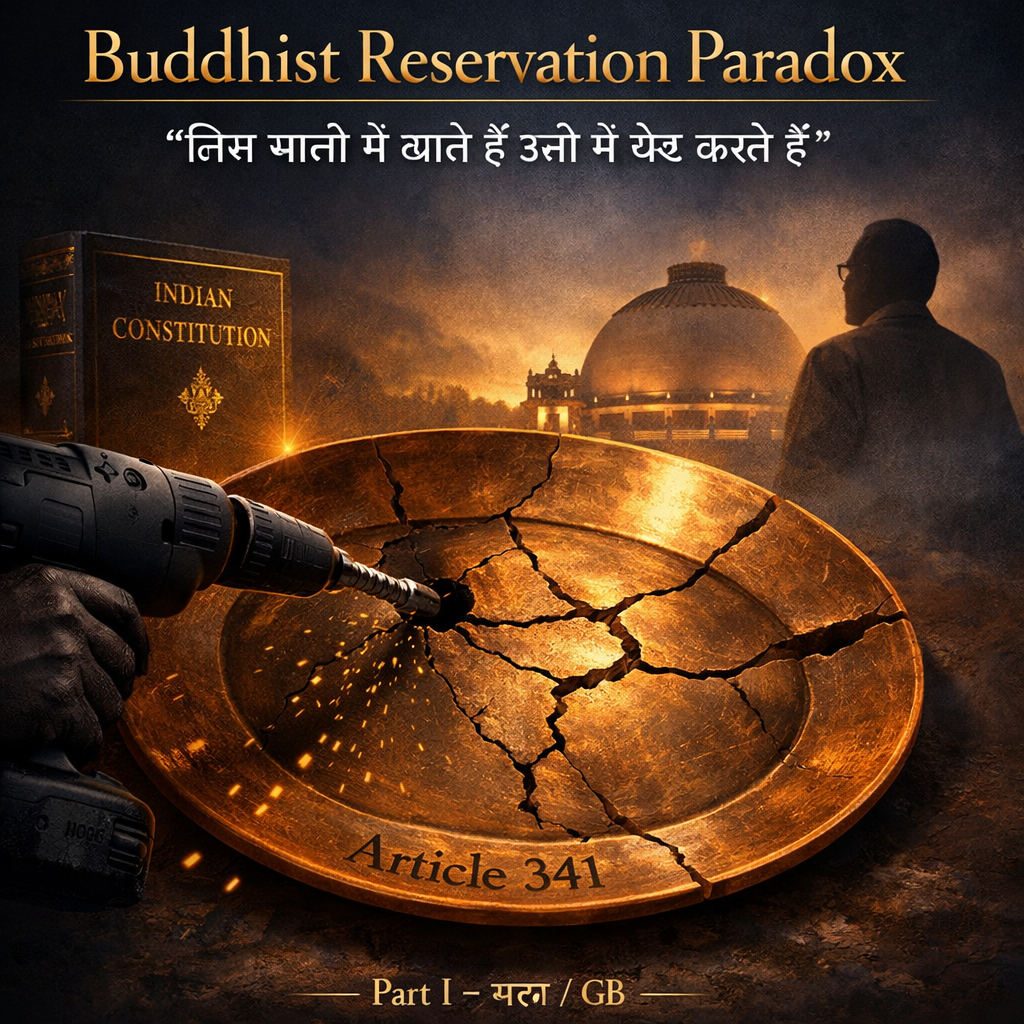
Buddhist Reservation Paradox: Biting the Hand That Feeds
Part I – The Buddhist Reservation Paradox
भारत/GB
Buddhist Reservation Paradox and the Hindi Proverb That Explains Everything
Every civilization that survives five thousand years does so because it develops immune systems — mechanisms that identify internal contradictions before they metastasize into existential threats. Hindu civilization is now facing one such contradiction so brazen, so structurally embedded, that most people cannot see it even when it operates in plain daylight. The Hindi proverb captures it perfectly: जिस थाली में खाते हैं उसी में छेद करते हैं — they drill holes in the very plate that feeds them.
Thank you for reading this post, don't forget to subscribe!Every civilization that survives five thousand years does so because it develops immune systems — mechanisms that identify internal contradictions before they metastasize into existential threats.
Hindu civilization is now facing one such contradiction so brazen, so structurally embedded, that most people cannot see it even when it operates in plain daylight.
The Hindi proverb captures it perfectly: जिस थाली में खाते हैं उसी में छेद करते हैं — they drill holes in the very plate that feeds them.
While ancient Vedic texts and the Manu Smriti explicitly describe the varna system as merit-based — determined by an individual’s qualities (guna) and actions (karma), not by birth (as stated in Bhagavad Gita 4.13: “The fourfold order was created by Me according to qualities and work”) — this flexible, functional division was later transformed into a rigid, hereditary birth-based system (jati). The rules governing varna marriages (anuloma and pratiloma) form a separate construct with distinct regulations for progeny classification and social order, but they do not make birth the exclusive or primary basis for determining an individual’s own varna. The most significant hardening and institutionalization of birth-based caste occurred under British colonial policies through mechanisms such as censuses (starting 1871–1872), the Criminal Tribes Act of 1871, divide-and-rule strategies, the Communal Award of 1932, separate electorates, Zamindari land systems, and legal codifications like the Indian Penal Code of 1860.1
This is the Buddhist Reservation Paradox — the institutional arrangement where individuals who have taken formal, public, written vows rejecting Hinduism as “harmful for humanity” continue to draw constitutional benefits designed exclusively for victims of the Hindu caste system. They eat from the plate of Hindu victimhood while publicly drilling holes in Hindu civilization itself.
As they say in Hindi: “जिस थाली में खाते हैं उसी में छेद करते हैं”
This is not a theological dispute. This is not about Buddhism versus Hinduism. This is about a political arrangement that has operated unchallenged for over three decades, funded by Hindu taxpayers, shielded by constitutional provisions, and increasingly weaponized for demographic conquest.
The Basic Contradiction: Vow 5 Meets Article 341
On October 14, 1956, at Deekshabhoomi in Nagpur, Dr. B.R. Ambedkar administered 22 vows to approximately 380,000–700,000 followers converting from Hinduism to Buddhism. These were not spiritual affirmations. They were declarations of complete severance.
Vow 1:
“I shall have no faith in Brahma, Vishnu and Mahesh nor shall I worship them.”
Vow 2:
“I shall have no faith in Rama and Krishna who are believed to be incarnation of God nor shall I worship them.”
Vow 3:
“I shall have no faith in ‘Gauri’, Ganapati and other gods and goddesses of Hindus nor shall I worship them.”
Vow 5:
“I do not and shall not believe that Lord Buddha was the incarnation of Vishnu. I believe this to be sheer madness and false propaganda.”
Vow 19:
“I renounce Hinduism which is harmful for humanity and impedes the advancement and development of humanity because it is based on inequality.”
Read those again. Not “I am reforming Hinduism.” Not “I am returning to the original Vedic dharma.” But: Hinduism itself is harmful for humanity. Total, explicit, absolute separation.
Now place this against the constitutional reality. The Constitution (Scheduled Castes) Order of 1950 originally limited SC status to Hindus only. The logic was straightforward: caste discrimination is a product of the Hindu social system, so only those who remain within that system and suffer its consequences qualify for remedial benefits. Sikhs were added in 1956. Buddhists were added in 1990 — thirty-four years after Ambedkar’s mass conversion.
The Buddhist Reservation Paradox crystallizes here: you cannot simultaneously declare Hinduism “harmful for humanity,” take vows of “complete severance” from it, reject every Hindu deity by name, call the Buddha-Vishnu connection “sheer madness” — and then claim constitutional benefits that exist solely because you were once a victim of that very Hindu system.
The logic is broken. You left. You said so publicly. You carved the vows in marble at Deekshabhoomi. You administer them at every conversion ceremony to this day. Either you are part of the Hindu social system (and therefore subject to its caste consequences) or you have completely severed from it (as you publicly declared). You cannot be both.
The 22 vows were not a gentle renunciation or reform of Hinduism. They were a public, explicit, and absolute condemnation: calling Hinduism “harmful for humanity” (Vow 19), rejecting its deities by name (Vows 1–3), and dismissing core beliefs like Buddha as Vishnu’s incarnation as “sheer madness and false propaganda” (Vow 5). These were carved in marble at Deekshabhoomi and continue to be administered at every conversion ceremony today.
In 1956, under Nehru, these vows were not treated as sedition, hate speech, or incitement. No legal action was taken against Dr. Ambedkar or the converts for these declarations. Statements perceived as hurting Hindu sentiments were often tolerated when directed against Hinduism itself.
By contrast, primary records from the same period show enforcement of IPC Sections 153A and 295A in cases involving outrage to Muslim religious feelings — for example, the conviction upheld in Ramji Lal Modi v. State of U.P. (AIR 1957 SC 620), where an article deemed to outrage Muslim sentiments led to prosecution. Similar language directed against another community would likely have invited swift legal action under these provisions.
Ambedkar and Caste Series
How did Dr. Ambedkar’s political journey — shaped by clashes with Nehru and Gandhi — lead to the strategic choice of Buddhism? This series documents the ideological divergence that transformed caste reform into religious conversion and political mobilization.
Explore now:
Why This Is Not an Academic Debate
This paradox would be merely philosophical if it did not involve real institutional power, real taxpayer money, and real demographic consequences.
The reservation system channels billions of rupees annually into educational seats, government jobs, promotions, and political representation for Scheduled Castes. Every rupee comes from Indian taxpayers — the overwhelming majority of whom are Hindu. The system was designed as remedy, as civilizational self-correction by a Hindu-majority society that acknowledged caste discrimination as a historical wrong.
When Hindu society agreed to the 1990 amendment extending SC status to Buddhists, it was an act of generosity. The Hindu majority did not have to make that concession. The reasoning was compassionate: caste discrimination persists even after conversion, so practical relief should continue regardless of the religious label. This was Hindu society saying: your suffering matters more than your theological position.
This isn’t new — it’s been happening for years. Merit must be transparent for everyone.
That generosity has been repaid with a campaign to eliminate Hindu civilization itself. The Buddhist Reservation Paradox is not a loophole being passively exploited. It is a mechanism being actively weaponized — positions gained through Hindu-funded reservation are used to organize mass conversion events, fund anti-Hindu campaigns, and pursue explicit goals of demographic replacement.
Manusmriti and Caste Analysis
The caste system debate is incomplete without examining what the texts actually say versus what critics claim. This series provides section-by-section analysis — separating the Manusmriti’s original merit-based varna framework from its colonial-era distortions.
Explore now:
The Logic Test That Exposes the Paradox
Consider this simple test applied to other groups in identical situations.
Dalit Christians face the same caste discrimination after conversion. They are excluded from SC status. Dalit Muslims face similar caste discrimination after conversion. They are excluded from SC status. The constitutional reasoning is consistent: Christianity and Islam are classified as foreign-origin religions, so their converts cannot claim benefits tied to the Hindu caste system.
Dalit converts to Islam and Christianity often face caste-based discrimination and social exclusion within their communities—sometimes argued to be as severe as or worse than among Hindus in socio-economic terms (e.g., segregation in religious spaces, marriage, and occupations). Yet they receive no SC reservation as Dalits, because their faiths are deemed foreign-origin and do not officially recognize caste (though practice persists).
This exclusion stands in sharp contrast to the treatment of Buddhist converts.
Buddhism, however, gets the exemption — classified as an Indian-origin religion. There is no evidence that Dalits converted to Buddhism face systematic discrimination comparable to historical Hindu caste practices. This creates a logical inversion.
The 22 vows answer that question with absolute clarity: No. Not reform. Not respect. Not acknowledgment. But explicit, formal, public rejection — “harmful for humanity.”
Dalit Christians at least understand the contradiction. Millions of them in South India publicly maintain Hindu identity to retain SC benefits while privately practicing Christianity. Morally dishonest, yes. But at least they recognize that conversion should logically eliminate eligibility. The Buddhist Reservation Paradox operates without even that minimal shame. The rejection is open. The vows are public. The benefits continue.
Sanatan Dharma and Ethics
What do Hindu scriptures actually teach about social structure, merit, and duty? This series examines the original texts — not through colonial or political lenses, but as living documents of a civilization that has continuously reformed itself for millennia.
Explore now:
What This Series Will Examine
This seven-part investigation will systematically document every dimension of the Buddhist Reservation Paradox:
Blog 2 traces the constitutional evolution from the 1950 SC Order through the 1956 Sikh amendment to the critical 1990 Buddhist amendment — documenting the generosity Hindu society showed and the question it never asked.
Blog 3 examines all 22 vows in detail — demonstrating that these are not spiritual refinements but political declarations of total civilizational warfare against Hinduism.
Blog 4 documents the active demographic conquest campaign — the stated goal of converting “10 crore by 2025,” the Mission Jai Bheem infrastructure, and the foreign funding that powers it.
Blog 5 traces how reservation-enabled positions across the Supreme Court, politics, academia, and bureaucracy have been systematically weaponized — from beneficiary to aggressor.
Blog 6 applies the constitutional logic test rigorously — if Christians and Muslims are excluded as foreign-origin converts, how does a movement that explicitly rejects Indian civilizational values while taking foreign funding qualify as “Indian origin”?
Blog 7 closes with the dharmic standard of Kṛtajñatā (gratitude) — contrasting the Ambedkarite Buddhist approach with even the crypto-Christian approach, and asking: what does basic human decency demand from those who eat from a plate they are drilling holes in?
Manusmriti Deep Dives
Beyond the headlines and political slogans — what does the Manusmriti actually prescribe? These blogs go verse-by-verse through the most contested sections, separating merit-based varna from colonial-rigidified caste.
Explore now:
This Is About Institutional Integrity, Not Religious Rivalry
Let this be stated clearly from the outset: this series is not an attack on Buddhism. The Buddha was born in the dharmic tradition. His teachings on suffering, compassion, and the middle path are part of India’s civilizational inheritance.
This series targets a specific political phenomenon: the Ambedkarite movement that has transformed Ambedkar’s conversion into a permanent institutional weapon against Hindu civilization — using the very benefits Hindu civilization provides.
The Buddhist Reservation Paradox is ultimately a question of institutional integrity. Can a system designed to remedy historical discrimination within Hindu society be used to fund the elimination of that society? Can generosity shown in 1990 be repaid with a campaign for civilizational replacement? Can you renounce the plate publicly and continue eating from it?
जिस थाली में खाते हैं उसी में छेद करते हैं।
The plate will not hold forever. This series documents why — and what must change before it breaks.
Nehru Series
The political environment that shaped Ambedkar’s choices did not emerge in a vacuum. Nehru’s governance framework — Western-secular, exclusionary of traditional Hindu voices, hostile to radical reform — created the conditions for civilizational fracture.
Explore now:
Civilization Under Siege Series
The Buddhist Reservation Paradox is one mechanism among many targeting Hindu demographic and institutional survival. This series documents the mathematical evidence and strategic architecture of civilizational siege.
Explore now:
Credits
Primary Sources: Constitution (Scheduled Castes) Order, 1950 (Ministry of Social Justice and Empowerment); 22 Vows text from Dr. Babasaheb Ambedkar International Association for Education; Round Table India archives
Constitutional References: Act 63 of 1956 (Sikh amendment); Act 15 of 1990 (Buddhist amendment); Article 341, Constitution of India
Historical References: Deekshabhoomi conversion ceremony, October 14, 1956, Nagpur; Kaka Kalelkar Commission (1955); High-Powered Panel on Minorities, SCs and STs (1983)
Feature Image: Click here to view the image.
Videos
Glossary of Terms
- Buddhist Reservation Paradox: The institutional contradiction where individuals who formally renounce Hinduism through the 22 vows continue receiving constitutional benefits designed for victims of the Hindu caste system
- 22 Vows: The pledges administered by Dr. B.R. Ambedkar at the 1956 Nagpur mass conversion, prescribing complete severance from Hinduism
- SC Order 1950: The Constitution (Scheduled Castes) Order that originally limited SC status to Hindus, later amended to include Sikhs (1956) and Buddhists (1990)
- Deekshabhoomi: Sacred monument at Nagpur marking the site of Ambedkar’s mass conversion ceremony on October 14, 1956
- Article 341: Constitutional provision empowering the President to specify castes as Scheduled Castes for affirmative action purposes
- Navayana Buddhism: Ambedkar’s reinterpretation of Buddhism, distinct from Theravada, Mahayana, and Vajrayana traditions, oriented toward social revolution rather than monastic practice
- Kṛtajñatā (कृतज्ञता): Gratitude — a foundational dharmic virtue (Bhagavad Gita 16.2) that this series argues is violated by the paradox
- Varna: The original merit-based social classification system in Hindu scriptures, distinct from the rigidified birth-based caste system that developed through historical distortion
- Crypto-Christians: Dalit Christians who publicly maintain Hindu identity to retain SC benefits while privately practicing Christianity
- Kaka Kalelkar Commission: The First Backward Classes Commission (1955) whose report aided the 1956 Sikh amendment to the SC Order
#BuddhistReservationParadox #Ambedkar22Vows #SCReservation #DalitConversion #HinduinfoPedia
Follow us:
- English YouTube: https://www.youtube.com/@Hinduofficialstation
- Hindi YouTube: https://www.youtube.com/@HinduinfopediaIn
- X: https://x.com/HinduInfopedia
- Instagram: https://www.instagram.com/hinduinfopedia/
- Facebook: https://www.facebook.com/Hinduinfopediaofficial
- Threads: https://www.threads.com/@hinduinfopedia
Comments are closed.