
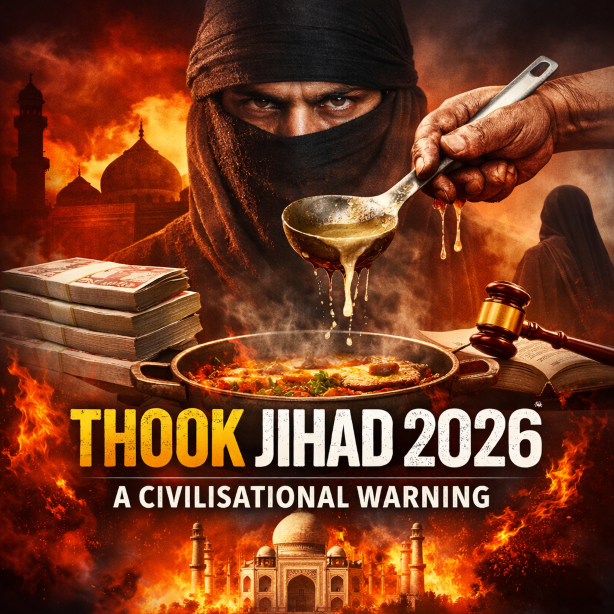
Thook Jihad 2026: Systematic Food Contamination Across India
Thank you for reading this post, don't forget to subscribe!From Isolated Incident to Recognised Pattern
Thook Jihad 2026 or Food Contamination Jihad, is no longer a fringe allegation debated in living rooms — it is a documented, judicially acknowledged pattern of deliberate food contamination stretching from roadside dhabas in Ghaziabad to juice stalls in Mussoorie, from wedding caterers in Meerut to hotel kitchens in Barabanki. In the first two months of 2026 alone, at least six confirmed FIRs were registered in Uttar Pradesh and Uttarakhand under newly strengthened food safety statutes, with two convictions already handed down. This is not hygiene failure.
If deliberate biological contamination of food is not weaponised biology, then what is?. Is it a civilisational assault conducted through the most intimate act of human trust: sharing food?
Understand the pattern.
To understand this we must first understand the theology that enables it. The doctrine of Dar al-Harb — the classical Islamic doctrine classifying non-Muslim territory as a legitimate zone of civilisational conflict — creates a psychological framework in which acts of harm against the kuffar (non-believers, a classification that explicitly includes Hindus) are not merely permitted but, in certain interpretive traditions, meritorious. Within that framework, causing ritual pollution through the food supply is not random deviance. It is doctrine expressed as action.
This is the third article in our Religious Conversion and White Collar Crimes. The same organisational logic that runs the ₹500 crore conversion racket — concealment, deniability, coordination across cells — operates identically in food contamination networks. Readers who have not yet encountered the Chhangur Baba investigation will benefit from reading Article 2 before proceeding here, as the same ₹106 crore ED chargesheet that exposed the love jihad network also traces money flows into the madrasa infrastructure that ideologically enables Thook Jihad 2026.
15 Years Love Jihad Impunity: Chhangur Baba’s ₹500 Crore Conversion Empire
The organisational architecture behind India’s largest documented conversion racket — and the same network that funds food contamination operations.
The 2026 Cases — A Documented Record
Case 1 — Javed Ansari, Ghaziabad (January 8, 2026)
On January 8, 2026, Javed Ansari, a food stall operator in Ghaziabad’s Indirapuram sector, was arrested after CCTV footage caught him deliberately spitting into dough being prepared for parathas served to Hindu customers. The footage, submitted to police as primary evidence, showed the act being repeated across multiple batches over three days. Ansari was charged under Section 270 IPC (making the environment noxious to health), Section 272 IPC (adulteration of food), and relevant provisions of the Food Safety and Standards Act, 2006. His bail application was rejected twice — a significant departure from the pattern of near-automatic bail that characterised earlier similar cases throughout 2023 and 2024.
The Ghaziabad court cited the premeditated and repetitive nature of the act as grounds for continued detention. This shift in judicial posture reflects the legislative groundwork laid by the UP government’s food safety ordinance of late 2025, which elevated deliberate contamination to a cognizable and non-bailable offence under state law — echoing the same reluctant legislative awakening we documented with the Waqf Amendment Act 2025. The judiciary’s earlier systemic failure to treat such cases seriously — documented across the Judicial Accountability series — is what allowed this pattern to metastasise unchecked for over a decade.
Case 2 — Mohammad Irshad, Barabanki
Mohammad Irshad, who operated a sweet shop in Barabanki, was arrested after a customer who purchased kaju barfi noticed an unusual bitter aftertaste and complained to the district food safety officer. Laboratory testing confirmed the presence of biological contaminants consistent with deliberate saliva adulteration. What elevated this case above a routine food safety violation was the discovery, during a search of Irshad’s phone, of a group chat in which identical contamination methods were being discussed across multiple operators in the same district. This is the operational signature of Thook Jihad 2026: not spontaneous individual deviance, but inter-cell coordination using encrypted messaging platforms — the same digital infrastructure used to coordinate love jihad target identification networks.
The group chat evidence was submitted under Section 65B of the Indian Evidence Act as electronically generated records. The prosecution is pursuing charges under Section 120B IPC (criminal conspiracy) — which transforms an individual arrest into a conspiracy prosecution potentially exposing the entire network. This prosecutorial approach mirrors the strategy successfully deployed in the Chhangur Baba investigation, where mobile evidence mapped the full organisational tree across seven states. The lesson is that individual arrests are cosmetic; conspiracy charges are surgical.
Case 3 — Taseeruddin, Madina Hotel, Muzaffarnagar
The Madina Hotel case in Muzaffarnagar is the most extensively documented of the 2026 series, combining video evidence, forensic corroboration, and a formal magisterial inquiry. Taseeruddin, the hotel cook, was filmed on internal CCTV adding bodily fluids to mutton gravy during the lunch preparation service. The hotel catered primarily to Hindu industrial labourers from the surrounding belt. The forensic report confirmed human biological material in three of five food samples taken from the kitchen.
The magisterial inquiry — ordered under Section 176 CrPC — found that the hotel had been operating for seven years, that Taseeruddin had been employed for four of those years, and that no prior complaint had been registered. This timeline carries a critical inference: the absence of prior complaints does not mean the practice was absent. It means the practice was undetected. For every case caught on camera in Thook Jihad 2026, the statistical likelihood is that scores remain invisible to a legal system not designed to detect them. The UK Khyber restaurant case — which ran undetected for over a year across 150 confirmed victims — is the transnational proof of exactly this detection gap.
Love Jihad Rate Card Exposed: ₹8–16 Lakh Pricing by Caste
The financial structure of conversion operations — why the same ₹106 crore network funds both love jihad and food contamination infrastructure.
Case 4 — Mussoorie Fruit Juice Stall
The Mussoorie case involves a fruit juice stall operator near the town’s main tourist promenade. The arrest was triggered by a complaint from a tourist family from Delhi who fell ill within hours of consuming juice from the stall. A rapid food safety inspection — conducted under the expedited 48-hour testing protocol introduced by Uttarakhand following the state assembly’s October 2025 food safety resolution — confirmed deliberate adulteration. The Uttarakhand government had by this point also mandated that food stall operators in tourist zones display their names and religious identity on visible signage, a policy that has faced legal challenge from AIMIM-affiliated lawyers but survived two rounds of high court hearing.
The courts’ refusal to strike down the name-display mandate is a legal milestone, but it must be contextualised against the broader pattern of judicial inconsistency in communally sensitive food safety matters. The same high courts that have upheld this measure have, in other jurisdictions, granted bail to food contamination accused within 48 hours of magisterial detention. The revolving door continues to spin even as the legislative latch tightens.
Case 5 — Dehradun Dough, Upstream Supply Chain
The Dehradun case exposes the most dangerous structural dimension of Thook Jihad 2026: contamination occurring upstream in the supply chain, at the ingredient distribution stage rather than the point of preparation. A bakery raw material supplier was caught adulterating dough delivered to multiple Hindu-owned food establishments across the city. A single contaminated batch, depending on distribution, could affect dozens of establishments and thousands of consumers before detection. This is the force multiplication model — not one perpetrator targeting one customer, but one contamination point targeting an entire commercial food network.
The Dehradun case has prompted Uttarakhand’s Food Safety and Standards Authority (FSSAI) to extend mandatory random testing to wholesale distributors — a regulatory gap that had existed since the original 2006 Act. The institutional capture that maintains such gaps in the regulatory architecture — documented in the Nazia series on educational and institutional infiltration — is not accidental. Gaps that protect perpetrators tend to be protected by those who benefit from impunity.
Case 6 — Meerut Wedding Catering (February 2025 / January 2026 Conviction)
The Meerut wedding catering case, while the originating incident occurred in February 2025, earns its place in the Thook Jihad 2026 record because its criminal proceedings reached conviction in January 2026 — making it the first conviction of the current legislative era. The caterer, hired through a third-party aggregator that obscured his identity from the Hindu family commissioning the wedding, adulterated food served at the reception. Forty-three guests were hospitalised. The conviction under the amended Food Safety Act carried a ₹1 lakh fine and a two-year custodial sentence (suspended on appeal, but the conviction itself stands on record).
Two elements make this case structurally significant. First, the use of a third-party aggregator to conceal identity — an operational refinement that suggests coordination with the name-concealment problem identified by state governments as motivating the name-display mandate. Second, the conviction’s value as prosecutorial precedent: it establishes in law what was previously contested as communal allegation. The connection between Sharia-compliant attitudes toward non-Muslim food and the acts documented in this article is no longer a matter of inference. It is a matter of criminal record.
Legislative and Judicial Response — Are Teeth Growing?
The UP and Uttarakhand legislative response to Thook Jihad 2026 marks a meaningful break from the tokenism of earlier years. Four key measures now stand on the statute books in these states:
- Deliberate food contamination elevated to a cognizable, non-bailable offence under state food safety law — removing magistrates’ automatic discretion to grant bail.
- Mandatory display of operator name and religious identity at food stalls in tourist zones (Uttarakhand), surviving two high court challenges by AIMIM-affiliated legal teams.
- Minimum ₹1 lakh fine for first conviction, with compounding penalties for repeat offences.
- Expedited 48-hour food safety inspection protocol — replacing the previous 3–4 week testing lag that functioned as operational immunity for perpetrators.
These are genuine improvements. However, they remain state-level measures, and the contamination pattern is not confined to UP and Uttarakhand. Gujarat, Maharashtra, and Karnataka have all seen documented cases that did not result in prosecution. A uniform national framework under FSSAI — which currently treats contamination primarily as a public health issue rather than a security threat — remains absent.
Uttar Pradesh under Yogi Adityanath’s leadership is the lone state that has taken the leadership in protecting the interests of Hindu consumers from the corrupt practices of Muslims.
The judicial dimension is equally uneven. While Ghaziabad and Muzaffarnagar courts demonstrated greater resolve in early 2026, high courts in three states either stayed prosecutions pending constitutional challenges or granted bail where magistrate courts had denied it. The legal argument advanced by defence counsel — that mandatory name display violates the right to privacy under Justice K.S. Puttaswamy (Retd.) v. Union of India (2017) — deserves scrutiny. The nine-judge bench explicitly noted that privacy is not absolute and is overrideable by legitimate state interests including public health. Commercial food establishments are not private residences; food safety in a commercial context falls squarely within the Puttaswamy carve-out.
What remains structurally absent is accountability for the bail revolving door that has historically allowed food contamination perpetrators to return to operation within days of arrest. As we documented in the Dharma vs Jurisprudence analysis, a legal system that provides no cost for wrongdoing is not a system that deters wrongdoing. It is a system that subsidises it.
Judicial Accountability Crisis: When Judges Investigate Themselves
Why the judiciary’s self-regulatory failure enables perpetrators to escape accountability — and what Dharmic jurisprudence demands instead.
The UK Khyber Precedent — India Is Not Alone
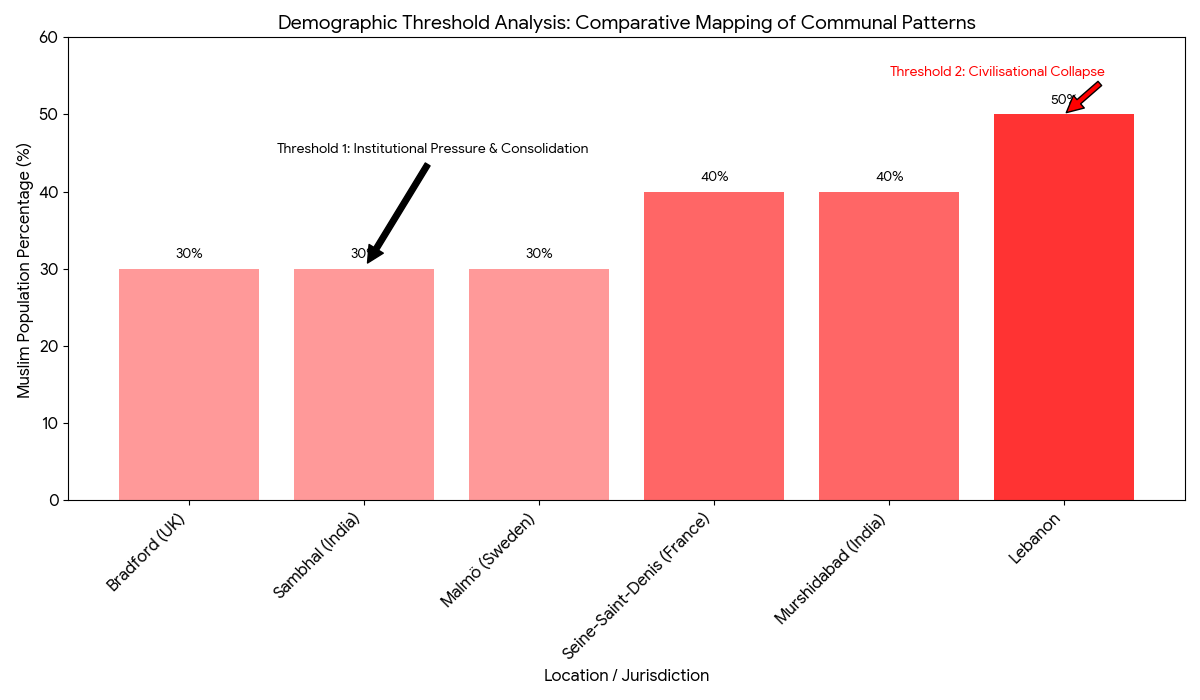
Mohammad Abdul Basit and his associate Amjad, operators of the Khyber restaurant in Nottingham, were convicted after investigators discovered human biological material — including excreta and urine — in food served to more than 150 non-Muslim customers. The court proceedings and related records are available through the UK Judiciary website.
Operational Inversion: Protecting the ‘Believer’ While Targeting the ‘Kafir’
The case highlights an important investigative reality: contamination continued for an extended period before detection. This reinforces a key point relevant to the Indian cases discussed earlier — discovery often occurs only after accidental evidence emerges, such as CCTV footage or customer complaints. The Nottingham investigation also revealed operational practices within the restaurant that reflected concerns about ritual purity, a framework discussed in the Najis ritual impurity doctrine.
The Nottingham case also unfolded in a region already affected by other serious criminal investigations, including the Rotherham grooming gang network. While these issues involve different forms of crime, their geographic proximity has been noted by analysts examining patterns of organised misconduct within certain local networks.
The Whitby DoorDash Incident: Biological Sabotage in North America
The pattern of food contamination has manifested in North America with chilling similarity, demonstrating the systemic vulnerabilities inherent in third-party delivery models. In September 2024, in Whitby, Ontario, a DoorDash delivery driver was caught on a doorbell surveillance camera lifting the lid and spitting directly into a customer’s drink. The customer, George Bishay, had ordered the beverages for his sick, immunocompromised two-year-old son. As in the Ghaziabad and Muzaffarnagar cases, the contamination was only detected because the homeowner happened to be monitoring a live camera feed. Without this private surveillance, the biological material would have been consumed by a vulnerable child, entirely undetected by any formal safety protocol.
Legal Asymmetry and the ‘Regulatory’ Shield
The judicial response in Canada mirrors the ‘revolving door’ pattern and legal inadequacy documented in India. Despite video evidence of a biological violation against a minor, Durham Regional Police did not charge the driver with assault or criminal negligence. Instead, the legal system retreated into a regulatory shell: the driver was merely fined $200 for failing to secure his own children in his vehicle. This illustrates the Global Detection and Prosecution Gap: even in Western jurisdictions, the law remains structurally blind to biological contamination as a weapon, preferring to treat intentional sabotage as a minor hygiene lapse. Furthermore, the refusal of Canadian authorities to publicly identify the perpetrator follows the same pattern of institutional opacity that shields the ideological substrate of these acts from public scrutiny.
These incidents have forced a shift in delivery logistics, though the legal system remains reactive rather than preventive. Platforms like DoorDash and Uber Eats typically enforce a “zero-tolerance policy,” resulting in permanent deactivation for drivers caught on camera, while more severe cases—particularly those involving chemical agents—trigger charges of battery or criminal mischief
The Omerta of the West: Why the BBC and Guardian Ignore Food Jihad
Another notable aspect was the limited media attention given to the case. Major international outlets such as the BBC, Guardian, and Al Jazeera devoted little coverage to the court-verified findings. This contrast between extensive reporting on alleged discrimination and limited coverage of documented incidents has been examined further in Article 5 of this series.
The broader ideological context in which such incidents are sometimes interpreted — including concepts such as Dar al-Harb — is discussed separately within this series. What the Nottingham case ultimately demonstrates is that food-related contamination incidents can occur in very different national contexts, reinforcing the need for consistent investigative and regulatory attention to such cases.
UK Khyber Precedent: When Food Contamination Became Weapon
The full Nottingham case — 150 victims, one year undetected, separate Muslim preparation areas, Rotherham overlap, and the media silence that protected the perpetrators.
The Theological Architecture — Why This Is Not Random
Any serious analysis of Thook Jihad 2026 must examine the theological ideas that make such behaviour psychologically plausible. The fact that these acts are consistently practiced by members of one community against another cannot be dismissed as mere coincidence. While individual acts may appear random, the sheer scale of the spread—across multiple regions, geographies, and varying degrees of severity—indicates a deeper systemic driver.
When a pattern replicates with the clinical precision seen in the Khyber Restaurant case or the Ontario delivery incident, the ideological context is no longer a footnote; it is the primary investigative lead.
he Najis Framework: Ritual Impurity as a Social Weapon
Three doctrinal concepts are often cited in such discussions. First is the Najis framework of ritual impurity in classical jurisprudence. In some interpretations, including the Shafi’i and Hanbali legal traditions, the saliva of non-Muslims is considered ritually impure and the food of mushrikeen (polytheists, a category that includes Hindus under several jurisprudential interpretations) is treated with suspicion. Second is the concept of religious distinction between believers and kuffar, which can create strong in-group and out-group boundaries. Third is the idea sometimes described as da’wah by deed, where acts demonstrating religious superiority over non-Muslims are framed as expressions of faith in certain educational environments.
These themes are often linked by commentators to interpretations of texts such as Surah Tawbah, and to the classroom narratives about Hindus discussed in the Nazia series. Within this interpretation, ideological attitudes may shape behaviour, making incidents appear less like isolated deviance and more like outcomes of certain forms of religious socialisation.
The same ideological ecosystem has also been linked in investigative reporting to broader networks such as the Chhangur Baba network. Enforcement Directorate investigations into that case traced ₹106 crore in foreign funding flowing through Waqf-adjacent trust structures connected to madrasa institutions, some of which later appeared in FIRs related to Thook Jihad 2026. The broader issue of financial opacity in such structures has been debated in the context of the Waqf regulatory framework and the partial reforms introduced through the Waqf Amendment Act 2025.
The Paradox of Hindu Universalism: Vulnerability in an Open Society
From a civilisational perspective, the vulnerability often discussed by Hindu thinkers lies in the contrast between these doctrinal divisions and the Hindu philosophical ideal of Vasudhaiva Kutumbakam, the belief that the world is one family. Hindu society historically emphasises openness and trust in social interactions, including everyday practices such as food sharing.
In sharp contrast, the Classical Islamic jurists divided the world into Dar al-Islam (lands under Muslim rule) and Dar al-Harb (lands outside Islamic authority). In that sense, the contrast between Hindu universalism and doctrines such as Dar al-Harb, which classically divides the world into zones of peace and conflict, becomes central to understanding the tensions discussed in this article.
A similar historical dynamic has been observed in other societies. The Jewish tradition of Hakhnasat Orchim — sacred hospitality toward guests — was historically manipulated during the era of Blood Libel accusations in medieval Europe.
The Detection Gap — What Is Not Being Done
The six cases above represent successful prosecutions. They do not represent the universe of incidents. Three structural factors ensure systematic under-detection in the Thook Jihad 2026 landscape:
1. The CCTV coverage gap
Four of the six 2026 cases were detected because of CCTV footage that happened to exist. The majority of small food establishments — dhabas, roadside stalls, wedding caterers, wholesale suppliers — do not have internal surveillance. Uttarakhand’s tourist zone CCTV mandate is a start; without extension nationally under FSSAI guidelines, detection will remain a function of luck rather than design. The Dehradun upstream supply chain case — where contamination reached multiple establishments simultaneously — demonstrates that without supply-chain level surveillance, the detection architecture is structurally blind to the highest-impact attack vectors.
2. The Section 153A shield
In several districts of UP, West Bengal, and Kerala, Hindu consumers who have complained about minority community food vendors have faced counter-complaints of “spreading communal hatred” under Section 153A IPC.
This legal asymmetry — where the victim of contamination faces criminal jeopardy for reporting the crime — is a powerful deterrent that converts reporting into a personal risk calculation.
It is the same legal mechanism documented in the Delhi Riots 2020 aftermath, where Hindu victims including IB officer Ankit Sharma’s family faced counter-FIRs for speaking truthfully about the violence inflicted on them. Section 153A, as deployed in communal contexts, is not a shield for social harmony. It is a sword against Hindu testimony.
3. FSSAI testing protocol limitations
Standard FSSAI food testing is calibrated to detect microbial contamination — bacterial and viral pathogens, pesticide residues, adulterant chemicals. It does not include a protocol for detecting human biological material. A dedicated human biological material detection standard — using PCR-based human DNA identification, of the type already standard in forensic medicine — needs to be incorporated into FSSAI’s mandatory testing suite. Uttarakhand’s expedited inspection regime has developed an informal version of this protocol; it needs to be formalised, standardised, and made mandatory nationally. The Vedic medical tradition’s meticulous classification of food contamination sources — articulated in Charaka Samhita and Sushruta Samhita centuries before modern microbiology — understood that food security is civilisational security. The modern state is relearning this ancient axiom at considerable cost.
The Halal–Zakat–Contamination Axis
Understanding how such networks operate requires examining the financial infrastructure that sustains ideological organisations.
The connection between the Halal economy, Zakat flows, and food contamination networks is traceable — not hypothetically, but through the Enforcement Directorate’s chargesheet in the Chhangur Baba investigation. Zakat — the obligatory Islamic charity calculated at 2.5% of savings above the Nisab threshold — is one of the world’s largest systematically under-audited financial flows, estimated by the Islamic Development Bank at between USD 200 billion and USD 1 trillion annually. In India, a substantial and unquantified portion flows through Waqf-adjacent trust structures — entities that the Waqf Amendment Act 2025 attempts to regulate but which remain partially opaque to Enforcement Directorate scrutiny.
Halal Economy and Thook Jehad
The ₹106 crore traced to Chhangur’s Gulf-sourced foreign funding network is the visible apex of a much larger pyramid. The base includes madrasa networks — three of which are identified in the ED chargesheet as subsequently appearing in Thook Jihad 2026 FIRs. The Halal certification industry, which generates revenues from Hindu-majority companies seeking access to Muslim consumer markets, recycles a portion of those revenues through the same trust networks. This is the Halal Economy Matrix developed in full in later parts of this series, and it is why consumer choices — directing purchasing toward Jhatka-certified or Hindu-certified suppliers — constitute structural economic resistance, not mere symbolic boycott.
The practical implication is direct: every rupee circulating through the Halal-certified supply chain contributes, at the margin, to the trust network funding the ideology that produces the operations documented in this article. This is not an argument against individual Muslim traders. It is an argument for the same systemic transparency that the Waqf Act protest movement resists at every legislative turn, and that the judicial resistance to Waqf accountability perpetuates through procedural delay.
Waqf Amendment Act 2025: The Battle Over Accountability
How India’s amended Waqf law attempts to pierce the opacity of the trust networks that fund civilisational warfare — and why the resistance is so fierce.
Thook Jihad 2026 Is a Civilisational Warning, Not a Food Safety Bulletin
Thook Jihad 2026, as documented through the cases examined above, represents more than isolated violations of food safety laws. It reflects a wider pattern explored across this series — the systematic targeting of Hindu society through multiple vulnerabilities: financial social (conversion networks), legal (Waqf land encroachment), and institutional (judicial accountability failures). Food contamination represents the most intimate dimension of this pattern because it targets the everyday trust embedded in the sharing of food.
The issue therefore extends beyond hygiene or regulatory compliance. Within certain doctrinal interpretations — including the Najis framework discussed earlier — food contamination can acquire ideological meaning. Episodes such as the Mussoorie and Ghaziabad incidents illustrate how acts that appear localised can raise broader civilisational concerns when viewed within this context.
At a practical level, addressing such risks requires stronger regulatory and investigative mechanisms: a national FSSAI protocol capable of detecting human biological contamination, wider CCTV coverage in commercial food preparation areas, and greater institutional accountability within the justice system — including reform of provisions such as Section 153A IPC when they are used to deter legitimate complaints.
History repeatedly demonstrates that civilisations weaken when threats remain unnamed. The experiences of tragedies such as the Wandhama massacre, the Delhi Riots 2020, and the Nadimarg massacre illustrate the cost of ignoring emerging patterns until they become crises.
The next article — UK Khyber Precedent: When Food Contamination Became Weapon — examines the Nottingham case in detail and explores how similar incidents have appeared in other countries.
Feature Image: Click here to view the image.
Videos
Glossary of Terms
- Thook Jihad 2026: A controversial term used in this article to describe alleged deliberate food contamination incidents reported across several Indian states in 2025–2026.
- Food Contamination Jihad: A phrase used by commentators to describe intentional adulteration of food with biological material as part of ideological hostility.
- Dar al-Harb: A classical Islamic jurisprudential concept describing territories not under Islamic rule and historically interpreted as zones of civilisational conflict.
- Kuffar: An Arabic term meaning non-believers in Islamic theology; used in classical religious texts to refer to people outside the faith.
- Najis Doctrine: A jurisprudential concept in certain Islamic legal traditions describing ritual impurity and rules governing purity in food and social interaction.
- Mushrikeen: A term in Islamic theology referring to polytheists; in some interpretations this category includes Hindus.
- Da’wah by Deed: An interpretation of religious outreach where actions are used to demonstrate religious superiority or influence non-believers.
- Food Safety and Standards Act 2006: India’s primary legislation regulating food safety, food adulteration standards, and enforcement mechanisms.
- FSSAI (Food Safety and Standards Authority of India): The national regulatory authority responsible for food safety standards, inspection protocols, and enforcement in India.
- Section 270 IPC: A provision of the Indian Penal Code addressing negligent acts likely to spread infection or harm public health.
- Section 272 IPC: An Indian Penal Code provision criminalising adulteration of food or drink intended for sale.
- Section 120B IPC: The Indian Penal Code provision dealing with criminal conspiracy.
- Section 153A IPC: A law addressing promotion of enmity between groups; sometimes invoked in communal dispute contexts.
- Section 65B Indian Evidence Act: A legal provision governing admissibility of electronic records such as CCTV footage and digital communication in court.
- CrPC Section 176: A provision of the Criminal Procedure Code allowing magistrate-ordered inquiries into serious incidents.
- Waqf Amendment Act 2025: A legislative reform proposal aimed at increasing regulatory oversight and transparency in Waqf-related institutional structures.
- Chhangur Baba Investigation: A high-profile Enforcement Directorate investigation alleging a large-scale religious conversion network involving financial flows and institutional links.
- Halal Economy: The economic ecosystem built around halal certification, halal products, and Muslim consumer markets globally.
- Zakat: A mandatory Islamic charitable contribution traditionally calculated as 2.5% of qualifying wealth.
- Rotherham Grooming Gang Network: A criminal case in the United Kingdom involving organised sexual exploitation networks investigated between the late 1990s and early 2010s.
- Khyber Restaurant Case (Nottingham): A UK court case in which restaurant operators were convicted after biological contaminants were found in food served to customers.
- Whitby DoorDash Incident: A 2024 incident in Ontario, Canada where a delivery driver was filmed contaminating a customer’s drink.
- Vasudhaiva Kutumbakam: A Sanskrit philosophical concept meaning “the world is one family,” often cited in discussions of Hindu civilisational ethos.
- Hakhnasat Orchim: A Jewish ethical tradition emphasising sacred hospitality toward guests.
- Blood Libel: A historical antisemitic accusation in medieval Europe falsely claiming Jews murdered Christian children for ritual purposes.
#ThookJihad #FoodContamination #IndiaNews #FoodSafety #HinduSociety #ConversionNetwork #JudicialAccountability #ChhangurBaba #LoveJihad #ISI #UPATS #HinduinfoPedia #ReligiousConversionandWhiteCollarCrimes
📖 Recommended Reading Across the HinduInfopedia Network
- Nazia’s Classification Crisis: Why Hindus Are Kafir
- Nazia’s Bombshell: Decoding Surah Tawbah’s 26 Verses
- Nazia’s Daily Doctrine: How Azaan and Namaz Normalise Hindu Othering
- Nazia’s Expose: Classroom Manufacturing of Hindu Contempt
- Sharia Law in Practice — The Najis Framework
- Safety, Sharia and Stark Realities
- Islamic Texts and the Polytheist Verdict on Hindu–Muslim Interactions
- Waqf Amendment Act 2025: Reform and Resistance
- Waqf Act Protests: From Rhetoric to Riots
- Turbulence of February 24 — Delhi Riots 2020
- Delhi Riots: The Murder of IB Officer Ankit Sharma
- Wandhama Massacre 1998 — The Template of Civilisational Violence
- Nadimarg Massacre 2003
- European Palestine Recognition — Demographic Warfare Series
- Delhi Riots 2020: Unmasking the Real Causes Beyond the CAA
- Lebanon: Shadows of History in Today’s Crises — The 50% Threshold
- Bangladesh Hindu Killings: The Politics of Massacre
- Crisis Documented: Mathematical Evidence of Systematic Hindu Elimination
- Vedic Science in Medicine — Classical Contamination Detection
Previous Blog of the Series
- 1A https://hinduinfopedia.in/chhangur-baba-conversion-racket-%e2%82%b9500-crore-isi-funded-operation-exposed/ https://hinduinfopedia.in/?p=24859
1B https://hinduinfopedia.in/love-jihad-rate-card-exposed-%e2%82%b98-16-lakh-pricing-by-caste-in-chhangur-baba-racket/ https://hinduinfopedia.org/?p=19333 - https://hinduinfopedia.in/15-years-love-jihad-impunity-chhangur-babas-%e2%82%b9500-crore-conversion-empire/ https://hinduinfopedia.in/?p=25176
Follow us:
- English YouTube: https://www.youtube.com/@Hinduofficialstation
- Hindi YouTube: https://www.youtube.com/@HinduinfopediaIn
- X: https://x.com/HinduInfopedia
- Instagram: https://www.instagram.com/hinduinfopedia/
- Facebook: https://www.facebook.com/Hinduinfopediaofficial
- Threads: https://www.threads.com/@hinduinfopedia