
Lord Vishnu Can Repair Himself: When Chief Justice Mocks Hindu Beliefs
Blog 5|#6: “When Courts Fail Both Ancient Dharma and Modern Jurisprudence”
CJI Advising, in effect: “Lord Vishnu Can Repair Himself”
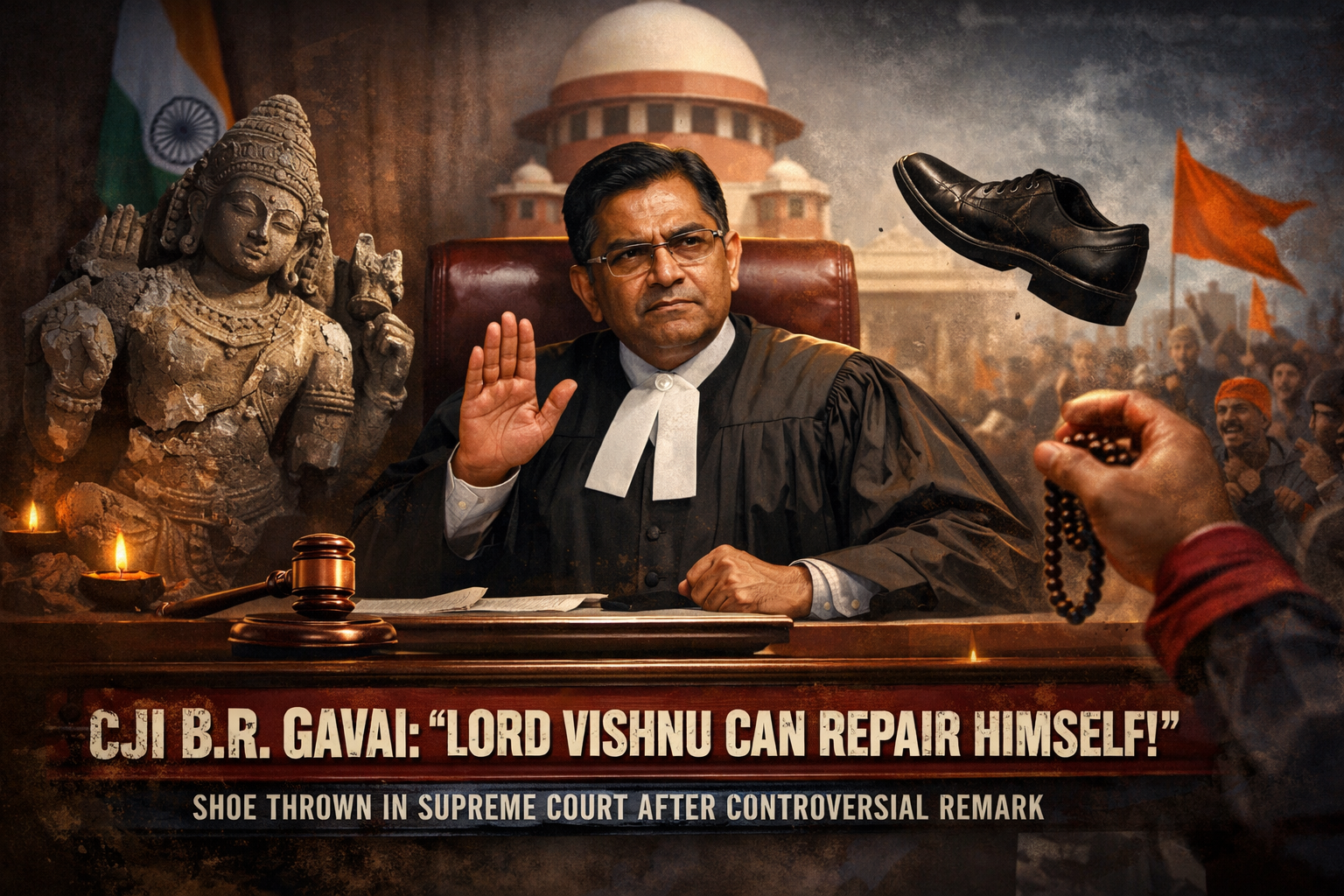
One of the worst incidents in India’s justice system occurred in September 2025, when lawyer Rakesh Kishore threw a shoe at CJI B.R. Gavai in the Supreme Court. The context was shameful: a few weeks earlier, on September 16, 2025, CJI Gavai had dismissed a petition to restore a damaged Lord Vishnu idol at Khajuraho’s Javari Temple, essentially conveying to the petitioner that “Lord Vishnu Can Repair Himself” – conveying that the petitioner should pray to the deity and meditate instead of approaching the Court. We covered this incident briefly in our first blog of the series.
Thank you for reading this post, don't forget to subscribe!This remark – telling Hindu devotees that ‘Lord Vishnu Can Repair Himself’ rather than deserving judicial protection – was unprecedented in its directness. While the judiciary’s pattern of insensitivity toward Hindu concerns has decades of history, never before had a sitting Chief Justice so explicitly suggested that a Hindu deity should handle desecration without court intervention. The remark crystallized accumulated frustration among Hindus who watch other communities receive extraordinary protection while their sacred concerns face judicial dismissal or mockery.
This casual mockery of Hindu beliefs is precisely what drove that lawyer to throw his shoe in 2025. In his video message, he specifically referenced how the Supreme Court tells Hindus to “go meditate before the idol” while showing extraordinary sensitivity to other communities’ religious sentiments.
As we established in our framework, when both modern jurisprudence and ancient dharma condemn an action, we witness complete institutional failure. The Lord Vishnu comment is that failure manifest.
Kautilya Beyond Arthashastra: The Civilizational Mind Behind Statecraft
Kautilya is often reduced to a cold strategist or Machiavellian figure.
This analysis dismantles that colonial caricature and reveals the deeper
Hindu philosophical foundations of Kautilya’s thought—dharma, ethics,
restraint, and civilizational responsibility.
- Why Arthashastra cannot be read outside Hindu philosophy
- Dharma, rajadharma, and moral limits of power
- How Kautilya differs fundamentally from Machiavelli
- The relevance of Hindu statecraft in modern governance
What Exactly Was Said
The case did not involve a religious property dispute in Karnataka. It concerned a petition before the Supreme Court regarding the restoration of a damaged Lord Vishnu idol at the Javari Temple in the Khajuraho temple complex in Madhya Pradesh. The Hindu petitioner sought a court-directed restoration of the idol, citing its religious significance. During the hearing, Chief Justice of India B. R. Gavai made a remark questioning the need for judicial intervention, stating that if the petitioner truly believed in Lord Vishnu’s power, he should pray to the deity instead of seeking court orders.
Now imagine if Justice Gavai had said:
- “If Allah wants to, he can protect the mosque himself”
- “If Jesus wants to, he can resurrect the church himself”
- “If Prophet Muhammad wants to, he can defend his own honor”
The aftermath would have included international diplomatic incidents, suo motu contempt proceedings, demands for resignation, violent protests, and 24/7 media coverage for weeks.
But when the remark targets Lord Vishnu? Silence from the secular establishment.
Modern Jurisprudence: Constitutional Violations
Article 25: Freedom of Religion
Article 25 guarantees all persons the right to “freely to profess, practise and propagate religion.” Although the Supreme Court has avoided formally declaring that Article 25 prohibits deliberate insults to religion, its jurisprudence unmistakably demonstrates that protection of religious sentiments is treated as a constitutional value—especially when minority faiths are involved. Yet, when Hindu beliefs are subjected to ridicule or dismissive treatment, the same Court routinely invokes free expression, secularism, or constitutional morality to justify non-intervention. This asymmetry is not accidental; it reflects a long-standing partisan judicial approach in which Hindu religious sentiments are systematically accorded lesser constitutional weight.
When a Supreme Court judge makes dismissive remarks about Lord Vishnu from the Bench:
- As a constitutional authority and state actor, remarks made during open court proceedings carry the weight of the State and are perceived as expressions of institutional authority, not personal opinion.
- By invoking the deity in a manner that appears to question or trivialize divine agency, the remark is reasonably understood by Hindu believers as undermining a core element of their faith.
- Delivered during official judicial proceedings, such observations draw legitimacy from the Supreme Court’s authority, giving them an institutional character that amplifies their impact beyond ordinary speech.
- When religious belief is treated with levity or rhetorical dismissal, it creates an impression of unequal judicial sensitivity, conflicting with the spirit of religious neutrality and equal respect that Article 25 seeks to uphold in constitutional governance.
Bangalore Principles: Contravention of Judicial Ethics
The Bangalore Principles of Judicial Conduct, though not statutory or legally enforceable, function as universally accepted governing principles of judicial ethics, articulating the minimum standards by which judicial conduct is evaluated. They require judges to preserve impartiality, dignity, and public confidence, and to ensure that their conduct “reaffirms the people’s faith in the integrity and impartiality of the judiciary.”
Measured against these principles — not criminal or constitutional law — the comment made from the Supreme Court bench stands in clear contravention of core ethical expectations.
Ethical Impartiality Undermined
By publicly trivializing a central Hindu belief during official judicial proceedings, the judge created a reasonable perception of bias. For Hindu litigants, this signals that their faith may be treated as an object of ridicule rather than neutral respect — a perception the Bangalore Principles explicitly warn judges to avoid.
Public Confidence Eroded
Judicial ethics focus not only on actual bias, but on appearance. The widespread public reaction demonstrates that many citizens concluded that India’s highest court treated their faith dismissively. This ethical erosion of confidence — irrespective of legal culpability — culminated in the unprecedented shoe-throwing incident in 2025, a symptom of lost institutional reverence rather than its cause.
Comparative Ethical Standards
Other democracies treat such ethical lapses seriously — even when no law is broken:
- United States: Judges have faced public censure under the ABA Model Code of Judicial Conduct for remarks that manifest religious bias, including joking references to religious communities.
- United Kingdom: The Judicial Conduct Investigations Office (JCIO) has disciplined judges for comments perceived as dismissive of religious belief, even without targeting a specific deity.
- Canada: The Canadian Judicial Council removed Justice Robin Camp (2017) for insensitive courtroom comments, establishing that spoken bias alone can breach judicial ethics.
India’s Ethical Asymmetry
In India, a comment perceived by millions as mocking a Hindu deity drew no ethical inquiry, no censure, and no institutional acknowledgment, while the judge proceeded to occupy the highest judicial office. This disparity highlights not a legal failure, but an ethical double standard in applying universally accepted norms of judicial conduct.
The “Would They Dare?” Test
| Hypothetical Comment | Would Judge Say It? | Consequence if Said |
|---|---|---|
| “Lord Vishnu can repair himself” | Yes – Actually said | None – Promoted to CJI |
| “Allah can protect mosque himself” | No – Career suicide | International incident |
| “Prophet can defend his honor” | No – Physical danger | Fatwa, security threat |
| “Jesus can resurrect church” | Unlikely – Risky | Christian protest, media coverage |
Judicial mockery is directly proportional to the perceived powerlessness of the religious community and inversely proportional to the likelihood of violent response.
Ancient Dharma: Sacred Duties Betrayed
Sarva Dharma Sambhava: Equal Respect
Bhagavad Gita 9.23: “Even those who worship other deities with faith, they too worship Me, though not in the proper way.”
Krishna establishes: All sincere religious devotion deserves respect, even when the object differs.
Rig Veda 1.164.46: “Ekam sat vipra bahudha vadanti” – Truth is one, the wise call it by many names.
Manusmriti 2.162: “One should speak what is true; one should speak what is pleasant; one should not speak unpleasant truth unnecessarily.”
Applied to judges: Truth may require hard decisions, but gratuitous mockery is neither truth nor dharma.
Sthan-Maryada: Dignity of Office
Arthashastra (Book 1, Chapter 7): “The king shall protect dharma, for dharma protected protects the protector.”
Mahabharata (Shanti Parva 56.17): “A king should be impartial like dharma itself, serene like the sky, patient as the earth.”
The remark, delivered from an elevated judicial office of Chief Justice of India, departed from sthāna–maryādā by using institutional authority to trivialize rather than protect religious sentiment, replacing the expected serenity and restraint of the office with sarcasm and thereby disregarding legitimate Hindu concerns.
 Manusmriti Legal Principles — Dharma as the Foundation of Justice
Read the Legal Framework →
Ishvara-Ninda: Mocking the Divine
Bhagavad Gita 16.18: “Bewildered by egotism and arrogance, these malicious people blaspheme Me.”
Krishna categorizes those who mock the divine as asuric (demonic)—characterized by arrogance rather than humility.
Yoga Sutras 1.23: Even philosophical inquiry requires respect for traditional conceptions of the divine.
Bhagavad Gita 12.13-14: One who mocks devotees and insults their faith is far from dharma.
When Hindu devotees approach courts seeking protection for sacred sites, they deserve respect—not judicial sarcasm.
The Pattern of Selective Sensitivity
Contrast: The Nupur Sharma Case (June 2022)
Nupur Sharma, a BJP spokesperson, quoted Islamic texts during TV debate. She faced death threats and approached Supreme Court seeking clubbing of FIRs.
Supreme Court’s Response:
- “She is single-handedly responsible for what is happening in the country”
- “She should apologize to the whole nation”
- “Her loose tongue has set the entire country on fire”
| Aspect | Lord Vishnu Mockery | Nupur Sharma Quotes |
|---|---|---|
| What was said | Mocked Hindu deity | Quoted Islamic texts |
| Where | SC bench – official proceedings | TV debate – private capacity |
| Speaker position | SC judge wielding state power | Private citizen |
| Immediate violence | None | Protests in multiple cities |
| Court’s response | None – promoted to CJI | “Setting country on fire” |
| Career consequence | Promotion | Life in hiding, destroyed |
Judicial mockery example: “Lord Vishnu Can Repair Himself” — no consequences
Hindu woman quotes texts → Blamed for violence, denied relief
 Haq Movie Raises Questions — Hindu Haq is the Answer
Read on Hindu Haq →
The Religious Sentiments Hierarchy
Tier 1 (Absolute Protection – Islamic):
- Prophet references: Extreme sensitivity
- Mosque disputes: Instant stays, years of delays
Tier 2 (Moderate – Christian):
- Church issues: Fair hearings, balanced approach
Tier 3 (Minimal – Sikh):
- Gurdwara disputes: Procedural handling
Tier 4 (No Protection – Hindu):
- Temple property: Government control
- Hindu deities: Subject to mockery
- Hindu festivals: Interference common
December 2025: The Swaminathan Impeachment
Justice G.R. Swaminathan ordered traditional Karthigai Deepam lamp lighting on Thirupparankundram hill. When government defied his order, he initiated contempt proceedings.
Result: On December 9, 2025, more than 100 Members of Parliament — including a large cross‑party group of INDI bloc and allied MPs — filed an impeachment notice against Justice G.R. Swaminathan in Parliament over his order relating to the traditional Karthigai Deepam lamp at Thiruparankundram Hill. Several reports noted that the notice bore signatures from approximately 120 MPs.
Action vs. Consequence Table: Perceived Bias
| Action | Public / Institutional Response | Perceived Message to Judges |
|---|---|---|
| Alleged mockery of Hindu deity (Justice Gavai) | No formal inquiry; career progressed → promoted to CJI | Perception: Safe to mock Hindu practices or symbols |
| Judicial protection of Hindu festival practices (Justice Swaminathan) | Impeachment notice and political criticism | Perception: Sensitive actions toward Hindu observances can be politically risky |
| Judicial enforcement or stays for minority religious property disputes | Widely reported and generally praised | Perception: Actions favoring minority interests are rewarded |
The system PUNISHES fairness to Hindus and REWARDS bias against them.
A group of former judges — reported to number over 50 — issued a public statement describing the impeachment move as ‘brazen browbeating’.
During judicial proceedings, Chief Justice Surya Kant raised questions regarding the legal basis under which Rohingyas were granted refugee status in India.
The remarks triggered immediate criticism from activist groups, including a public letter alleging that the comments dehumanized refugees and undermined humanitarian principles.
In response, a group of former Supreme Court and High Court judges issued a joint statement defending the Chief Justice, characterizing the attacks as a motivated campaign aimed at delegitimizing the judiciary and warning against attempts to chill judicial questioning on sensitive policy matters.
A Discernible Pattern
The Career Calculus
Safe behaviors (no career risk):
- Mock Hindu deities
- Delay Hindu cases
- Show extreme Islamic sensitivity
- Support government on Hindu issues
Risky behaviors (career threatening):
- Protect Hindu festivals (Swaminathan impeachment)
- Question illegal immigration (CJI attacked)
- Fast-track Hindu religious cases
Career-ending behaviors:
- State Hindu concerns deserve equal treatment
- Challenge secular establishment
Post-Retirement Rewards
As documented in our Gogoi analysis:
Judges favoring establishment:
- Rajya Sabha nominations
- Commission appointments
- Governorships
Example: CJI Gogoi – Favorable rulings → Rajya Sabha 4 months post-retirement
Judges protecting Hindu rights:
- Impeachment threats
- Unfavorable transfers
- No post-retirement benefits
The Violence-Response Correlation
Communities with violent responses → Maximum judicial protection
Communities with peaceful responses → Minimum protection (or mockery)
Hindus respond through legal complaints (ignored), social media (dismissed), peaceful protests (unnoticed). Other communities respond with international pressure, diplomatic incidents, and threats.
Judges rationally respond to threat matrix. The community least likely to create danger receives least protection.
Public Impact
Social Media Eruption
Within 24 hours:
- #RespectHinduBeliefs
- #JudicialBias
- Over 50,000 tweets
- Trending 3 days
Legal community: Hindu lawyers expressed shock, said they’d hesitate bringing Hindu matters before Justice Gavai.
Hindu organizations: VHP, Hindu Mahasabha filed formal complaints. All ignored.
Secular establishment: Defended as “judicial rationalism.”
Complaints Went Nowhere
Filed with:
- Supreme Court In-House Committee: No response
- Bar Council of India: No action
- National Human Rights Commission: Outside jurisdiction
- Media: Minimal coverage
As documented, the zero-accountability system ensures judges face no consequences for any misconduct.
Conclusion: The Double Failure
| Principle | Modern Standard | Dharma Standard | Gavai Comment |
|---|---|---|---|
| Religious Equality | Article 25 | Sarva Dharma Sambhava | FAILED |
| Judicial Decorum | Bangalore Principles | Sthan-Maryada | FAILED |
| Impartiality | No bias | Sama-darshana | FAILED |
| Respect | Natural justice | Nyaya | FAILED |
The failure is systemic:
✗ Zero accountability for Hindu religious insensitivity
✗ Career advancement despite anti-Hindu bias
✗ Selective sensitivity protecting some faiths, mocking others
✗ Perverse incentives punishing judges who protect Hindu rights
✗ Institutional culture treating Hindu beliefs as mockery subjects
The shoe thrown in 2025 was inevitable. When legal remedies are exhausted, when mockery faces zero consequences, when protecting Hindu rights triggers impeachment while mocking Hindu deities earns promotion—frustration explodes.
The question isn’t why someone threw a shoe. The question is why it took so long.
 Shoe at Supreme Court: Symbol of India’s Judicial Crisis
Read the Full Analysis →
Key Takeaways
✓ Justice Gavai mocked Lord Vishnu from bench in 2021—zero consequences, later promoted
✓ Violates Article 25 (religious freedom), Bangalore Principles (judicial conduct), and international standards
✓ Violates Sarva Dharma Sambhava, Sthan-Maryada, and Ishvara-Ninda principles
✓ “Would they dare?” test proves selective mockery—same about Islamic/Christian figures would end careers
✓ Contrast with Nupur Sharma: Hindu woman quoting texts blamed; judge mocking deity promoted
✓ December 2024: Swaminathan impeachment for protecting Hindu rights proves career incentives favor bias
✓ System PUNISHES fairness to Hindus, REWARDS anti-Hindu bias
✓ Career calculus rational: mockery safe, protection dangerous
Next: Lord Vishnu Can Repair Himself
 Manish Sisodia Bail: Legal Analysis of the Delhi Excise Policy Case
Read the Legal Breakdown →
Feature Image: Click here to view the image.
Glossary of Terms
- “Lord Vishnu Can Repair Himself” Remark: A controversial judicial comment attributed to a Supreme Court bench, widely perceived as dismissive of Hindu religious concerns and temple protection claims.
- Chief Justice of India (CJI): The head of the Indian judiciary and the Supreme Court, responsible for constitutional interpretation and judicial administration.
- Judicial Accountability: The principle that judges, including those in constitutional courts, must be answerable for conduct, bias, or ethical lapses.
- Bangalore Principles of Judicial Conduct: Internationally recognized standards outlining judicial independence, impartiality, integrity, and propriety.
- Article 25 of the Indian Constitution: A constitutional provision guaranteeing freedom of conscience and the right to profess, practice, and propagate religion.
- Sarva Dharma Sambhava: A Hindu civilizational principle advocating equal respect for all faiths, not religious equivalence but equal dignity.
- Sthan-Maryada: A dharmic concept referring to the dignity, restraint, and responsibility attached to one’s position or office.
- Ishvara-Ninda: In Hindu philosophy, the act of mocking or showing contempt toward the divine or sacred belief.
- Temple Encroachment: Illegal occupation, damage, or takeover of temple property, often contested in courts.
- Judicial Selective Sensitivity: A pattern where courts are perceived to apply different standards of sensitivity across religious communities.
- Nupur Sharma Case (2022): A legal and political controversy involving comments made during a televised debate, often cited in discussions on free speech and judicial response.
- Swaminathan Impeachment Episode (2025): A recent parliamentary move against a High Court judge following orders protecting Hindu religious practice.
- Suo Motu Proceedings: Legal action initiated by a court on its own motion, without a formal complaint.
- Judicial Ethics: Norms governing judges’ speech, behavior, and conduct to maintain public trust in the judiciary.
- Dharmic Jurisprudence: An ethical framework derived from Hindu texts emphasizing justice, restraint, and moral responsibility.
#JudicialBias #HinduRights #SupremeCourt #Dharma #HinduinfoPedia #JudicialAccountabilityCrisis #GogoiCoverUp #SupremeCourtBias #DharmaVsJurisprudence #JudicialReform #WhenCourtsFailAncientDharmaandModernJurisprudence
Previous Blog of the Series
- https://hinduinfopedia.in/shoe-at-supreme-court-symbol-of-indias-judicial-crisis/
- https://hinduinfopedia.in/dharma-vs-jurisprudence-the-framework-for-measuring-judicial-failure/
- https://hinduinfopedia.in/ranchi-court-confrontation-when-lawyers-challenge-judicial-arrogance/
- https://hinduinfopedia.in/public-order-and-protests-supreme-courts-shaheen-bagh-failure/
- https://hinduinfopedia.in/judicial-accountability-crisis-when-judges-investigate-themselves/

Read Rights-Based Solutions →
Understanding the Pattern:
- Selective Judgement of Waqf Act – How unaccountability enables bias
- Waqf Act and Judging Justice – Pattern of selective protection
- Judicial Response to Waqf Act Unrest – Systematic bias documented
- Delhi Riots 2020: Real Causes Beyond CAA – Institutional failures cascade
- Manish Sisodia Bail Analysis – Political connections matter
Follow us:
- English YouTube: Hinduostation – YouTube
- Hindi YouTube: Hinduinfopedia – YouTube
- X: https://x.com/HinduInfopedia
- Instagram: https://www.instagram.com/hinduinfopedia/
- Facebook: https://www.facebook.com/Hinduinfopediaofficial
- Threads: https://www.threads.com/@hinduinfopedia