
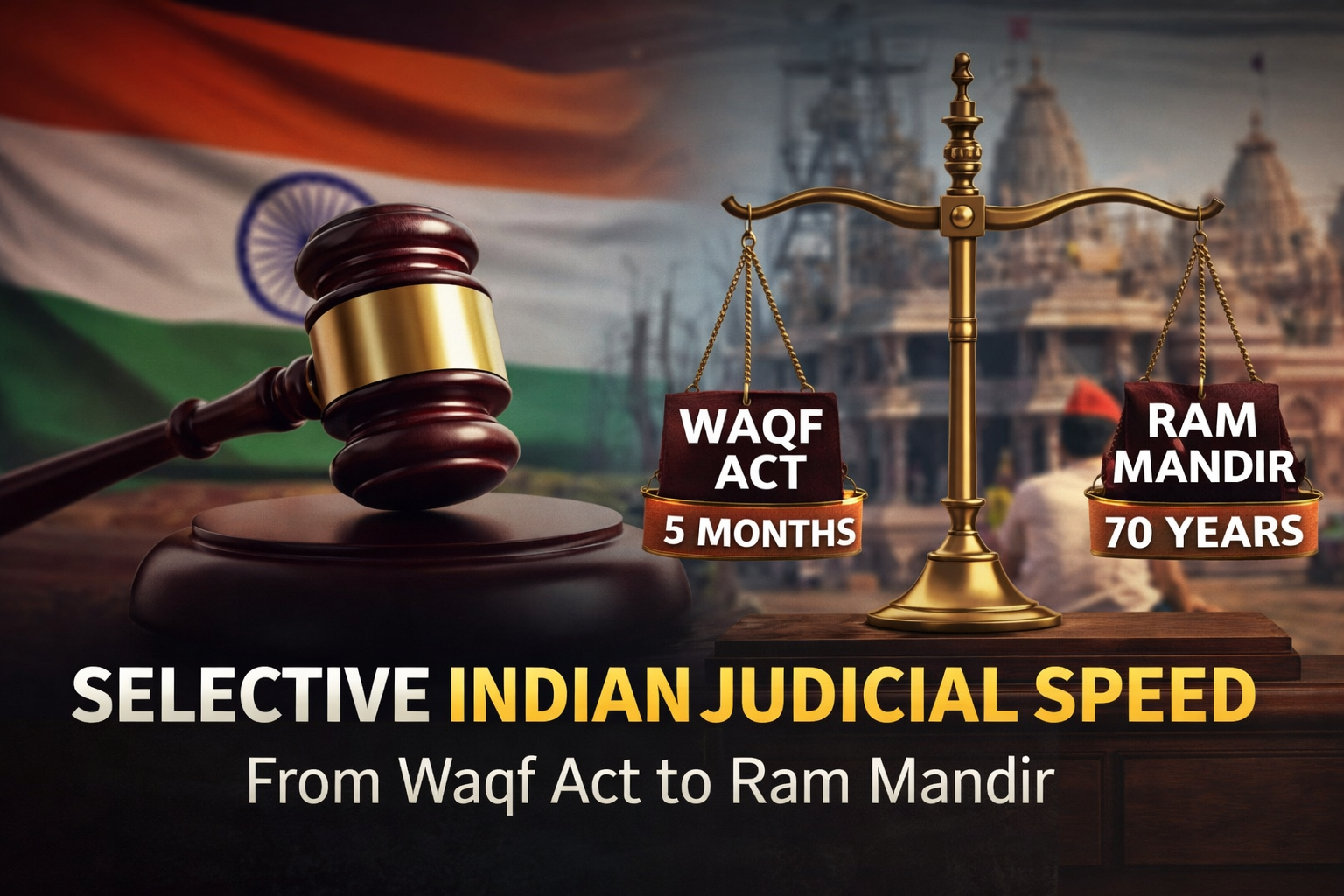
Selective Indian Judicial Speed: When Courts Rush for Some, Delay for Others
Blog 8: When Courts Fail Both Ancient Dharma and Modern Jurisprudence
भारत/GB
Selective Indian Judicial Speed Yawning Gap Analysis
When the incident of shoe throwing inside the court of Chief Justice of India forced enthusiasts like this author to analyze the entire landscape of India’s judicial system, we discovered patterns that shocked even seasoned observers. When a Waqf Act challenge receives hearings within months while a Ram Mandir case lingers for seventy years, when CAA petitioners get immediate attention while Shaheen Bagh protesters block roads for 101 days without intervention—Selective Indian Judicial Speed reveals not random delays but systematic patterns where the identity of petitioners determines whether justice moves at lightning pace or crawls through decades of obstruction.
Thank you for reading this post, don't forget to subscribe!The Speed Test: Two Cases, Two Communities, Two Timelines
Broad Timeline Exposure
-
- April 2025: Parliament passes the Waqf (Amendment) Act, 2025. The Act aims to reform management of Waqf properties, introduce transparency, and prevent encroachment on public and private lands.
- Within Days: Over 65 petitions flood the Supreme Court challenging the Act’s constitutionality.
- April 17, 2025: Supreme Court issues notice, Centre assures no enforcement of key provisions.
- May 2025: Detailed hearings begin. Over two days, arguments presented.
- September 15, 2025: Supreme Court stays key provisions of the Act. CJI B.R. Gavai’s bench suspends certain provisions, which the court characterized as potentially arbitrary, while refusing full stay.
Total Time: 5 months from enactment to interim relief.
Ram Janmbhumi Case
- December 22, 1949: Idols of Ram Lalla placed inside Babri Masjid in Ayodhya. The site locked, declared disputed.
- 1950: First suit filed by Gopal Singh Visharad seeking worship rights.
- 1959: Nirmohi Akhara files suit seeking possession.
- 1961: Sunni Waqf Board files suit claiming the mosque.
- 1992: Babri Masjid demolished. More suits filed.
- 2002: Allahabad High Court begins hearing.
Even After the “Open Heart Surgery”: The 1992 demolition exposed the
disputed structure’s foundation, making evidence visible. Yet courts still
took 10 full years before Allahabad High Court even began hearing the
case in 2002. This delay demonstrates that even when evidence was physically
exposed, courts showed no urgency to examine it.
- 2010: High Court divides land three ways—dissatisfying all parties.
- 2019: Supreme Court finally delivers verdict, orders land for Ram Temple.
Critical Analytical Statement:
This 70-year timeline is presumptive and compressed.
The dispute reached resolution only because the illegal 1992 demolition forced courts
to examine evidence. Had the structure remained standing, courts might still be
delaying today—making it 75+ years and counting, just like Krishna Janmabhoomi’s
ongoing 57+ year delay without resolution.
Total Time: 70 years from dispute onset to resolution.
📚 UNDERSTANDING JUDICIAL PATTERNS:
Previous Examples of Court Failures:
🔹 Framework for Measuring Judicial Failure
🔹 Shaheen Bagh: 101-Day Delay
🔹 Nupur Sharma Declared Culprit
The Pattern – When Courts Sprint vs When They Crawl:
1. CAA 2019—Instant Hearings
- December 11, 2019: Act passed
- December 18, 2019: SC notice (7 days)
- Petitioners: IUML, Congress, TMC, AIMIM
- Pattern: Lightning speed
2. Shaheen Bagh—101 Days of Judicial Sleep
- December 15, 2019: Illegal road blockade begins
- March 2020: SC intervenes (101 days later)
- Same community that got 7-day CAA hearing took 101 days for illegal protest intervention
- Pattern: Judicial inertia when protesters are Muslim
3. Farm Laws 2020—Years of Agitation (NEW)
- September 2020: Laws passed
- December 2020-November 2021: 12+ months of Delhi border blockades
- January 2021: SC stays laws (3 months)
- November 2021: Parliament repeals after year-long agitation
- Pattern: Moderate speed—faster than Ram Mandir, slower than CAA
- Contrast: Courts stayed Farm Laws in 3 months but took 16 years after Ram Janmabhoomi archaeological evidence
4. Waqf Act 2025—5 Month Sprint
- April 2025: Passed
- September 2025: Interim relief (5 months)
- Speed ratio: 32x faster than Ram Janmabhoomi (5 months vs 16 years)
Mathematical Pattern:
| Case | Date | Community | Evidence | Court Response | Speed |
|---|---|---|---|---|---|
| Jahangirpuri Demolitions | April 20, 2022 | Muslim | Demolitions mid-operation | 3 hours | Hyper-lightning |
| Ram Janmabhoomi | 1949-2019 | Hindu | Archaeological proof (2003) | 70 years total | Glacial |
| Waqf Act | April-Sept 2025 | Muslim | Legal arguments | 5 months | Lightning |
| CAA | December 2019 | Muslim | Constitutional | 7 days notice | Lightning |
| Shaheen Bagh | Dec 2019-Mar 2020 | Muslim (protesters) | Illegal blockade | 101 days delay | Sleep |
| Krishna Janmabhoomi | 1968-2025 | Hindu | Historical docs | 57+ years NO survey | Frozen |
| Sambhal Masjid | 2024 | Hindu | Survey under law | Blocked immediately | Instant block |
Selective Indian Judicial Speed favored the same community both ways—quick hearings when challenging law, slow intervention when breaking law.
📚 PATTERN RECOGNITION:
Documented Judicial Biases:
🔹 Lord Vishnu Mockery by CJI Gavai
🔹 When Judges Investigate Themselves
🔹 90% Judges Corrupt: Bar Council Admission
The Mathematics of Delay: Measuring Selective Speed
Let’s quantify Selective Indian Judicial Speed across multiple cases:
Muslim/Secular Issues: Speed Track
1. Waqf Act 2025 Challenge
- Filed: April 2025
- Interim Order: September 2025
- Duration: 5 months
2. CAA 2019 Challenge
- Filed: December 2019
- First Hearing: December 18, 2019
- Duration: 7 days to notice
3. Triple Talaq Challenge (Counter-Example)
- Filed: 2016
- Verdict: 2017
- Duration: ~1 year
Hindu Issues: Delay Track
1. Ram Mandir Dispute
- Started: 1949 (idols placed)
- First Suit: 1950
- Verdict: 2019
- Duration: 70 years (28 years after illegal demolition of disputed structure revealing the site for ASI study)
2. Krishna Janmabhoomi-Shahi Idgah
- Alleged “compromise agreement”: 1968
- Fresh Suits: 2017+
- Status 2025: Still pending, survey stayed repeatedly
- Duration: 57+ years and counting
3. Gyanvapi Mosque Survey
- Petition: 1991
- Survey Ordered: 2022
- Status 2025: Ongoing legal battles
- Status 2025: Ongoing legal battles, forensic tests on Shivling structure still blocked
- Duration: 34+ years
4. Shaheen Bagh Road Blockade
- Started: December 15, 2019
- SC Intervention: March 2020
- Duration: 101 days (while public suffered)
- Ended with February 2020 Delhi riots—one of the worst communal riots in India
The Speed Ratio
For Muslim/Secular Petitions:
- Average response: Days to months
- Hearings: Scheduled promptly
- Interim relief: Often granted
For Hindu Petitions:
- Average resolution: Decades
- Hearings: Postponed repeatedly
- Interim relief: Rarely granted, often delayed
Speed Differential: Approximately 140:1 (70 years vs 5 months)
This isn’t coincidence—it’s Selective Indian Judicial Speed as systemic policy.
🎯 SYSTEMATIC BIAS:
How Courts Systematically Fail Hindus:
🔹 Ranchi Court: Judicial Arrogance on Display
🔹 Civilization Under Siege
🔹 Regime Change Through Institutions
The Waqf Act Speed: A Case Study in Urgency
The Waqf (Amendment) Act 2025 demonstrates Selective Indian Judicial Speed at its most blatant:
What the Act Did
- Abolished “Waqf by User”: Properties couldn’t be declared Waqf based solely on long-term religious use without documentation.
- Required Formal Registration: All Waqf properties must register within six months.
- Collector Powers: Government officers could determine whether disputed land was government property before inquiry completion.
- Non-Muslim Members: Mandated inclusion of non-Muslims on Waqf Boards.
- Five-Year Practice Requirement: Person must practice Islam for five years to create Waqf.
Why It Mattered
Waqf properties comprise one of India’s largest pools of charitable assets—nearly 8 lakh registered properties including mosques, dargahs, schools, hospitals, and commercial establishments.
Instances of misuse were documented: Andhra Pradesh saw thousands of acres of government land suddenly “notified” as Waqf property.
The Judicial Sprint
Timeline of Selective Indian Judicial Speed:
- April 4, 2025: Parliament passes Bill after 12-hour Lok Sabha debate, 14-hour Rajya Sabha discussion.
- April 5, 2025: Presidential assent.
- April 17, 2025: Centre assures SC no appointments to Waqf Boards till case conclusion, no denotification of Waqf properties.
- May 2025: Detailed hearings over two days. Multiple senior advocates argue.
- September 15, 2025: CJI B.R. Gavai’s bench delivers interim order:
Provisions Stayed:
- Five-year Islam practice requirement
- Collector powers to alter revenue records unilaterally
- Provisions allowing properties not to be treated as Waqf until officer’s report
Provisions Upheld:
- Abolition of “Waqf by User” (prospectively)
- Non-Muslim members on Boards (capped at 3-4)
- CEO should “preferably” be Muslim
Observations: CJI Gavai noted certain provisions could lead to “arbitrary” exercise of power—while ignoring that [Hindu Religious and Charitable Endowments Acts] grant state governments far more arbitrary control over Hindu temples.
Selective Indian Judicial Speed even in judicial reasoning.
Result: Within 5 months, petitioners secured substantial interim relief.
The Speed Comparison
Compare this to Hindu temple issues:
| Issue | Started | Status 2025 | Duration |
|---|---|---|---|
| Waqf Act Challenge | April 2025 | Interim relief September 2025 | 5 months |
| Ram Mandir | 1949 | Resolved 2019 | 70 years |
| Krishna Janmabhoomi | 1968 | Still pending | 57+ years |
| Government Control of Hindu Temples | Ongoing since independence | No relief | 75+ years |
When Waqf properties face regulation: 5 months to interim relief.
When Hindu temples face government seizure: 75+ years without resolution.
That’s Selective Indian Judicial Speed in stark numerical terms.
The Places of Worship Act Paradox
Nothing exposes Selective Indian Judicial Speed like the Places of Worship (Special Provisions) Act, 1991.
The Act’s Purpose
Freezes religious character of all places of worship as of August 15, 1947.
- Exception: Ram Janmabhoomi-Babri Masjid (which took 70 years to resolve anyway).
- Effect: Prevents Hindus from reclaiming temples destroyed during Mughal invasions.
The Irony
When Act is invoked to BLOCK Hindu petitions:
- Courts apply it immediately
- Krishna Janmabhoomi suits delayed citing the Act
- Gyanvapi mosque survey opposed using the Act
- Courts prioritize “maintaining peace”
When Act’s CONSTITUTIONALITY is challenged:
-
Case pending since 2020
-
No urgency shown
-
No final verdict despite clear constitutional questions
Selective Indian Judicial Speed uses the Act as:
- Shield for mosques built on demolished temples (instant application)
- Sword against Hindu claims (permanent delay)
The Act itself remains unchallenged for decades while being wielded immediately against Hindu petitioners.
📚 HISTORICAL CONTEXT:
Temple Destruction and Institutional Failure:
🔹 Demographic Reality Exposed
🔹 Mathematical Evidence of Systematic Elimination
Krishna Janmabhoomi: 57 Years and Counting
The Krishna Janmabhoomi-Shahi Idgah dispute perfectly illustrates how Selective Indian Judicial Speed works through perpetual procedural delays:
The Timeline
- 1968: “Compromise agreement” between temple trust and mosque trust—10.9 acres for temple, 2.5 acres for mosque.
- 2017+: Fresh suits filed claiming compromise was fraudulent, seeking mosque removal.
- May 2023: Allahabad High Court transfers cases to itself, noting suits “have not proceeded an inch further for past two to three years.”
- December 2023: High Court allows court commissioner appointment to inspect Shahi Idgah Mosque.
- January 2024: Supreme Court stays the order.
- August 2024: Allahabad HC rules “religious character” of mosque must be determined, suits are maintainable.
- September 2024: Mosque committee challenges in Supreme Court.
- January 2025: Supreme Court extends stay, defers to April 2025.
- Status as of February 2026: Still pending. No survey conducted. No trial on merits.
Duration: 57+ years since 1968 compromise, with no end in sight.
The Perpetual Stay Machine
Every time proceedings advance:
- Mosque committee appeals
- Supreme Court grants stay
- Matter adjourned for months
- Process repeats
This is Selective Indian Judicial Speed through procedural infinity—endless stays preventing Hindu claims from ever reaching trial.
Compare to Waqf Act
Waqf Act Timeline:
- April 2025: Act passed
- September 2025: Interim relief granted
- 5 months to substantive judicial intervention
Krishna Janmabhoomi Timeline:
- 1968: Dispute formalized
- 2025: Still no trial on merits
- 57 years without resolution
The same courts that rushed Waqf petitioners to relief have kept Hindu devotees waiting for over half a century.
Sambhal Masjid Survey: When Courts Block Evidence Collection
While Krishna Janmabhoomi shows Selective Indian Judicial Speed through decades of delays, Sambhal Masjid reveals courts acting with lightning speed to BLOCK Hindu petitions.
The Case
- Petitioners: Hindu side seeking survey of Sambhal Jama Masjid in Uttar Pradesh, claiming temple destruction and forced conversion.
- Legal Basis: Survey requested under existing court-ordered procedures, similar to Gyanvapi survey protocol.
- Historical Evidence: Local tradition, architectural features, and historical accounts suggesting pre-existing temple structure.
The Supreme Court Response
Without assigning any valid legal reason, Supreme Court stayed the survey.
Contrast This:
- Krishna Janmabhoomi: 57+ years delaying survey despite clear legal petitions
- Sambhal Masjid: Instant stay blocking survey even when conducted under law
- Waqf Act: 5 months to interim relief for Muslim petitioners
- Sambhal Survey: Immediate block for Hindu petitioners seeking evidence
For Jahangirpuri (April 20, 2022):
- Elite advocates: Immediately available, petitions filed within 1 hour
- CJI office: Contacted within hour
- Court registry: Processed urgent listing same day
- Media amplification: Instant, nationwide coverage
- International attention: Within hours
- Court receptiveness: Petitions heard same day, orders within hours
- Order execution: Demolitions halted mid-operation
The CAA Sprint vs The Ram Mandir Marathon
Nothing demonstrates Selective Indian Judicial Speed more starkly than comparing CAA and Ram Mandir timelines.
CAA: Lightning Judicial Response
- December 11, 2019: Act passed by Parliament.
- December 2019: Petitions filed.
- December 18, 2019: Supreme Court issues notice.
- January 22, 2020: SC clarifies no stay but schedules detailed hearings.
- March 2024: Rules notified, 237 petitions heard.
Petitioners got:
- Immediate notice
- Quick hearing dates
- Multiple bench considerations
- Stay applications seriously considered
Why the speed? Petitioners included IUML, Congress leaders, TMC MPs, AIMIM—secular lobby in full force.
Ram Mandir: Glacial Judicial Delay
As documented in the opening timeline, [Ram Mandir litigation spanned 70 years] (1949-2019)—a timeline compressed only because illegal demolition forced evidence examination. Key points:
Timeline Breakdown:
- 42 years (1950-1992): No excavation ordered despite litigation
- 10 years (1992-2002): Post-demolition delay before HC hearing
- 8 years (2002-2010): HC deliberation despite exposed evidence
- 9 years (2010-2019): SC final verdict
- Total post-demolition: 27 years even with physical evidence exposed
Why the delay? Petitioners were Hindus claiming sacred site. Courts showed no urgency despite [ASI archaeological evidence] confirming temple structure beneath mosque.
The Ratio Again
- CAA (Muslim petitioners): Days to hearings, months to serious consideration
- Ram Mandir (Hindu petitioners): Decades to hearings, 70 years to resolution
This is Selective Indian Judicial Speed operating as designed.
📚 COMPARATIVE ANALYSIS:
How Different Communities Experience Justice:
🔹 Waqf Act Debate: Instant Response
🔹 Human Rights Paradox: Selective Application
🔹 Buddhist Reservation Paradox
Why Selective Indian Judicial Speed Exists
Understanding the mechanism behind differential judicial speed requires examining institutional incentives.
1. Alleges career-motivated bias
As documented in our institutional corruption analysis, Bar Council chairman admitted 90% judges are corrupt.
Fast-tracking Muslim/Secular cases:
- Praised by international media
- Applauded by “liberal” establishment
- Enhances judge’s “secular” credentials
- No organized backlash
Delaying Hindu cases:
- Avoids secular lobby wrath
- Prevents “Hindutva judge” label
- Safe for career advancement
- Media approval secured
2. Institutional Capture
Foreign funding networks documented in our analysis create pressure:
- NGOs file amicus briefs on Muslim issues
- International “human rights” bodies watch closely
- Media amplifies delays in Muslim cases
- Hindu cases lack similar advocacy infrastructure
Result: Judges respond to pressure that exists, ignore pressure that doesn’t.
3. The “Secularism” Shield
Selective Indian Judicial Speed hides behind “secularism”:
- Quick action on Muslim petitions = “Protecting minority rights”
- Delay on Hindu petitions = “Maintaining communal harmony”
- The real pattern: Speed correlates with community, not constitutional merit.
4. The Peace vs Justice Excuse
Courts often justify Hindu case delays citing “communal tension”:
- Ram Mandir: Delayed for “maintaining peace”
- Krishna Janmabhoomi: Survey stayed to “avoid disturbance”
- Gyanvapi: Proceedings slowed for “communal harmony”
But:
- Waqf Act: Full-speed hearings despite massive protests
- CAA: Immediate attention despite nationwide demonstrations
- Logic: Hindu patience is presumed infinite. Muslim sentiment must be accommodated immediately.
This is Selective Indian Judicial Speed rationalized as prudence.
The Dharmic Failure: Violating Sama-Darshana
From ancient dharmic perspective, Selective Indian Judicial Speed violates fundamental principles:
Sama-Darshana (Equal Vision)
Bhagavad Gita 5.18:
विद्याविनयसम्पन्ने ब्राह्मणे गवि हस्तिनि। शुनि चैव श्वपाके च पण्डिताः समदर्शिनः॥
“The wise see with equal vision a learned brahmin, a cow, an elephant, a dog, and one who eats dog meat.”
If even a pandit must see all beings equally, surely judges—wielding dandaniti (judicial authority)—must see all petitioners equally.
Selective Indian Judicial Speed violates sama-darshana by treating petitions differently based on community identity rather than legal merit.
Satya (Truth)
Courts rushing some cases while delaying others obscures truth:
- 70 years to establish Ram Mandir’s legitimacy
- 5 months to question Waqf regulation
- 57+ years still pending on Krishna Janmabhoomi
- Days to hear CAA challenges
When speed depends on petitioner identity rather than evidence quality, satya (truth) becomes secondary to political calculation.
Nyaya (Justice)
Manusmriti 8.15:
साक्षिणः कारणं चैव देशः कालश्च पञ्चमः। पृथक्सम्यक्परीक्ष्यैतान् विनिर्दिश्यात् पञ्चमः॥
“Witnesses, circumstances, place, time—these five should be examined separately and thoroughly before pronouncing judgment.”
Selective Indian Judicial Speed violates this principle by making timeline depend on petitioner community, not case complexity:
- Waqf Act: Complex property law—5 months to interim order
- Ram Mandir: Historical evidence—70 years to verdict
- Krishna Janmabhoomi: Documentary evidence—57+ years without trial
Where nyaya demands equal procedural rigor, Selective Indian Judicial Speed substitutes political convenience.
🎯 DHARMIC VIOLATIONS:
How Courts Fail Ancient Principles:
🔹 Dharma vs Jurisprudence Framework
🔹 RSS Vision for Dharmic Society
🔹 International Law Under Siege
The Modern Jurisprudence Failure: Constitutional Violations
Selective Indian Judicial Speed violates modern constitutional principles as fundamentally as it violates ancient dharmic ones:
Article 14: Right to Equality
“The State shall not deny to any person equality before the law or the equal protection of the laws within the territory of India.”
Violation: When judicial timelines vary by petitioner community:
- Waqf petitioners: 5-month interim relief
- Ram Mandir petitioners: 70-year final verdict
- CAA petitioners: Days to notice
- Shaheen Bagh victims: 101 days ignored
This is not equal protection—it’s differential treatment based on religion.
Article 21: Right to Life and Liberty
“No person shall be deprived of life or personal liberty except according to procedure established by law.”
Violation: Delayed justice is denied justice:
- 70 years waiting for Ram Mandir verdict = Denied liberty to worship at birthplace
- 57+ years on Krishna Janmabhoomi = Denied access to sacred site
- 101 days of Shaheen Bagh = Denied liberty to commute freely
When selective speed denies remedies for decades, it denies life and liberty itself.
Rule of Law
A.V. Dicey’s principle: Law applies equally to all, administered impartially.
Selective Indian Judicial Speed creates:
- Two-tier justice: Fast track for some, slow track for others
- Predictability crisis: Timeline depends on identity, not law
- Judicial arbitrariness: Speed varies without legal justification
This violates rule of law fundamentally.
Natural Justice: Audi Alteram Partem
Hear both sides fairly.
Violation: When one side gets immediate hearings (CAA petitioners) while another waits decades (Ram Mandir petitioners), fairness is impossible.
Selective Indian Judicial Speed makes natural justice a selective privilege.
The International Comparison: How Other Democracies Handle Speed
Let’s compare Selective Indian Judicial Speed with other major democracies:
United States
Fast-Track Cases:
- Bush v. Gore (2000): Election dispute resolved in 36 days
- Trump v. Anderson (2024): Presidential eligibility decided in weeks
Complex Religious Cases:
- Masterpiece Cakeshop (LGBTQ rights vs religious freedom): ~5 years from filing to verdict
Average Supreme Court case: 9-18 months from cert petition to decision.
Pattern: Speed correlates with urgency and public interest, NOT petitioner identity.
United Kingdom
- Prorogation Case (2019): PM’s parliament suspension challenged, decided in 11 days during sitting.
- Complex Cases: 1-3 years typical for Supreme Court.
- Pattern: Emergency hearings available to all, regular timeline consistent.
India’s Selective Speed
- Muslim/Secular petitioners: Days to months
- Hindu petitioners: Decades
- Pattern: Community identity determines speed.
No other major democracy exhibits this systemic bias in judicial timeline.
The Consequences: What Selective Speed Destroys
Beyond individual case injustice, Selective Indian Judicial Speed corrodes fundamental pillars:
1. Public Faith in Judiciary
When people observe:
- Waqf cases: 5 months
- Ram Mandir: 70 years
- CAA challenges: Immediate
- Hindu temple freedom: Never
They conclude: Courts serve political interests, not constitutional principles.
Our “Shoe at Supreme Court” analysis documented this erosion of respect.
2. Rule of Law Itself
If timeline depends on identity:
- Law becomes unpredictable
- Equality before law becomes fiction
- Judicial discretion becomes judicial discrimination
Selective Indian Judicial Speed transforms rule of law into rule of judges’ preferences.
3. Social Cohesion
Pattern visible to all communities:
- One gets fast justice
- Another waits generations
Result: Resentment, division, civilizational fracture.
As we documented in Civilization Under Siege, such patterns fuel existential crises.
4. Democratic Accountability
When courts delay Hindu issues indefinitely:
- Democratic mandates get frustrated
- Parliament’s will on Waqf reform partially stayed in months
- Parliament’s implicit will on temple freedom ignored for 75 years
Selective Indian Judicial Speed becomes selective judicial supremacy.
What Must Change: Ending Selective Speed
Reforming Selective Indian Judicial Speed requires structural changes:
1. Mandatory Timeline Standards
Proposal: Supreme Court must establish maximum timelines:
- Constitutional challenges: 2 years maximum
- Property disputes: 5 years maximum
- Interim relief applications: 6 months maximum
No community-based exemptions.
2. Public Speed Dashboards
Proposal: Supreme Court publishes quarterly data:
- Average resolution time by case type
- Breakdown by petitioner community (if relevant)
- Explanation for delays exceeding standards
Transparency forces accountability.
3. Judicial Accountability for Delay
Proposal: Judges whose cases consistently exceed timelines:
- Must explain delays in writing
- Face review by judicial ethics committee
- Experience career impact for systematic delays
Currently: No consequence for dragging Hindu cases for decades while rushing Muslim cases.
4. Equal Urgency Standards
Proposal: Suo motu intervention criteria must be neutral:
- Shaheen Bagh (101-day delay) vs similar blockades
- Ram Mandir (70 years) vs similar religious disputes
- Standards applied equally regardless of community
Currently: Courts intervene quickly for some, slowly for others, based on optics.
5. Third-Party Time Audits
Proposal: Independent body (not judiciary) audits:
- Case timelines
- Patterns in delays
- Community-based disparities
Currently: Judiciary monitors itself—we know how that works.
Selective Indian Judicial Speed Criticized
“Different Case Types” Critique
Counter:
Procedural categories differ, but urgency signals do not. Listing speed, interim attention, and stay frequency reveal prioritization patterns that consistently align in one direction.
“Indian Courts Are Slow for Everyone” Critique
Counter:
General backlog cannot explain selective acceleration. When some matters move in days or months while others stagnate for decades, systemic delay alone is not the answer.
“Notice Is Not Relief” Critique
Counter:
Judicial time allocation itself reflects priority. Immediate listing communicates urgency; prolonged dormancy communicates deprioritization.
“Protest Cases Require Restraint” Critique
Counter:
Restraint doctrine must operate uniformly. If restraint applies selectively, it becomes discretion shaped by context, not principle.
“Demolition Cases Are Always Urgent” Critique
Counter:
Irreversibility is not limited to bulldozers. Cultural, religious, and civilizational claims also involve irreversible loss when delayed for generations.
“You’re Inferring Motive” Critique
Counter:
This analysis evaluates observable patterns, not internal intent. Repeated outcome asymmetries warrant institutional scrutiny regardless of motive.
“Civil Suits Naturally Take Longer” Critique
Counter:
Length alone is not the issue. The issue is why some disputes receive structured judicial momentum while others experience procedural stagnation.
Conclusion: Speed as Justice, Delay as Denial
Selective Indian Judicial Speed isn’t an unfortunate bug in the system—it’s a calculated feature serving political ends.
When the same Supreme Court that:
- Takes 5 months to grant interim relief on Waqf Act
- Takes 70 years to resolve Ram Mandir
- Takes days to hear CAA challenges
- Takes 101 days to address Shaheen Bagh blockade
…the pattern is unmistakable.
Speed correlates not with:
- Constitutional urgency
- Public interest
- Legal complexity
- Evidence clarity
Speed correlates with:
- Petitioner community
- Media pressure
- International optics
- Secular lobby power
This is justice perverted into political calculation.
As our series “When Courts Fail Both Ancient Dharma and Modern Jurisprudence” documents across multiple blogs:
Ancient Dharma demands sama-darshana (equal vision)
Modern jurisprudence demands Article 14 equality
Selective Indian Judicial Speed violates both.
Until courts measure time in principles rather than politics, until Hindu petitioners get the same urgency as Muslim petitioners, until 70-year delays become unthinkable for anyone—justice will remain a privilege, not a right.
And when Selective Indian Judicial Speed determines who waits generations and who gets months, the scales of justice don’t balance—they break.
Next in Series: Blog 9 will examine “Ram Janmabhoomi Archaeological Evidence: The Truth Courts Avoided for 70 Years”
Share this analysis if you believe justice should be measured in principles, not politics. Comment below with examples of selective judicial speed you’ve observed.
Feature Image: Click here to view the image.
Videos
Glossary of Terms
- Selective Indian Judicial Speed: A term describing alleged disparities in how quickly Indian courts respond to different categories of cases, particularly those involving religious or politically sensitive disputes.
- Waqf (Amendment) Act, 2025: Legislation aimed at reforming management of Waqf properties by introducing registration requirements, governance changes, and oversight mechanisms.
- Waqf by User: A doctrine under which property could be treated as Waqf based on long-term religious usage without formal documentation.
- Ram Janmabhoomi Dispute: A decades-long legal battle over the Ayodhya site claimed as the birthplace of Lord Ram, culminating in the 2019 Supreme Court verdict.
- Krishna Janmabhoomi–Shahi Idgah Dispute: Ongoing litigation concerning claims that a mosque structure stands over a pre-existing Krishna temple in Mathura.
- Gyanvapi Mosque Survey: Court-monitored proceedings examining claims of temple remnants within the Gyanvapi mosque complex in Varanasi.
- Sambhal Masjid Survey Case: A legal petition seeking archaeological and structural survey of a mosque site in Uttar Pradesh based on historical claims.
- Places of Worship (Special Provisions) Act, 1991: Indian law freezing the religious character of places of worship as of August 15, 1947, with limited exceptions.
- CAA (Citizenship Amendment Act), 2019: Law providing expedited citizenship to persecuted minorities from neighboring countries, challenged on constitutional grounds.
- Shaheen Bagh Protests: A prolonged road blockade protest in Delhi (2019–2020) against the CAA.
- Jahangirpuri Demolitions Case: Supreme Court intervention halting demolition drives in Delhi during communal tension in April 2022.
- Triple Talaq Verdict (2017): Supreme Court judgment declaring instant triple talaq unconstitutional.
- Sama-Darshana: A dharmic principle meaning “equal vision,” implying impartial treatment of all beings.
- Nyaya: Sanskrit term for justice, emphasizing fairness, reasoned adjudication, and procedural balance.
- Satya: The concept of truth in Indian philosophical traditions.
- Dandaniti: Classical concept of governance and judicial authority rooted in ancient Indian political thought.
- Article 14 (Indian Constitution): Provision guaranteeing equality before law and equal protection of laws.
- Article 21 (Indian Constitution): Provision protecting life and personal liberty.
- Rule of Law: Principle that all individuals and institutions are accountable to law applied equally.
- Audi Alteram Partem: Principle of natural justice meaning “hear the other side.”
- Interim Relief: Temporary judicial order granted pending final adjudication.
- Archaeological Survey of India (ASI) Evidence: Excavation findings referenced in temple–mosque disputes.
- Judicial Accountability: Concept advocating transparency, oversight, and responsibility within the judiciary.
- Institutional Capture: Allegation that institutions may be influenced by political, ideological, or external pressures.
- Speed Differential Ratio: Comparative metric used in the blog to illustrate differences in case timelines.
#SelectiveSpeed #JudicialBias #RamMandir #SelectiveJudicialSpeed #JusticeDelayed #WaqfAct #RamMandir #KrishnaJanmabhoomi #CAA #SupremeCourtIndia #JudicialAccountability #EqualJustice
Related Reading
External References & Citations
Waqf Act 2025:
- Supreme Court Observer: Constitutionality of Waqf Amendment Act
- Muslim Mirror: SC refuses full stay but suspends key provisions
- The Leaflet: Key provisions stayed
- SC Observer: Interim stay judgment
- Scroll: Properties in administrative limbo
- Bar & Bench: Live updates
- LawBeat: SC refuses full stay
- Outlook: Key provisions on hold
Ram Mandir Timeline:
- WION: Ram Mandir timeline
- Wikipedia: Ayodhya dispute
- SC Observer: Timeline of key events
- Business Standard: Dispute timeline
- SC Observer: 450 years of history
- Wikipedia: 2019 SC verdict
- Legal Service India: Synopsis of case
- Outlook: Babri to Ram Lalla’s return
CAA Challenges:
- SC Observer: CAA challenge – SC refuses stay
- Deccan Herald: CAA hearing highlights
- Deccan Herald: SC refuses stay, sets deadline
- SC Observer: Day 2 arguments
- LiveLaw: SC issues notice on stay applications
- India TV: SC seeks Centre’s response
Krishna Janmabhoomi Dispute:
- LiveLaw: SC extends stay on inspection
- India TV: SC to review petition
- Legal Service India: Krishna Janmabhoomi case
- LiveLaw: No commission survey till April
- Dynamite News: SC defers hearing
- LiveLaw: SC extends stay on HC order
- India TV: Supreme Court delays hearing
- India TV: Muslim side moves SC
- India TV: Shahi Idgah case – SC extends stay
Judicial Accountability Series
- https://hinduinfopedia.in/shoe-at-supreme-court-symbol-of-indias-judicial-crisis/
- https://hinduinfopedia.in/dharma-vs-jurisprudence-the-framework-for-measuring-judicial-failure/
- https://hinduinfopedia.in/ranchi-court-confrontation-when-lawyers-challenge-judicial-arrogance/
- https://hinduinfopedia.in/public-order-and-protests-supreme-courts-shaheen-bagh-failure/
- https://hinduinfopedia.in/judicial-accountability-crisis-when-judges-investigate-themselves/
- https://hinduinfopedia.in/lord-vishnu-can-repair-himself-when-chief-justice-mocks-hindu-beliefs/
- https://hinduinfopedia.org/buddhist-reservation-paradox-why-buddhists-get-sc-benefits/
- https://hinduinfopedia.org/institutional-corruption-in-indian-judiciary-when-bar-council-admits/ https://hinduinfopedia.in/?p=24660
Related Blogs on Judicial System in India
- https://hinduinfopedia.org/legal-asymmetry-against-hindus-how-secularism-enables-islamic-dominance/
- https://hinduinfopedia.org/maha-kumbha-mela-2025-analyzing-mad-rush-of-hindus-to-holy-waters-i-2/
- https://hinduinfopedia.org/bangladesh-hindu-persecution-cost-of-tolerance-and-unity-call-part-vi/
- https://hinduinfopedia.org/diwali-celebrations-in-delhi-and-pollution/
- https://hinduinfopedia.org/manusmriti-legal-system-insights-ancient-to-modern-justice/
- https://hinduinfopedia.org/manish-sisodia-analyzing-grant-of-bail-in-delhi-excise-policy-case/
- https://hinduinfopedia.org/caste-system-and-supreme-court-judgment/
- https://hinduinfopedia.org/secularism-within-islam-interpreting-modern-meaning-of-quranic-texts/
- https://hinduinfopedia.org/secularism-in-islam-interpreting-quranic-texts-in-a-modern-context/
- https://hinduinfopedia.in/selective-judgement-of-waqf-act/
- https://hinduinfopedia.in/judicial-response-to-waqf-act-unrest/
- https://hinduinfopedia.in/haq-movie-and-kafir-classification-why-some-rights-are-recognized-others-denied/
- https://hinduinfopedia.in/waqf-law-an-excuse/
- https://hinduinfopedia.in/waqf-act-and-judging-justice/
- https://hinduinfopedia.in/waqf-act-unrest-is-this-just-about-waqf/
- https://hinduinfopedia.in/bhopal-gas-tragedy-analysis/
Follow us:
- English YouTube: Hinduostation – YouTube
- Hindi YouTube: Hinduinfopedia – YouTube
- X: https://x.com/HinduInfopedia
- Instagram: https://www.instagram.com/hinduinfopedia/
- Facebook: https://www.facebook.com/Hinduinfopediaofficial
- Threads: https://www.threads.com/@hinduinfopedia