
Gandhi’s Sea-Sand Chemical Bomb: The Arsenal That Could End Empire (09)
भारत / GB
Part 9: Mahatma Gandhi’s Peace Efforts | Series Index
At Sabarmati, it was a plan. On the road, it was a procession. But at Dandi, it became a detonation. This post examines the anatomy of the “Chemical Bomb” Gandhi assembled—a weapon that used the salt of the earth to dissolve the foundations of an Empire.
The Action Taken: The civil disobedience campaign deliberately overloaded the colonial judicial, policing, and penal systems with over 60,000 arrests in under ten months.
Who Paid the Price: Over 60,000 imprisoned volunteers, dispossessed peasant farmers whose lands were attached, and families enduring commercial disruption.
The Alternative Bypassed: Targeted constitutional test cases and limited symbolic salt raids that would not have exposed a nationwide volunteer mass to uncoordinated arrest.
Why This Matters: Demonstrated that disciplined mass civil disobedience could produce severe administrative paralysis within the colonial state, creating immense leverage for constitutional demands.
The Lab and the Casting Room
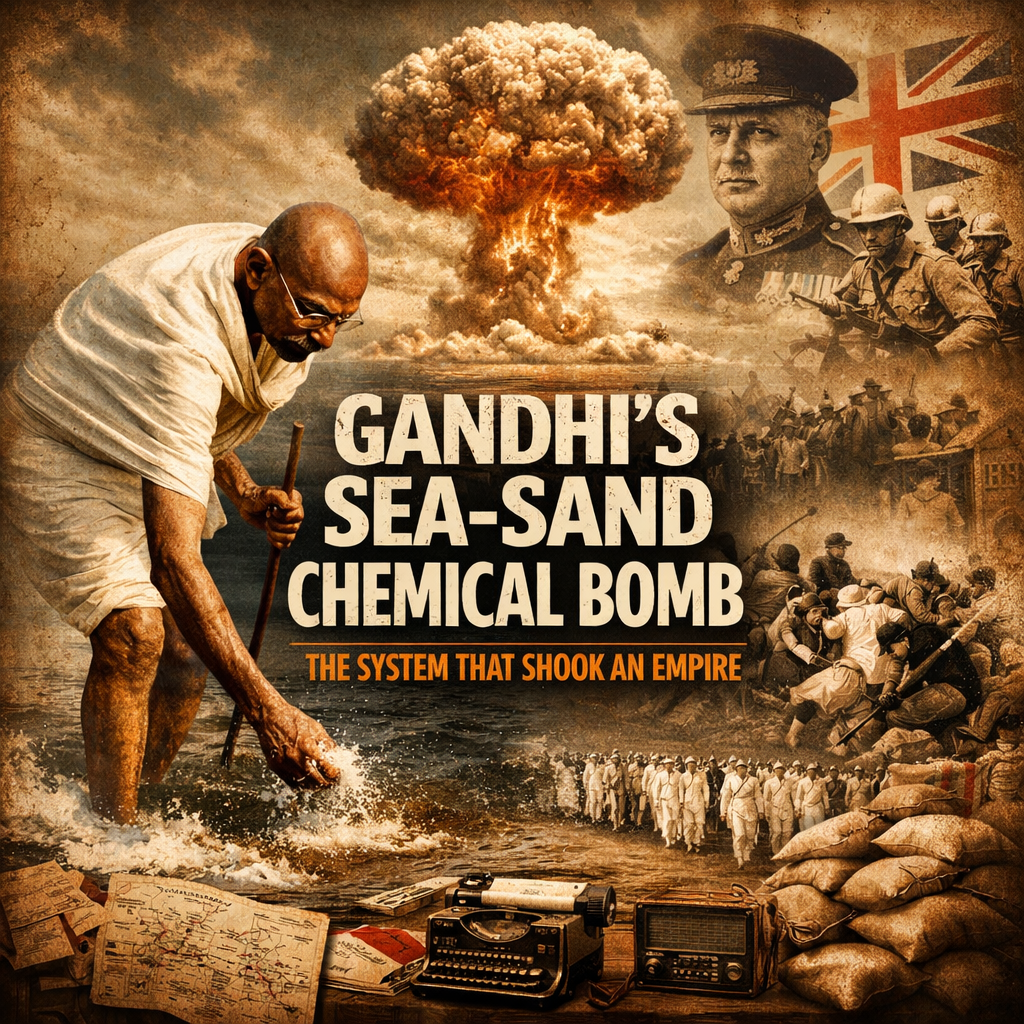
When Gandhi picked up a handful of sea-sand from the shores of Dandi on April 6, 1930, he was one of the most photographed people on earth. What did that handful of sand contain that attracted the entire world’s media? Why did every major newsreel camera focus on this half-naked old man on the shores of an ugly-looking beach? The answer lay in the composition. Within Gandhi’s sea-sand was hidden a Chemical Bomb—a weapon with the potential to dissolve the most powerful kingdom of the time. Gandhi’s Sea-Sand Chemical Bomb was revealed and displayed to the world by the 61 years old man like a poor farmer from Champaran.
Thank you for reading this post, don't forget to subscribe!But Gandhi’s Sea-Sand Chemical Bomb wasn’t built at the shoreline; it was “enriched” during the 241-mile journey that led there. It began in the casting room. Every step the old man took on foot had enriched the toxin that the Sea-Sand Chemical Bomb was to hold.
The 78 marchers who left Sabarmati on March 12, 1930, were not a random gathering of volunteers. They were carefully selected isotopes for a national reaction—men from almost every region, caste, and religion of India. The march had to be visually legible as a national statement, not a regional one. The route was not the shortest path to the sea; it was the path that maximized the daily audience, ensuring the “fuse” was seen by thousands in every village before the final detonation at the coast.
Before the first grain of sand was touched, the “trailer” had been released to the global public. If the mechanism was chemical, its visibility was cinematic The Congress Working Committee had contacted American, European, and Indian media.
Foreign journalists were not accidental observers; they were the invited distributors of the explosion. The letter to Lord Irwin ten days prior established the terms—released in advance so the world knew the British had been warned and had refused to blink.
Gandhi controlled the staging of the most precisely directed political spectacle of the twentieth century. The world watched as the act was performed at the shoreline. The “Duplicates”—the millions who would follow—were about to receive the blast.
Gandhi’s Sea-Sand Chemical Bomb Construction
Gandhi’s Sea-Sand Chemical Bomb was not made of gunpowder. It did not kill. It did not destroy bridges or buildings. It was made of something the British could not replace and could not manufacture: Indian cooperation.
The British Raj was a giant with a British head but an entirely Indian body. Every clerk who filed the papers, every peon who carried the message, every policeman who raised the lathi, every railway worker who moved the supplies, every domestic servant who ran the bungalow — all Indian. The Empire’s daily functioning depended on Indian hands at every level of its operation. Remove those hands and the Empire could not move.
Gandhi’s Sea-Sand Chemical Bomb was designed to trigger a biological failure in that body across three simultaneous layers.
Layer One — Administrative Paralysis
Every Indian clerk who misplaced a file, every peon who refused to carry a message, every typist who slowed their stroke became a resistor in the circuit. The bureaucracy — the nervous system of the Empire — began to lag. Files moved slowly. Correspondence was delayed. Orders were misunderstood. None of it was dramatic enough to report. All of it was fatal to the functioning of a colonial administration that depended on Indian hands to move every paper it had ever produced.
Layer Two — Enforcement Collapse
This was the most dangerous layer. When an Indian policeman looked at a man being beaten for picking up a handful of salt and recognised his own father’s face, and hesitated for one second before raising his lathi — the Empire’s muscle mass began to atrophy from within. The British had no reserve army of enforcers. Their enforcement was entirely Indian. John Court Curry, an Indian Imperial Police officer, wrote in his memoirs that he felt nausea every time he dealt with Congress demonstrations in 1930. When the men whose job was to sustain the Raj by force began to feel nausea at the act of sustaining it, the Raj had lost something it could never recover through legislation.
Layer Three — Logistic Stagnation
Railway workers slowed the transport of British supplies. Porters mishandled the luggage of colonial officials. Domestic staff walked out of British bungalows. Merchants refused British goods. Village headmen declined to collect the salt tax. Each individual act was small. Collectively they constituted a withdrawal of the one thing the British could not manufacture from within their own ranks: Indian willingness to keep the system running. The Empire would have been left ruling over an empty shell — holding titles that commanded no hand to move in their service, issuing orders that produced no response, governing a country that had stopped acknowledging their right to govern it.
The Exposure of Millions
Where the Cameras Were
The world saw Dharasana, the salt factory owned and operated by the British. 2,000 satyagrahis advancing in columns toward the salt works, each line beaten to the ground with steel-tipped lathis, carried away on stretchers, replaced immediately by the next. 320 injured. Two dead. Not one arm raised in defence. Webb Miller’s dispatch appeared in over 1,350 newspapers worldwide. Dharasana became a symbol because the cameras were present. Yet, most who fell were neither photographed nor remembered as martyrs.
Nearly 700 telegrams poured out from journalists covering Gandhi near Dandi on April 6 alone. Zero telegrams went out from the thousands of villages where the duplicates were being systematically broken. What was seen was curated. What was not seen was the scale.
Where the Duplicates Were — The Unseen Millions Who Repeated the Act
In Andhra Pradesh, groups of village women walked for miles to carry a handful of salt — no journalist present, no newsreel camera, no dispatch to London. In Midnapore, Bengal, people refused the chowkidar tax and faced property seizure that was never photographed. 10,000 people invaded the Sanikatta salt works in Karnataka and were met with lathis and bullets — no foreign correspondent was there. In Peshawar, British troops fired on unarmed Khudai Khidmatgar protesters at the Qissa Khwani Bazaar. In Sholapur, workers shut down an entire city — the British declared martial law.
The Emergency Powers Ordinances of 1930 gave local magistrates authority to seize property, confiscate livestock, and beat protesters without producing reports that would surface in London or New York.
The lathi charge was classified as crowd dispersal — not a casualty-producing event. Broken bones, fractured ribs, torched crops, seized livestock entered no official count. The Empire managed the information as precisely as Gandhi managed the cameras.
The duplicates who responded to Gandhi’s Sea-Sand Chemical Bomb were also its fuel cells. They believed they were freedom fighters — and they were.
They were also the expendable components of a mechanism whose most important output was not Indian freedom but consolidation and strengthening of the image of Gandhi as the indispensable intermediary between India and its own liberation.
The bomb ran on their willingness. They paid with their bodies. The cameras stayed where the hero was.

Gandhi’s Sea-Sand Chemical Bomb Disposal
By early 1931, Gandhi’s Sea-Sand Chemical Bomb had brought the colonial administration to the edge of functional collapse. Revenue was falling. Provinces were ungovernable. The British had no answer for millions of people who had simply stopped cooperating at every level simultaneously. The three-layer mechanism was running precisely as designed. The bomb was at its moment of maximum potency.
Then it was thrown into the Indian Ocean. Who did it? The hero?
How it was thrown, what was received in exchange, and what sixty thousand people who had gone to jail discovered their suffering had purchased — that is the subject of Part 10.
When the most powerful weapon ever assembled against colonial rule is thrown into the sea at the moment of its greatest potency — who made that decision, and why?
Feature Image: Click here to view the image.
वीडियो
Glossary of Terms
- Sea-Sand Chemical Bomb: A conceptual framework describing the Salt March as a coordinated system designed to weaken the British Raj through withdrawal of Indian cooperation.
- Salt March (Dandi March): A two hundred forty one mile journey led by Mahatma Gandhi from Sabarmati to Dandi in nineteen thirty to oppose the British salt tax.
- Sabarmati Ashram: Gandhi’s base in Gujarat from where the Salt March began on March twelfth, nineteen thirty.
- Dandi: A coastal village in Gujarat where Gandhi lifted sea-sand, marking the symbolic act against the salt law.
- Congress Working Committee: The decision-making body of the Indian National Congress that coordinated communication and political actions during the movement.
- Lord Irwin: The British Viceroy of India at the time, to whom Gandhi sent a letter outlining demands before starting the Salt March.
- Satyagrahis: Participants in non-violent resistance movements who followed Gandhi’s method of disciplined civil disobedience.
- Dharasana Salt Works: A British-controlled salt facility where non-violent protesters were beaten during a major demonstration after the Salt March.
- Lathi Charge: A police tactic involving the use of long sticks to disperse crowds during protests.
- Khudai Khidmatgar: A non-violent movement in the North-West Frontier Province whose members protested British rule and faced firing in Peshawar.
- Qissa Khwani Bazaar: A marketplace in Peshawar where British troops fired on unarmed protesters during the movement.
- Chowkidar Tax: A colonial tax imposed for village watchmen, resisted by people in regions like Midnapore during the movement.
- Emergency Powers Ordinances of 1930: British regulations allowing authorities to seize property, detain individuals, and suppress protests without standard reporting.
- Administrative Paralysis: A condition where routine government functions slowed due to reduced cooperation from Indian clerks and staff.
- Logistic Stagnation: Disruption of supply chains and transport systems caused by withdrawal of cooperation by railway workers, porters, and merchants.
#Gandhi #SaltMarch #DandiMarch #BritishRaj #IndianFreedom #CivilDisobedience #History #ColonialIndia #Satyagraha #HinduinfoPedia
Annex: The Roll of Honor (The Duplicates of the Sea-Sand Bomb)
There are millions whose names are not known. Some, whose names were recovered from forgotten, dust-covered records, are listed here.
| Theater of War | The Martyr | The Sacrifice |
| Dharasana / Gujarat | Bhailal Dajibhai Patel | Died on the spot from steel-tipped lathi blows and kicks during the Salt Works raid. |
| Dharasana / Gujarat | Bhan Kheppu Hulla | Succumbed to lathi-charge injuries sustained during the raid on June 10, 1930. |
| Dharasana / Gujarat | Bhaw Revaya Halla | Congress volunteer; died of septicemia from salt-raid injuries at Nair Hospital. |
| Dharasana / Gujarat | Harilal Shah | Succumbed to injuries on June 15 after the brutal May 22 lathi charge. |
| Dharasana / Gujarat | Kishore Yesav | Arrested at Dharasana while injured; died in J.J. Hospital while in custody. |
| Dharasana / Gujarat | Narayan Gopal Gowri | Injured at Dharasana; died of dysentery in J.J. Hospital while under arrest. |
| Dharasana / Gujarat | Narottam Nathubhai Patel | Died of pneumonia contracted while imprisoned in Worli jail for the salt raid. |
| Dharasana / Gujarat | Naruthnath | Died on June 13 from injuries sustained during the May 22 lathi charge. |
| Dharasana / Gujarat | Vallabh Nath Gowri | Died in J.J. Hospital while in custody for the Salt Satyagraha. |
| Navasari / Gujarat | Vithalbhai Dallubhai Patel | National School teacher; fatally injured while offering salt Satyagraha in April. |
| Delhi (Post-Arrest) | Ami Lal | Joined the May 6 procession against Gandhi’s arrest; died from a blow to the head. |
| Delhi (Post-Arrest) | Amrit Lal | Hit on the head during the May 6 lathi charge; died the same day. |
| Delhi (Post-Arrest) | Chaman Lal | Severely injured by police during the May 6 protest; succumbed to injuries. |
| Delhi (Post-Arrest) | Chandra Bhan Gupta | Active political worker; killed during the May 6 firing and lathi charge in Delhi. |
| Delhi (Post-Arrest) | Manu Mal | Received severe injuries during the May 6 protest; died on the spot. |
| Delhi (Post-Arrest) | Mohammed Ismail | Died on May 6 during the police firing on the demonstration against the arrest. |
| Delhi (Post-Arrest) | Munni Lal | Received severe bullet wounds during the May 6 unarmed procession. |
| Sholapur (Post-Arrest) | Abdul Rashid | Trade union worker; executed for the Sholapur uprising following Gandhi’s arrest. |
| Sholapur (Post-Arrest) | Abdul Rasul | Executed in Yerwada Jail for the post-arrest Sholapur protests on Jan 12, 1931. |
| Sholapur (Post-Arrest) | Jagannath Shinde | Executed for his role in the vociferous post-arrest Sholapur processions. |
| Sholapur (Post-Arrest) | Mallapaa Dhanshetti | Leading worker; executed for the May 8 protests against the Mahatma’s arrest. |
| Sholapur (Post-Arrest) | Narayan | Killed by bullet wounds on May 8 during the arrest protest. |
| Sholapur (Post-Arrest) | Shankar Shivadare | Fatally shot during the May 8 procession for the Mahatma. |
| Sholapur (Post-Arrest) | Shrikrishana Sarda | Executed for the May 8 Sholapur police station attack. |
| Midnapore / Bengal | Baikuntha Dinda | Participated in Salt Satyagraha; severely beaten by police and died of injuries. |
| Midnapore / Bengal | Bipra Prasad Bera | Seriously wounded in police firing at his village during salt protests. |
| Midnapore / Bengal | Bir Narayan Baguri | Killed in police firing during the salt-tax/Chowkidari protest. |
| Midnapore / Bengal | Ram Krishna Das | Shot dead during Salt Satyagraha firing at Kharika on July 15, 1930. |
| Midnapore / Bengal | Ramkrishna Das | Killed in a shoot-out during the Salt Satyagraha protest at Pratapdighi. |
| Midnapore / Bengal | Kartick Ch. Misra | Killed in a shoot-out protesting police atrocities at Pratapdighi. |
| Calcutta / Bengal | Harendranath Bhattacharya | Salt Satyagrahi; died in Feb 1935 after brutal beatings by the police. |
| Calcutta / Bengal | Jethi Lilavati | The first female martyr of Calcutta; Dandi March participant. |
| Faridpur / Bengal | Hari Dayal Chakrabarti | Participated in Salt Satyagraha in 1930; died while in internment. |
| Bihar / Haryana | Mool Chand | Imprisoned for 9 months for the Salt Satyagraha in 1930. |
| Bihar | Baikunth Shukla | Imprisoned for Salt Satyagraha in 1930; later executed in 1933. |
| Bihar | Matukdhari Singh | Salt Satyagrahi; arrested while picketing; died in Hazaribagh Jail in 1932. |
| Bihar | Nar Singh Rai | Salt Satyagrahi; arrested and died in jail in 1930. |
| Odisha | Artatrana Mohapatra | Imprisoned for Salt Satyagraha; died from inhuman jail tortures in Patna Jail. |
| Odisha | Dinbandhu Behera | Arrested for Salt Satyagraha; died in Patna Jail from severe police torture. |
Scan Through The Entire Series at
Gandhi’s Peace Efforts: The Questions Before the Mahatma (0)