
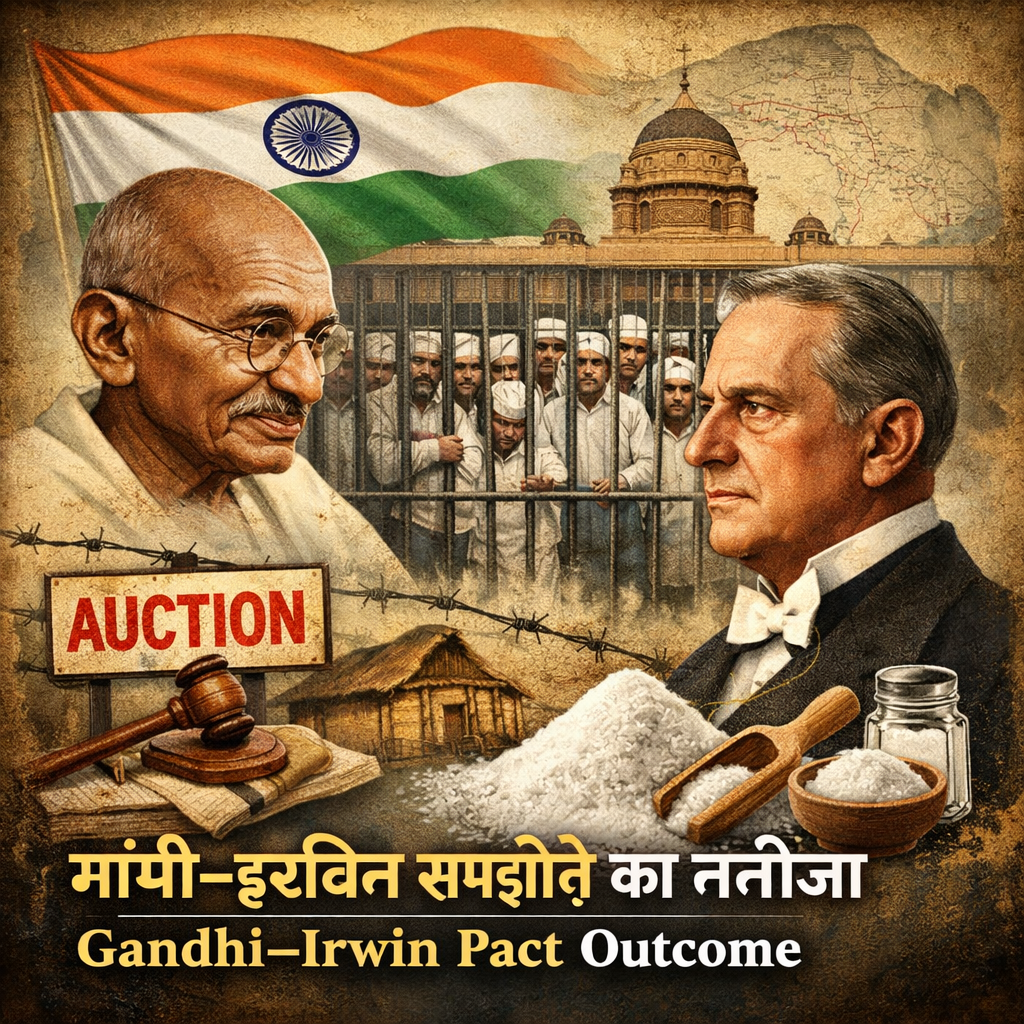
Gandhi’s Pact Aftermath: What the Prisoners In The Pact (27)
भारत / GB
Part 27: Mahatma Gandhi’s Peace Efforts | Series Index
The series has so far examined how each of Gandhiji’s actions shaped the next, actions popularly known as satyagrahas. In recent posts, we analysed how he transformed himself from an activist into an unchallenged leader — a monarch of sorts, without formal appointment. The Authority Arc is now complete. Last four blogs documented the authority’s construction, formalisation, operating method, and final act. This post returns to where the Irwin Pact Arc left off — with sixty thousand people released from jail, a movement suspended at its peak, and a set of conditions the pact had promised. What happened when those conditions met the documented reality is the subject of this post.
Thank you for reading this post, don't forget to subscribe!The Action Taken: Gandhi exchanged nationwide mass mobilization for sole plenipotentiary status at the Second Round Table Conference in London, which concluded without constitutional progress.
Who Paid the Price: The nationalist movement, whose civil disobedience machinery was demobilized during the truce while the colonial state reorganized.
The Alternative Bypassed: A broad-based nationalist delegation with specialized economic and constitutional advisers.
Why This Matters: Illustrated the strategic deficit: peak civil leverage was traded for personal diplomatic standing that yielded zero structural constitutional concessions.
The Pact’s Three Promises
Gandhi’s Pact Aftermath begins with three commitments. The Irwin Pact of March 5, 1931 made three categories of commitment to the people whose sacrifice had produced the leverage Gandhi carried into the negotiations: release of non-violent political prisoners, return of confiscated property not yet sold to third parties, and permission for Indians in coastal villages to collect salt for personal use.
Gandhi’s Pact Aftermath is the documented distance between those three promises and what the people who had paid for the movement actually received when they came out of jail, returned to their villages, and looked for what the pact had secured for them.
The Prisoners
The release clause covered non-violent political prisoners. The qualification — non-violent — was applied by provincial governments that had spent the incubation year classifying resistance activity. The classification of what constituted violence varied by province, by collector, and by the political pressures each administration faced. Prisoners whose activity had been classified as violent — even where the original act had been defensive, reactive, or disputed — remained in jail.
The violence-excluded prisoners served their full terms. The pact had drawn a line. The line was drawn by the same administrative apparatus that had spent twelve months under Emergency Powers Ordinances classifying, filing, and processing the people it had imprisoned. Gandhi’s Pact Aftermath, for this category, was the continuation of their imprisonment beyond the moment the pact had appeared to promise their release.
The non-violent prisoners who were released came out to a movement that had been suspended. The Congress Working Committee had been declared unlawful in June 1930. The movement’s organisational infrastructure — the volunteer networks, the Congress committees, the civil disobedience coordination — had been dismantled under the Emergency Powers Ordinances of the incubation year. What the incubation year had taken apart, the pact did not require to be put back together. The released prisoners came out into the organisational silence the incubation year had produced.
The Precedent the Pact Set
Gandhi’s Pact Aftermath established something beyond the immediate release terms — a structural precedent that would govern every future negotiation between the independence movement and the colonial administration. By accepting the violence-exclusion clause without an independent review mechanism, the pact conceded that the colonial administration was the sole arbiter of who qualified for relief. The same apparatus that had arrested the prisoners, framed the charges, conducted the trials, and imposed the sentences was now also the authority that classified them as violent or non-violent — and therefore as eligible or ineligible for release under the pact. Judge, jury, prosecutor, and now gatekeeper: all four functions remained in the same hands.
There was no independent tribunal. No joint Congress-Government review committee. No appeal mechanism for prisoners whose classification was disputed. The Congress had signed a document that accepted the colonial administration’s own categorisation of the people the colonial administration had imprisoned.
The fine print of the pact did not challenge this structure. It accepted it. And in accepting it, the pact set the template for all subsequent interactions: the administration would define the terms of relief, and the Congress would negotiate within those terms rather than challenging the administration’s right to define them.
The deterrent was not stated in the pact’s clauses. It was built into the pact’s architecture. Every future administration that arrested political prisoners had the 1931 precedent available: classify the most dangerous as violent, retain them, release the rest, and invite the Congress to call it a concession.
The Properties
The property return clause covered confiscated properties not yet sold to third parties. The incubation year had been the period during which the colonial administration, operating under Emergency Powers Ordinances that did not require public record-keeping of sales, had auctioned properties seized from satyagrahis across Gujarat, Andhra, Bengal, and the North-West Frontier Province.
The auction process had been systematic. Land revenue defaults — which had been encouraged by the movement itself, as part of the Civil Disobedience strategy — had triggered confiscation procedures. The confiscated properties had entered the auction cycle. By the time the pact was signed on March 5, 1931, a substantial portion of what had been available for return had already been transferred to third-party purchasers.
The clause’s qualification — not yet sold to third parties — meant the pact protected properties the administration had not yet disposed of.
Gandhi’s Pact Aftermath, for the farmers whose land had been auctioned between April 1930 and March 1931, was the permanent loss of what the movement had cost them. The pact clause covered what remained. What had been sold was gone.
The Salt
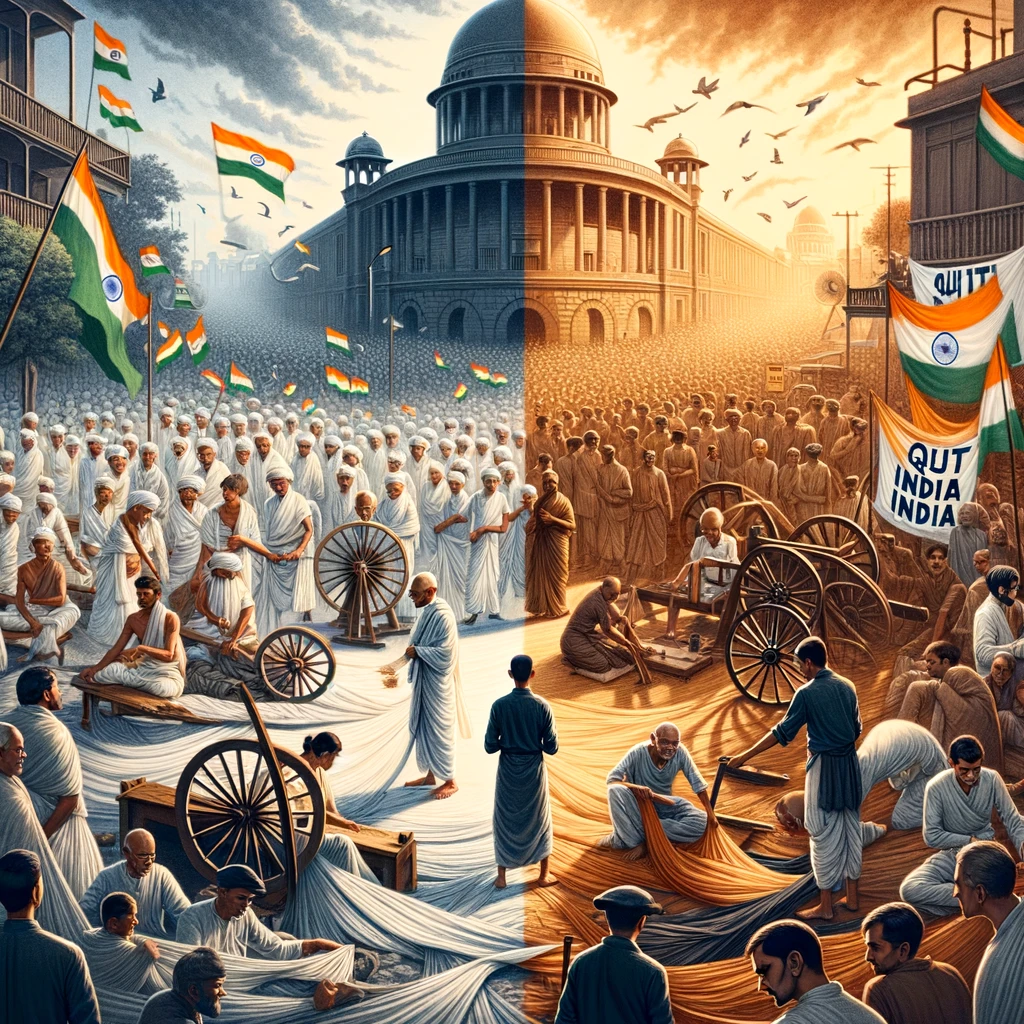
The salt clause permitted Indians in coastal villages to collect salt from the sea for personal use. It was the single most visible element of the pact — the one concession directly connected to the Salt March itself, the act that had ignited the Civil Disobedience Movement and brought sixty thousand people to jail.
Was it worth the cost India paid?
The Salt Act of 1882 had given the British a monopoly over salt production and imposed a tax on every Indian who consumed it. Gandhi’s eleventh demand had been the abolition of the salt tax and the end of the government’s salt monopoly. The pact delivered coastal personal collection. The salt monopoly remained. The salt tax remained. The commercial salt trade remained entirely under colonial control. The eleven demand had asked for the end of the machine. The pact delivered a small opening in one of its walls.
The salt tax remained on the statute books until 1947 — sixteen years after the movement that had put sixty thousand people in jail over it. The people who had gone to jail over the salt tax in 1930 lived with it for the rest of British rule.
Myth vs. Documented Reality
Myth 1: The Pact was a major victory releasing all prisoners and restoring gains.
Reality: It covered only non-violent prisoners; those classified as violent by provincial administrations served full terms. The ~60,000 who filled jails in 1930 returned to a Congress infrastructure dismantled by Emergency Ordinances — with no pact requirement to rebuild it.
Myth 2: Confiscated properties were fully returned.
Reality: Only properties “not yet sold to third parties” qualified. During the incubation year, many lands (seized over revenue defaults the movement itself encouraged) were auctioned without full public records. These were permanently lost; the pact offered no remedy for what had already changed hands.
Myth 3: The Salt March ended the salt tax and monopoly.
Reality: The pact allowed coastal villagers to collect salt for personal use only. Gandhi’s eleventh demand sought full abolition of the tax and monopoly. Both remained intact until the Interim Government abolished the tax in March/April 1947 — sixteen years later.
Myth 4: The suspension was a wise truce that preserved momentum.
Reality: The movement was halted at its peak after producing the strongest leverage any Indian leader had held. The pact delivered narrow, qualified concessions while normalizing what the Salt March had directly challenged: the salt monopoly stayed, auctions stood, and “non-violent” classifications locked in. The strongest hand produced only partial releases, unsold scraps of property, and token coastal collection. The eleven demands went largely unmet.
These gaps are written into the pact text itself: non-violent releases only, unsold properties only, personal salt only. The sixty thousand paid fully. The pact delivered exactly its clauses — no more.
What Came Next
Gandhi sailed to London in August 1931 as India’s representative to the Second Round Table Conference.
He attended as an equal of the Empire — Time magazine’s Man of the Year, received by the King, followed by crowds. The conference produced nothing. No constitutional advance. No timeline for self-governance. No acknowledgement of the demands the pact had left unanswered. Gandhi returned to India in December 1931.
Lord Willingdon, who had replaced Irwin as Viceroy, arrested him within days. Civil disobedience was resumed in January 1932. The British government banned the Congress, arrested its leadership, and applied repression that the movement — its infrastructure dismantled by the incubation year, its momentum broken by the pact suspension — could not match at the scale of 1930. The movement never again reached the explosive intensity of April-December 1930. The prisoners who had come out found a movement that no longer existed at the scale that had put them inside. The salt they had marched for remained taxed. The land many had lost remained sold. Gandhi’s Pact Aftermath, for the individual participants this blog has documented, ends here — with what they found, not with what the pact purchased for the struggle as a whole. That question is the subject of the next post.
The Note on Evidence
The series does not claim that the British colonial administration secretly coordinated the incubation year’s property auctions and press censorship with knowledge that a specific pact clause would be written to exclude their products. The documentary record does not establish secret coordination. What it establishes is correspondence: the Emergency Powers Ordinances permitted auction without systematic public record; the auctions proceeded at scale during the incubation year; the pact’s property clause covered what had not yet been sold; the people whose properties had been sold during the incubation year received nothing the pact could restore. Whether this correspondence was strategy or consequence, the people who bore the cost paid it either way. The gap between what the movement earned and what the pact delivered is documented in the clauses themselves, measured against the eleven demands that had defined the movement’s stated purpose. The Irwin Pact Arc continues. This post has answered one question: what did the individual participants find? The next post asks the larger one — what did the nation and the freedom struggle receive from the strongest hand any Indian leader had ever held?
Sixty thousand went to jail. The salt tax they went to jail over remained until 1947. The properties auctioned during the year before the pact were not in the pact’s reach. The prisoners classified as violent served their full terms. Gandhi’s Pact Aftermath is not the story of what the pact failed to deliver. It is the story of what the pact was designed to deliver — and the precise distance between that and what the movement had earned.
Feature Image: Click here to view the image.
Videos
Glossary of Terms
- Gandhi–Irwin Pact: An agreement signed on five March nineteen thirty one between Mahatma Gandhi and Lord Irwin outlining limited concessions during the Civil Disobedience Movement.
- Civil Disobedience Movement: A nationwide movement launched in nineteen thirty encouraging non-payment of taxes and peaceful resistance against British rule.
- Non-violent Political Prisoners: Individuals imprisoned for participation in protest activities without use of physical force, as classified by colonial authorities.
- Emergency Ordinances: Special administrative measures used by the British government in nineteen thirty to suppress protests and expand executive powers.
- Provincial Administration: Regional governing authorities under British rule responsible for law enforcement, classification of prisoners, and implementation of policies.
- Violence Classification Clause: A key condition in the pact that excluded those labeled “violent” from release, determined solely by the administration.
- Salt Act of eighteen eighty two: A British law imposing monopoly and tax on salt production and sale across India.
- Salt Satyagraha: A mass protest led by Gandhi against the salt tax, symbolized by the Dandi March in nineteen thirty.
- Property Confiscation and Auction: The process through which lands of protest participants were seized and transferred to others for non-payment of revenue.
- Congress Working Committee: The executive body of the Indian National Congress, declared illegal during the movement.
- Organizational Vacuum: The absence of functioning political and protest structures after widespread suppression by colonial authorities.
- Second Round Table Conference: A meeting held in London in nineteen thirty one to discuss constitutional reforms in India, attended by Gandhi.
- Colonial Administrative Control: The centralized authority exercised by British officials over legal, political, and economic decisions in India.
- Salt Monopoly: Exclusive control of salt production and trade by the British government, maintained even after the pact.
- Key Phrase – Gandhi–Irwin Pact Outcome: The documented gap between the promises of the pact and the actual conditions experienced by participants after its implementation.
#GandhiIrwinPact #IndianHistory #FreedomMovement #CivilDisobedience #SaltSatyagraha #ColonialIndia #BritishRule #HinduinfoPedia