
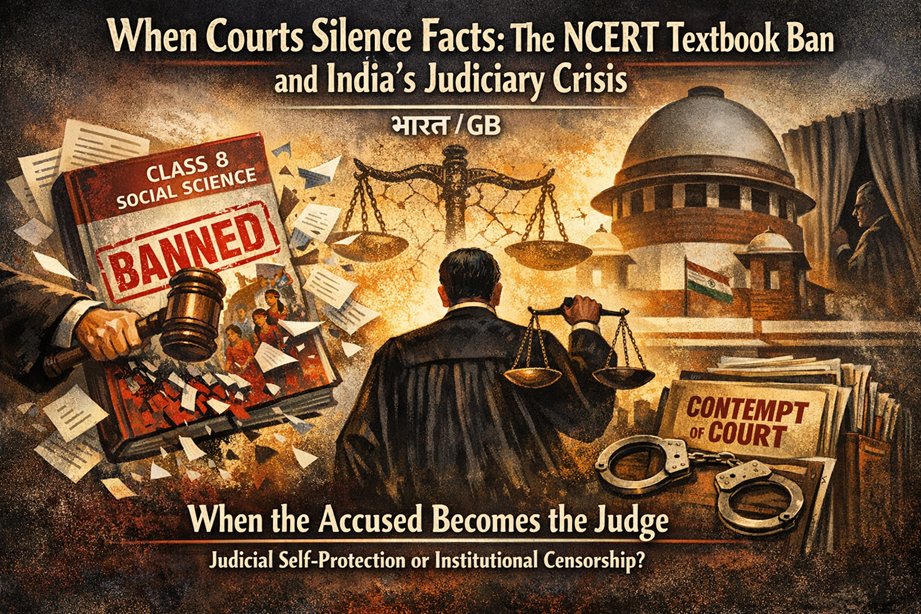
Judicial Boundary of Truth: The NCERT Textbook Ban and India’s Judiciary Crisis
भारत/ GB
Blog 7|8#: When Courts Fail Both Ancient Dharma and Modern Jurisprudence
A Class 8 Social Science textbook cited government data on court pendency. The Supreme Court banned it, ordered seizure of every copy, and called it a “deep-rooted conspiracy.” When the institution itself comes under scrutiny—does the NCERT-SC incident reveal the anatomy of institutional self-protection, or is it a necessary defense of judicial dignity?
Judicial Boundary of Truth and Institutional Scrutiny
When the Judicial Boundary of Truth is tested, the event is rarely announced as censorship. It arrives dressed in the language of institutional dignity, public interest, and the majesty of justice. On February 26, 2026, the Supreme Court of India demonstrated this principle with disturbing clarity. A newly released Class 8 NCERT Social Science textbook — written for 13-year-old children — included a chapter titled “The Role of the Judiciary in Our Society.” The chapter cited government-verified data on case pendency from the National Judicial Data Grid, reflecting tens of thousands of cases pending in the Supreme Court, several million in High Courts, and over four crore cases in district courts. It also referenced public remarks by former CJI B.R. Gavai on judicial misconduct and cited a Lok Sabha statement by the Union Law Minister acknowledging thousands of complaints against sitting judges between 2016 and 2025.
Thank you for reading this post, don't forget to subscribe!The Supreme Court’s response to these publicly available, facts disclosed in Parliament was immediate and total: a blanket ban on production and distribution of the book, orders to physically seize all copies in circulation, removal of the PDF from all digital platforms, criminal contempt notices to the Secretary of School Education and the NCERT Director, and a declaration that sharing the book — in any form — would constitute wilful breach of court orders. When the Judicial Boundary of Truth is drawn around an institution’s own functioning, the constitutional implications extend far beyond a school textbook.
The Facts That Triggered the Ban
Understanding what the NCERT chapter actually said is essential — because the Court’s reaction makes no sense without it.
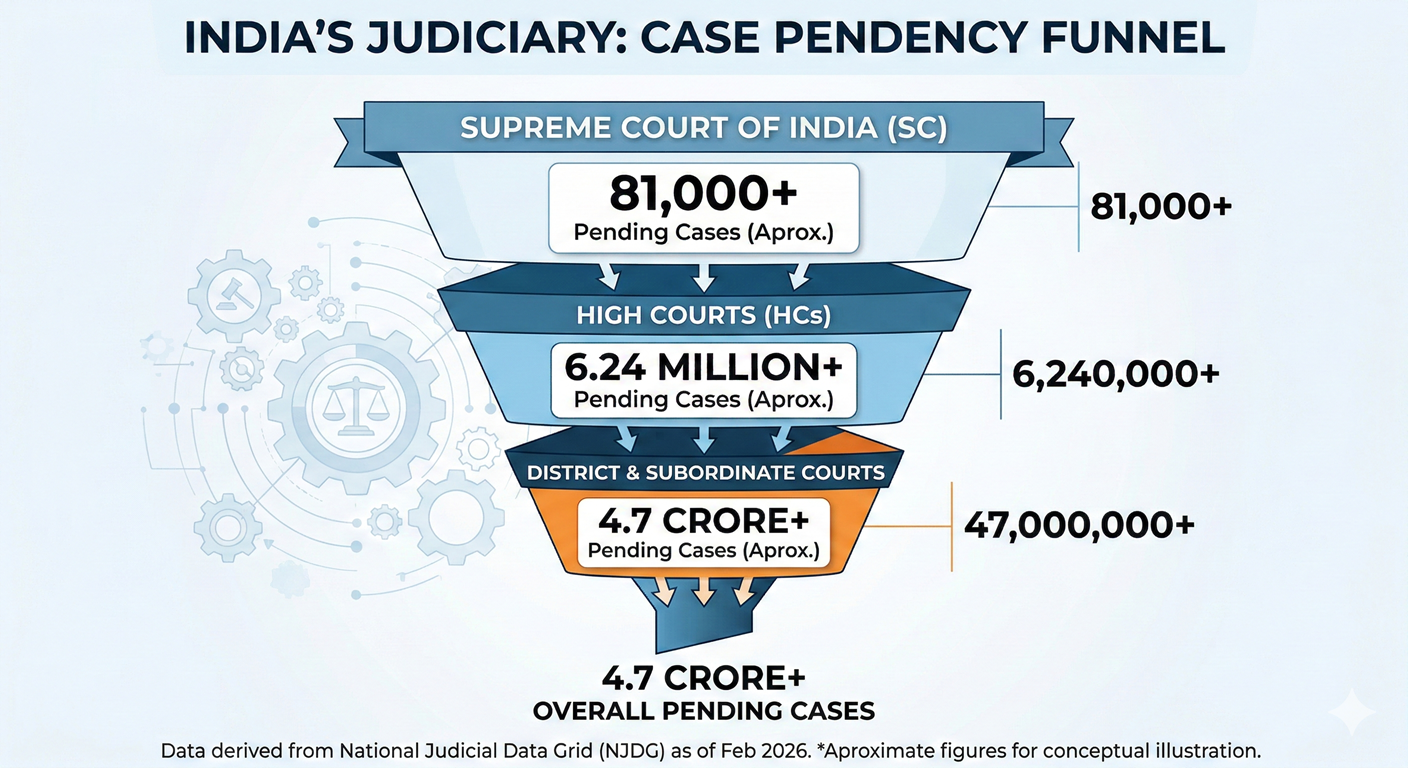
The chapter in question, “The Role of the Judiciary in Our Society,” did not publish secret information. It cited data that the Union Law Minister had presented in Parliament — detailing thousands of complaints against sitting judges between 2016 and 2025, including a substantial number received by the office of the Chief Justice of India. The pendency figures it quoted — drawn from the government’s own National Judicial Data Grid — reflect tens of thousands of matters in the Supreme Court, lakhs in High Courts, and crores in district courts. The reference to former CJI Gavai’s speech about judicial misconduct came from a speech the former Chief Justice himself had delivered publicly in July 2025.
None of this is classified. None of it is fabricated. All of it is in the public domain, in Parliament records, in government databases.
The Admitted Reality: Corruption and Immunity
On March 23, 2025, in an exclusive conversation with Republic TV’s Editor-in-Chief Arnab Goswami, Senior Advocate K.K. Manan made a shocking revelation: “90% of judges in the lower judiciary are corrupt.”
The Supreme Court’s characterization of the NCERT chapter as a “deep-rooted conspiracy” stands in stark contrast to the judiciary’s own admitted state. While the court moved to silence a textbook for mentioning judicial complaints, the leadership of India’s legal establishment has already placed the following on the public record:
- The 90% Admission: K.K. Manan, former three-term Chairman of the Bar Council of Delhi, stated in March 2025 that “90% of judges in the lower judiciary are corrupt,” and noted that lawyers are fully aware of who they are.
- The Justice Varma Incident: In March 2025, approximately ₹15 crore in unaccounted cash was discovered burning in a storeroom at the residence of Delhi High Court Justice Yashwant Varma.
- The Protective Shield: Despite the discovery of burning currency, no criminal FIR was filed because a 1991 Supreme Court ruling prevents police from investigating a sitting judge without the CJI’s permission.
- Routine Transfer: The institutional response was a “routine transfer” back to the Allahabad High Court rather than a criminal investigation by the CBI or ED.
And yet the bench — led by the same CJI Surya Kant whose stay of discriminatory UGC regulations we documented earlier — declared this a “calculated move to undermine institutional authority,” a “deep-rooted conspiracy,” and directed that “heads must roll.”

Symbol of Judicial Crisis
The Accused Becomes the Judge: A Constitutional Crisis
The mechanism by which the Judicial Boundary of Truth is legally enforced in India is the Contempt of Courts Act, 1971. Specifically, Section 2(c)(i) criminalises any publication that “scandalises or tends to scandalise, or lowers or tends to lower the authority of, any court.”
This provision is self-referential in a way that should alarm every student of constitutional law: the court determines what constitutes “scandalising” itself; the court investigates; the court prosecutes; and the court sentences — with no external check at any stage.
Legal scholars have long identified this as the most dangerous clause in India’s contempt framework. Human Rights Watch documented in 2020 that India’s criminal contempt law “does not require proof that the statement has led to actual interference with the administration of justice” — meaning the threshold for contempt is whatever the bench perceives as damage to its own image.
The Rajiv Gandhi School of Intellectual Property Law notes that the distinction between “fair criticism” and “scandalising the court” is ultimately at the court’s own discretion.
The UK abolished this very provision — “scandalising the court” — through the Crime and Courts Act, 2013, at the explicit recommendation of its Law Commission and with the support of the UK Supreme Court itself, which concluded that a mature judiciary in a democracy should withstand criticism without reaching for criminal law.
The UK’s last conviction for scandalising the court was in 1931. India’s Supreme Court, in February 2026, invoked this provision against a Class 8 school textbook.
This is the same judiciary whose accountability crisis we have been documenting in this series — from the Ranjan Gogoi self-investigation scandal to the pattern of religious double standards in its orders. The NCERT incident does not exist in isolation. It is the logical culmination.

The Accountability Crisis
The Political Establishment’s Instant Capitulation
What makes this incident even more revealing is not just the Court’s behaviour — it is the speed and completeness with which every other institution folded.
Solicitor General Tushar Mehta, appearing for the Centre, offered an unconditional apology at the very first hearing before the court had even completed its observations. Is the Government’s submission to the judiciary a judicial overreach?
He assured the bench that the two officials who prepared the chapter “will never be part of any ministerial work from now on.” The Union Education Minister expressed “profound regret.” NCERT issued a press note within hours calling the chapter an “error of judgement” — even as the content they were apologising for consisted entirely of verifiable government statistics.
Contrast this with the Shaheen Bagh situation, where the Court took 101 days to act while citizens were blocked from public roads, or the Haldwani demolition stay where the Court moved within hours on the first working day to halt a government action.
Does the extraordinary speed of the NCERT ban raise questions about institutional priorities—specifically, why judicial response time is measured in minutes when the court’s own image is at stake, yet years for millions of ordinary citizens?
The question this raises — and the one no mainstream publication has posed directly — is: who actually triggered this?
The suo motu action was not initiated by aggrieved citizens or by the government. Senior advocate Kapil Sibal and AM Singhvi mentioned the chapter in open court while representing other matters. Two of India’s most politically connected Senior Advocates — both former Congress ministers — casually mentioned a textbook, and the court proceeded to ban it within 24 hours. The CJI then noted that he had received “hundreds and hundreds of phone calls” urging action.
We have documented extensively in this series that many institutions in the Indian judicial system were presumably operating under the shadow of NGOs. It is time to ask if the NGO-lawyer nexus shapes judicial behaviour.
Institutional Corruption
The CJI Surya Kant Contradiction
When the Judicial Boundary of Truth is invoked, the contradiction between stated principle and actual action becomes the most revealing data point. CJI Surya Kant declared from the bench: “The necessity of judicial intervention is not from a desire to suppress criticism but to uphold the integrity of education.”
Is this the “Gospel Truth?”
Let us examine this claim against the record.
The same CJI Surya Kant, in January 2026, stayed the UGC 2026 Regulations and made remarks about achieving a “casteless society” — for which he was immediately condemned by the Campaign for Judicial Accountability and Reforms as “insensitive.” He did not ban their criticism. He did not issue contempt notices. He did not order that responses to his remarks be removed from digital platforms.
But when a Class 8 textbook cited the Law Minister’s Lok Sabha statistics about judicial complaints, he called it a “deep-rooted conspiracy” and ordered seizure of physical copies.
What is the difference? Is it the difference about protecting “integrity of education?” Is it the difference that now we are discussing the institution of judiciary itself?
Does this incident invite us to evaluate the judiciary through the Dharmic framework established in Blog 2—specifically questioning whether the institution is struggling with a failure of the svadhyaya (self-study) principle, and to what extent it is willing to subject itself to the same scrutiny it applies to other pillars of the state?
The Court stated its orders were not meant to stifle “legitimate criticism.” Yet the data in the NCERT chapter — case pendency figures, complaint statistics, a former CJI’s own speech — is, by any reasonable standard, precisely what legitimate criticism looks like. What remains that is still permissible to teach Indian children about their judiciary?

Dharma vs Jurisprudence
Regime Change Patterns and Institutional Gatekeeping
This incident does not occur in a vacuum. Concurrent with the Supreme Court’s decision to ban a school textbook for citing its own pendency data, geopolitical analysts tracking India’s institutional landscape have noted a convergence of pressure points: international media narratives about Indian institutional reliability, NGO-driven litigation ecosystems, and the weaponization of contempt law against inconvenient documentation.
The Regime Change Playbook consistently identifies judicial capture as a primary mechanism. Courts are often positioned as institutional gatekeepers—determining which narratives about the state are permissible and which trigger the threat of contempt. When domestic educational materials citing Parliament’s own statistics are seized from school shelves while external criticisms from foreign-funded bodies face no such proceedings, does this asymmetry become a significant data point in itself?
The Activation of Destabilization Doctrine identifies the judiciary as a key leverage point in sustained institutional pressure campaigns. The NCERT incident provides a live example: an institution that struggles under crores of pending cases moves with extraordinary speed to ensure the next generation cannot read about those very numbers. Does this rapid response reflect a necessary protection of institutional dignity, or does it invite deeper questions about how a democracy balances judicial image with public transparency?

Challenging Arrogance
What the Contempt Shield Actually Protects
The deeper structural question the NCERT incident forces is this: the Contempt of Courts Act’s “scandalising” provision does not protect justice. Does it protect the judiciary’s image of dispensing justice or improving the judicial delivery system?
India’s Bar & Bench documented the legal circularity in an analysis of criminal contempt that has become more relevant with every passing year: the court is plaintiff, investigator, judge, and sentencer simultaneously. Or, let us ask, is it so? There is no jury. There is no independent review.
When the Law Commission of India, in its 274th Report (2018), declined to remove the “scandalising” provision—a commission chaired by a former Supreme Court judge—does the fact that they were asked whether the law protecting courts from criticism should be retained and predictably answered “yes” raise questions about institutional self-interest?
Is this the institutional equivalent of asking a fox to design the henhouse security system?
The Buddhist Reservation Paradox blog in our series documents how the judiciary simultaneously interprets reservation law in ways that create maximum ambiguity—keeping litigation alive indefinitely while pendency numbers continue to climb. When the Judicial Boundary of Truth is enforced, is it merely restricting “one-sided” narratives, or does it serve to protect specific NGO-driven ecosystems and political philosophies? Does this process effectively silence the ledger of the institution’s own debt to its citizens?
The Shaheen Bagh blockade persisted even after the Delhi Riots—one of the worst in independent India’s history, occurring during a strategically sensitive US Presidential visit—yet the Court did not declare the protest illegal. No suo motu note was taken to clear the roads; the blockade only ended when the government enforced COVID-19 protocols. Similarly, the Court stayed evictions in the Haldwani encroachment case and mandated schooling for illegal Rohingya migrants.
When years of litigation are allowed for illegal blockades and encroachments and providing the facilities to illegal migrants, the asymmetry is apparent. Does this suggest the “Contempt Shield” has become more responsive to the sustained pressure and sophisticated legal machinery of an NGO-lawyer nexus than to the transparency required by its own citizens?
The Dharmic Perspective: When Institutions Lose the Mirror of Accountability
From the Dharmic standpoint — which forms the philosophical foundation of this entire judiciary series — the most significant aspect of this incident is not the ban itself but the institutional incapacity for self-reflection it reveals.
The Vedic concept of Rtam — cosmic order sustained by truth — holds that institutions which cannot withstand truthful accounting of their own functioning have begun the process of adharma.
In the context of this framework, is the CJI’s statement that “the judiciary is bleeding” after a textbook cited its own data a profound inversion? Is the bleeding caused not by the data itself, but by the crores of citizens waiting in judicial queues that the Court now seeks to erase from children’s minds?
Double Standards
The Textbook Is a Mirror
When the Judicial Boundary of Truth is drawn narrowly, it is not necessarily protecting justice. Is it protecting the distance between institutional image and institutional reality? The NCERT Class 8 chapter did nothing that every informed Indian adult does not already know — courts are backlogged, complaints against judges exist, former Chief Justices have said so themselves as also senior members of Bar. The only new information the chapter introduced was that 13-year-old children were about to know it too.
Was that what triggered the ban?
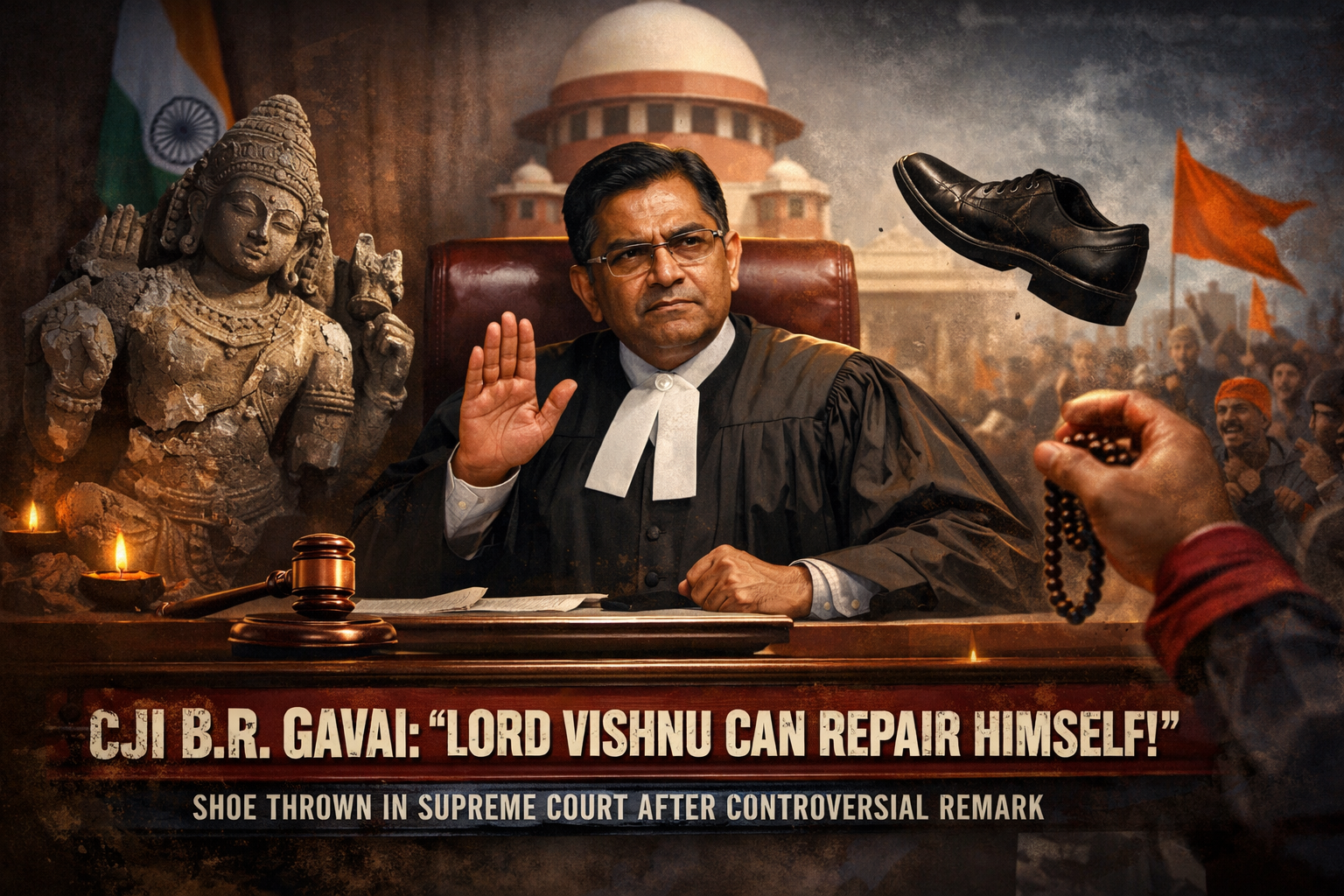
The shoe-throwing incident that opened this series was an act of individual desperation by a senior lawyer who had exhausted every formal channel. Is the NCERT textbook ban something more systemic—the judiciary formally declaring that the facts of its own failure are, in the hands of young citizens, a threat to the administration of justice?
When a textbook becomes “contempt,” have we crossed from judicial accountability into institutional authoritarianism? Is the difference between the two exactly what the chapter was trying to teach—and what the Court, in its haste to seize copies from the market, has demonstrated more powerfully than any textbook ever could?
This blog is part of the continuing series “When Courts Fail Both Ancient Dharma and Modern Jurisprudence” — India’s most comprehensive documented examination of Supreme Court institutional failures. Share this analysis if you believe Indian children have the right to know the facts about the institutions that govern their future.
Feature Image: Click here to view the image.
Videos
Glossary of Terms
- Supreme Court of India: The highest judicial authority in India, empowered to interpret the Constitution and adjudicate disputes of national importance.
- NCERT (National Council of Educational Research and Training): India’s central government body responsible for designing school curricula and publishing textbooks.
- Class 8 Social Science Textbook: An NCERT-issued educational book for middle school students containing a chapter on the judiciary that became subject to Supreme Court scrutiny in February 2026.
- National Judicial Data Grid (NJDG): An official government database that tracks pendency and disposal of cases across Indian courts.
- Contempt of Courts Act, 1971: Indian legislation defining civil and criminal contempt, including provisions relating to “scandalising the court.”
- Section 2(c)(i): A clause under the Contempt of Courts Act criminalising publications that lower or tend to lower the authority of any court.
- Criminal Contempt: A legal proceeding initiated when a publication or act is perceived to undermine judicial authority.
- Show Cause Notice: A formal judicial notice requiring individuals or institutions to explain why action should not be taken against them.
- Lok Sabha: The lower house of India’s Parliament where ministers present official data and policy statements.
- Judicial Pendency: The accumulation of unresolved cases awaiting adjudication in courts.
- Suo Motu Action: A proceeding initiated by a court on its own motion without a formal petition.
- Chief Justice of India (CJI): The head of the Supreme Court of India and the Indian judiciary.
- Bar & Bench: A legal news publication reporting on Indian judicial proceedings.
- Human Rights Watch (HRW): An international organisation that has critiqued India’s criminal contempt framework.
- Law Commission of India – 274th Report: A 2018 review examining whether the offence of scandalising the court should be retained.
- Crime and Courts Act, 2013 (United Kingdom): Legislation that abolished the offence of “scandalising the court” in the UK.
- Judicial Accountability: The principle that members of the judiciary remain answerable to constitutional and ethical standards.
- Institutional Self-Protection: A concept describing institutional behaviour aimed at preserving authority or image.
- Public Domain Data: Information officially disclosed through parliamentary records or government databases.
- Judicial Review: The power of courts to examine the legality of legislative and executive actions.
#NCERT #SupremeCourt #Judiciary #Contempt #JudicialReform #FreeSpeech #CourtPendency #IndiaNews #WhenCourtsFailIndia #NCERTBan #JudiciaryAccountability #ContemptOfCourt #IndianJudiciary #SupremeCourtIndia #JudicialReform #FreeSpeech
Sources and Further Reading
Primary Sources — NCERT-SC Incident:
- Bar & Bench: Supreme Court bans NCERT textbook
- The Print: ‘Heads must roll’ — full court report
- Republic World: Complete court proceedings
- Vibes of India: Context and complaint data
- Verdictum: Full court order text
Legal Framework:
- PRS India: Law Commission 274th Report on Contempt of Courts Act
- Human Rights Watch: India’s contempt law and free speech
- RSRR: Validity of scandalising the court provision
- Bar & Bench: The need to revisit criminal contempt laws
Judicial Accountability Series
- https://hinduinfopedia.in/shoe-at-supreme-court-symbol-of-indias-judicial-crisis/
- https://hinduinfopedia.in/dharma-vs-jurisprudence-the-framework-for-measuring-judicial-failure/
- https://hinduinfopedia.in/ranchi-court-confrontation-when-lawyers-challenge-judicial-arrogance/
- https://hinduinfopedia.in/public-order-and-protests-supreme-courts-shaheen-bagh-failure/
- https://hinduinfopedia.in/judicial-accountability-crisis-when-judges-investigate-themselves/
- https://hinduinfopedia.in/lord-vishnu-can-repair-himself-when-chief-justice-mocks-hindu-beliefs/
- https://hinduinfopedia.org/buddhist-reservation-paradox-why-buddhists-get-sc-benefits/
- https://hinduinfopedia.org/institutional-corruption-in-indian-judiciary-when-bar-council-admits/ https://hinduinfopedia.in/?p=24660
- https://hinduinfopedia.in/cji-surya-kant-defends-hindu-unity-when-questioning-caste-division-triggers-leftist-rage/
Cross-Series Reading — hinduinfopedia.org:
- Buddhist Reservation Paradox: Why Buddhists Get SC Benefits
- Institutional Corruption in Indian Judiciary: When Bar Council Admits
- Rigvedic Kavacha for Divine Protection: Invoking Indra, Agni, Soma
- Dharma in the Information Age: Vedic Principles
Cross-Series Reading — hinduinfopedia.com: