
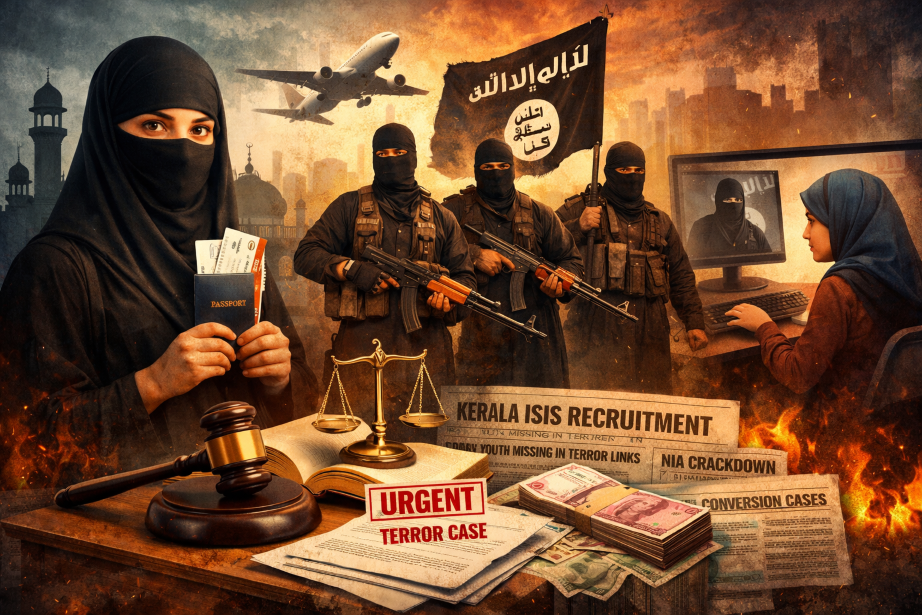
The Kerala Story 2 Analyzed: The Raktbeej of Civilisational Warfare
भारत/ GB
The Film Arrives — And So Does the Suppression Machine
Three days before The Kerala Story 2: Goes Beyond releases in Indian theatres on February 27, 2026, the Kerala High Court is questioning the CBFC over its certification, ordering teasers removed from the internet, and Justice Bechu Kurian Thomas is declaring — from the bench — that “Kerala is so secular” and “lives with total harmony.” Chief Minister Pinarayi Vijayan has called the sequel “poisonous propaganda” and the Communist Party of India’s Kerala unit has passed a resolution demanding re-certification. Three petitions seek an outright ban.
Thank you for reading this post, don't forget to subscribe!This is the reception for a film that the CBFC already cleared with a U/A certificate after 16 modifications — including a 50% reduction in violence scenes, added disclaimers, voiceover-backed text clarifications, and edits to the forced-feeding sequence. The censor board did its job. The state machinery wants more.
I watched the pre-release screening. What follows is not a review. It is an analysis of what the film documents, what the suppression attempts reveal, and how the Raktbeej framework — which we have been developing across the Economic Jihad Infrastructure series and the Haq Movie Analysis series — explains why this film matters more than its box office numbers.
THE DOSSIER: Chhangur Baba & Economic Jihad
From amulet seller to a 500-crore empire. Read the investigation into the infrastructure that The Kerala Story 2 hints at.
“Kerala Lives in Total Harmony” — The Judicial Gaslight
Let us address the elephant in the courtroom first.
Justice Thomas’s observation that Kerala “lives with total harmony” is not a legal finding. It is an ideological assertion masquerading as judicial temperament—and it collapses on contact with documented reality.
Moreover, as analyzed in our deep-dive on Selective Indian Judicial Speed, the statement of a judge or the judgment itself is not “Gospel Truth.” We are witnessing a systemic bias where the courts exhibit Supersonic Speed to hear petitions seeking to ban films or stop Hindu rituals, yet fall into a state of chronic delay when victims of forced conversion seek justice.
When a court uses its platform to declare “harmony” while ignoring documented NIA reports on ISIS recruitment in the state, it isn’t delivering justice—it is performing narrative protection. This is the Institutional Capture we have documented: a framework where “secularism” is used as a judicial shield to ensure the Raktbeej remains undisturbed by cinematic or legal exposure.
Nimisha Sampath, a Hindu woman from Kerala, took the name Fathima Isa after conversion and fled to Afghanistan to join ISIS alongside Sonia Sebastian and Merin Jacob, all radicalised by ISIS frontman Abdul Rashid. Nimisha ended up in an Afghan prison after her terrorist husband was killed. The National Investigation Agency has repeatedly confirmed that Kerala produced a disproportionately high number of radicalised individuals attempting to join ISIS in conflict zones. The Syro-Malabar Church and Kerala Catholic Bishops’ Council raised alarms about systematised Love Jihad targeting as early as 2020.
This is the “total harmony” the bench is protecting.
The real question the court should be asking is not whether the film disturbs Kerala’s harmony—but whether they are playing the old playbook like the Supreme Court played in the case of Nupur Sharma or Shaheen Bagh in making such judgements and whether that “harmony” was always a fiction maintained by suppressing the voices of victims. When a state government, a judiciary, and a political party coordinate to prevent a certified film from reaching theatres, they are not protecting secularism. They are protecting a narrative.
When a state government, a judiciary, and a political party coordinate to prevent a certified film from reaching theatres, they are not protecting secularism. They are protecting a narrative. As we have documented in our series on Institutional Capture, this narrative protection is precisely what the Raktbeej infrastructure requires to function.
The 37 Women in Delhi — And the Question Nobody Wanted to Ask
On February 23, 2026, at India Habitat Centre in Delhi, producer Vipul Amrutlal Shah and director Kamakhya Narayan Singh held a press conference ahead of the release. They brought 37 women to the stage — women from Bengal, Bihar, Bhilwara, Gangapur, Rajkot, Udaipur, Jammu, Maharashtra, Bhopal, Jharkhand, Faridabad, Meerut, Delhi, Noida, Gurugram, and Indore — all describing themselves as survivors of forced religious conversion.
One by one, they spoke.
Tara Shahdeo, a national-level shooter from Ranchi, recounted how she married a man posing as Ranjit Kohli — who turned out to be Raqibul Hasan. Pressured to convert from the second day of marriage. Subjected to physical abuse. Helped by a magistrate named Mustaque Ahmed in evading law. It took until October 2023 for Hasan to receive life imprisonment — his mother and the magistrate also sentenced.
The media immediately noted: not one of the 37 women was from Kerala.
This was framed as a gotcha. It is actually the film’s strongest argument.
The subtitle is “Goes Beyond.” The sequel expands the narrative across Rajasthan, Madhya Pradesh, and Kerala — three parallel stories of Hindu women trapped through deception, false identity, and coerced conversion. That 37 survivors from across a dozen states could be assembled on a single stage in Delhi does not undermine the Kerala connection. It proves the connection has metastasised. The infrastructure documented in Part 1 of The Kerala Story — conversion, radicalisation and sex slavery, ISIS recruitment originating from a single state — has replicated itself nationally. The Raktbeej has multiplied.
EXPLORE THE SERIES: The Haq Movie Analysis
Why is Hindu ‘Haq’ systematically denied in the modern narrative? We dismantle the theological foundation that normalizes discrimination.
The Raktbeej Framework: Why This Film Fits the Pattern
For readers who have followed our analysis across the Chhangur Baba conversion empire, the 15 years of administrative impunity that protected it, and the Hygiene at Kanwar Yatra Route and Related Controversies documentation of systematic food contamination, The Kerala Story 2 is not a standalone film. It is a cinematic node on the same infrastructure map.
The Raktbeej operates through a self-replicating logic that creates win-win outcomes for the predatory infrastructure regardless of individual case results.
The Success Path
If the operative succeeds — through deception, false identity marriage, coerced conversion — the demographic and territorial hold expands and if they fail they treat it as sacrifice in the name of their supreme authority. Tara Shahdeo’s husband operated for years before conviction. The two sisters from Agra reported missing in March 2025 — targeted through a friend named Saima from Udhampur, J&K — represent the recruitment-chain model where each successful conversion becomes a recruitment tool for the next.
The Martyrdom Path
If the operative is caught, arrested, or exposed — as Raqibul Hasan eventually was — the infrastructure reframes the case as persecution.
The legal battle itself becomes recruitment material. Every arrest generates a “victim narrative” that fuels the next cycle of radicalisation. This legal battle is financed by agencies like Jamiat Ulama-i-Hind who collect money for issuing Halal Certificates, supported Zakir Naik, and attempted to block the film The Udaipur Files, which documented the brutal murder of the tailor Kanhaiya Lal obstruction.
The Multiplier
Every legal or social strike against the infrastructure triggers fresh victimhood claims that power the next generation. The legal system protects and promotes the victimhood. This is why the Kerala High Court challenge to The Kerala Story 2 is itself Raktbeej logic in action: the film documents the infrastructure, so the infrastructure activates its judicial and political nodes to suppress the documentation. The suppression attempt then becomes proof of “Islamophobia,” which feeds the next cycle. The term “Islamophobia” itself is a creation of global institutional capture, where international bodies are weaponized to shield radicalism from scrutiny. This is part of a broader Genocide Inversion strategy, where the predatory infrastructure depicts itself as the victim to paralyze any state or civilizational response.
As we documented in our analysis of Yogi Adityanath’s breakthrough against the Chhangur Baba network, the only intervention that disrupts the Raktbeej is one that treats the infrastructure as an infrastructure — not as a series of individual crimes. The Kerala Story 2 does precisely this by showing three parallel cases across three states converging on a single mechanism. It is structural analysis through narrative cinema.
THE YOGI BREAKTHROUGH: From Impunity to Accountability
How do you stop the Raktbeej? We analyze the civilizational context behind the administrative shift in Uttar Pradesh.
The Kota Garba Incident: Sacred Space Penetration in Real Time
The film’s thematic territory intersects directly with the Kota Garba incident of September 2025 — a case we analysed in the Salafist Trojan Technique series.
On September 26, 2025, two Muslim women in Kota, Rajasthan were denied entry to the 56 Bhog Garba event despite holding valid passes. They filmed a viral video alleging discrimination. The passes contained no mention of the non-Hindu entry policy. They were eventually refunded.
The incident was universally framed as discrimination. The framing omits the documented pattern that triggered the policy.
During the 2024 Navratri in Deesa Taluka, Banaskantha, Gujarat, a married Hindu woman failed to return home from a Garba celebration — a Muslim man was accused of enticing her. In 2024, a gang of five Muslim men raped a 16-year-old girl during Navratri in Gujarat. In Ujjain, a Muslim youth entered a Garba pandal with condoms while posing as “Rahul” before being apprehended by Hindu Jagran Manch. In Madhya Pradesh, Muslim women were simultaneously barred from Garba events while local Muslim clerics — Shahar Qazi Maulavi Sayyed Quazi Ahmad Ali in Ratlam, Maulana Ali Qadar in Bhopal — issued written appeals asking Muslim youth to stay away from Garba, acknowledging it would offend Hindu organisers and was not in line with Islamic principles.
This is the asymmetry the film exposes through its Rajasthan track. When Muslim clerics themselves declare Garba participation un-Islamic, the insistence on entry by others is not cultural participation — it is boundary testing. As we documented in the Haq Movie Analysis series on how Kafir classification creates a rights hierarchy, the fabricated “right to participate” is deployed specifically to subvert the “right to preserve.” The entry demand is never accompanied by reciprocal access — no Hindu is demanding the right to participate in Muharram processions or enter mosques during Jummah.
The Kerala Story 2’s Rajasthan track — a minor girl targeted under POCSO-applicable circumstances — is the cinematic rendering of exactly this asymmetric penetration pattern.
The Digital Troll Infrastructure: Suppression by Volume
The YouTube landscape around The Kerala Story 2 deserves separate documentation. Within hours of the trailer’s release, coordinated “reaction” channels began producing content designed not to engage with the film’s claims but to delegitimise the conversation itself. The word “propaganda” appears in video titles and descriptions with a frequency that suggests SEO coordination rather than organic criticism.
This mirrors the pattern we documented in the Nazia Azan Analysis — where the normalisation of one community’s religious practices in shared spaces is defended as “freedom,” while any Hindu assertion of sacred boundaries is framed as “hate.” The digital troll infrastructure around Kerala Story 2 operates on the same inversion: the film documents victims, so the infrastructure attacks the documentation. The victims disappear from the discourse. The “propaganda” label becomes the story.
Director Anurag Kashyap publicly called the film propaganda, positioning his critique as artistic integrity. This is the same Bollywood ecosystem that produced Haq — a film we analysed across five parts — which normalises the subversion of local laws and customs under the guise of “rights” while framing Hindu resistance as communalism. When Kashyap objects to “The Kerala Story” but raises no objection to films that normalise forced religious compliance, the selectivity is the message.
MUST READ: The Nazia Series & Demographic War
How normalization becomes domination through institutional capture.
Chhangur Baba and the Film’s Final Act: Cinema Meets Documentation
The conclusion of The Kerala Story 2 bridges cinematic narrative into the territory we continue to document. The Chhangur Baba phenomenon — Jamaluddin, who built a ₹500 crore conversion empire from amulet-selling to controlling 40 bank accounts and a ₹3 crore mansion in Madhupur — is not referenced directly in the film, but the infrastructure the film depicts is the same infrastructure Chhangur operated within.
Consider the parallels. The film shows Hindu women targeted through deception in interpersonal relationships — Chhangur targeted widows and the poor through manufactured “spiritual authority.” The film shows false identity as an entry mechanism — Chhangur operated under a fake RSS identity for years, and Raqibul Hasan posed as “Ranjit Kohli.” The film shows state-level inaction enabling the infrastructure — Chhangur enjoyed 15 years of administrative protection across SP and BSP regimes while court clerks actively weaponised the legal system on his behalf.
The only intervention that broke the Chhangur cycle was when Yogi Adityanath’s administration treated the racket as anti-national infrastructure rather than individual crime. The film’s tagline — “Is baar sahenge nahi… ladenge” (this time we will not tolerate, we will fight) — articulates in cinema what the Yogi breakthrough demonstrated in governance: that civilisational predation cannot be addressed through individual FIRs. It requires structural recognition and structural response.
The “Inspired by True Events” Trap and the Contempt Factory
Justice Thomas’s concern that the film “claims to be inspired by true events” and therefore the petitioners’ complaints seem “justified” reveals a deeper judicial logic worth examining—a logic that is being examined in our series When Courts Fail Both Ancient Dharma and Modern Justice.
When Bollywood produces films “inspired by true events” that portray Hindu practices as regressive — dowry, caste violence, religious obscurantism — no court demands private screenings or questions the CBFC’s certification. When the same label is applied to documented cases of forced conversion, fake identity marriages, and ISIS recruitment, suddenly it becomes grounds for suppression.
This is the dual contempt factory we analysed in the Haq Series Part 5 — the NCERT-to-university pipeline that manufactures Hindu self-contempt while simultaneously producing the “secular” framework within which any documentation of anti-Hindu predation becomes “communalism.” The Kerala Story 2 is threatening not because it lies, but because it documents. And documentation is the one thing the contempt factory cannot survive.
The 37 women who stood on a Delhi stage were not actors. Tara Shahdeo is not a fictional character. Raqibul Hasan’s life imprisonment is not propaganda. Nimisha Sampath’s Afghan prison cell is not a screenplay. The “inspired by true events” label is the filmmakers’ most powerful weapon precisely because the true events exist — and the infrastructure’s only defence is to prevent citizens from seeing them dramatised.
The Beef-Forcing Scene: Civilisational Defilement as Method
The fury surrounding the “beef-forcing” scene in The Kerala Story 2 is not merely about a dietary choice; it is about the weaponization of food to achieve civilizational submission through the same logic seen in the Chhangur Baba rate card, where higher bounties for Brahmins and Jains prove that the goal is to maximize civilizational injury.
The Political Context: Kerala’s Beef Extremism
To understand why this scene is so visceral, one must look at the unique political climate of Kerala. It remains the only state where members of a major political party (Youth Congress) publicly butchered a calf in broad daylight in Kannur (2017) specifically to send a “message” to the rest of the country. When the state’s political culture treats the slaughter of a animal sacred to Sanatanis as a celebratory “Beef Festival,” it normalizes a culture of contempt.
The film’s depiction of a Hindu girl being forced to eat beef after marriage is the logical extension of this public extremism. If they can butcher a cow on the street to humiliate a civilization, they can certainly force its consumption in a kitchen to break an individual.
Hygiene, Transparency, and the “Spitting” Pattern
This dietary coercion is the “hard” edge of a broader spectrum of food-based warfare. As analyzed in the series, there is a documented pattern of “intentional unhygienic practices” that target the sacred boundaries of the majority community.
- The Ontological Violation: In the Vedic tradition of Anna Brahma (Food is Divine), the act of eating is a sacred ritual. Forcing beef or contaminating food with spit is not just a hygiene issue; it is an “ontological violation” designed to defile the body and spirit of the victim.
- The Transparency Gap: The recent controversy over displaying names on the Kanwar Yatra route highlights the infrastructure’s fear of transparency. When patterns of “intentional hygiene malpractices”—such as the spitting-on-roti cases in India or the documented human waste contamination at a Nottingham takeaway in the United Kingdom—are exposed, the predatory infrastructure reacts with “victimhood” narratives to hide the identity of the perpetrators.
- The Trojan Technique: Just as the Kota Garba incident was an attempt to penetrate sacred social spaces, the rejection of food transparency is an attempt to maintain a “Right to Deceive” in the culinary space.
Breaking the “Win-Win” Trap
This is the Raktbeej at work in our kitchens.
- Success: The victim consumes the forbidden, breaking their spiritual link to Sanatan Dharma.
- Failure: If exposed, the perpetrator claims “discrimination” or “Islamophobia,” using the legal system as a shield—as seen in the judicial pushback against name-plates on pilgrimage routes.
The Kerala Story 2’s subtitle “Goes Beyond” is a direct reference to this. It moves beyond the physical abduction of women to the spiritual and psychological abduction of the civilization through its most intimate habit: the consumption of food.
Breaking the Cycle: What the Film Cannot Do Alone
The Kerala Story 2 is an essential document, but it is a document that arrives in a war zone where the rules of engagement are rigged. The Kerala High Court can order teasers removed. The Communist Party can pass resolutions. Pinarayi Vijayan can deploy the word “propaganda.” But none of these responses address a single one of the 37 women who stood in Delhi. None of them reverse Raqibul Hasan’s conviction. None of them bring Nimisha Sampath home from Afghanistan.
The film’s subtitle — “Goes Beyond” — is both a description of its expanded geographical scope and a challenge to its audience. Going beyond means recognising that the conversion infrastructure documented in Kerala has replicated itself across Rajasthan, Madhya Pradesh, Bihar, Bengal, Jharkhand, Uttar Pradesh, and beyond. Going beyond means understanding that the Chhangur Baba network, the Thook and hygiene Jihad pattern, the Kota Garba boundary testing, and the Love Jihad recruitment chains are not separate phenomena but different operational arms of the same civilisational Raktbeej.
Going beyond means doing what the film’s critics most fear: connecting the dots.
The infrastructure wins when each case is treated as isolated. When Tara Shahdeo’s case is “Jharkhand’s problem.” When Nimisha Sampath is “Kerala’s aberration.” When Chhangur Baba is “one man’s crime.” When spitting on roti is “a hygiene issue.” When Muslim girls denied entry to Garba is “Hindu intolerance.” The infrastructure loses when the pattern becomes visible. When the audience sees that the Rajasthan minor, the Madhya Pradesh bride, the Kerala convert, the Ghaziabad cook, the Kota boundary-tester, and the Chhangur Baba operative are all drawing from the same playbook — the same theological foundation we documented in the Haq Series on Kafir classification, the same normalisation mechanics we exposed in the Azan analysis, the same contempt factory we mapped in the NCERT indoctrination analysis.
The Kerala Story 2 opens in theatres on February 27. Whether the Kerala High Court lets it play uncut, the infrastructure has already confirmed the film’s thesis — by doing exactly what the film says it does.
Feature Image: Click here to view the image.
Videos
Glossary
- The Kerala Story 2: Goes Beyond: Sequel to the 2023 film, directed by Kamakhya Narayan Singh, produced by Vipul Amrutlal Shah under Sunshine Pictures; follows three Hindu women across Rajasthan, Madhya Pradesh, and Kerala facing deceptive marriages and forced conversion. Releasing February 27, 2026.
- Raktbeej Framework: Analytical model drawn from the Puranic demon whose every blood drop spawned a new warrior; applied to self-replicating predatory infrastructure where success expands the network and failure generates victimhood narratives that fuel recruitment.
- U/A Certificate with 16 Modifications: CBFC clearance requiring 50% reduction in violence, added disclaimers, voiceover clarifications, and scene edits — the film passed official censorship before judicial challenge.
- 37 Women Press Conference: February 23, 2026, India Habitat Centre, Delhi — survivors of alleged forced conversion from 12+ states presented by the film’s makers; none were from Kerala, demonstrating pan-India spread of the documented infrastructure.
- Tara Shahdeo Case: National-level shooter from Ranchi who married Raqibul Hasan posing as Ranjit Kohli in 2014; forced conversion, physical abuse; Hasan sentenced to life imprisonment October 2023 by Special CBI Court.
- Nimisha Sampath / Fathima Isa: Hindu woman from Kerala who converted and fled to Afghanistan with ISIS; radicalised by Abdul Rashid alongside Sonia Sebastian and Merin Jacob; ended up in Afghan prison.
- Kota Garba Incident (September 2025): Two Muslim women denied entry to 56 Bhog Garba event in Kota, Rajasthan despite valid passes; incident framed as discrimination while documented predatory patterns at Garba events had triggered Hindu-only policies.
- Section 5B, Cinematograph Act 1952: Provision under which petitioners challenged CBFC certification, requiring films not threaten public order, decency, morality, or sovereignty.
- Shahar Qazi Appeals: Written appeals by Muslim clerics in Ratlam and Bhopal asking Muslim youth to stay away from Garba events — acknowledging incompatibility with Islamic principles while media framed Hindu exclusion policies as intolerance.
- POCSO Act: Protection of Children from Sexual Offences Act — applicable to the Rajasthan track in the film involving a minor.
- Dual Contempt Factory: Analytical framework from Haq Series Part 5 — System One (madrasas/fatwa bodies) manufactures anti-Hindu classification while System Two (NCERT/universities) manufactures Hindu self-contempt; together they produce external hostility and internal surrender.
- Anna Brahma: Vedic concept from the Taittiriya Upanishad declaring food as Brahman (the divine); forced beef consumption constitutes ontological violation of the sacred relationship between body and sustenance in Dharmic tradition.
- “Is baar sahenge nahi… ladenge”: Film’s tagline — “This time we will not tolerate, we will fight” — specifically flagged by petitioner Sreedev Namboodiri as potentially inciting violence; represents the shift from victim documentation to resistance assertion.
- Sreedev Namboodiri: Biologist from Kannur who filed the primary petition in Kerala High Court challenging the film’s certification; argued the title stigmatises Kerala.
- Pinarayi Vijayan: Chief Minister of Kerala (CPI-M); called the sequel “poisonous propaganda” and an attempt to incite “communal discord.”
[Short URL https://hinduinfopedia.in/?p=25177]