
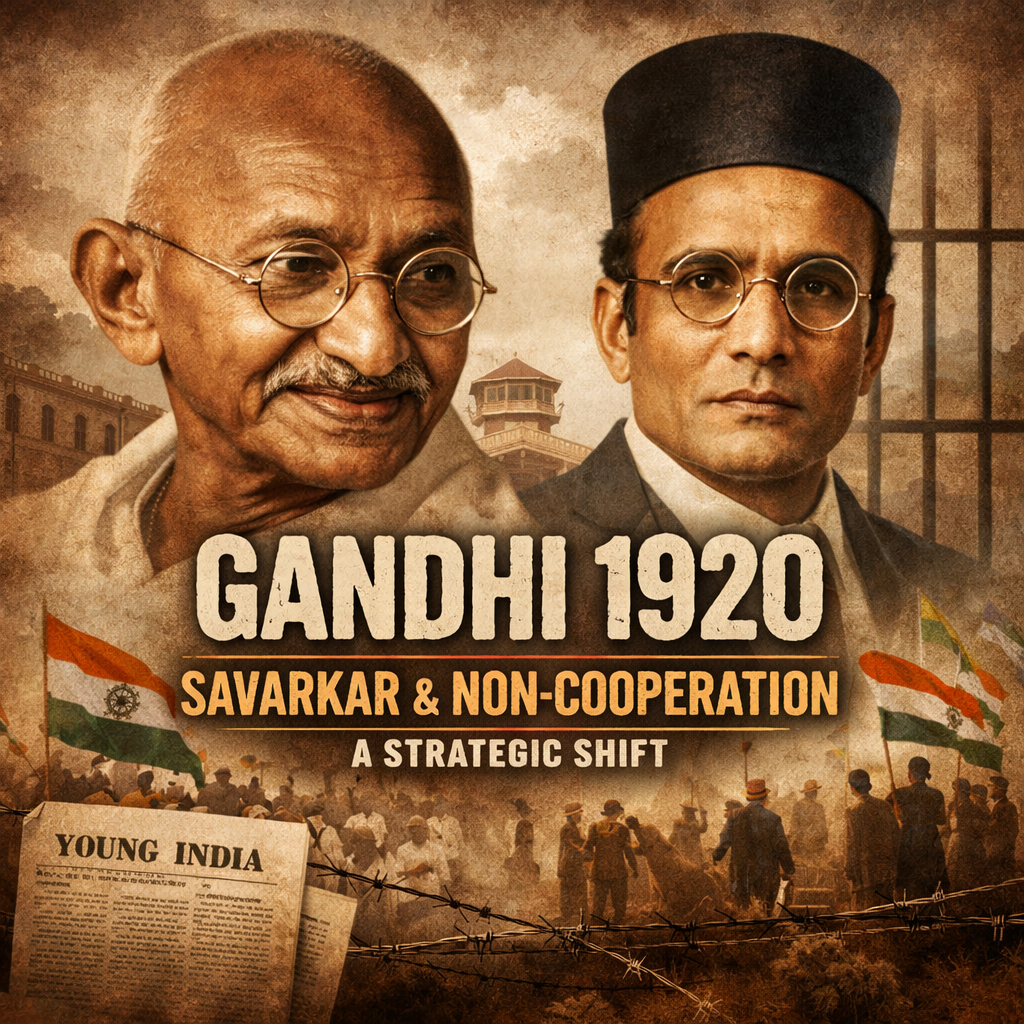
Gandhi’s Philosophy Unmasked: The Geometry of Misinformation (25)
भारत / GB
Part 25: Mahatma Gandhi’s Peace Efforts | Series Index
Blog 22 established that Gandhi’s authority derived from moral sanctity rather than election or appointment. Blog 23 followed the bureaucratic circular of 1938 into the thirteen months that followed it. Blog 24 digs deeper how Gandhi’s philosophy was entrenched with accommodating British rule as a principle. Gandhi’s Philosophy Unmasked pinpoints how two actions separated by a few months displays the dichotomy explicitly and without any inhibitions.
Thank you for reading this post, don't forget to subscribe!The Action Taken: In 1946, Gandhi overrode the nominations of 12 out of 15 Provincial Congress Committees who voted for Sardar Patel, personally installing Jawaharlal Nehru as Congress President.
Who Paid the Price: Sardar Patel, the provincial party committees, and internal democratic party procedures.
The Alternative Bypassed: The formal electoral constitution of the Indian National Congress.
Why This Matters: Documents that the extra-constitutional veto operated through to the transfer of power, determining the leadership of the post-colonial executive through personal selection rather than democratic vote.
Gandhi’s Philosophy Unmasked: Method Vs Mandate
Blog 22 showed how Gandhi built an unchallengeable authority by fusing his personal will with the moral destiny of the freedom struggle, making any opposition appear as an attack on the nation’s ethical core itself. Blog 23 documented how that moral authority was formally entrenched in the bureaucratic machinery through the 1938 circular and the critical thirteen-month window that followed.
This post, Blog 24, moves beyond the construction and formalisation of that authority to reveal how it actually functioned in practice. It exposes Gandhi’s Operating Method — the consistent “Method of Dissonance” — through which he made decisions, managed dissent, and executed tactical transactions with the British while maintaining his moral stature. The most precise and damning exhibit of this method survives in a single article published in Young India on 26 May 1920: the Savarkar File.
On 26 May 1920, Mahatma Gandhi published a remarkable article in Young India titled “Savarkar Brothers.” In it, he made a clear, unequivocal case for the release of Vinayak Damodar Savarkar and his brother Ganesh Damodar Savarkar, who were languishing in the Cellular Jail in the Andamans. The Royal Proclamation of December 1919 had offered clemency to political offenders. Many had been freed. The Savarkar brothers had not. Gandhi stepped in.
Here is what he wrote, verbatim:
“Both the brothers have declared their political opinions and both have stated that they do not entertain any revolutionary ideas and that if they were set free they would like to work under the Reform Act… They both state unequivocally that they do not desire independence from the British connection. On the contrary, they feel that India’s destiny can be best worked out in association with the British.”
Gandhi was not merely asking for mercy. He was publicly certifying that the Savarkar brothers had accepted British rule — that they had renounced any desire for independence and were ready to operate within the colonial framework of the 1919 Government of India Act. He presented this acceptance as the very reason they posed “no danger to the State” and should therefore be released. The message was crystal clear: loyalty to the British connection was the price of freedom for these revolutionaries.
Now read the calendar again.
26 May 1920: Gandhi tells the world that Savarkar must accept British rule.
1 August 1920: Gandhi launches the Non-Cooperation Movement — the first time India said “No” to the Empire on a mass scale.
September 1920: The Calcutta Congress formally adopts the programme. Gandhi promises Swaraj within one year. The demand was no longer reform within the Empire. It was non-cooperation until the British apparatus cracked.This is not a minor inconsistency. This is the foundational contradiction at the heart that helps Gandhi’s Philosophy Unmasked.
Gandhi’s Philosophy Unmasked: Core of Satyagraha
Gandhi’s entire doctrine — Satyagraha, Ahimsa, the spinning wheel, the “inner voice” — was sold to India as the pure pursuit of truth. Yet on 26 May 1920 he publicly endorsed the idea that India’s destiny was best served “in association with the British.” Three months later he was telling millions to withdraw all cooperation from that same British connection. Either the May statement was a tactical misinformation to secure the release of the Savarkar brothers, or the August movement was built on a foundation he himself had just declared unnecessary.
The Hindu Infopedia series has documented this pattern relentlessly. In “Gandhi’s Non-Cooperation: The First Time India Said No” (Blog 7), we showed how Gandhi ignited a mass movement the day Bal Gangadhar Tilak died — co-opting the Extremist energy while quietly inserting his own safety valves. In “Gandhi’s Four Satyagrahas, Four Betrayals” (Blog 10) and the entire arc from the Eleven Demands to the Irwin Pact (Blogs 11–20), we saw the same script: build pressure, extract concessions for himself and the Congress, then call off the struggle before real independence could materialise.
The 26 May 1920 article is the smoking gun of that philosophy in its rawest form.
Gandhi did not say “Savarkar should be released because he is a patriot who has suffered enough.” He did not say “Political prisoners deserve clemency regardless of their views.”
He explicitly tied their release to their acceptance of British rule. He made loyalty to the Empire the qualifying criterion for mercy. This was not compassion. This was ideological policing: revolutionaries must be tamed before they can be freed.
Philosophy or Political Theatre?
Gandhi’s defenders will say he was only quoting the Savarkars’ own petitions. That misses the point. A leader who claims to speak truth to power does not amplify a prisoner’s acceptance of subjugation as the moral basis for his release — especially when that same leader is weeks away from mobilising the entire nation against that subjugation.
By May 1920, Gandhi had already returned from South Africa, conducted Champaran and Kheda, and positioned himself as the new face of Indian resistance. He knew the revolutionary current was alive — Savarkar represented precisely that current. Yet instead of demanding their unconditional release as political prisoners, he chose to broadcast their “acceptance” of the British connection. Why?
Because Gandhi’s philosophy was never about Purna Swaraj in 1920. It was about controlled pressure. Swaraj, at that stage, still meant self-rule within the Empire for many Congress leaders. Gandhi’s genius — and his tragedy — was to ride the wave of popular anger while keeping the final demand elastic. When the British offered the right price (titles, seats, pacts), he folded. When revolutionaries like Savarkar threatened to pull the movement toward complete severance, he reminded them — and the British — that the acceptable path was “association with the British.”
This is why the Non-Cooperation Movement, for all its historic power (detailed in Blog 7 of this series), was ultimately called off at the pretext of Chauri Chaura incident in 1922. The same pattern repeated in 1931 with the Gandhi-Irwin Pact, and again in 1942 with Quit India. The extraction machine (Blogs 13–16) kept running because Gandhi’s philosophy ensured the machine was never dismantled — only negotiated with and even strengthened as reflected in Blog 20.
Gandhi’s Philosophy Unmasked: The Cost of the Misinformation
Consider the message sent to every young revolutionary in 1920:
-
If you renounce independence and accept British association, Gandhi will plead your case in Young India.
-
If you continue to demand complete severance, you remain in the Andamans while Gandhi launches a “non-violent” movement that still leaves the door open to future association.
This was not truth-force. This was power management.
Gandhi’s philosophy positioned him as the indispensable mediator — between Indians and British, between Moderates and Extremists, between Hindus and Muslims via Khilafat. But mediation requires keeping both sides alive. A genuine demand for Purna Swaraj would have ended the mediation role. Hence the May statement was necessary: it reassured the British that even the most dangerous prisoners could be “reformed,” while the August movement reassured the masses that Gandhi was still their leader.
The Indian people paid the price. The revolution that could have ended in 1920–22 was stretched until 1947 — on Gandhi’s terms. The 9.2 trillion pounds extracted by Britain (Blogs 13–14) continued flowing. The life expectancy that stood at 27 years in 1947 was the direct result of a freedom struggle that was repeatedly paused, diluted, and compromised.
This Is Not Hindsight. This Is the Record.
The Hindu Infopedia series — from Gandhi’s South Africa years (Blogs 2–4) through Champaran (Blog 5), Khadi (Blog 6), the Eleven Demands (Parts 11–12), the Irwin Pact betrayals (Blogs 17–20), and his unelected mandate (Blogs 21–22) — has shown that this contradiction was not an aberration. It was the operating system of Gandhi’s philosophy.
On 26 May 1920 he told Savarkar, in effect: accept British rule.
By August 1920 he told India: demand Swaraj.
By 1930 he would declare Purna Swaraj at Lahore — only to negotiate it away again at the Round Table Conferences.
The statement on 26 May 1920 was not a slip. It was the philosophy speaking plainly before the mass movement required it to wear the mask of revolution.
India did not achieve freedom because of this philosophy. It achieved freedom despite it — after decades of unnecessary delay, compromise, and the deliberate sidelining of those who refused to “work under the Reform Act.
”The record stands. Gandhi’s own words in Young India on 26 May 1920 remain the most damning evidence against the myth he so carefully constructed.
Read the full series:
Gandhi’s Non-Cooperation: The First Time India Said No
Gandhi’s Four Satyagrahas, Four Betrayals
Gandhi’s Eleven Demands …and the entire 23-part English edition exposing the man before the Mahatma.
The truth was never hidden. It was simply never allowed to interrupt the legend — until now.
Series Index
Feature Image: Click here to view the image.
Videos
Glossary of Terms
- Young India: A weekly journal edited by Mahatma Gandhi, used to communicate political ideas and influence public opinion during the freedom movement.
- Savarkar Brothers: Vinayak Damodar Savarkar and Ganesh Damodar Savarkar, Indian revolutionaries imprisoned by the British in the Andamans.
- Cellular Jail: A colonial prison in the Andaman and Nicobar Islands where many Indian revolutionaries were incarcerated.
- Royal Proclamation of 1919: A British announcement offering clemency to certain political prisoners after World War One.
- Government of India Act 1919: A British law introducing limited self-governance in India through reforms like dyarchy.
- Non-Cooperation Movement: A mass movement launched by Mahatma Gandhi in 1920 urging Indians to withdraw from British institutions.
- Calcutta Congress 1920: A session of the Indian National Congress where the Non-Cooperation programme was formally adopted.
- Swaraj: Self-rule for India; initially interpreted as dominion status, later evolving into full independence.
- Purna Swaraj: Complete independence from British rule, formally declared as a goal in 1929.
- Chauri Chaura Incident: A violent event in 1922 that led Gandhi to withdraw the Non-Cooperation Movement.
- Satyagraha: Gandhi’s method of non-violent resistance based on truth and moral force.
- Ahimsa: The principle of non-violence central to Gandhi’s philosophy.
- Khilafat Movement: A pan-Islamic political campaign in India that Gandhi supported to unite communities during the freedom struggle.
- Reform Act Framework: Refers to the constitutional structure created under the Government of India Act 1919 within which limited political participation was allowed.
- Key Phrase – Gandhi’s Philosophy Unmasked: The central theme examining the contrast between Gandhi’s public positions and political actions during critical moments.
#Gandhi #Savarkar #IndianHistory #FreedomMovement #NonCooperation #Swaraj #History #India #Politics #HinduinfoPedia
Scan Through The Entire Series at
Gandhi’s Peace Efforts: The Questions Before the Mahatma (0)