
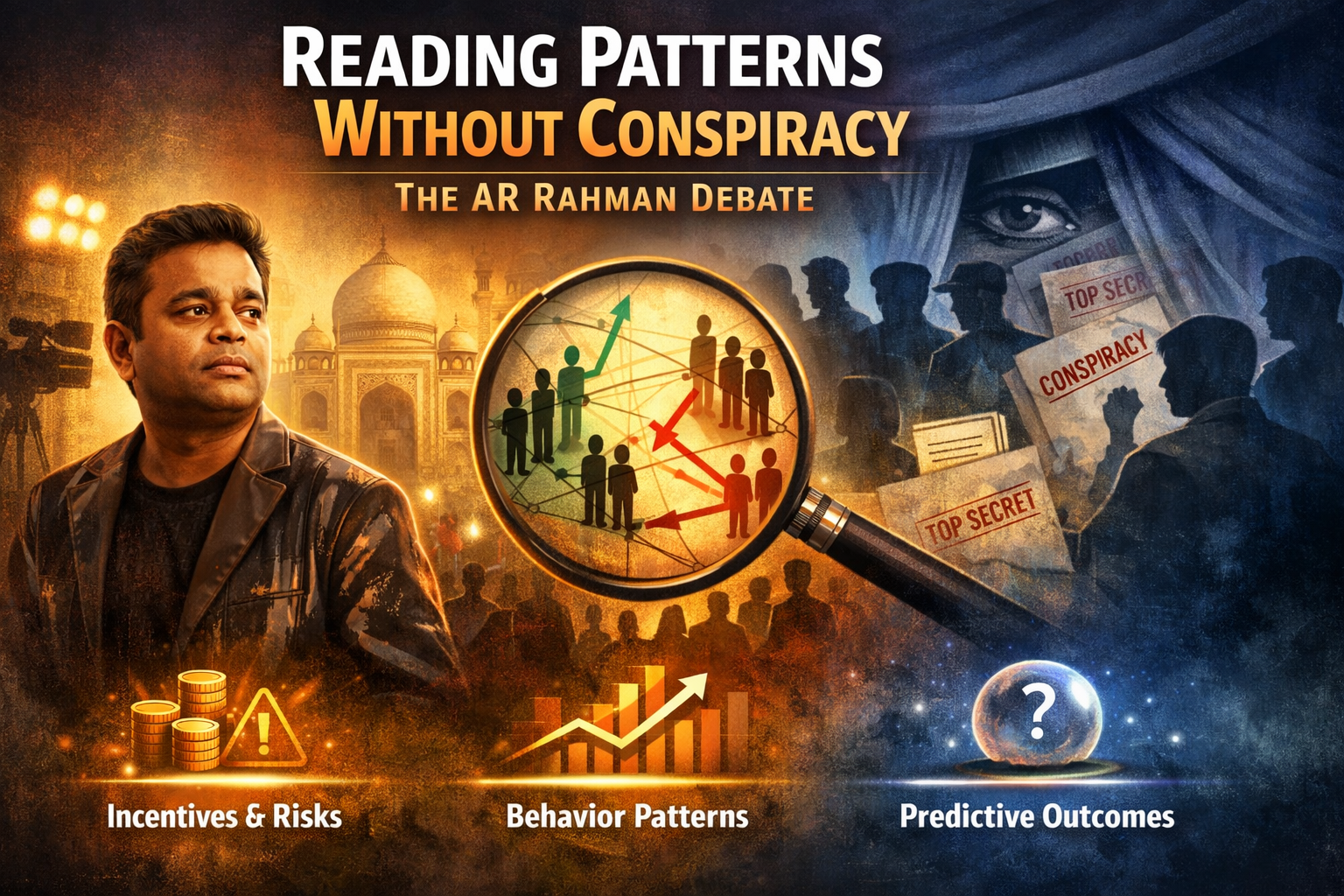
Reading Patterns Without Conspiracy: The AR Rahman Debate
Blog 1: Muslim Narrative Immunity and Hindu Silence
भारत/ GB
Why Pattern Recognition Is Not Conspiracy Allegation
The statement of the music maestro, AR Rahman that he was “discriminated against” owing to his religious alliance has brought reactions on expected lines. Most of those belonging to his religious and ideological alliance have reaffirmed his claim while those on the other side of the divide read patterns of conspiracy. This observation forced us to start this series to enable us to identify reading patterns without conspiracy has become one of the most contested analytical skills in contemporary discourse. Critics routinely collapse pattern analysis into conspiracy allegation, treating any observation of directional clustering as an accusation of secret coordination. This conflation serves a defensive purpose: it delegitimizes structural analysis by demanding proof of intent rather than examining outcomes. Rahman’s case exemplifies exactly this analytical failure—and why a pattern-based approach reveals what both sides miss.
Thank you for reading this post, don't forget to subscribe!The series attempts to analyze the patterns that give a clear and unambiguous direction of behaviour.. This blog establishes the methodological foundation for a series examining narrative power, selective advocacy, and institutional asymmetry in Indian cinema. Before analyzing specific patterns, we must clarify what reading patterns without conspiracy actually means—and why the absence of coordination does not negate the presence of systematic outcomes.
The distinction matters because informal power operates differently than formal institutions. Where formal systems leave paper trails, informal influence works through:
- Incentive alignment
- Risk calculation
- Network effects
- Narrative safety
- Reputational consequences
These mechanisms produce directional outcomes without requiring central command. Understanding this difference separates rigorous analysis from unfounded accusation.
When diverse outcomes consistently align in one direction, reading patterns without conspiracy becomes essential—not to prove coordination, but to understand how incentive structures shape behavior across time and institutions.
The Fundamental Distinction: Patterns vs. Plots
What Conspiracy Theory Claims
Conspiracy theories assert:
- Centralized coordination among diverse actors
- Hidden agendas that explain surface-level events
- Intentional deception as the primary mechanism
- Proof of secret meetings, documents, or directives
- Universal participation in coordinated action
Classic conspiracy thinking requires believing that disparate individuals consciously coordinate toward shared hidden goals. It demands evidence of explicit planning, secret communications, and orchestrated execution.
What Pattern Analysis Observes
Pattern analysis, by contrast, examines:
- Directional clustering of outcomes across time
- Incentive structures that make certain choices safer than others
- Emergent alignment without central coordination
- Observable asymmetries in treatment, advocacy, or silence
- Predictable behavior given known incentive gradients
Reading patterns without conspiracy means recognizing that when access to resources, protection from failure, and career advancement consistently correlate with specific ideological positioning, we are observing structural incentives—not secret plots.
Related Analysis: Our examination of demographic strategy in Western democracies demonstrates how patterns emerge without central coordination through local incentive alignment.
The Incentive Framework: How Alignment Happens Without Orders
Mechanism 1: Risk-Adjusted Decision Making
When individuals face asymmetric consequences for different choices, rational actors cluster toward safer options. This requires no conspiracy—only predictable self-interest.
Example in cultural production:
- Criticizing Ideology A: High personal risk, limited career benefit
- Criticizing Ideology B: Low personal risk, high moral capital
- Result: Overwhelming criticism flows toward B, not because of orders, but because incentives make it rational
This is not coordination. It is convergent behavior under shared incentive structures.
Illustrative example from academic institutions:
During recent geopolitical protests on US university campuses, administrators, faculty, and student organizations displayed sharply asymmetric response patterns.Expressions critical of one side of the conflict carried immediate institutional, legal, and reputational risks, while expressions critical of the opposing side carried minimal personal risk and often generated moral or social capital.
The resulting pattern—overwhelming criticism flowing in one direction—did not require coordination, directives, or conspiracy. It emerged naturally from risk-adjusted decision-making under shared incentive constraints.
Mechanism 2: Network Access as Discipline
Informal power systems operate through access control:
- Who gets repeat opportunities after failure?
- Who receives institutional protection during controversy?
- Whose careers survive despite box office disasters?
- Who faces career consequences for ideological deviation?
When access patterns correlate consistently with ideological alignment, we observe soft gatekeeping—a disciplining mechanism that never needs to announce its criteria because everyone learns them through observation.
The US Universities demonstrations against Israel, as referred in previous subsection is apt example.
Historical Context: The underworld financing era in Indian cinema operated similarly—outcomes shaped by informal power, not formal directives.
Why Absence of Evidence Does Not Equal Absence of Pattern
The Documentation Fallacy
Critics often demand: “Show me the documents. Where are the memos? Prove the orders exist.”
This demand misunderstands how informal systems function. By design, they leave no paper trails. Consider:
Formal Systems:
- Written policies
- Documented decisions
- Traceable chains of command
- Recordable communications
Informal Systems:
- Verbal understandings
- Implicit red lines
- Social sanctions
- Reputation management
- Access withdrawal
The absence of documentation in informal systems is expected, not suspicious. It is the mechanism’s strength, not its weakness.
The “Plausible Deniability” Feature
When power operates informally:
- No one can be held accountable (no records)
- Patterns are dismissed as coincidence
- Critics are accused of seeing conspiracies
- The system protects itself through invisibility
Like the learned coordination between sensory input and muscle response that moves your hand to brush away a fly, societal behavior too can become conditioned through repeated exposure to incentives and consequences.
Reading patterns without conspiracy means accepting that the lack of smoking-gun evidence does not invalidate observable asymmetries. We measure systems by their outcomes, not just their stated intentions.
The Three-Level Test for Pattern Validity
Not every correlation indicates a meaningful pattern. To distinguish signal from noise, apply three filters:
Test 1: Temporal Consistency
Does the pattern persist across different time periods?
Weak Pattern: Isolated incidents in a single year Strong Pattern: Repeated outcomes across decades despite changing personnel
Test 2: Cross-Sectional Breadth
Does the pattern appear across diverse individuals and institutions?
Weak Pattern: One or two similar cases Strong Pattern: Consistent clustering across multiple independent actors
Test 3: Predictive Power
Can the pattern explain outcomes in new, unrelated cases?
Weak Pattern: Requires constant post-hoc revision to fit new data Strong Pattern: Predicts behavior in cases not yet examined.
Rahman’s early experiences suggested that aligning with certain ideological currents could protect or enhance career prospects. Observing the clustering of similar outcomes among other artists allows us to predict which positions are structurally safer—demonstrating pattern strength without assuming coordination.
When all three tests pass, we are observing a structural pattern, not a statistical fluke.
Pattern Application: The systematic media manipulation patterns across Western democracies demonstrate temporal consistency, cross-sectional breadth, and predictive power—passing all three tests.
Case Study: How Reading Patterns Without Conspiracy Works
Hypothetical Scenario: Selective Moral Outrage
Imagine a cultural elite group that:
- Immediately condemns Issue A within hours
- Remains silent on Issue B for months/years
- Both issues involve comparable severity
- Both have similar evidence quality
- Geographic proximity differs
Conspiracy Theory Approach: “They’re all coordinating to suppress Issue B while promoting Issue A. There must be secret meetings and shared directives.”
Pattern Analysis Approach: “Issue A fits global legitimacy templates (receives international validation, low personal risk to support, signals virtue to key audiences). Issue B contradicts these templates (receives no international validation, high reputational risk to support, provides no virtue signaling value). The silence on B and advocacy for A emerge from rational incentive alignment, not coordination.”
Key Difference: The conspiracy approach demands proof of intent and coordination. The pattern approach examines which positions are structurally safer given known incentive gradients.
The differential response of Western universities to Israel-related conflicts versus documented mass detention of Uyghurs in China illustrates how incentive alignment, not coordination, explains selective moral outrage.
The latter explains the same outcome without requiring unprovable claims about secret coordination.
The Counter-Argument: Isn’t This Just Confirmation Bias?
“Pattern analysis can become a self-fulfilling exercise where every data point gets interpreted through a predetermined lens. How do you avoid seeing patterns where none exist?”
This objection has merit. Confirmation bias—the tendency to interpret new evidence as supporting existing beliefs—is a real methodological hazard.
However, confirmation bias and genuine pattern recognition are distinguishable through three safeguards:
Safeguard 1: Falsifiability
A legitimate pattern claim must be falsifiable—that is, it must specify what evidence would contradict it.
Example:
- Unfalsifiable: “Every positive outcome for Group X proves conspiracy; every negative outcome proves they’re hiding it.”
- Falsifiable: “If selective advocacy correlates with incentive structures, we should observe [specific outcome]. If we instead observe [contrary outcome], the pattern claim fails.”
Genuine pattern analysis welcomes disconfirming evidence. Confirmation bias dismisses it.
Safeguard 2: Alternative Explanations
A robust pattern claim must:
- Acknowledge competing explanations
- Show why they are insufficient
- Demonstrate that the pattern explanation fits data better
Example in this series: When examining career trajectories in Bollywood actirs, we will consider:
- Pure talent/merit explanations
- Random chance/statistical noise
- Alternative incentive structures
Only after showing these explanations fail to account for observed outcomes do we infer systematic patterns.
Safeguard 3: Predictive Testing
If a pattern is real, it should predict outcomes in new cases not used to derive it.
Example: If informal power networks create promotional advantages, we should be able to:
- Identify the historical pattern (1980s-2000s)
- Predict who would receive similar advantages in new eras (2010s-2020s)
- Test whether predictions match reality
When patterns survive predictive testing across new data, we move beyond confirmation bias into valid empirical observation.
We are not jumping to conclusions about anyone’s intent. We are looking at historical patterns and showing how the system’s structure leads to certain outcomes. From these patterns, we can identify predictable effects—without assuming hidden coordination or blaming individuals.
Institutional Analysis: Judicial accountability patterns demonstrate how self-investigation mechanisms create predictable outcomes without requiring conspiracy—a parallel to cultural power structures.
Why This Methodology Matters for Cultural Analysis
The Stakes of Getting This Right
Cultural discourse shapes civilizational self-perception. When narrative power concentrates asymmetrically:
- Some grievances gain instant moral legitimacy
- Others remain invisible regardless of severity
- Certain doctrines receive immunity from critique
- Others face constant scrutiny
If we cannot analyze these asymmetries because any pattern observation gets dismissed as “conspiracy theory,” we lose the ability to understand how soft power actually functions.
Reading patterns without conspiracy preserves analytical capacity while avoiding the intellectual bankruptcy of conspiracy thinking.
The Alternative to Pattern Analysis
If we reject pattern analysis entirely, we’re left with:
Option 1: Naive Individualism “Each outcome is purely individual, unrelated to any broader trends.”
This renders structural analysis impossible. We cannot examine racism, sexism, or any systematic bias because each case is treated in isolation.
Option 2: Total Randomness “Outcomes cluster by chance with no underlying causes.”
This denies that incentive structures influence behavior—a position no serious social scientist accepts.
Option 3: Explicit Conspiracy “If there’s a pattern, there must be secret coordination.”
This is precisely the error we’re avoiding.
Reading patterns without conspiracy is the only approach that:
- Acknowledges structural causation
- Avoids conspiracy fallacies
- Remains empirically testable
- Preserves analytical rigor
This is why the methodology matters: it creates space for honest analysis between the extremes of conspiracy theory and analytical paralysis.
Practical Application: How to Apply This Framework
Step 1: Document Observable Outcomes
Begin with facts, not interpretations:
- Who received what opportunities?
- What statements were made when?
- How did different groups respond to comparable situations?
- What patterns appear in timing, frequency, and tone?
Do not yet explain. First, establish that directional clustering exists.
Step 2: Map Incentive Structures
Identify what makes certain positions safer/riskier:
- Career consequences
- Reputational costs
- International validation opportunities
- Institutional access changes
- Physical safety concerns
Step 3: Test Alternative Explanations
Before inferring systematic patterns, rule out:
- Random statistical clustering
- Pure talent/merit differentiation
- Unrelated external factors
- Coincidental timing
Only when alternatives fail to explain observed clustering do we infer structural patterns.
Step 4: Predict and Verify
Use the inferred pattern to predict outcomes in new cases not used to derive it. If predictions consistently fail, revise or abandon the pattern claim.
This four-step process embodies reading patterns without conspiracy—it moves from observation to explanation through testable inference, not predetermined conclusions.
Civilizational Context: The Yogi Adityanath analysis series demonstrates this methodology applied to political discourse—examining patterns without alleging coordination.
Common Objections and Responses
Objection 1: “You’re Just Cherry-Picking Data”
Response: Cherry-picking selects only confirming evidence while ignoring disconfirming cases. Pattern analysis examines all available cases within defined parameters and explicitly addresses counter-examples.
Test: A cherry-picked argument cannot survive predictive testing because it’s tailored to past cases. A genuine pattern predicts new cases accurately.
Objection 2: “Correlation Doesn’t Equal Causation”
Response: Correct. That’s why pattern analysis uses convergent evidence—when temporal consistency, cross-sectional breadth, and predictive power all align, we move beyond simple correlation toward causal inference.
Analogy: Medical science rarely has “proof” that smoking causes cancer in any individual case. Yet the pattern is so overwhelming (temporal, cross-sectional, predictive) that causal inference is warranted. Pattern analysis operates similarly.
Objection 3: “This Sounds Like Rationalized Prejudice”
Response: Prejudice judges individuals by group membership. Pattern analysis examines institutional behavior and incentive structures. The distinction:
- Prejudice: “Person X behaves this way because of their group identity.”
- Pattern Analysis: “Institutions consistently produce outcome Y; what incentives explain this?”
Pattern analysis never attributes individual behavior to group membership. It examines how systems shape behavior across diverse actors.
Objection 4: “Why Not Just Accept Things Happen Randomly?”
Response: Because randomness produces random distributions. When outcomes consistently cluster one direction across decades, geography, and personnel changes, randomness is statistically implausible.
Example: If coin flips produced heads 90% of the time across millions of trials, we would investigate the coin, not assume randomness. Social outcomes work similarly—persistent directional clustering demands explanation.
Doctrinal Analysis: Islamic Texts and Polytheist Verdict on Hindu-Muslim Interactions shows how textual analysis combined with pattern observation reveals structural dynamics without conspiracy claims.
The Ethical Dimension: Why Precision Matters
The Cost of Overclaiming
When analysis crosses into conspiracy allegation, it:
- Loses credibility with neutral observers
- Provides easy targets for dismissal
- Obscures genuine patterns beneath unfounded speculation
- Creates legal and reputational vulnerabilities
Precision is not weakness. It is the difference between analysis that survives scrutiny and rhetoric that collapses under examination.
The Cost of Underclaiming
Conversely, refusing to identify patterns for fear of being called conspiratorial:
- Prevents understanding of how power actually operates
- Leaves asymmetries unexamined and unchallenged
- Privileges those who benefit from analytical paralysis
- Abandons the field to conspiracy theorists
Reading patterns without conspiracy navigates between these dangers—it makes defensible claims based on observable evidence without requiring proof of secret coordination.
The Responsibility of Analysis
Cultural analysis shapes public discourse. When done irresponsibly:
- It fuels genuine bigotry
- It creates unfounded panic
- It delegitimizes legitimate grievances
- It poisons civil discourse
When done rigorously:
- It reveals genuine asymmetries
- It explains outcomes without demonization
- It creates accountability for structural bias
- It enables informed public debate
The methodology outlined here aims for the latter. It treats readers as capable of distinguishing incentive analysis from hate, pattern recognition from paranoia, and structural critique from scapegoating.
What Comes Next: Applying the Framework
This blog establishes the analytical foundation. The subsequent blogs in this series apply it to specific domains:
Blog 1: Historical power structures in Bollywood—how informal financing shaped access and outcomes during the underworld era
Blog 2: The victimhood paradox—when exceptional success coexists with claims of systemic discrimination
Blog 3: Gender reversal patterns—how conservative religious pressure manifests asymmetrically by gender
Blog 4: Selective moral advocacy—why some victims gain instant legitimacy while others remain invisible
Each analysis will:
- Document observable patterns
- Map incentive structures
- Test alternative explanations
- Apply predictive testing
- Maintain the boundaries established here
Reading patterns without conspiracy is not a one-time declaration. It is a methodological commitment maintained across every subsequent analysis.
Related Framework: The Great Deception series demonstrates how this methodology applies to international institutional analysis—examining UN patterns without alleging global conspiracy.
Conclusion: Pattern Recognition as Analytical Responsibility
The ability to observe patterns without alleging conspiracies represents analytical maturity. It requires:
Intellectual Humility:
- Acknowledging what we cannot prove
- Accepting uncertainty where it exists
- Revising claims when evidence contradicts them
Methodological Rigor:
- Documenting observable outcomes
- Mapping incentive structures
- Testing competing explanations
- Subjecting claims to falsification
Ethical Clarity:
- Never attributing systematic malice without evidence
- Distinguishing individuals from institutions
- Maintaining precision even when inconvenient
Civilizational Responsibility:
- Examining power asymmetries honestly
- Refusing analytical paralysis
- Making defensible claims that survive scrutiny
Reading patterns without conspiracy is not about being “safe” or “politically correct.” It is about being analytically defensible—making claims that rest on observable evidence, testable predictions, and logical inference rather than unfounded speculation.
The series that follows applies this framework to Bollywood’s narrative ecosystem. Not because Indian cinema is uniquely problematic, but because it offers a clear case study where:
- Historical documentation exists (underworld financing era)
- Observable outcomes cluster directionally (career trajectories, advocacy patterns)
- Alternative explanations are testable (talent, timing, randomness)
- Predictions can be verified (do patterns persist in new eras?)
If the methodology is sound, it should explain these patterns without requiring conspiracy claims. If it cannot, the methodology itself requires revision.
That is the test. Let us proceed to the evidence.
Comprehensive Context: For readers seeking broader civilizational analysis, the Nazia Ilmi series on doctrinal education and Waqf Amendment Act analysis provide parallel frameworks for institutional pattern examination.
About This Series
Series Title: Narratives, Power, and Selective Victimhood: Reading Bollywood Beyond Applause
Blog 0 (Current): Reading Patterns Without Conspiracy – Methodological Framework
Upcoming Blogs:
- Blog 1: From Industry to Ecosystem – How Informal Power Shaped Access
- Blog 2: The Victimhood Paradox – When Success Contradicts Discrimination Claims
- Blog 3: Gender Reversal Patterns – Social Constraint, Not Liberation
- Blog 4: Silence as Structure – Why Bollywood Speaks Selectively
Series Commitment: Every blog will maintain the methodological boundaries established here—examining patterns through incentive structures, not alleging conspiracies.
Related Series: Readers interested in how reading patterns without conspiracy applies to other domains may explore:
- Two-State Delusion series (geopolitical pattern analysis)
- Wall of Truth series (refugee policy patterns across Muslim-majority nations)
- Demographic Reality series (population dynamics without conspiracy)
Next in Series: Blog 1 – From Industry to Ecosystem: How Informal Power Shaped Bollywood Access (Publishing Soon)
This analysis examines patterns and incentive structures, not intentions or conspiracies. It aims for defensible claims grounded in observable evidence.
Feature Image: Click here to view the image.
Video
Glossary of Terms
- AR Rahman: Indian music composer and singer whose statement on discrimination sparked analysis of pattern recognition in cultural discourse.
- Pattern Analysis: A method of observing directional clustering in outcomes across time and actors without assuming secret coordination.
- Conspiracy Theory: A claim that disparate individuals or institutions coordinate secretly to achieve hidden goals.
- Incentive Alignment: The phenomenon where actors’ behaviors converge because rewards, risks, or legitimacy benefits make certain choices safer.
- Network Effects: How repeated access and participation in informal systems shape behavior across individuals and institutions.
- Narrative Safety: The measure of risk associated with publicly expressing certain positions within cultural or institutional contexts.
- Reputational Consequences: The social or professional costs that follow from ideological alignment or deviation.
- Directional Clustering: Observable grouping of outcomes in one direction over time or across actors, indicating structural influence.
- Falsifiability: The ability of a pattern claim to be disproven if contradictory evidence appears.
- Predictive Power: The ability of a recognized pattern to anticipate outcomes in new, unrelated cases.
- Soft Gatekeeping: Informal mechanisms through which access to opportunities is regulated without explicit rules or directives.
- Plausible Deniability: A feature of informal systems where actions leave no documented evidence, protecting actors from accountability.
#Bollywood #ARRahman #PatternAnalysis #CulturalBias #HinduinfoPedia #MuslimNarrativeImmunity #MuslimNarrativeImmunityandHinduSilence
Follow us:
- English YouTube: Hinduostation – YouTube
- Hindi YouTube: Hinduinfopedia – YouTube
- X: https://x.com/HinduInfopedia
- Instagram: https://www.instagram.com/hinduinfopedia/
- Facebook: https://www.facebook.com/Hinduinfopediaofficial
- Threads: https://www.threads.com/@hinduinfopedia