
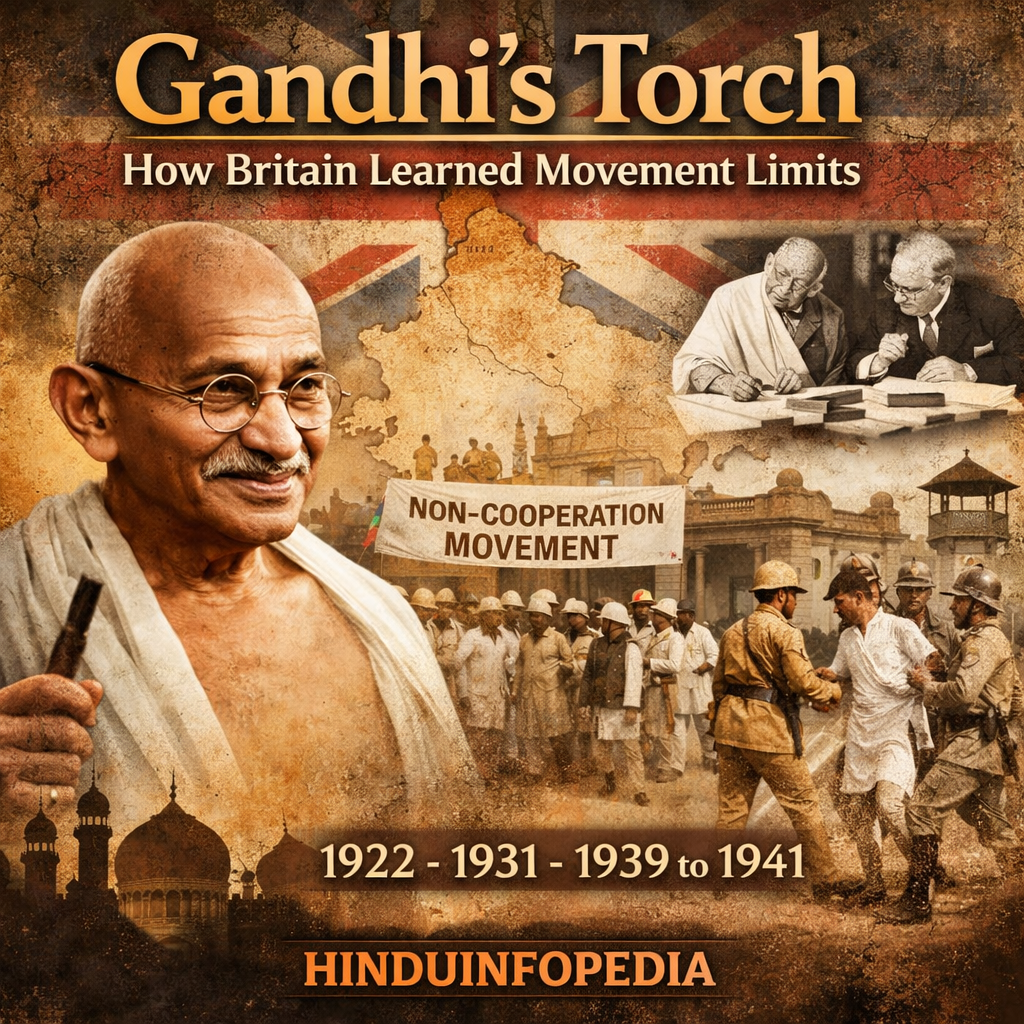
Gandhi’s Torch: The Light That Showed Britain Where to Strike (33)
भारत / GB
Part 33: Mahatma Gandhi’s Peace Efforts | Series Index
Blog 30 documented the signal. Blog 31 tested the counterfactual — three British options, all costly, none clean. Blog 32 documented the mechanism — Dharasana, the 1942 killings, the lathi issued by an administration that knew Gandhi’s ceiling. This post names the pattern. Gandhi did not send the British one signal. He sent them three. Each one was Gandhi’s Torch — and each one showed the British precisely where the movement would stop.
Thank you for reading this post, don't forget to subscribe!The Action Taken: Gandhi dissolved the national campaign following Chauri Chaura, transferring all organizational liability onto local village defendants.
Who Paid the Price: Over 30,000 imprisoned satyagrahis whose sacrifices yielded zero concessions, and 172 local peasants condemned to death by the Sessions Court.
The Alternative Bypassed: Retaining the national campaign as a political bargaining instrument to demand an amnesty and fair trial for the peasant defendants.
Why This Matters: Identifies the structural asymmetry: the executive leadership retained its moral preeminence, the Raj re-established control, and the participants paid with the gallows.
The Instrument That Illuminated Itself
Gandhi’s Torch is a pattern, not a single act — and a movement’s greatest strategic asset is unpredictability. An adversary that cannot calculate where resistance will end must assume it may never end — and that assumption constrains what the adversary will risk. The independence movement’s greatest strategic liability, from February 12, 1922 onward, was that its ceiling had been illuminated with precision.
Gandhi’s Torch is the name for what that illumination produced. Not one act — a pattern. Three moments across twenty years in which Gandhi’s consistent choices showed the British administration exactly where the movement would stop, how it would stop, and who would stop it. Each torch made the next British calculation easier. Each torch reduced the strategic uncertainty that had been the movement’s most powerful protection.
Blog 30 established that the first torch ended seventeen months of hesitation in twenty-six days. This post maps all three and names what they collectively produced.
The First Torch — February 12, 1922
The Non-Cooperation Movement at high pressure. Lord Reading’s dispatches reflected documented concerns. The British faced three costly options simultaneously — mass force, negotiation, continued waiting — with no easy path through any of them.
Gandhi suspended the movement. No major concession extracted. The ceiling revealed: it was enforced prioritizing absolute ahimsa, which meant it was predictable — it would activate whenever violence occurred within the movement, regardless of where the movement was in its strategic arc.
The first torch showed the British four things simultaneously: the ceiling existed, Gandhi would enforce it himself, the Congress could not override him, and the trigger was moral rather than strategic. From that morning, every British calculation about Gandhi’s movements was made with this knowledge.
The administration that had hesitated for seventeen months arrested Gandhi twenty-six days after the first torch was lit.
The Second Torch — March 5, 1931
The Civil Disobedience Movement. Sixty thousand in jail. Provinces losing administrative control. One of the strongest negotiating positions Congress had achieved up to that point.
Gandhi negotiated the Irwin Pact and suspended the movement. Eight of eleven demands abandoned. The salt tax largely intact. Many political prisoners excluded on grounds of violence — the same moral trigger that had operated in 1922. The administrative machine intact.
The second torch confirmed what the first had shown and added one piece of information the British had not yet verified: the ceiling operated at the negotiating table as well as in the field. Gandhi would accept a settlement that preserved the British administrative apparatus rather than use maximum pressure for maximum concession. The 1922 suspension had shown the ceiling was self-enforced. The 1931 pact showed the ceiling was also self-limiting at the negotiating stage.
Willingdon arrested Gandhi within days of his return from London. The second torch had been received as immediately as the first.
The Third Torch — 1939 to 1941
September 1939. Germany invaded Poland. The Viceroy announced India was at war — without consulting a single Indian leader, without approaching the Congress Working Committee, without asking the provincial governments that had been administering eight provinces for two years.
The window that opened was the fourth reservoir — not built by Gandhi but handed to him by Hitler. Britain standing alone after Dunkirk. The Indian Army the largest single military force available to the Allies. Three hundred million people whose participation the Empire desperately needed. The moment of maximum British vulnerability since 1857.
Gandhi’s response: Individual Satyagraha. A deliberately contained campaign in which only senior Congress leaders courted arrest by delivering anti-war speeches — one leader at a time, one arrest at a time, carefully bounded so as not to destabilise the British war effort. It was, by design, the minimum possible resistance at the moment of maximum possible leverage.
The third torch showed the British something more precise than the first two. Not merely that Gandhi had a ceiling. Not merely that he would enforce it at peak pressure. But that the ceiling operated even when the adversary was at its most vulnerable — even when the strategic case for maximum pressure was overwhelming, even when the moral case for non-violence itself was complicated by the nature of the enemy Britain was fighting.
At Dunkirk, Gandhi held the torch. The British saw where the movement would stop. They survived.
What Three Torches Produced
A single signal can be an accident. Two signals establish a pattern. Three signals across twenty years — each at a moment of significant British vulnerability, each self-enforced, each consistent in its trigger mechanism — constitute a strategic map.
Gandhi’s Torch was not a metaphor. It was the accumulated information that made every British calculation from 1922 to 1947 more confident than the calculation before it. The hesitation of 1919 to 1922 — the genuine strategic uncertainty that had constrained British conduct — was replaced, one torch at a time, with certainty.
Blog 32 documented what the British did with that certainty — the lathi charges, the ordinances, the 1942 crushing. The certainty was not an accident of British intelligence. Even when the 1942 Quit India movement shifted toward a “total” demand, the British response was conditioned by two decades of observed patterns. They moved with lethal speed because the “Torches” had already mapped the movement’s brakes, allowing the administration to strike the leadership instantly and isolate the leaderless masses. It was information Gandhi’s consistent choices provided, act by act, across two decades.
The movement that required unpredictability to protect its participants was made more predictable by the man who led it. The volunteers at Dharasana walked into lathi charges issued by an administration that had read three torches and knew the columns would not fight back. While other factors — war pressures, internal Congress dynamics, economic costs, and global opinion — always shaped British decisions, Gandhi’s consistent self-imposed limits narrowed one critical variable: fear of uncontrolled escalation. The 1942 marchers died in an uprising that the British crushed because they knew, from three torches, that Gandhi would not escalate beyond what his moral framework permitted.
The Khilafat Parallel — The Fourth Torch
Gandhi’s Torch did not illuminate only the independence movement’s ceiling. It illuminated a second domain — one whose consequences this series will document in full in the blogs ahead.
The Khilafat compact of 1920 was Gandhi’s alliance of the independence movement with pan-Islamic political mobilisation. The stated purpose was Hindu-Muslim unity. The instrument was the most volatile strand of political Islam available in 1920 — amplified, funded, and legitimised by the moral authority of the independence movement.
The fourth torch showed — not the British this time, but the communal architecture of Indian society — exactly where mass religious mobilisation could be ignited using Gandhi’s moral authority as the spark. The Caliphate was abolished in 1924. The mobilisation did not dissolve with it.
The series will document what that fourth torch produced. The downstream flood is long, wide, and still running. It requires its own arc — and it will receive one.
The Prosecution’s Position
Gandhi’s Torch does not require Gandhi to have designed the illumination. The prosecution does not claim he lit the torches deliberately to serve the British. It claims the arithmetic was consistent.
Three times across twenty years — 1922, 1931, 1939 to 1941 — Gandhi’s consistent choices provided the British administration with precise information about where the movement would stop. Each time, the information arrived at a moment of British vulnerability. Each time, the administration used it. The hesitation that had constrained British conduct before each torch was replaced, after each torch, with confidence.
The volunteers at Dharasana walked into lathi charges issued by an administration reading from Gandhi’s Torch. The 1942 marchers died in an uprising the British crushed because three torches had already shown them Gandhi’s ceiling. The people who paid for the illumination were not the man who held the torch.
What those people contributed, what they received, and what Gandhi received — the full account of February 12, 1922 stated in its plainest form — is the subject of the next post.
A movement’s greatest protection is the adversary’s uncertainty about where it ends. Gandhi’s consistent choices removed that uncertainty — one torch at a time, one act at a time, across twenty years. The British did not need spies to read the map. Gandhi held the torch himself. They only needed to watch where he pointed it.
Feature Image: Click here to view the image.
Videos
Glossary of Terms
- Gandhi’s Torch: A term coined in this series describing moments when Gandhi’s repeated strategic choices revealed to British authorities the limits, stopping points, and methods of nationalist resistance.
- Strategic Ceiling: The maximum level of pressure or escalation a movement is willing to apply before stopping, retreating, or negotiating.
- Ahimsa: Sanskrit term meaning non-violence; central to Gandhi’s political and moral philosophy.
- Non-Cooperation Movement: Mass anti-colonial campaign launched in 1920 urging Indians to boycott British institutions, titles, courts, and goods.
- Civil Disobedience Movement: Nationwide resistance movement beginning in 1930, marked by open violation of colonial laws, especially the Salt Laws.
- Irwin Pact: 1931 agreement between Gandhi and Viceroy Lord Irwin that paused Civil Disobedience in exchange for limited concessions.
- Individual Satyagraha: Limited protest campaign launched by Gandhi in 1940 where selected leaders publicly opposed the war and courted arrest one at a time.
- Satyagraha: Gandhi’s doctrine of resistance through truth-force, civil disobedience, and non-violent suffering.
- Dharasana: Site of the 1930 Dharasana Salt Works protest where non-violent volunteers were brutally beaten by police.
- Quit India Movement: Mass uprising launched in August 1942 demanding immediate British withdrawal from India.
- Khilafat Movement: Political agitation by sections of Indian Muslims after World War I seeking preservation of the Ottoman Caliphate.
- Pan-Islamic Mobilisation: Political mobilisation based on wider Islamic identity beyond local or national boundaries.
- Lord Reading: Viceroy of India during the later phase of the Non-Cooperation Movement and Gandhi’s arrest in 1922.
- Lord Willingdon: Viceroy of India who repressed Congress agitation after the breakdown of the Gandhi-Irwin settlement.
- Strategic Uncertainty: A condition where rulers cannot predict how far resistance will go, often limiting the force they are willing to use.
#Gandhi #MahatmaGandhi #IndianHistory #FreedomStruggle #BritishRaj #Congress #QuitIndia #CivilDisobedience #Khilafat #History #India #Nationalism #Colonialism #Politics #HinduinfoPedia
Scan Through The Entire Series at
Gandhi’s Peace Efforts: The Questions Before the Mahatma (0)