
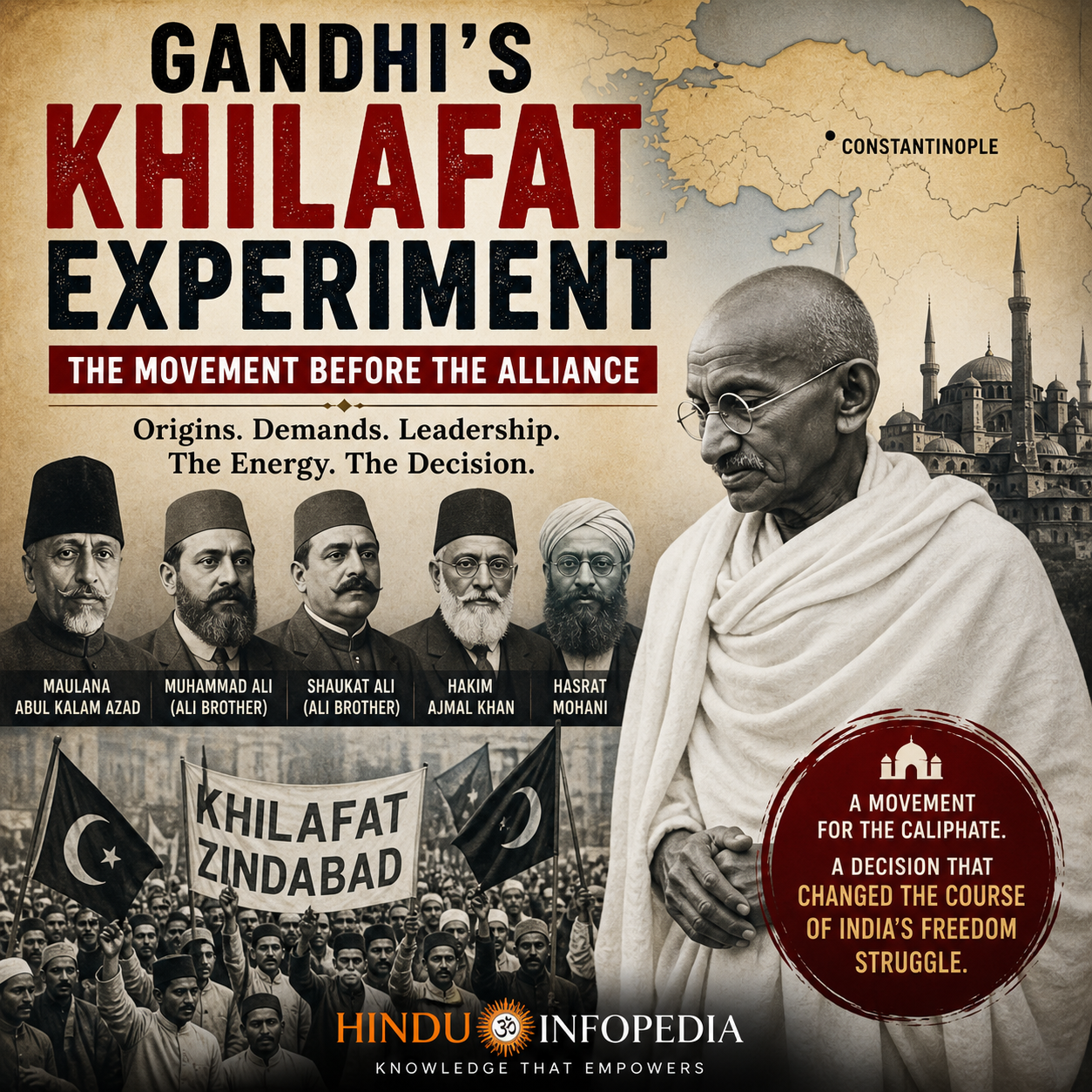
Gandhi’s Khilafat Experiment: The Instrument Before the Alliance (45)
भारत / GB
Part 45: Mahatma Gandhi’s Peace Efforts | Series Index
Blog 44 documented what Gandhi injected — four simultaneous injections, the numbers he needed, the instrument he chose. Before the prosecution documents the alliance and its consequences, it documents the instrument itself. This post carries the Khilafat movement on its own terms — what it was, what it demanded, who led it, and what kind of energy it carried before Gandhi chose to amplify it.
Thank you for reading this post, don't forget to subscribe!The Crisis That Preceded Gandhi
Gandhi’s Khilafat Experiment requires understanding what the Khilafat movement was before Gandhi touched it.
For Indian Muslims, this was not a distant geopolitical event. The Ottoman Sultan held the title of Caliph — the spiritual successor to the Prophet, the symbolic head of the worldwide Sunni Muslim community. Britain was now at war with the institution Indian Muslims regarded as the guardian of their faith. The caliphate had already been endangered by Italian attacks in 1911 and the Balkan Wars of 1912 to 1913. The First World War placed it under existential threat.
When the Ottoman Empire was defeated in 1918, the Allied powers began dismembering its territory. The Treaty of Sèvres of August 1920 not only detached all non-Turkish regions from the empire but proposed to give parts of the Turkish homeland to Greece and other non-Muslim powers. For Muslims across India, this was not a treaty. It was a desecration.
The Committee, the Demands, the Leaders
In early 1919 the All India Khilafat Committee was formed in Bombay under the leadership of the Ali Brothers, Maulana Abul Kalam Azad, Hakim Ajmal Khan, and Hasrat Mohani. Its purpose was to force the British Government to change its attitude toward Turkey.
The movement’s demands were clear and specific: the Khalifa must retain control over Muslim holy places, sufficient territory to lead the Islamic world, and Muslim sovereignty over the Arabian peninsula (including Syria, Iraq, and Palestine).
These were not demands about India. They concerned a foreign empire, a foreign institution, and territories thousands of miles away, a foreign institution, and territories thousands of miles from the subcontinent. Every Indian Muslim who joined the Khilafat movement was marching for the preservation of an institution in Constantinople — not for swaraj, not for representation in Indian legislatures, not for the removal of the salt tax or the land revenue. Above all, it had no relevance to how British governed India but an issue that impacted no one in India.
The leadership documented this character clearly. The Ali Brothers — Muhammad Ali and Shaukat Ali — were newspaper editors from Delhi whose politics were explicitly grounded in Islamic identity. Their spiritual guide was Maulana Abdul Bari of Lucknow. Maulana Abul Kalam Azad — who would later become independent India’s first Education Minister — was the Calcutta journalist and Islamic scholar who provided the movement’s theological foundation. Maulana Mahmud al-Hasan, head of the Deoband madrasa, gave it the institutional authority of India’s most significant Islamic seminary.
Not one demand addressed British conduct in India. Not one demand addressed Indian governance, Indian rights, or Indian territory. The movement made no claim on behalf of Hindus, Sikhs, or any non-Muslim community — not because they were excluded, but because the movement was not about them. It was about Muslims, Muslim sovereignty, and a Muslim institution. Its grievance was religious. Its constituency was the umma. Its geography was Constantinople, not Calcutta.
This was not a secular nationalist leadership. It was an Islamic religious and political leadership whose primary allegiance was to the global Muslim community — the umma — and whose specific demand was the restoration of its symbolic head.
The Energy the Movement Carried
The Khilafat movement’s energy was not constitutional. It was not the energy of a community demanding political representation or legal rights within the colonial framework. It was pan-Islamic energy — the energy of a global religious community driven by the ummah philosophy that felt its symbolic centre under attack.
Pan-Islamic energy carries properties that constitutional grievance energy does not. It connects its participants to a framework that extends beyond national borders — to Muslims in Egypt, Turkey, Afghanistan, Arabia, and across the world. It operates through religious identity rather than civic identity. It is sustained by theological conviction rather than political calculation.
And it does not dissolve when the specific constitutional grievance is addressed — because its roots are in religious solidarity, not in a particular political demand.
The Khilafat movement brought this energy into Indian politics. Before 1919 it had operated at the margins — in mosque sermons, in the writings of the ulema, in the private convictions of the devout. The formation of the All India Khilafat Committee brought it into organised mass politics for the first time.
This was the energy Gandhi chose to amplify. Gandhi’s Khilafat Experiment took this bounded pan-Islamic energy and gave it the independence movement’s full organisational weight.
Tilak’s Warning
The most significant objection to the alliance came from Bal Gangadhar Tilak — Lokmanya, accepted by the people as their leader, the first and strongest advocate of swaraj in Indian politics.
Tilak was not in favour of allying with Muslim leaders on religious issues. His concern was structural: the Congress was a political organisation pursuing a political goal. Allying it to a religious cause — the restoration of a foreign Caliphate — would compromise the Congress’s civic character and introduce communal dynamics the independence movement was not designed to manage.
Tilak was the tallest leader in Indian politics in 1920. Gandhi was not yet his equal — formidable, rising, but still operating in a political landscape where Tilak commanded a mass reverence Gandhi was still accumulating. Had Tilak lived, he had the standing to challenge the alliance institutionally.
He died at dawn on August 1, 1920. On the same morning Gandhi announced the Non-Cooperation Movement — built on the Khilafat compact Tilak had opposed. Two lakh people came to mourn the man who had been India’s first leader. Gandhi was among them. He paid his respects. Then he launched the movement.
The tallest tree had fallen. The cleared space was occupied on the same day.
What the Movement Was — Before Gandhi Amplified It
The Khilafat movement before Gandhi’s alliance was a significant but bounded phenomenon. It had mass emotional depth among Indian Muslims. It had organised leadership. It had specific demands and a documented institutional structure.
It also had properties that made it a fundamentally different instrument from the independence movement’s existing toolkit. It was transnational — connected to pan-Islamic frameworks beyond India’s borders. It was theologically grounded — sustained by religious conviction rather than political calculation. It was led by people whose primary identity was Islamic rather than Indian nationalist. And its demands had nothing to do with India’s independence.
Gandhi chose to place the independence movement’s moral authority, organisational machinery, and his own personal leadership behind this instrument. The prosecution does not claim he did not understand what he was choosing. His operating method was documented in Blog 24. He was the most politically sophisticated actor in Indian public life in 1920.
He chose it because he needed the numbers. The reservoir thrust required mass. The Khilafat movement was the largest available source of Muslim mass participation. And perhaps something more — the alliance with a pan-Islamic mass movement, launched on the day Tilak died, placed Gandhi at the head of a coalition no previous Congress leader had assembled. The numbers served the movement. The movement served the authority. Gandhi made the calculation. Gandhi’s Khilafat Experiment began. Gandhi’s stature grew in size, depth and width.
What the experiment produced — on the streets, in the communities, and in the long arc of Indian history — is documented in the blogs that follow.
The Khilafat movement was a pan-Islamic religious cause dressed in the clothing of Indian politics. Its demands were about a foreign institution in a foreign country. Its energy was transnational and theologically sustained. Its leadership was Islamic, not nationalist. Gandhi chose this instrument for the numbers it would deliver. The experiment that followed is documented in this series. The foundation of the experiment is documented here.
Feature Image: Click here to view the image.
Videos
Glossary of Terms
- Khilafat Movement: A pan-Islamic political movement (1919–1924) in India aimed at preserving the Ottoman Caliphate after World War I.
- Ottoman Caliphate: The Islamic leadership institution held by the Ottoman Sultan, regarded by many Sunni Muslims as the symbolic successor to Prophet Muhammad.
- All India Khilafat Committee: An organization formed in 1919 in Bombay to coordinate protests and demands regarding the preservation of the Caliphate.
- Treaty of Sèvres: A post–World War I treaty that dismantled the Ottoman Empire, triggering strong reactions among Muslims worldwide, including in India.
- Pan-Islamism: A political and religious ideology advocating unity among Muslims across national boundaries under a common leadership.
- Umma: The global community of Muslims bound by shared religious identity, transcending national borders.
- Ali Brothers: Muhammad Ali and Shaukat Ali, key leaders of the Khilafat Movement in India.
- Abul Kalam Azad: Islamic scholar and nationalist leader who provided intellectual and theological support to the Khilafat Movement.
- Maulana Abdul Bari: A religious scholar from Lucknow who served as a spiritual guide to Khilafat leaders.
- Deoband Madrasa: An influential Islamic seminary in India associated with religious scholarship and leadership in movements like Khilafat.
- Non-Cooperation Movement: A mass protest led by Mahatma Gandhi that coincided with and incorporated Khilafat mobilization.
- Swaraj: The concept of self-rule or independence from British colonial rule in India.
- Pan-Islamic Energy: A term used in this series to describe mobilization driven by transnational religious solidarity rather than territorial nationalism.
- Khilafat Compact: A term used in this blog series referring to the political alignment between Congress leadership and Khilafat leaders.
- Reservoir Thrust: A term coined in this series to describe the strategy of mobilizing large mass participation to generate political pressure.
#Khilafat #Gandhi #IndianHistory #FreedomStruggle #OttomanEmpire #PanIslamism #Tilak #Congress #ColonialIndia #HinduinfoPedia
Gandhi’s Peace Efforts: The Questions Before the Mahatma (0)
Read The Prosecution Exhibits Through Links