
Gandhi’s Moplah Timeline: The Four Months the Ceiling Was Unknown (55)
भारत / GB
Part 55: Mahatma Gandhi’s Peace Efforts | Series Index
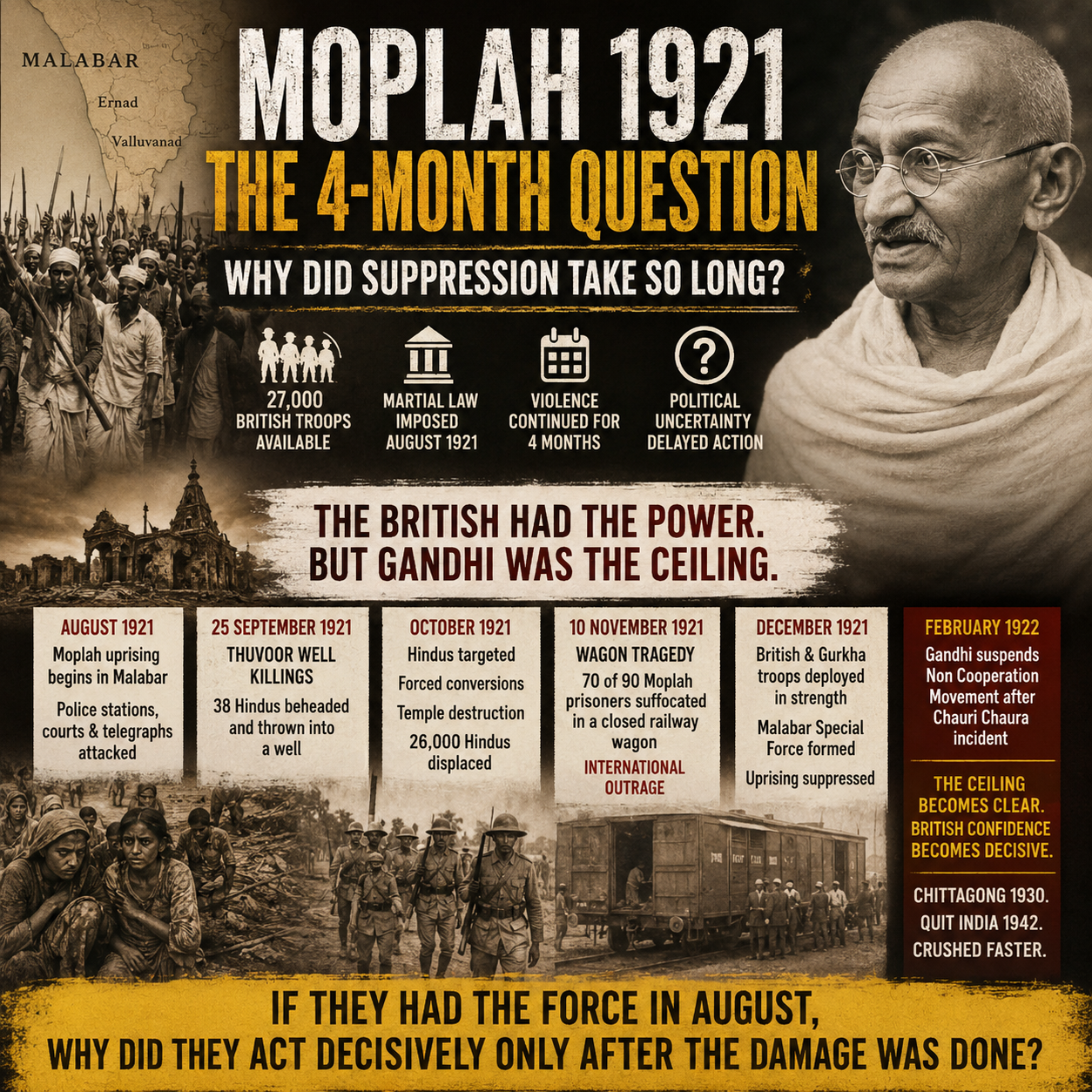
Blog 54 documented what the Moplah massacre produced — 2,500 Hindus killed, 2,500 forcibly converted, 26,000 displaced. This post asks a different question: why did it run for four months? The British had 27,000 troops available. They had crushed previous Moplah uprisings. They imposed martial law in August. Yet the communal damage ran to December — the forced conversions, the temple destruction, the displacement, the beheaded bodies in the Thuvoor well — before decisive suppression arrived. The answer lies in what the British did not have in August 1921 that they had in February 1922.
Thank you for reading this post, don't forget to subscribe!The Action Taken: British military authorities operated under severe operational constraints, taking four months to deploy four complete brigades to restore control in Malabar.
Who Paid the Price: The agrarian civilian population of Malabar, who absorbed four months of unchecked armed conflict.
The Alternative Bypassed: Immediate, rapid deployment of overwhelming state force within the first two weeks of the outbreak.
Why This Matters: Documents that colonial state response hesitated during the autumn of 1921 due to post-Jallianwala political caution and troop shortages, before re-establishing full martial deterrence.
What the British Had — and Did Not Have — in August 1921
Gandhi’s Moplah Timeline begins with a precise account of the British administration’s position when the Moplah uprising began on August 20, 1921.
The British had military capacity — documented. They would eventually deploy 27,000 troops, British and Gurkha regiments, and form the Malabar Special Force. That capacity existed in August. They did not deploy it at full strength immediately.
The British had the post-Jallianwala constraint — documented. April 1919, two years earlier. The Hunter Commission inquiry. International outcry. Dyer censured. The price of mass force against Indian subjects in post-war international conditions had been established. The British administration knew what overwhelming force cost them in reputation, in parliamentary scrutiny, in the deteriorating case for continued colonial rule.
What the British did not have in August 1921 was Gandhi’s ceiling.
The Suspension Signal — Blog 30 — came on February 12, 1922. Five months after the Moplah uprising began. The Lathi-Charge Licence — Blog 32 — was issued after that date. In August 1921, the British administration was operating under the uncertainty Blog 31 documented — three options, all costly, none clean.
The Question the British Could Not Answer
Gandhi’s Moplah Timeline identifies the specific question the British administration could not answer in August 1921 — and why that question determined the duration of the massacre.
The question was: if we use overwhelming force to crush the Moplah uprising now — deploying the full military capacity available, suppressing the rebellion in days rather than months — how will Gandhi react?
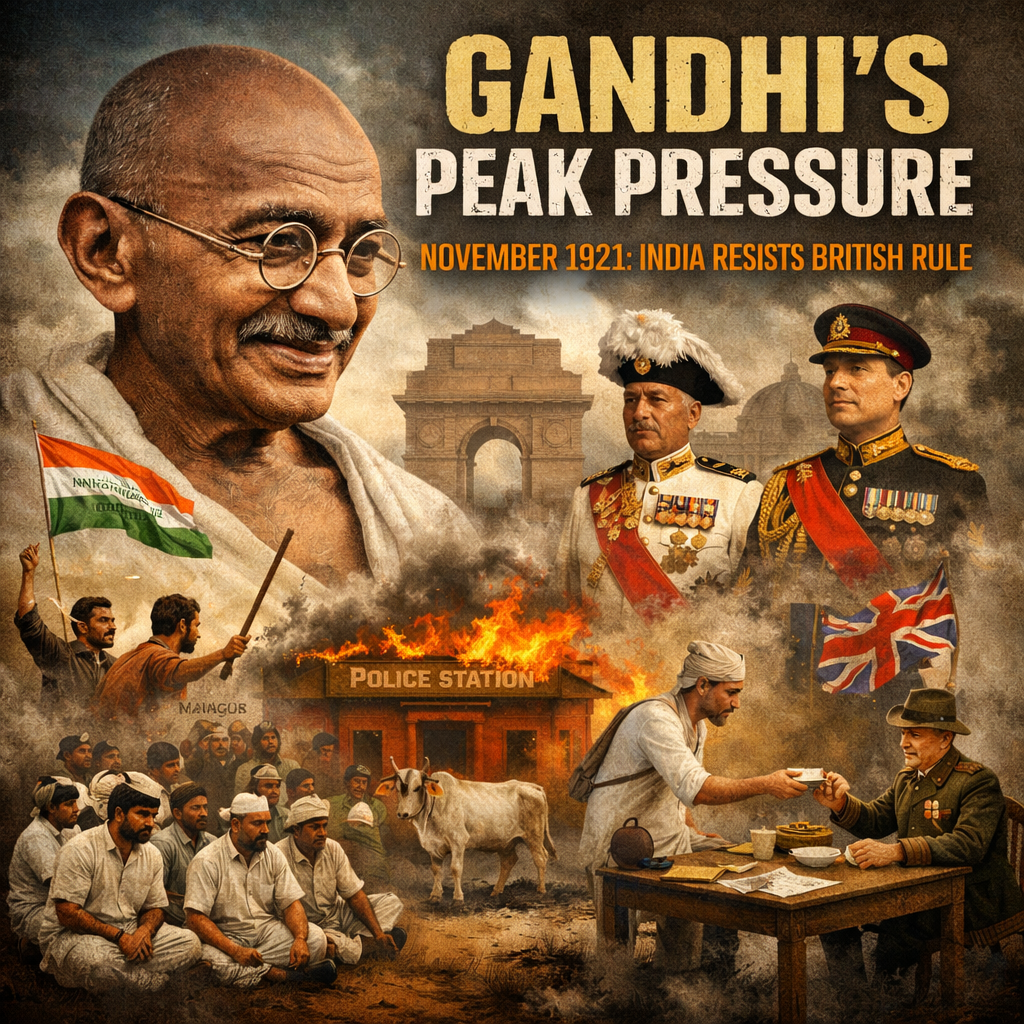
This was not a trivial question. Gandhi was at the peak of his Non-Cooperation Movement. The movement had brought Lord Reading’s administration to documented alarm — Blog 29 documented November 1921 as the moment the British nearly broke. The movement was building, not dissolving.
If Gandhi treated overwhelming British force in Malabar as a provocation — if he escalated Non-Cooperation in response, if he called a nationwide hartal, if he used the British suppression of a Muslim uprising to intensify the independence movement’s momentum — the British administration faced a strategic crisis far larger than the Moplah uprising itself.
They did not know his ceiling. They did not know whether he would escalate or contain. They had not yet seen the moment — five months away — when Gandhi would dissolve the entire movement over twenty-two policemen.
The uncertainty was genuine. Blog 31 documented it precisely — the British had no clean answer. In August 1921 that uncertainty was at its peak. The measured response was not cowardice. It was calculated risk management under genuine uncertainty about the most powerful political actor in Indian public life.
The October Escalation — What the Timeline Shows
Gandhi’s Moplah Timeline documents the escalation sequence precisely — because the timing is the prosecution’s exhibit.
August 20 — uprising begins in Ernad and Valluvanad taluks. British impose martial law. Initial actions: arms gathering, attacks on British symbols — telegraph lines, courts, police stations. The British deploy local police and troops.
September 25 — Thuvoor well. 38 Hindus beheaded and thrown into the well. The uprising has been running for five weeks. British force has been present for five weeks. The beheading of 38 people and disposal of their bodies in a well occurs while martial law is in effect.
October — the documented escalation. Violence against the Hindu general populace becomes severe. The forced conversions intensify. The temple destruction accelerates. The 26,000 refugee displacement runs through October and November.
November 10 — Wagon Tragedy. 70 of 90 Moplah prisoners suffocate in a closed railway wagon. Global headlines. International press coverage. The Moplah uprising is now an international news story — not merely an Indian administrative problem.
November onwards — British deploy full force. 27,000 troops. British and Gurkha regiments. Malabar Special Force formed.
December — uprising suppressed.
The timeline is the prosecution’s exhibit.
The communal damage — the forced conversions, the temple destruction, the mass displacement — ran through October and November. The full force arrived after the global headlines. The force that was available in August arrived after the damage was complete.
What Changed in February 1922
Gandhi’s Moplah Timeline requires one additional documented comparison — what the British did differently after February 1922, when the ceiling was known.
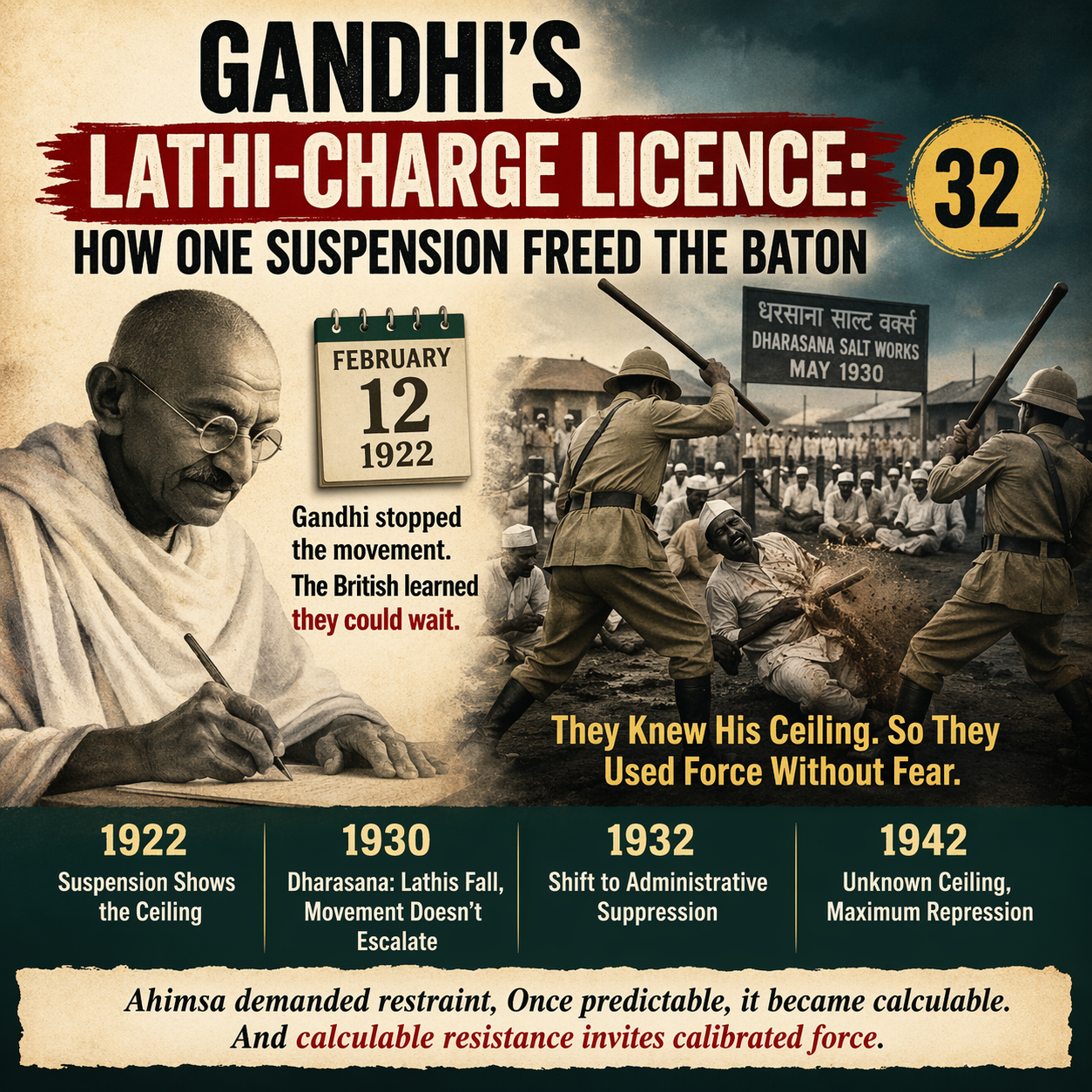
February 12, 1922 — Gandhi suspended Non-Cooperation. The British read the map. They now knew the ceiling — its location, its trigger mechanism, its self-enforcement. The uncertainty that had constrained their conduct during Moplah was resolved.
The operational consequence was documented in subsequent decades:
The 1930 Dharasana salt march — lathi charges issued with documented confidence. The columns walked into the batons. Gandhi did not escalate.
The 1932 crackdown — bureaucratic instruments deployed efficiently. Gandhi did not escalate beyond his framework.
The 1942 uprising — 1,008 documented dead, the most serious rebellion since 1857. Crushed in weeks — not four months. The British knew the ceiling. They knew Gandhi’s Congress would not sustain the uprising beyond his framework. They acted with the operational confidence the Moplah period had lacked.
The contrast between four months at Moplah and weeks in 1942 is not a difference in military capacity.
The military capacity existed in August 1921. The difference is the ceiling — unknown in 1921, known after February 1922.
The Chittagong comparison sharpens the exhibit further. Master Da Surya Sen’s Indian Republican Army raided the Chittagong armoury on April 18, 1930 — nine years after Moplah, eight years after Gandhi’s ceiling was known. The British response was not measured. It was immediate, decisive, and sustained. Master Da was hunted for years and hanged on January 12, 1934. The same military capacity. The same administration. The same India. The variable was the ceiling — unknown at Moplah, fully known and operationally confirmed by 1930. Unknown ceiling: communal violence ran four months. Known ceiling: armed Indian resistance crushed without hesitation.
The Prosecution’s Position
Gandhi’s Moplah Timeline does not claim the British deliberately delayed suppression to allow maximum Hindu deaths. It claims the documented arithmetic of the timeline.
The British had the capacity to suppress the Moplah uprising quickly. They did not use it at full strength until October-November — after the communal damage was complete and global headlines had established the massacre’s scale. The reason was documented uncertainty — they did not know Gandhi’s ceiling. They did not know whether overwhelming force against a Muslim uprising, while Gandhi’s Khilafat alliance was active, would trigger escalation of the Non-Cooperation Movement.
The contrast with Chittagong 1930 is the prosecution’s sharpest single exhibit. Nine years after Moplah — when the ceiling was known — Master Da Surya Sen’s IRA raided the Chittagong armoury. The British response was immediate, decisive, and sustained. Master Da was hanged on January 12, 1934. Same military capacity. Same administration. The variable was the ceiling — unknown at Moplah, known by Chittagong. Unknown ceiling: measured force, four months, communal damage complete. Known ceiling: overwhelming force, armed Indian resistance crushed.
What the measured response at Moplah produced — beyond the documented deaths — is the subject of the next dedicated blog. The communal damage that ran to completion between August and December 1921 served documented British strategic interests that pre-dated and outlasted Gandhi’s alliance. The prosecution places the timeline and its consequences before the reader.
Gandhi’s Reservoir Thrust named the frame — the water going where it went, the forts standing undamaged, the shanties swept. Gandhi’s Moplah Timeline adds the mechanism: the ceiling was unknown, the British were constrained by that uncertainty, and the water ran for four months before decisive force arrived. The arithmetic states itself.
The British had 27,000 troops. They had crushed previous Moplah uprisings. They imposed martial law in August. The massacre ran to December. The difference between the capacity they had and the force they deployed was Gandhi’s ceiling — unknown in August 1921, received in February 1922. Unknown ceiling: four months, communal damage complete. Known ceiling: 1942 uprising crushed in weeks. Chittagong 1930: armed Indian resistance crushed immediately. The variable was always the ceiling. The prosecution places the timeline before the reader. The arithmetic states itself.
Feature Image: Click here to view the image.
Videos