
Gandhi’s Legitimisation: The Two Acts That Validated British Authority (51)
भारत / GB
Part 51: Mahatma Gandhi’s Peace Efforts | Series Index
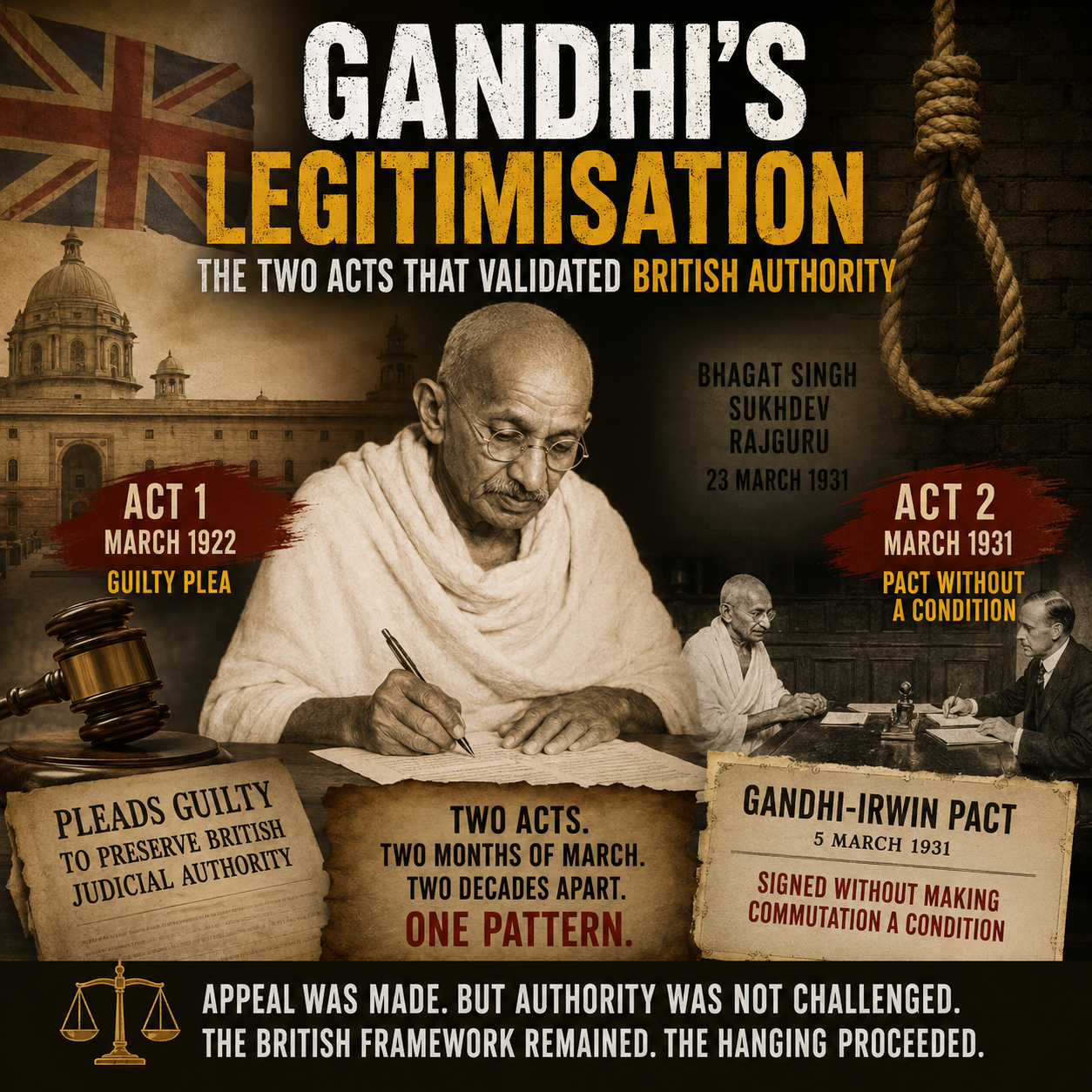
Blog 50 documented the guilty plea of March 18, 1922 — the boycott leader who bowed to the boycotted court, preserving British judicial authority over himself. This post documents a second act of legitimisation — nine years later, in March 1931 — that preserved British judicial authority over three others. Two acts, two months of March, two decades apart. The pattern the series has documented across fifty blogs runs through both.
Thank you for reading this post, don't forget to subscribe!The Action Taken: Gandhi proposed that Hindus provide unconditional assistance to the Khilafat movement as a unilateral moral gesture, in the expectation of voluntary reciprocal cow protection.
Who Paid the Price: The principle of negotiated constitutional reciprocity between communities.
The Alternative Bypassed: A formal, binding treaty of mutual civic obligations between communities before launching mass agitation.
Why This Matters: Conceded political leverage upfront without reciprocal guarantees, establishing a pattern of unilateral concessions that failed to secure long-term communal peace.
What Legitimisation Means
Gandhi’s Legitimisation requires a precise definition before the exhibits are placed.
To legitimise an authority is not merely to acknowledge it exists. It is to act in ways that confirm it has the right to exercise power — that its decisions are valid, its processes acceptable, its outcomes binding. A man who challenges a court’s jurisdiction does not legitimise it even if the court proceeds. A man who pleads guilty accepts the court’s right to try him. A man who negotiates a settlement with an administration without making its pending executions a condition of settlement accepts that administration’s right to execute.
Blog 50 documented the first exhibit — the guilty plea of March 1922. This post documents the second. Both belong to the same prosecutorial category: acts through which Gandhi, the leader of a movement that declared British authority illegitimate, confirmed that authority’s right to exercise its power over Indians.
When the documented actions are read without sentiment, they show a consistent pattern: at two decisive moments, Gandhi chose the path that explicitly or implicitly accepted the operating legitimacy of British judicial and administrative power over Indians.
Bhagat Singh — The Condition Gandhi Did Not Make
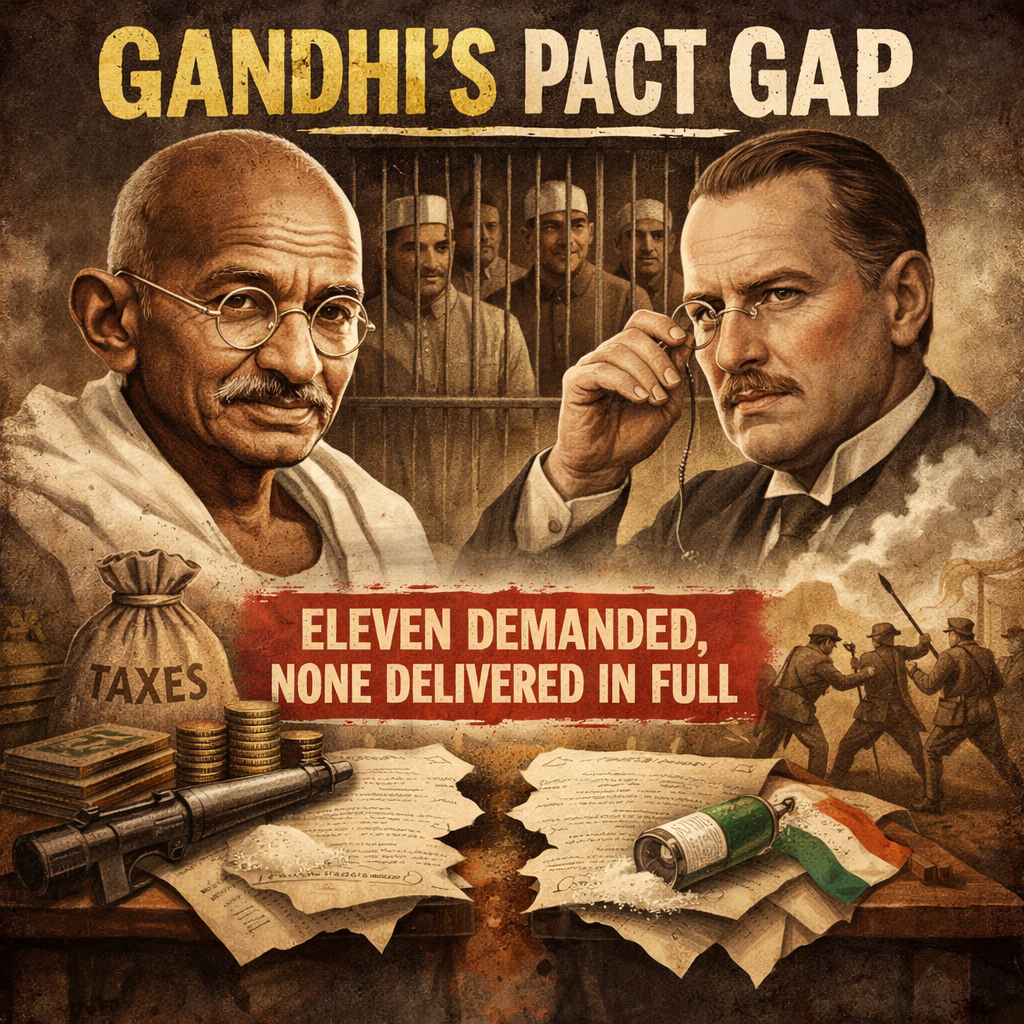
In February and March 1931, Gandhi conducted eight meetings with Viceroy Lord Irwin — totalling twenty-four hours — that produced the Gandhi-Irwin Pact of March 5, 1931. Blog 18 documented what the pact produced and surrendered.
During those negotiations, Gandhi raised the case of Bhagat Singh, Sukhdev, and Rajguru — three revolutionaries under sentence of death. They had been convicted of the 1929 killing of British police officer John Saunders at Lahore. Gandhi made multiple appeals to Irwin for commutation of their death sentences to life imprisonment.
The appeals were sincere. The documentation shows Gandhi raising the matter on February 18, again on March 19, again on March 21 and 22, and writing an emotional personal letter on the morning of March 23 — the day of the hanging. The documentation also shows Gandhi deliberately distancing the commutation request from the pact negotiations.
On February 18, Gandhi told Irwin: *”This has no connection with our discussion, and it may even be inappropriate on my part to mention it. But if you want to make the present atmosphere more favourable, you should suspend Bhagat Singh’s execution.”*
That sentence is the prosecution’s exhibit. Not what Gandhi asked — but how he asked it.
*This has no connection with our discussion.*
Gandhi himself severed the link between the commutation and the pact. He made the appeal personal and moral — the apostle of non-violence pleading for the lives of men who disagreed with his method. He did not make it political and conditional — the leader of the independence movement refusing to sign until the British administration demonstrated it would not execute political prisoners.
Irwin refused the commutation. Gandhi signed the pact on March 5. Bhagat Singh, Sukhdev, and Rajguru were hanged on March 23 — eighteen days after Gandhi signed, hours after Gandhi’s final letter arrived.
The Condition That Was Available
Gandhi’s Legitimisation does not claim Gandhi did nothing for Bhagat Singh. He appealed. He delayed. He wrote letters. The documentation is clear.
It claims Gandhi had a condition available that he chose not to use.
The Irwin Pact gave Gandhi something the British administration needed — the suspension of Civil Disobedience and Congress participation in the Second Round Table Conference. The British administration needed Gandhi’s signature. Without it, the Round Table Conference had no legitimate Indian nationalist participation and the imperial government faced continued mass resistance.
As presented in the blog on Unelected Mandate, Gandhi agreed to sign without consulting the Congress Working Committee. He had no formal mandate from the organisation he represented, let alone the Indian population whom the signature impacted. The movement that had filled the reservoir — sixty thousand in jail, provinces under Civil Disobedience, the strongest hand any Indian leader had held — was dissolved by one man’s signature on one morning. The thirty thousand who had built the Non-Cooperation Movement were not consulted in 1922. The sixty thousand who had built the Civil Disobedience Movement were not consulted in 1931. Both times Gandhi signed alone. Both times the British received what they needed. Both times the movement’s participants received the consequences.
The prosecution’s question is precise: if Gandhi had made commutation a condition — not a personal plea but a political requirement for his signature — what would Irwin have done? The documentation gives the answer partly. Irwin wrote in his farewell speech that he would regard it as “wholly wrong to allow my judgment to be influenced or deflected by purely political considerations.” But Irwin also needed Gandhi’s signature. The Round Table Conference needed it. Ramsay MacDonald needed it.
Whether the condition would have worked cannot be proven. That Gandhi chose not to impose it can be.
What the Two Acts Have in Common
Gandhi’s Legitimisation places the two acts side by side — not to claim they are identical but to show they share a structural property.
The guilty plea of March 1922: Gandhi had the option of challenging the court’s jurisdiction — as Tilak did, as Bhagat Singh later did. He chose the guilty plea. The British judicial framework received his validation.
The Irwin Pact of March 1931: Gandhi had the option of making commutation a condition of his signature. He chose to separate the two — explicitly, in his own words. The British judicial framework’s authority to execute Bhagat Singh received his implicit validation when he signed without the condition.
In both cases, British judicial authority over Indians was preserved by Gandhi’s choice. In both cases, an alternative was available. In both cases, Gandhi chose the path that preserved the framework over the path that challenged it.
The prosecution does not claim these choices were identical in their circumstances or in Gandhi’s intentions. It claims the documented outcome of both choices was the same: British colonial judicial authority over Indians was confirmed rather than contested, at moments when Gandhi had the standing and the leverage to contest it.
The Prosecution’s Position
Gandhi’s Legitimisation does not claim Gandhi wanted Bhagat Singh and others hanged. The appeals documented across February and March 1931 make that claim impossible to sustain. He tried to save Bhagat Singh’s life.
It claims Gandhi made a specific choice about how to try — as a personal moral appeal rather than a political condition — and that choice preserved the British administrative framework’s authority to proceed with the hanging regardless of Gandhi’s objection.
The Suspension Ledger’s question applies here: who benefited from Gandhi’s choice of method? The British administration received Gandhi’s signature on the pact without having to commute the sentences. The pact was signed. The Round Table Conference proceeded. The executions proceeded. Gandhi received moral credit for his appeals. Bhagat Singh, Sukhdev, and Rajguru received the gallows.
The arithmetic was consistent across four decades. The beneficiary column reads the same across two exhibits documented in this post.
The reader has now seen both acts of Gandhi’s Legitimisation — the guilty plea that confirmed the colonial court’s authority over Gandhi, and the pact signature that confirmed the colonial administration’s authority over Bhagat Singh. The series does not name what the pattern means. The next post places the accumulated pattern before the reader as a question.
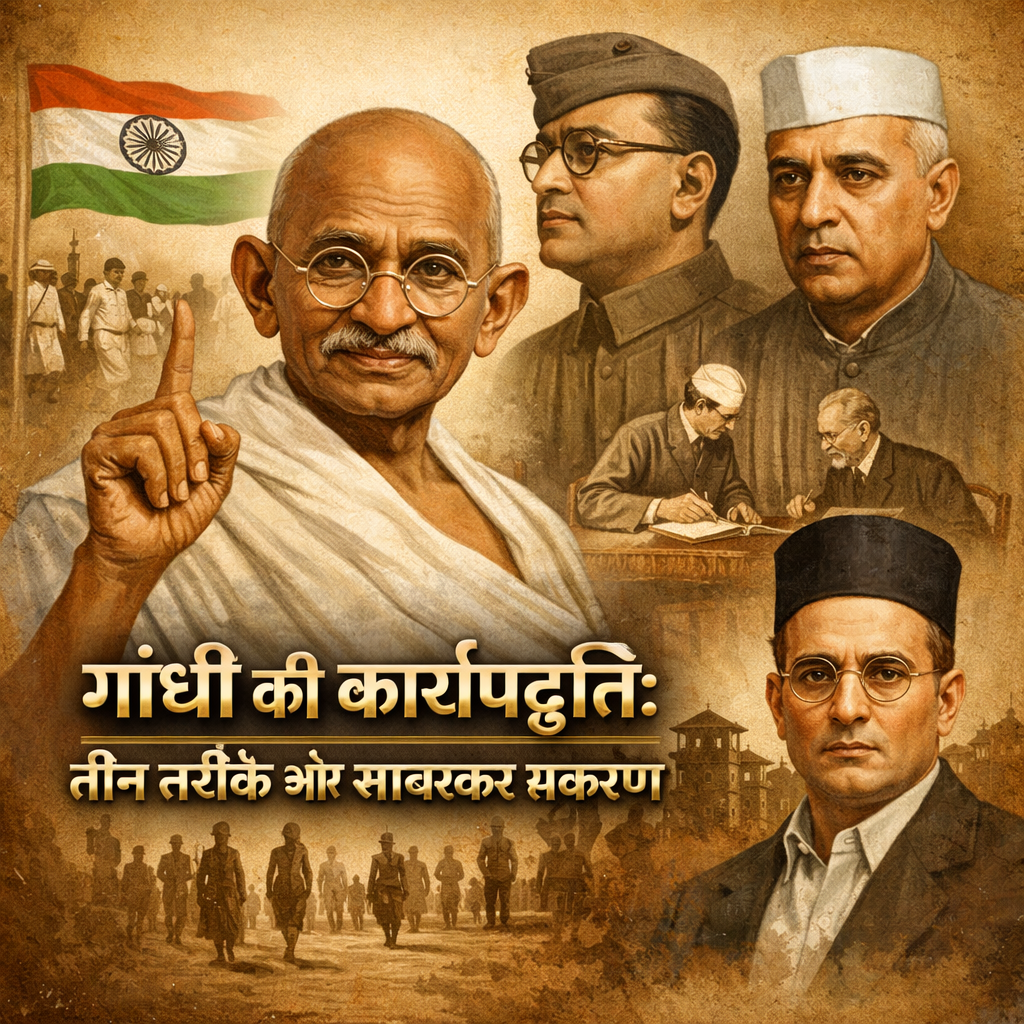
Gandhi told Irwin: “This has no connection with our discussion.” He was talking about Bhagat Singh’s life. He separated the commutation from the negotiation — explicitly, in his own words, on February 18, 1931. He signed the pact on March 5. Bhagat Singh was hanged on March 23. The British judicial framework’s authority to execute an Indian political prisoner was preserved by Gandhi’s choice of how to ask. The prosecution places this choice before the reader. The reader will decide what the choice means.
Feature Image: Click here to view the image.
Videos
Glossary of Terms
- Gandhi’s Legitimisation: A key phrase coined in this series referring to actions through which Mahatma Gandhi is argued to have affirmed or preserved the authority and legitimacy of British colonial institutions over Indians.
- Legitimisation: The act of confirming or accepting the authority, validity, or right of a political or legal system to exercise power and enforce decisions.
- Gandhi-Irwin Pact: A political agreement signed on March 5, 1931, between Mahatma Gandhi and Viceroy Lord Irwin that suspended the Civil Disobedience Movement and enabled Congress participation in the Second Round Table Conference.
- Lord Irwin: The Viceroy of British India from 1926 to 1931 who negotiated the Gandhi-Irwin Pact with Mahatma Gandhi.
- Bhagat Singh: Indian revolutionary socialist executed by the British in 1931 for the killing of British police officer John Saunders; regarded as one of the most iconic anti-colonial revolutionaries of India.
- Sukhdev: Indian revolutionary and associate of Bhagat Singh who was executed by the British on March 23, 1931, in the Lahore Conspiracy Case.
- Rajguru: Indian revolutionary freedom fighter executed alongside Bhagat Singh and Sukhdev in 1931 for participation in revolutionary anti-British activities.
- Civil Disobedience Movement: A mass anti-colonial movement launched by Gandhi in 1930 that encouraged Indians to defy British laws and institutions through non-violent resistance.
- Round Table Conference: A series of conferences held in London between 1930 and 1932 to discuss constitutional reforms and the political future of British India.
- Commutation: The legal reduction of a punishment, particularly the conversion of a death sentence into life imprisonment.
- Colonial Judicial Authority: The legal and institutional power exercised by British colonial courts and administrative systems over Indians during British rule.
- Jurisdiction: The official legal authority of a court or governing body to make decisions, enforce laws, and administer justice over individuals or territories.
- Ramsay MacDonald: British Prime Minister during the period of the Gandhi-Irwin negotiations and the Round Table Conferences on India’s constitutional future.
- Unelected Mandate: A phrase used in this series to describe Gandhi exercising decisive political authority without formal electoral or organisational approval from the broader Indian population or Congress members.
- Suspension Ledger: A recurring analytical phrase in this series examining who benefited and who suffered whenever Gandhi suspended or compromised mass political movements.
#Gandhi #BhagatSingh #Congress #BritishRaj #FreedomStruggle #CivilDisobedience #IndiaHistory #Colonialism #MahatmaGandhi #IndianHistory #Rajguru #Sukhdev #RoundTableConference #NationalMovement #HinduinfoPedia
Gandhi’s Peace Efforts: The Questions Before the Mahatma (0)
Read The Prosecution Exhibits Through Links
Follow us:
HinduinfoPedia, Gandhi, Bhagat Singh, Gandhi-Irwin Pact, British Raj, Colonial Authority, Civil Disobedience, Indian Freedom Movement, Congress, Lord Irwin, British Judiciary, Round Table Conference, Ramsay MacDonald, Colonial Law, National Movement