
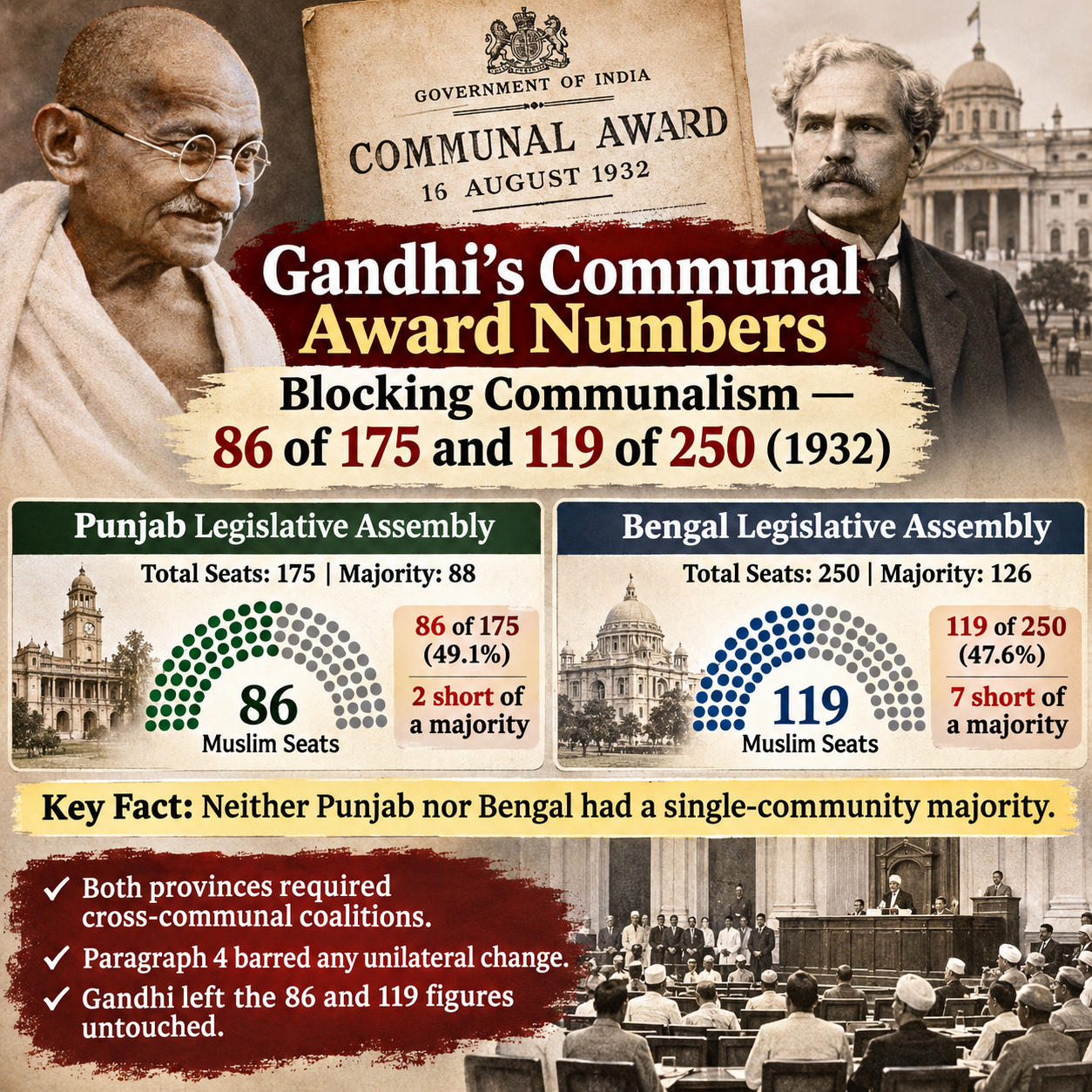
Gandhi’s Communal Award Numbers: Blocking Communalism — 86 of 175 and 119 of 250 (238)
भारत / GB
Part 238: Mahatma Gandhi’s Peace Efforts (Residue Enters Constitution) | Series Index
Blog 237 recorded that Gandhi left the Muslim, Sikh and European electorates of the Communal Award untouched and staked his life only against the Depressed Classes. Standard history blames that 1932 Award for locking India into rigid religious majorities that made Partition inevitable. This blog sets out Gandhi’s Communal Award Numbers—showing that in the Punjab and Bengal, the British seat map actually blocked a one-community majority and forced cross-communal coalitions until later political choices dismantled those safeguards.
Thank you for reading this post, don't forget to subscribe!THE 16 AUGUST 1932 SCHEDULE
The Action Taken: The Communal Award fixed 86 Muslim seats out of 175 in the Punjab and 119 Muslim seats out of 250 in Bengal. Neither figure reached a majority.
Who Paid the Price: No community received an outright majority in either province. Muslims saw their population majorities reduced to legislative minorities, while Hindus and Sikhs also fell short of controlling either assembly alone.
Why This Matters: Under the seats awarded on 16 August 1932, neither province could be governed by a single religious bloc. Coalition government across communities was built into the arithmetic.
1. The Alibi Against the Primary Schedule
A familiar defence of Congress strategy after 1932 holds that Ramsay MacDonald’s Communal Award (Blog 237) carved India into fixed religious majorities, leaving Muslim-majority provinces under unilateral communal rule and making the 1947 Partition inevitable.
That claim does not survive a reading of the Award’s own tables.
When Gandhi’s Communal Award Numbers are checked against the assembly totals of the two provinces that later formed the core of Pakistan—the Punjab and Bengal—the British allocation did not create a single-community majority. It blocked one.
2. The Punjab Schedule: 86 Seats Out of 175
According to the 1931 Census, Muslims made up nearly 56 per cent of the Punjab’s population. Under a straight population-based seat share, a Muslim party could have commanded an absolute majority on its own.
Instead, the 16 August 1932 Award distributed the **175 seats** of the Punjab Legislative Assembly—where **88 seats** were needed for a simple majority—across ten distinct categories:
| Punjab Constituency | Seats Awarded | Share / Majority Gap |
|---|---|---|
| Muslim (including 2 women’s seats) | 86 | 49.1% (2 short of 88) |
| General, mainly Hindu (including 1 woman’s seat) | 43 | 24.6% (45 short of 88) |
| Sikh | 32 | 18.3% (56 short of 88) |
| Indian Christian (2), Anglo-Indian (1), European (1) | 4 | 2.3% |
| Landholders (5), Labour (3), Commerce (1), University (1) | 10 | 5.7% |
| Total Assembly | 175 | Majority = 88 |
Even if every single Muslim legislator voted as a single block, the total stopped at 86—two votes short of control. At the same time, Hindus (43) and Sikhs (32) combined totalled 75 seats—still 13 short of a majority. Under Gandhi’s Communal Award Numbers, no ministry could survive in Lahore without bridging communal lines.
3. The Bengal Schedule: 119 Seats Out of 250
The same structural check was written into Bengal. Muslims formed roughly 54.8 per cent of Bengal’s population, yet out of **250 total seats**—where **126 seats** were required for a majority—the Award fixed the house as follows:
| Bengal Constituency | Seats Awarded | Share / Majority Gap |
|---|---|---|
| Muslim (including 2 women’s seats) | 119 | 47.6% (7 short of 126) |
| General, mainly Hindu (including 2 women’s seats) | 80 | 32.0% (46 short of 126) |
| Commerce, Industry, Mining and Planting | 19 | 7.6% |
| European | 11 | 4.4% |
| Labour (8), Landholders (5), University (2) | 15 | 6.0% |
| Anglo-Indian (4), Indian Christian (2) | 6 | 2.4% |
| Total Assembly | 250 | Majority = 126 |
Muslims received 119 seats—seven votes short of a majority. General seats stood at 80, forty-six short of a majority. And those 80 general seats were not a single block: Paragraph 9 of the Award reserved at least 10 special constituencies inside them for the Depressed Classes (for 20 years), while allowing Depressed Class voters to cast a second vote in the general constituencies as well.
Because their population majorities in both the Punjab and Bengal had been converted into legislative minorities, Muslim leaders were openly unhappy with Gandhi’s Communal Award Numbers—yet they were prepared to accept the Award and work within it.
4. What the 1932 Schedule Required
Paragraph 4 of the Award locked those seat ratios in place by stating that the allocation could be changed only if the communities concerned “are mutually agreed upon a practicable alternative scheme.”
Under the seats as awarded on 16 August 1932:
- A Muslim ministry in the Punjab needed at least two non-Muslim votes to reach 88.
- A Muslim ministry in Bengal needed at least seven non-Muslim votes to reach 126.
- A Hindu or Sikh ministry in either province was equally impossible without cross-communal partners.
- Unilateral revision by any single party was barred by Paragraph 4.
The schedule itself therefore blocked single-community communal rule in the two provinces that later formed the core of Pakistan. Gandhi’s Communal Award Numbers made coalition government across communities mathematically mandatory.
5. What Gandhi Contested and What He Left
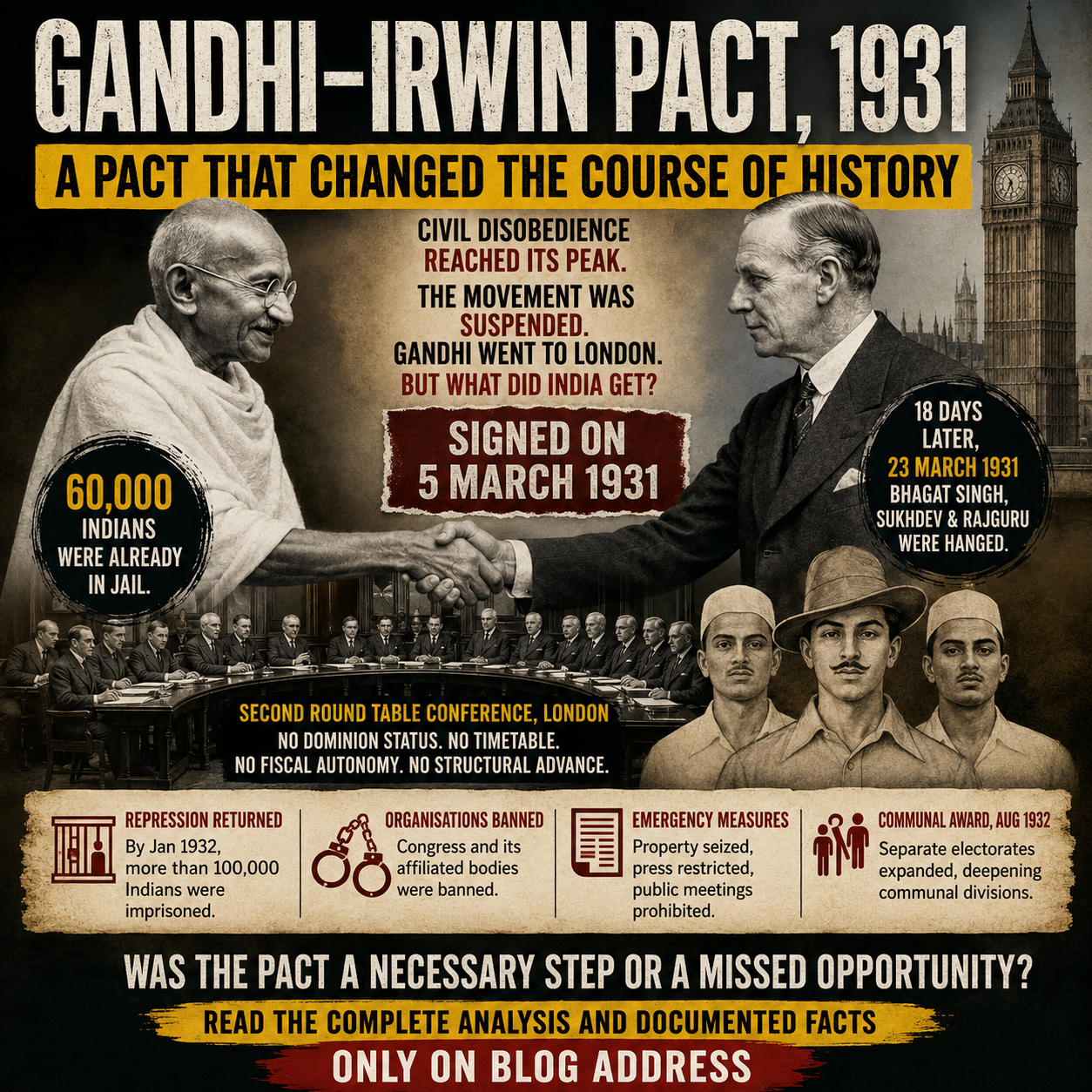
Gandhi’s letter to Ramsay MacDonald on 18 August 1932 (Blog 237) asked for the revision of only one piece of Gandhi’s Communal Award Numbers: the separate electorate for the Depressed Classes inside the general seats.
He asked for no change to the 86 Muslim seats in the Punjab, the 119 Muslim seats in Bengal, the 32 Sikh seats, or the 11 European and 19 commercial seats in Bengal. The numbers that denied a majority to every religious community—and required cross-communal coalitions to govern—were the numbers he left standing in August 1932. How subsequent political choices dismantled those buffers is examined in later blogs in this series.
Prosecution’s Position
The prosecution places on the record the complete 16 August 1932 seat schedules for the Punjab (175 seats) and Bengal (250 seats) to refute the claim that British seat arithmetic forced Partition. Under Gandhi’s Communal Award Numbers, Muslims were reduced from population majorities to legislative minorities in both provinces—86 of 175 in the Punjab (2 short of a majority) and 119 of 250 in Bengal (7 short of a majority)—while Hindus and Sikhs also fell short of controlling either assembly alone. Paragraph 4 barred any unilateral revision without mutual agreement. Gandhi left those provincial ratios untouched and staked his life solely against the Depressed Classes’ electorate inside Bengal’s general seats, proving that the 1932 seat map blocked single-community rule until later political decisions broke the coalition framework.
Invitation To Defence
The 16 August 1932 Communal Award schedules for the Punjab and Bengal, Paragraph 4 requiring mutual communal agreement for any change, Paragraph 9 governing the Depressed Classes’ seats in Bengal, and Gandhi’s letter of 18 August 1932 are established exhibits. The defence is invited to show how 86 seats out of 175 in the Punjab, or 119 seats out of 250 in Bengal, could produce a single-community majority without coalition partners, or to produce any 1932 statement by Gandhi objecting to the Muslim, Sikh or European seat totals.
The Communal Award of 16 August 1932 gave Muslims 86 of 175 seats in the Punjab and 119 of 250 seats in Bengal. Neither figure was a majority, blocking single-community communal rule in both provinces. Gandhi left both figures untouched.
Feature Image: Click here to view the image.
Videos
Glossary of Terms
1. Communal Award (1932): The constitutional arrangement announced by British Prime Minister Ramsay MacDonald on 16 August 1932, allocating legislative seats among different communities and interest groups in British India.
2. Depressed Classes: The historical administrative term used in the Communal Award for communities then subjected to untouchability and social discrimination, now broadly associated with Scheduled Castes.
3. Separate Electorate: An electoral arrangement under which members of a designated community elect their own representatives through a separate electorate.
4. General Constituencies: Legislative constituencies not exclusively assigned to a particular religious community, although special provisions could apply to certain groups within them.
5. Legislative Majority: More than half of the total membership of a legislative assembly, generally required to secure a simple majority in voting.
6. Cross-Communal Coalition: A political alliance involving representatives from different religious or social communities to establish or sustain a legislative majority.
7. Punjab Legislative Assembly: The provincial legislature of British Punjab, allocated 175 seats under the Communal Award, including 86 Muslim seats.
8. Bengal Legislative Assembly: The provincial legislature of British Bengal, allocated 250 seats under the Communal Award, including 119 Muslim seats.
9. Paragraph 4: A provision of the Communal Award stating that its community-based seat allocations could be changed only through a mutually agreed alternative arrangement among the communities concerned.
10. Paragraph 9: A provision governing special representation for the Depressed Classes within Bengal’s general constituencies, including reserved constituencies and an additional voting arrangement.
11. Population Majority: A numerical majority based on a community’s proportion of the total population of a geographical area, which does not automatically translate into a legislative majority.
12. Seat Allocation: The distribution of legislative seats among different communities, constituencies and special interest groups under a constitutional or electoral arrangement.
13. Single-Community Rule: A political arrangement in which representatives belonging to one community possess enough legislative seats to govern without support from other communities.
14. Assembly Arithmetic: A term used in this blog to describe the numerical relationship between total legislative seats, community allocations and the number required to establish a majority.
15. Gandhi’s Communal Award Numbers: The key analytical phrase of this blog referring to the 86 Muslim seats out of 175 in Punjab and 119 out of 250 in Bengal, which fell short of legislative majorities under the 1932 Award.
#Gandhi #CommunalAward #IndianHistory #BritishIndia #Punjab #Bengal #GandhiHistory #ConstitutionalHistory #IndianPolitics #HinduinfoPedia
Scan Through The Entire Series at