
Gandhi’s Dharasana Campaign: The Raid He Announced, the Blows Others Took (233)
भारत / GB
Part 233: Mahatma Gandhi’s Peace Efforts (Residue Enters Constitution) | Series Index
Blog 232 covered the Lahore Congress of December 1929. Gandhi’s deadline ran out, the Congress declared complete independence, and the Hindu–Muslim settlement was dropped with nothing in its place. Five weeks later Gandhi offered to call off civil disobedience if the Viceroy met eleven demands. The Viceroy did not, and the Salt March followed (Blog 8). This instalment covers what came after the march: Gandhi’s Dharasana Campaign of May 1930, the spread of civil disobedience across India, and the people who paid for it.
Thank you for reading this post, don't forget to subscribe!THE DHARASANA RECORD: MAY 1930 – FEBRUARY 1931
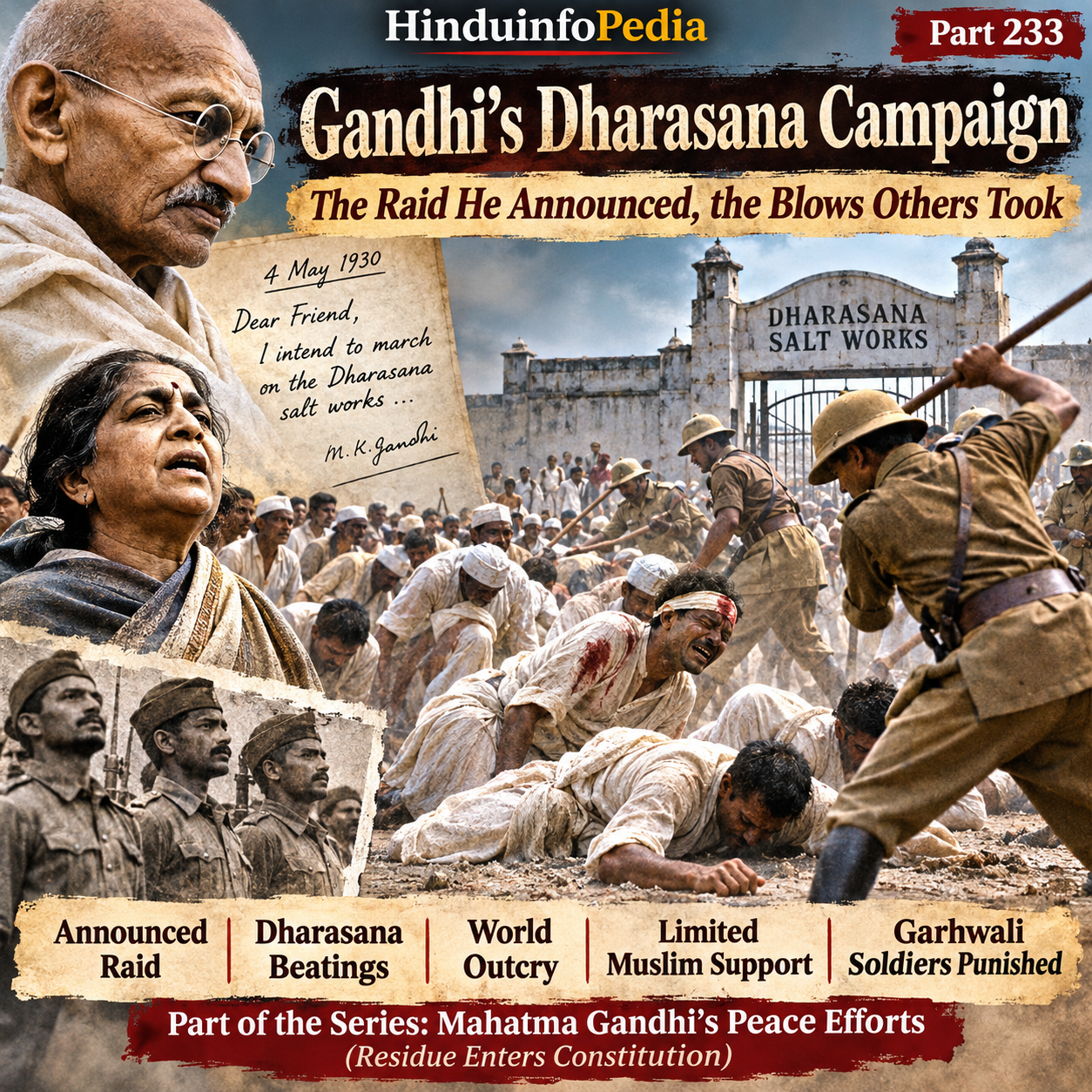
The Action Taken: Gandhi’s Dharasana Campaign began with a letter. On 4 May 1930 Gandhi wrote to the Viceroy that he would march on the Dharasana salt works and demand possession of them. He was arrested that night. On 21 May about 2,500 volunteers, led by Sarojini Naidu, walked up to the salt works in columns and were beaten down by police. An American reporter, Webb Miller, saw it and sent the story round the world. Across India about 60,000 people were jailed in the movement’s first nine or ten months.
Who Paid the Price: The volunteers who took the blows at Dharasana. The people shot at Peshawar on 23 April. The Garhwali soldiers who refused to fire on them, were court-martialled, and were left out when prisoners were released in March 1931 — men Gandhi later said had broken their oath.
Why This Matters: Dharasana is remembered as the purest example of non-violent resistance. The record also shows who was in jail and who was on the front line, how little of Muslim India joined outside the Frontier, and that the men whose refusal to shoot was the most direct challenge to British power received no support from Gandhi.
1. The Raid Gandhi Announced
The Salt March ended at Dandi on 6 April 1930 (Blog 8). For the next month Gandhi toured the villages of the coast and kept breaking the salt law. On 4 May, at the village of Karadi, he wrote his second letter to the Viceroy, again addressing him as “Dear Friend”. He said he intended to set out for the government salt works at Dharasana with his companions and demand possession of them.
The government had been slow to arrest him. Irwin did not want to make Gandhi a bigger figure by jailing him too early, and his officials had been pressing him to act. The letter settled it. At 0:45 a.m. on 5 May Gandhi was arrested at Karadi under an old regulation of 1827, which allowed detention without trial, and taken to Yerawada jail.
So the raid Gandhi announced was carried out without him. Abbas Tyabji, aged seventy-six, took the lead and was arrested on 12 May with fifty-eight marchers before they reached the salt works. Sarojini Naidu then took charge, with Gandhi’s son Manilal and Imam Sahib. Gandhi’s Dharasana Campaign had begun with its leader in prison.
2. 21 May 1930: What Happened at the Salt Works
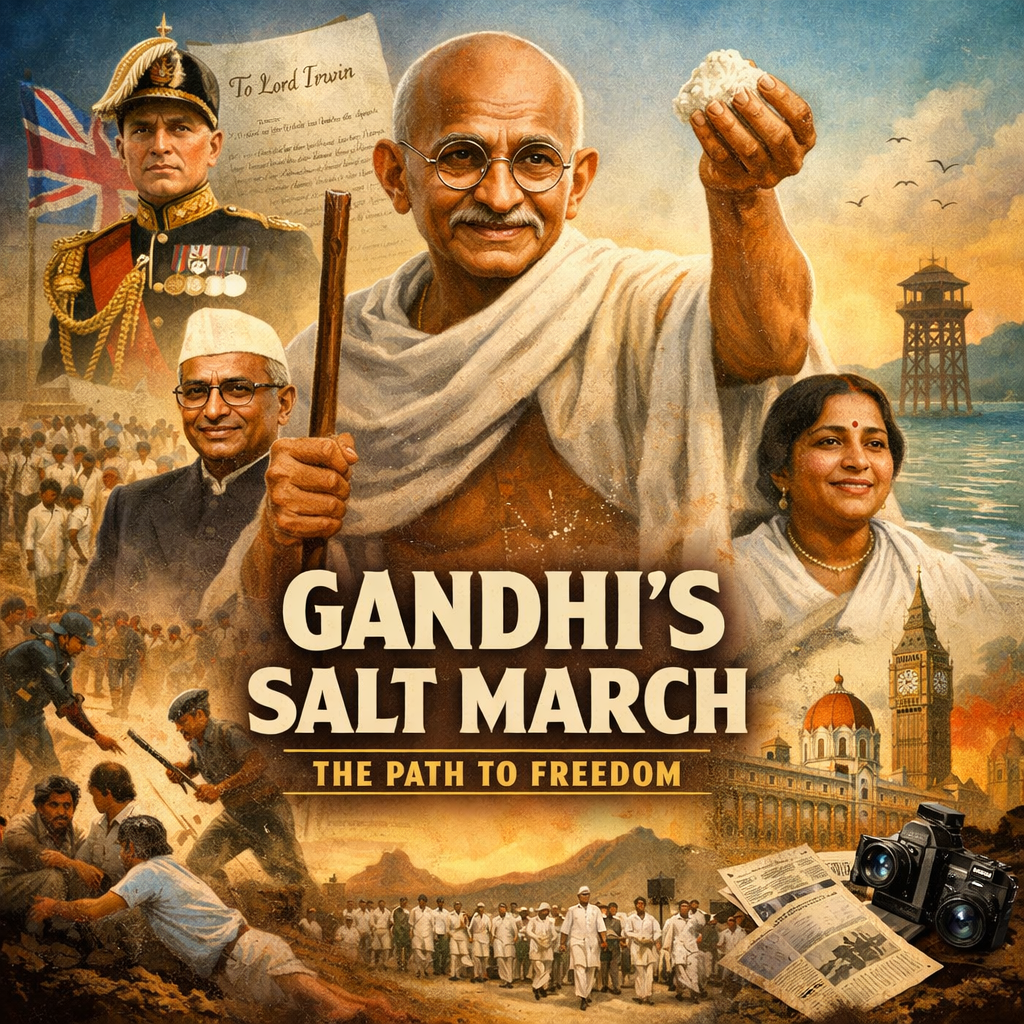
Before dawn on 21 May about 2,500 volunteers gathered near Dharasana. Sarojini Naidu spoke to them and told them they must not resist, even to ward off a blow. They prayed, formed columns, and walked towards the salt works carrying ropes, wire-cutters and stretchers. About 400 police were waiting behind ditches and barbed wire.
Webb Miller of the United Press watched what followed. The police charged each column as it came up and struck the marchers on the head and shoulders with steel-tipped lathis. The marchers did not hit back. As Miller wrote, “Not one of the marchers even raised an arm to fend off the blows.” When one column fell, the next walked forward. Stretcher-bearers carried the injured to a temporary hospital in blankets.
Miller’s dispatch that day reported 260 injured. When he later counted the wounded at the hospital, he found 320, and two men died. Sarojini Naidu and Manilal Gandhi were arrested. The raids went on for days.
3. Who Saw It
The salt works were not taken. What Gandhi’s Dharasana Campaign achieved was an audience. Miller’s report was held up at first by the censors, but once it got out it was printed in newspapers across the world, and it caused an international outcry against British rule in India.
That raises a fair question. The raid was announced to the Viceroy in advance. It was planned with stretchers, and led by volunteers who were told not to defend themselves. Its effect came from being seen. Whether Dharasana was planned for the eyes of the world is not recorded in Gandhi’s own words, and it is asked here only as a question. What is recorded is the division of roles: the leaders were in jail, the volunteers went forward, and the foreign press carried the result.
4. The Movement at Its Height
Gandhi’s Dharasana Campaign was one front among many. By February 1931 the Secretary of State told the House of Commons that about 60,000 people had been imprisoned in connection with the movement in its first nine or ten months. The other fronts of 1930 show how far the movement went, and where it did not reach:
| Where and when | What happened |
|---|---|
| Chittagong, 18 April 1930 | Revolutionaries raided the police armoury — armed action outside Gandhi’s movement |
| Peshawar, 23 April 1930 | After Abdul Ghaffar Khan’s arrest, troops fired on an unarmed crowd in the Qissa Khwani bazaar. The official toll was 39; non-official accounts put it far higher. Platoons of the Royal Garhwal Rifles — Hindu soldiers facing a Muslim crowd — refused to fire. |
| Peshawar, 25 April – 4 May 1930 | Police and troops withdrawn; the city was in the hands of its people for ten days |
| Dharasana, 21 May 1930 | 2,500 volunteers; 320 injured and 2 dead by Miller’s count |
| India, to February 1931 | About 60,000 imprisoned (House of Commons, 6 February 1931) |
Muslim participation was low outside the North-West Frontier, where Abdul Ghaffar Khan’s Khudai Khidmatgars joined in large numbers. In Bengal it stayed low. In 1930 Maulana Mohamed Ali — Congress President in 1923 — had told Muslims to keep out of Gandhi’s movement (Blog 229). Lahore had declared independence for all India. Outside the Frontier, the people who went to jail for it were mostly Hindus.
5. The Soldiers Who Would Not Fire
Of everything that happened in 1930, the refusal at Peshawar was the most direct threat to British rule. The Raj rested on its Indian army. On 23 April soldiers of that army, ordered to fire on an unarmed crowd, refused. The men were court-martialled and given heavy sentences.
When civil disobedience was called off in March 1931, political prisoners were released under the settlement with the Viceroy (Blog 17). The release did not cover those convicted of violence, and it did not cover soldiers who had disobeyed orders. The Garhwali soldiers stayed in prison.
In 1932 a French journalist, Charles Petrasch, asked Gandhi why the Garhwali soldiers had not been included in the truce. Gandhi replied: “A soldier who disobeys an order to fire breaks the oath which he has taken and renders himself guilty of criminal disobedience.” He added that he could not ask officials and soldiers to disobey.
The soldiers had done what no satyagrahi at Dharasana could do: they had refused to be the instrument of force. Gandhi’s answer was that they had broken their oath to the Crown. That is the plain record of how Gandhi’s Dharasana Campaign treated the one refusal in 1930 that reached the British army.
6. What the Record Shows
Put in order, Gandhi’s Dharasana Campaign shows five things:
- The raid was announced to the Viceroy. Gandhi told Irwin in writing what he would do. He was arrested before he could do it.
- Others took the blows. The leaders were in jail. The volunteers walked into the lathis, and 320 were injured.
- The world watched. Miller’s report made Dharasana known everywhere. The salt works stayed in government hands.
- Muslim India mostly stayed out. Outside the Frontier, the movement for an independent India was carried mainly by Hindus.
- The soldiers were left in prison. The men who refused to fire were not released, and Gandhi said they had broken their oath.
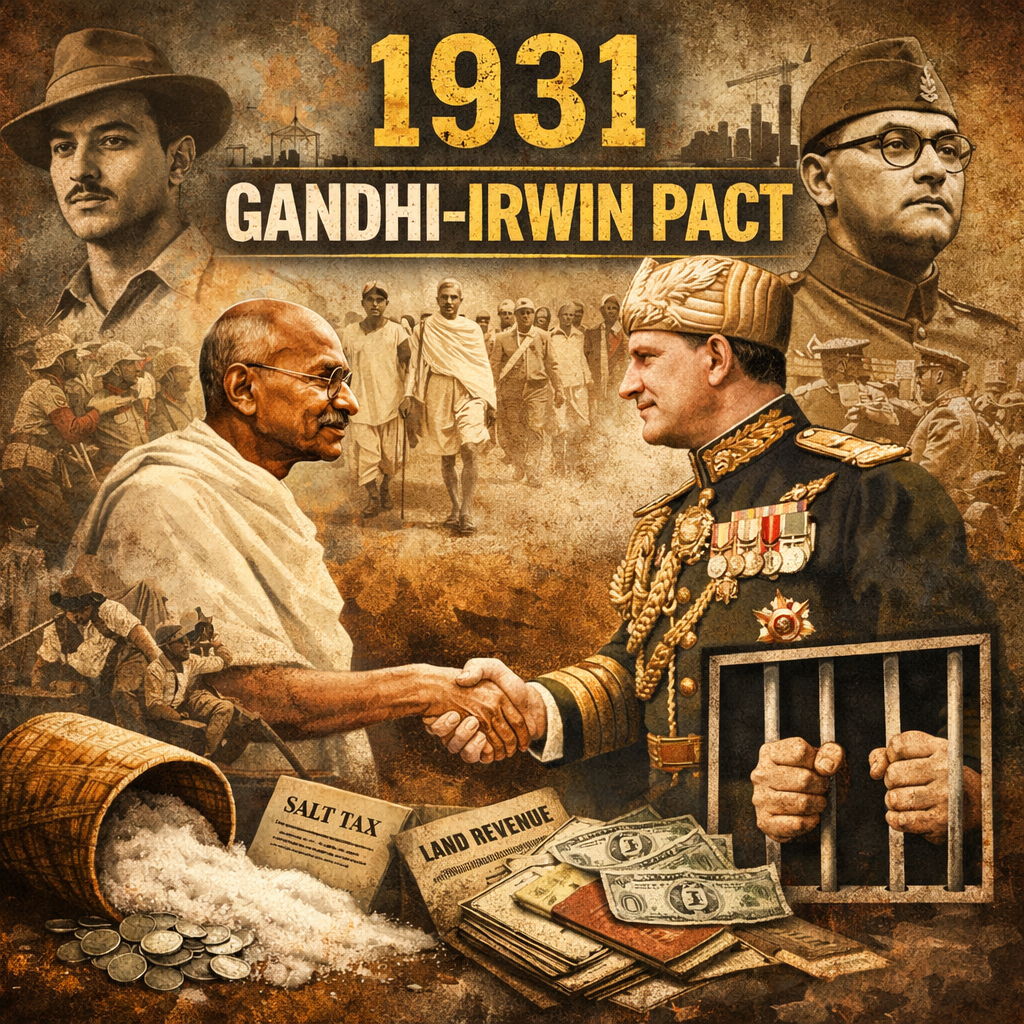
Ten months after Dharasana, with tens of thousands still paying the price, Gandhi signed the settlement with the Viceroy that ended the movement. Its terms, and what they gave up, are documented in Blogs 17 and 138.
Invitation To Defence
Gandhi’s letter of 4 May 1930 announcing the raid, his arrest on 5 May, Webb Miller’s dispatch of 21 May and his later count of 320 injured and 2 dead, the House of Commons figure of about 60,000 imprisoned, the Peshawar firing and the Garhwali refusal of 23 April 1930, the exclusion of the Garhwali soldiers from the 1931 release, and Gandhi’s 1932 statement to Charles Petrasch are established exhibits. The defence is invited to produce any public statement by Gandhi in 1930 or 1931 asking for the release of the Garhwali soldiers, or any step he took to bring Muslim India outside the Frontier into the movement after Mohamed Ali’s call to stay out.
Gandhi wrote to the Viceroy that he would raid the salt works, and was arrested that night. Two weeks later 2,500 volunteers walked into the lathis and 320 fell. The world saw it. At Peshawar Hindu soldiers refused to fire on a Muslim crowd and were court-martialled. When the prisoners were freed in 1931 the soldiers were not, and Gandhi said they had broken their oath.
Feature Image: Click here to view the image.
Videos
Glossary of Terms
1. Gandhi’s Dharasana Campaign: The May 1930 civil disobedience action targeting the government-controlled Dharasana Salt Works, announced by Gandhi but carried out by volunteers after his arrest.
2. Dharasana Salt Works: A government-controlled salt production facility in Gujarat that became the site of a major non-violent protest on 21 May 1930.
3. Civil Disobedience Movement: A political campaign involving deliberate and non-violent violation of colonial laws to challenge British authority in India.
4. Satyagraha: Gandhi’s method of non-violent resistance based on truth, moral conviction and willingness to endure punishment without retaliating.
5. Lathis: Heavy wooden or steel-reinforced police batons used to disperse crowds and inflict physical punishment.
6. Sarojini Naidu: Indian political leader and poet who assumed leadership of the Dharasana protest after Gandhi and Abbas Tyabji were arrested.
7. Abbas Tyabji: A senior nationalist leader who took charge of the Dharasana campaign following Gandhi’s arrest and was subsequently detained on 12 May 1930.
8. Webb Miller: American United Press correspondent whose eyewitness reporting of the police assault at Dharasana brought international attention to the campaign.
9. Qissa Khwani Bazaar: A marketplace in Peshawar where British troops fired on an unarmed crowd on 23 April 1930, during protests following Abdul Ghaffar Khan’s arrest.
10. Royal Garhwal Rifles: A British Indian Army regiment whose soldiers refused orders to fire on protesters at Peshawar, resulting in court-martial proceedings and imprisonment.
11. Khudai Khidmatgars: A non-violent political and social movement led by Abdul Ghaffar Khan in the North-West Frontier region, which participated in the struggle against British rule.
12. Court-Martial: A military judicial proceeding used to try members of the armed forces for offences such as disobedience of military orders.
13. Irwin Pact: The March 1931 agreement between Mahatma Gandhi and Viceroy Lord Irwin that suspended the Civil Disobedience Movement and provided for the release of certain political prisoners.
14. Dharasana Record: The historical account examined in this blog, covering Gandhi’s announced raid, the police assault on volunteers, international reporting, imprisonment and the treatment of the Garhwali soldiers.
15. Residue Enters Constitution: The broader series theme examining how unresolved political, communal and constitutional questions from the freedom struggle continued to influence India’s constitutional and political development.
#Gandhi #Dharasana #SaltSatyagraha #IndianHistory #FreedomStruggle #CivilDisobedience #SarojiniNaidu #BritishIndia #Peshawar #WebbMiller #HinduinfoPedia
Scan Through The Entire Series at