Gandhi’s Second Unanswered Question: What If He Had Not Suspended? (31)
भारत / GB
Part 31: Mahatma Gandhi’s Peace Efforts | Series Index
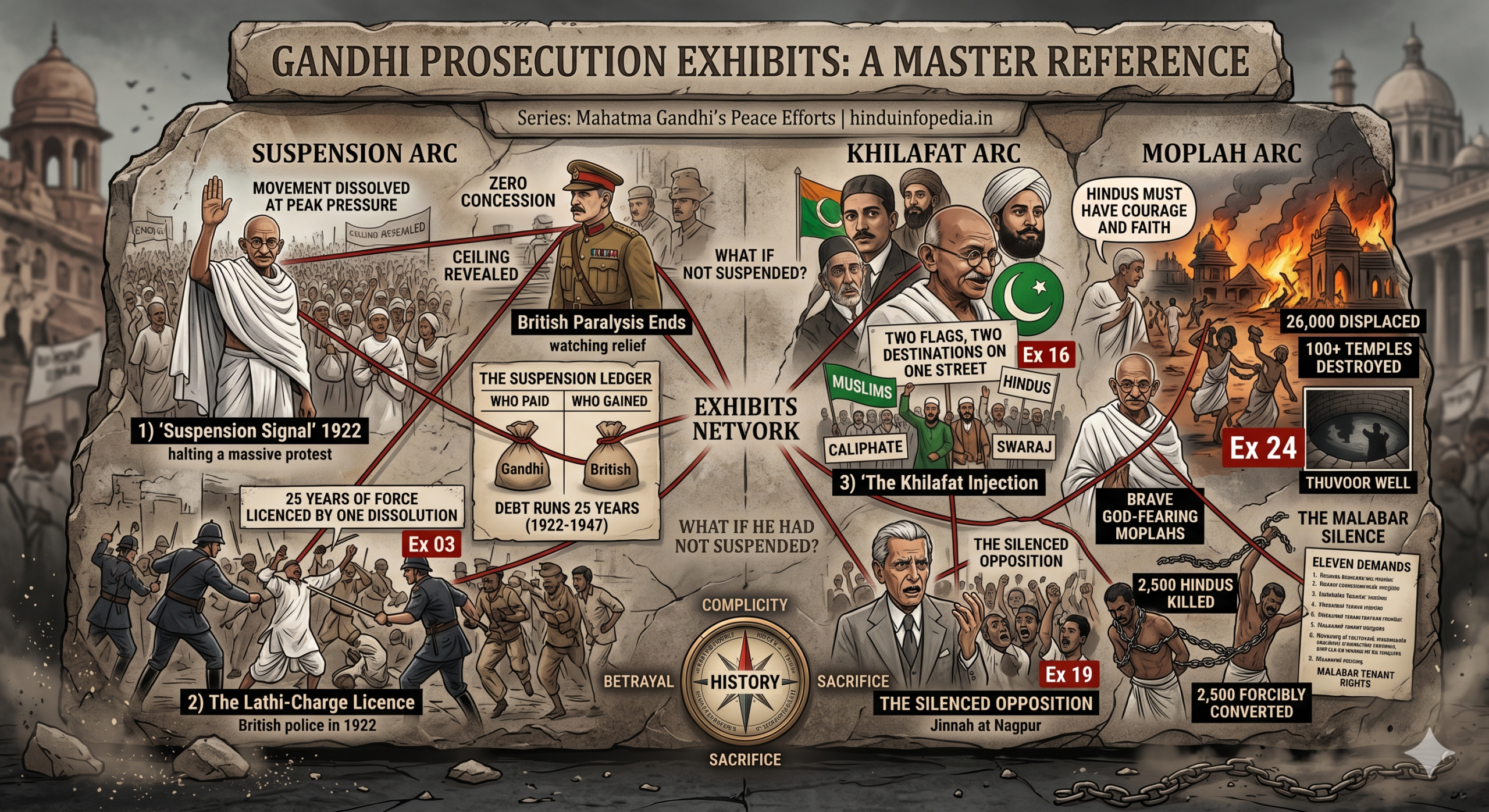
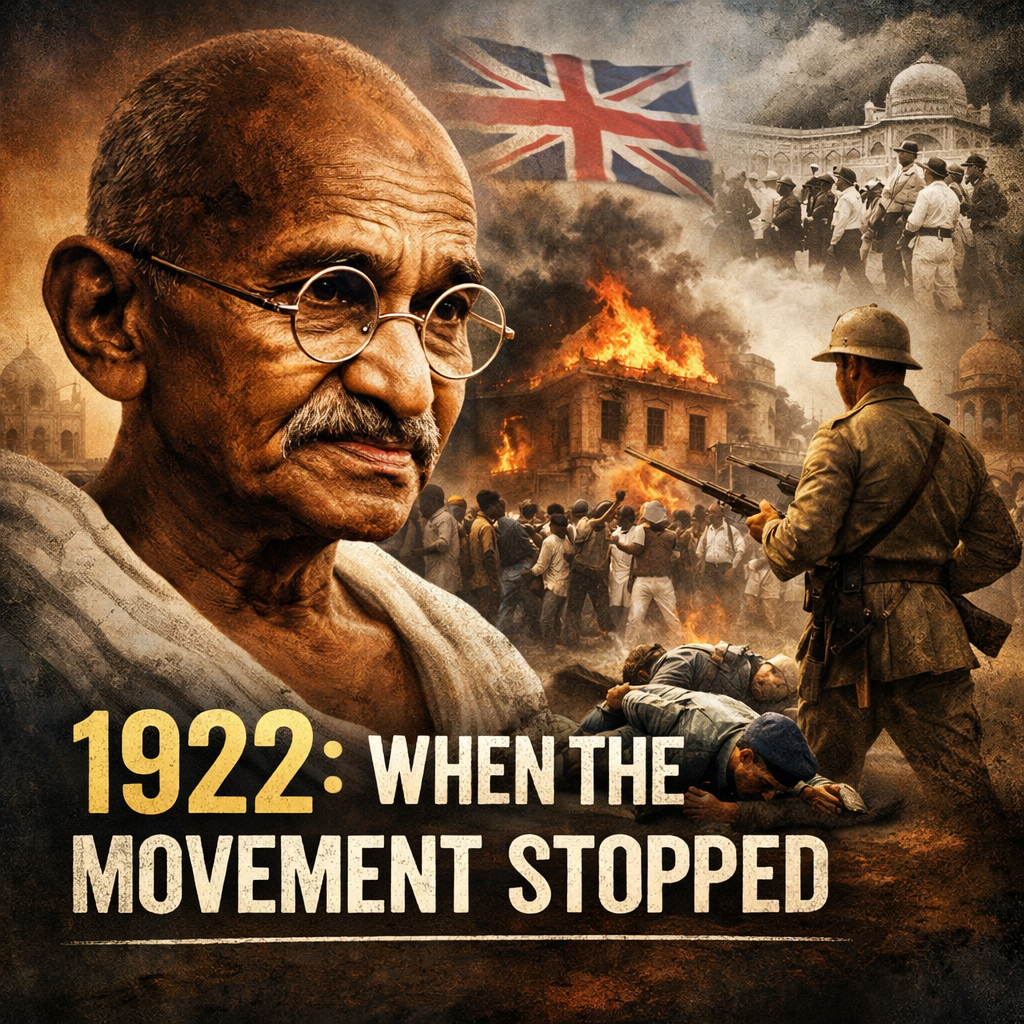
Blog 30 documented what February 12, 1922 gave the British — the answer to the question they could not answer before. Seventeen months of hesitation ended in twenty-six days. This post asks the question Gandhi’s defenders have never answered satisfactorily: what would the British have faced if Gandhi had not suspended? The answer does not exonerate him. It makes the prosecution’s case harder to dismiss.
Thank you for reading this post, don't forget to subscribe!The Action Taken: Gandhi halted Non-Cooperation unilaterally, relieving British administrators from having to choose between mass force, structural concessions, or executive collapse.
Who Paid the Price: The collective national movement, which surrendered an unrepeatable peak of imperial administrative vulnerability without reciprocal terms.
The Alternative Bypassed: Maintaining organized boycott pressure until the colonial administration formally conceded provincial constitutional terms.
Why This Matters: An audit of the tactical counterfactual: setting the price of exit at zero solved the adversary’s tripartite administrative dilemma without extracting any structural concession.
The Thesis That Must Be Tested
A prosecution that never faces its own weakest point is not a prosecution. It is advocacy. Gandhi’s Second Unanswered Question is this series facing its own weakest point — and the argument of Blog 30 is serious enough to require a serious test.
The thesis is: the suspension of February 12, 1922 gave the British information they used for twenty-five years. Before it, they faced strategic uncertainty. After it, they knew Gandhi’s ceiling — that it was reachable, self-enforced, and beyond the Congress’s capacity to override.
Gandhi’s Second Unanswered Question is the test the thesis must pass: what would the British have faced if Gandhi had not suspended? If the British had a viable path regardless — if they were going to win the confrontation with or without the suspension — the thesis weakens. If they had no viable path, the thesis stands.
The British Position — February 1922
Blog 29 documented what November 1921 looked like from the British side. Lord Reading’s dispatches recorded documented alarm. Revenue collection was failing across multiple provinces. The participation of Indian clerks, lawyers, teachers, and local officials — the human machinery through which the Empire administered three hundred million people — was withdrawing. The British could arrest individuals. They could not arrest a population that had collectively decided to stop.
By February 1922, seventeen months into the movement, the British faced three options. None was clean. British records, as expected, presented the unrest as ultimately manageable. But if they possessed any viable fourth option in those seventeen months of mounting pressure, they gave no sign of using it. The policy remained one of containment at the margins — until Gandhi’s suspension removed the need for any difficult choice.
Option One — Mass Force
The 1857 model: troops into crowds, mass arrests, public executions, the full weight of the colonial military apparatus applied to a civilian population.
This option was available in military terms. The British Army in India was intact. The capacity existed.
What made it unavailable was Jallianwala Bagh — April 1919. General Dyer had ordered fire into an unarmed crowd in an enclosed garden. Between 379 and over 1,000 people were killed depending on the source. The Hunter Commission followed. Parliamentary debates ran for months. Secretary of State Edwin Montagu called it a monstrous act. The moral framework through which Britain justified the Empire — civilising mission, rule of law — had taken direct damage.
The post-war international environment made this damage more costly than it would have been before 1914. Woodrow Wilson’s Fourteen Points had introduced self-determination as a governing principle of the new world order. The League of Nations existed. American opinion mattered to a Britain that had borrowed heavily from the United States to fight the war. Mass visible violence against a non-violent population in 1922 was not the same political act it had been in 1857.
Lord Reading was not Dyer. He knew the price of the 1857 model in 1922 conditions. Mass force was available and politically unaffordable simultaneously.
Option Two — Negotiation
Concede enough to fracture the movement’s unity. Find the price at which Gandhi’s coalition — students, lawyers, merchants, farmers, the urban middle class, the rural poor — would disaggregate.
This option was also available. The British had used incremental constitutional concession before — the Morley-Minto reforms of 1909, the Montagu-Chelmsford reforms of 1919.
The problem in February 1922 was the nature of the concession required. The movement had been built on a single demand — swaraj, complete self-rule — declared at Nagpur in December 1920. It was a demand that made every transactional concession the British had offered across two decades look like loose change. This one demand far exceeded in the eleven demands associated to the Dandi March. Behind that single word was the accumulated political energy of seventeen months of mass participation across every province. A concession large enough to genuinely fracture the coalition would have had to be structural — dominion status at minimum, representative government at the centre as a floor. The British were not prepared to pay that price under pressure. Conceding from weakness in 1922 meant every future movement would start from the point that concession had established. The next Gandhi would open negotiations where this one had forced the British to close them.
Negotiation was available and strategically catastrophic simultaneously.
Option Three — Continued Waiting
Do nothing dramatic. Continue arresting individuals at the margins till the jails are overwhelmed. Wait for internal Congress divisions to surface. Wait for the coalition to exhaust itself.
This was what the British were doing in late 1921. The problem documented in Blog 30 was that it was not working. The movement was building, not dissolving. The Congress was gaining organisational depth. Provincial compliance with non-cooperation was expanding, not contracting. Lord Reading’s dispatches in November 1921 were not the dispatches of an administration watching a movement tire. They were the dispatches of an administration watching a movement consolidate.
Continued waiting was available and failing simultaneously, with no evidence in contemporary records of it reversing the movement’s momentum.
The Verdict on the Counterfactual
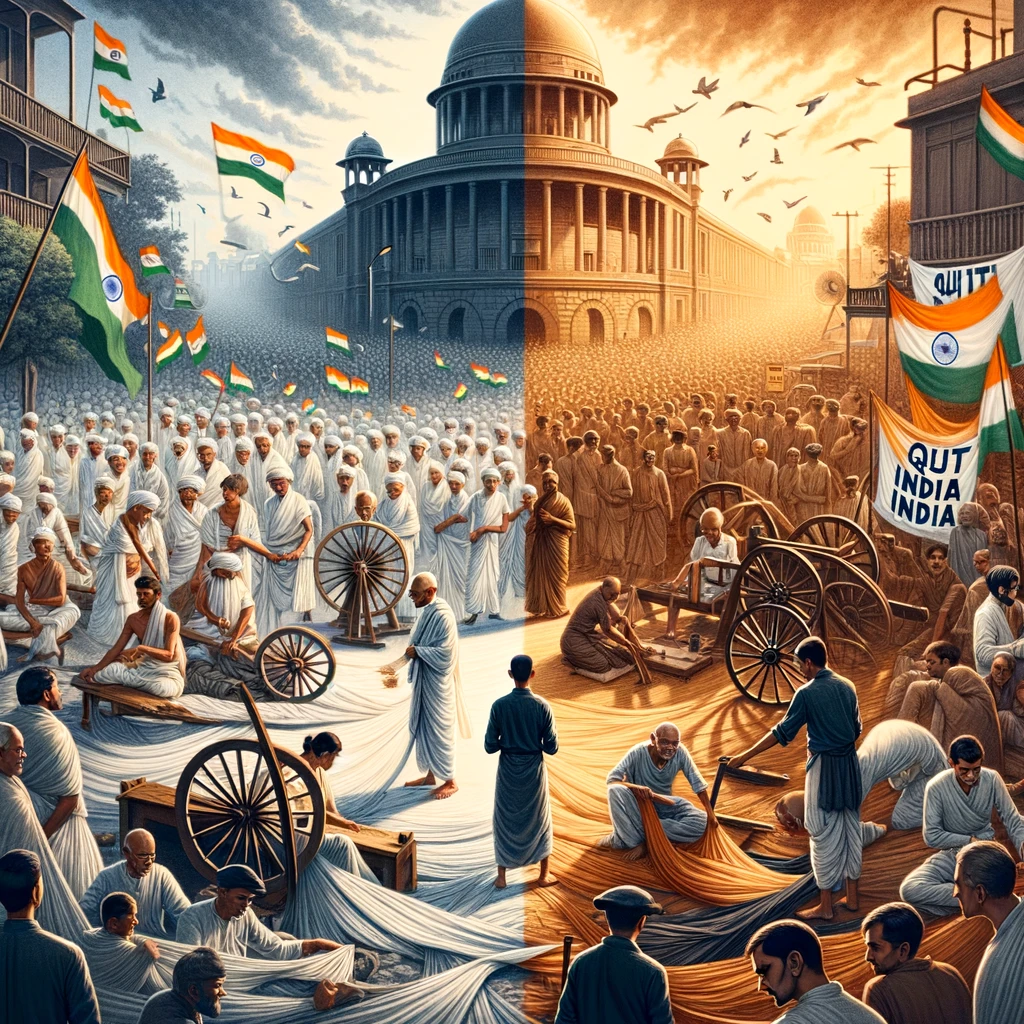
Three options. Mass force — available, politically unaffordable. Negotiation — available, strategically catastrophic. Continued waiting — available and failing.
Gandhi’s Second Unanswered Question has an answer: the British had no clean path in February 1922. They were not about to win. The movement was building. The administration was straining. Every tool available carried a cost that made using it a form of British defeat.
The suspension removed all three dilemmas simultaneously. The British did not need to choose between them. The movement that was building dissolved before any choice was required. The administration that was straining recovered within weeks. Twenty-six days after the suspension, they arrested Gandhi from a position of complete safety — something they had not dared attempt for seventeen months.
The counterfactual strengthens the thesis. Not weakens it.
The Defence — and Its Limit
Gandhi’s defenders have a serious argument and it must be stated seriously. Chauri Chaura was real. Twenty-two policemen died. The crowd that burned the police station was not an abstraction — it was a specific act of violence that Gandhi had built his entire movement’s moral authority on refusing to condone. Continuing after Chauri Chaura would have required Gandhi to either ignore the violence or redefine what non-cooperation meant. Either choice would have compromised the only thing that gave his instrument its power — its non-violent character. Without that character, the movement was just another uprising. The British knew how to manage uprisings.
This argument is not wrong. Gandhi’s commitment to non-violence was genuine. The suspension was not fabricated. The principled basis for it was real.
But the defence has a limit.
A man can act from genuine moral conviction and produce an outcome that serves his adversary perfectly. The two are not mutually exclusive. Gandhi’s Second Unanswered Question does not require him to have been calculating. It requires only that the arithmetic be read.
The arithmetic: at the moment of maximum British vulnerability, with no clean option available to the colonial administration, Gandhi’s genuine moral conviction dissolved the threat. The British paid nothing for what they received. The movement that had cost them seventeen months of documented strain was ended without a negotiation, without a concession, without a single British commitment.
The seller set the price at zero — with or without knowing that the price of zero is not actually zero and will put the seller into perpetual debt. The seller was Gandhi.
Whether he intended this outcome is unprovable. That it was the outcome is documented. This series does not prosecute intention. It prosecutes the arithmetic.
It also prosecutes the asymmetry. In April 1919, British troops enclosed thousands of unarmed Indians in a walled garden on Baisakhi and opened fire. Among the documented dead: Hassan Mohammad of Gujranwala, nine years old, student. Sohan Lal of Amritsar, nine years old, student. Gandhi did not fast. He did not stop the movement. He used the massacre as the moral foundation for everything that followed.
In November 1921, Indians clashed with Indians in a commercial district in Bombay. Gandhi fasted for five days.
The principle that did not activate for Jallianwala activated for Chauri Chaura. The prosecution does not characterise this asymmetry. It records it.
He demanded total sacrifice from the masses, then invalidated that sacrifice to protect a principle that only seemed to activate when the British were losing. The currency he used to set the price at zero was the spent lives and broken careers of his followers.
The Question That Remains
Gandhi’s Second Unanswered Question is not actually unanswerable. The counterfactual is clear. Without the suspension, the British faced three costly options simultaneously. With the suspension, they faced none.
What remains — what Gandhi’s defenders have never addressed satisfactorily — is not whether the suspension was principled. It was. The question is why a principled act consistently produced outcomes that served the adversary and cost the movement’s participants everything.
The record contains one data point that the defence has never explained. In April 1919, British troops enclosed hundreds of unarmed Indians inside the Jallianwala Bagh — a walled garden with one exit — and opened fire. At lease 489 under teens, women and other people died. They had assembled to celebrate Baisakhi. Gandhi did not fast. He did not stop the movement. He used the massacre as the moral foundation for everything that followed.
The series does not characterise this asymmetry. It places it before the reader.
British troops killing hundreds of unarmed civilians at Baisakhi — no fast.
Indians clashing with Indians in a commercial district — five days without food.
Gandhi’s principled commitment to non-violence is not in dispute. What is in dispute is the question his defenders have never answered: why did that commitment activate against Indian violence and not against British violence? And what did that selective activation produce — for the British, and for the Indians who paid the price of the movement he continued after Jallianwala and dissolved after Chauri Chaura?
Chauri Chaura 1922 — principled suspension, 172 defendants sentenced, movement dissolved at peak, zero concession extracted.
The same pattern would repeat nine years later in the Irwin Pact. But that is another story.
The principle was consistent. The outcome was consistent. The beneficiary was consistent.
Gandhi’s Second Unanswered Question is not what would have happened if he had not suspended. That answer is in the three British options and their costs. The question that remains is the one underneath it: if the principle consistently produced this outcome, and the man holding the principle was intelligent enough to know what he was doing — what does the consistency mean?
This series does not answer that question. It places the arithmetic before the reader. The reader will complete the sentence.
The British had no clean answer in February 1922. Three options — mass force, negotiation, continued waiting — each carried a cost the administration was not prepared to pay. Gandhi’s genuine moral conviction dissolved the threat before any of those costs was incurred. The principle was real. The outcome was documented. The price was paid by the tens of thousands who came out of jail to a movement that no longer existed.
Feature Image: Click here to view the image.
Videos
Glossary of Terms
- Non-Cooperation Movement: A mass civil resistance movement led by Mahatma Gandhi (1920–1922) urging Indians to withdraw from British institutions.
- Swaraj: A central demand meaning complete self-rule or independence from British colonial authority.
- Chauri Chaura Incident: A 1922 violent clash in which a mob killed 22 policemen, prompting Gandhi to suspend the movement.
- Jallianwala Bagh Massacre: The 1919 killing of unarmed civilians in Amritsar by British troops, a turning point in India’s freedom struggle.
- Counterfactual Analysis: A method of examining “what if” scenarios to test historical arguments and outcomes.
- Strategic Uncertainty: A condition where decision-makers lack clarity about outcomes, limiting effective response options.
- Mass Force Doctrine: Use of overwhelming military power (e.g., 1857-style suppression) to crush civilian resistance.
- Dominion Status: A form of partial independence within the British Empire with self-governance but allegiance to the Crown.
- Montagu-Chelmsford Reforms: Constitutional reforms (1919) introducing limited self-governance in India.
- Coalition Fragmentation: The breaking apart of a united political movement into smaller, less effective groups.
- Moral Authority: Legitimacy derived from ethical principles, especially non-violence in Gandhi’s strategy.
- Asymmetry (Moral/Strategic): Unequal application of principles or responses, highlighted between British and Indian violence.
- Administrative Strain: Pressure on colonial governance systems due to widespread non-compliance.
- Selective Activation (Coined Term): The pattern where moral principles are applied inconsistently across similar situations.
- Zero-Concession Outcome (Coined Term): A situation where a movement ends without extracting any political gain from the opponent.
#Gandhi #FreedomStruggle #IndianHistory #NonCooperation #ChauriChaura #JallianwalaBagh #BritishRaj #Swaraj #ColonialIndia #History #Politics #HinduinfoPedia
Scan Through The Entire Series
Gandhi’s Peace Efforts: The Questions Before the Mahatma (0)
Read The Prosecution Exhibits Through Links