Gandhi’s Complicity Test: Five Exhibits, One Pattern, One Question (52)
भारत / GB
Part 52: Mahatma Gandhi’s Peace Efforts | Series Index
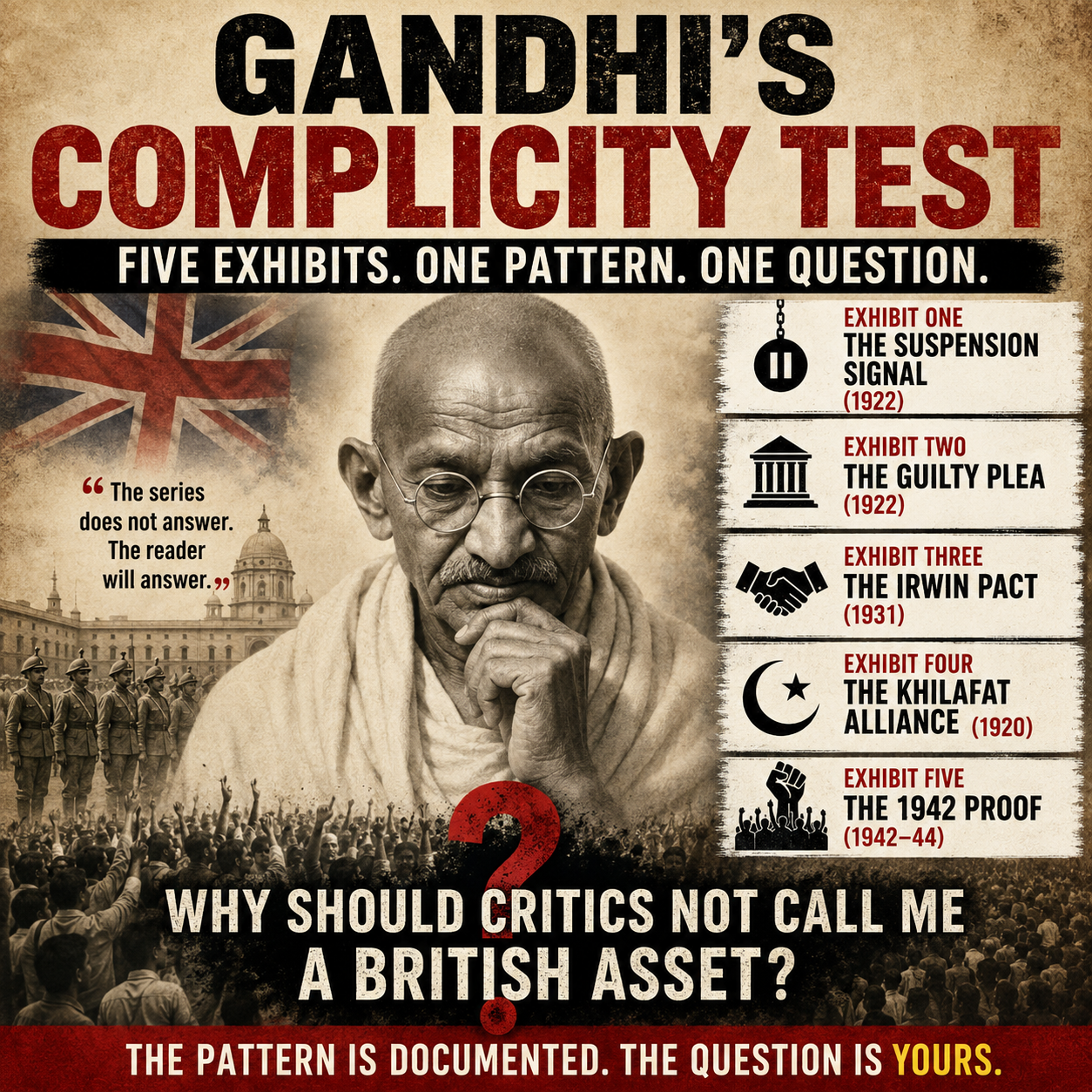
Blog 51 documented two acts of legitimisation — the guilty plea of 1922 and the Irwin Pact of 1931 — through which Gandhi confirmed British colonial authority rather than challenged it. This post does not add a sixth exhibit. It places the five most documented exhibits before the reader simultaneously — and asks the question the accumulated pattern raises on Gandhi’s Complicity Test verification. The series does not answer the question. Gandhi never asked it. The reader will ask it now.
Thank you for reading this post, don't forget to subscribe!SYNTHESIS
The Question the Series Has Not Asked
Gandhi’s Complicity Test is not a verdict. It is a method — the method of placing documented acts side by side and asking whether their pattern is consistent with the stated purpose.
The series has stated its prosecutorial standard from the beginning: no assertion of motive, no claim of conspiracy, no characterisation beyond what the documented record establishes. The arithmetic is placed before the reader. The reader completes the sentence.
Gandhi’s Complicity Test applies that standard to its most concentrated form. Five exhibits. One pattern. One question that the series frames — as Gandhi himself might have framed it, if he had examined his own record honestly.
The Five Exhibits
Exhibit One — The Suspension Signal
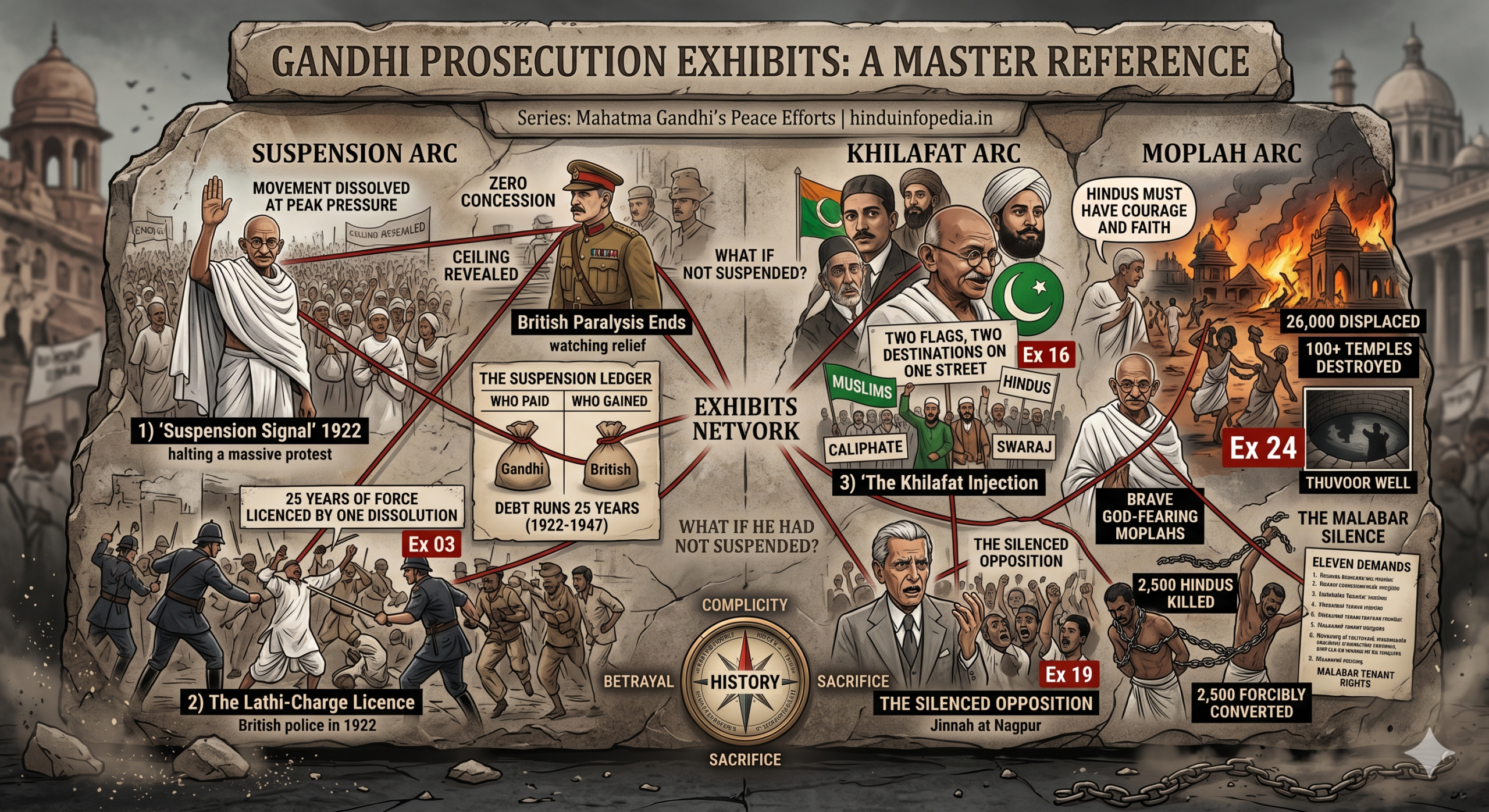
February 12, 1922. The movement at maximum pressure. The British with no clean answer. Gandhi suspended without extracting a single concession, without consulting the Congress Working Committee, without conditions, without caring for likely consequences given the historical record of the British. The British administration’s seventeen months of paralysis ended in twenty-six days. The thirty thousand in jail received nothing. Gandhi’s authority grew — demonstrated above the institution’s capacity to refuse, above the movement’s capacity to continue without him.
Beneficiary column: British administration received the answer that had been constraining their conduct post mass killing in Jallianwala Bagh. Gandhi received enhanced unilateral authority. The movement’s participants received nothing.
Exhibit Two — The Guilty Plea
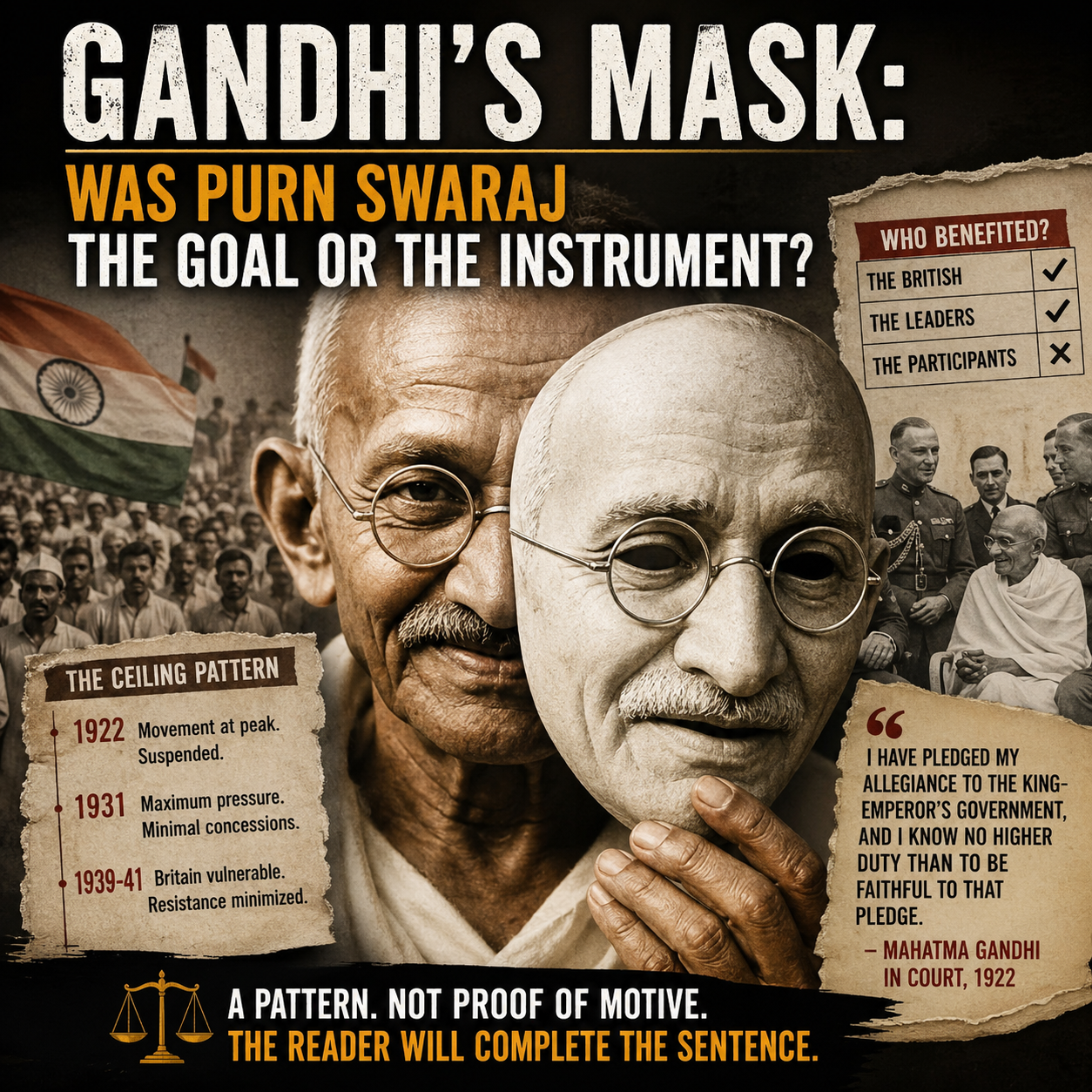
March 18, 1922. Six weeks after dissolving the movement that boycotted British courts as illegitimate, Gandhi stood before Judge Broomfield, accepted the court’s jurisdiction, and pleaded guilty to sedition under Section 124A. He told India British courts had no authority over Indians. He submitted to one. Bhagat Singh denied the court’s right to try him. Gandhi submitted and called the submission a sacrifice while preaching just contrary to his own stand for 17 months.
Beneficiary column: British court received procedural legitimacy from the independence movement’s most prominent defendant. Gandhi received martyrdom status and a celebrated speech. The movement received nothing — it had been dissolved six weeks earlier.
Exhibit Three — The Irwin Pact
March 5, 1931. Sixty thousand in jail. The strongest hand any Indian leader had held. Gandhi signed without consulting the Congress Working Committee — without mandate from the organisation he represented, let alone the Indian population whom the signature impacted. Not one of eleven demands met in full or to any measurable or enforceable extent. Gandhi explicitly told Irwin the Bhagat Singh commutation had no connection with the negotiation further legitimisation of British courts authority. Bhagat Singh was hanged eighteen days later.
Beneficiary column: British administration received the suspension of the most powerful movement in colonial history at its peak and Congress participation in the Round Table Conference. Gandhi received Time magazine’s Man of the Year and recognition as equal of the Empire. The movement’s participants received the consequences.
Exhibit Four — The Khilafat Alliance [Read More About Why]
September 1920. Gandhi allied the independence movement with pan-Islamic political mobilisation to acquire numerical mass. Gandhi’s Silenced Opposition — voices that warned but were prevented from altering the course. He announced the movement on the day Tilak died. The alliance consolidated Muslim political identity at mass scale for the first time. When the alliance collapsed, the consolidated identity was inherited by Jinnah. Pakistan followed. Death of millions of Hindus and Sikhs and lakhs of Muslims dying in the crossfire was the simultaneous outcome.
Beneficiary column: Gandhi received the numerical mass the reservoir required. The British received the communal division that made a unified India impossible to govern without them. It further resulted in division of India and later silently and illegally helped Pakistan to capture Gilgit Baltistan. The communities downstream received Partition.
Exhibit Five — The 1942 Proof
August 1942 to May 1944. The uprising without Gandhi’s ceiling — 1,008 documented deaths, the most serious rebellion since 1857. The British suppressed it with maximum force. Then released Gandhi before his sentence ended. Negotiated through his Congress at Simla 1945. Transferred power through his framework via the Mountbatten Plan 1947. Called him the greatest citizen of India.
Beneficiary column: The British chose the partner whose movements they could manage over the forces they could not. Gandhi’s framework received the transfer of power. The 1942 dead received no memorial in the standard account.
The Pattern
Gandhi’s Complicity Test places the five beneficiary columns side by side:
Five acts. Five times the British administration received what it needed. Five times Gandhi’s authority was preserved or enhanced. Five times the Indian freedom movement, the movement’s participants — the thirty thousand, the sixty thousand, the communities of Partition, the 1942 dead — paid the price.
The series does not assert this pattern was designed. It does not claim Gandhi was a British agent. It does not require conspiracy.
It claims the pattern is visible, documented, and consistent across five acts spanning twenty-five years. A pattern that consistent — produced by the most politically sophisticated actor in Indian public life across four decades — invites one question.
The Question Gandhi Never Asked
Gandhi was a man of documented self-examination. He fasted for his own failures. He wrote about his experiments with truth. He examined his celibacy, his diet, his relationship with his sons, his conduct toward his wife. He examined himself in public, at length, with apparent honesty.
He did not examine his beneficiary column.
He did not ask — in any document the series has found across fifty-one blogs — why every act of his career produced the same three outputs: partial delivery, if at all, to those who paid, protection of those who organised, enhancement of his own authority.
The Questions Gandhi Did Not Ask
- He did not ask why the British administration consistently received what it needed from his choices.
- He did not ask why the communities downstream consistently paid for his decisions.
- He did not ask what it meant that the British released him before his sentence ended, negotiated through his framework, and transferred power through his Congress — while the men who actually forced that transfer, the 20,000 sailors of the Royal Indian Navy mutiny of February 1946, were persuaded to surrender by Gandhi’s own Congress and court-martialled for the act that produced independence.
- He did not ask why the movement that made the British announce the Cabinet Mission the very next morning was suppressed not by the British alone but with the active assistance of the Congress leadership he had installed.
- He did not ask what it meant that the men who produced independence were dismissed from service while the man who managed resistance received the credit.
The series has documented his operating method across fifty-one blogs. He was the most politically sophisticated actor in Indian public life — not only in 1920 but consistently across four decades, from the Natal Indian Congress in 1894 to his final fast in January 1948. A man of that sustained sophistication, whose pattern produced these five consistent outputs, could have asked the question.
He did not.
Gandhi’s Complicity Test is the question he never asked — stated here as he might have stated it, if he had examined his own record with the honesty he claimed to apply to everything else:
Why should critics not call me a British asset?
The Series Does Not Answer
Gandhi’s Complicity Test does not answer the question it places before the reader. The series has maintained its prosecutorial standard across fifty-two blogs: no assertion of motive, no claim of conspiracy, no characterisation beyond the documented record.
The question is placed before the reader because the documented record raises it — not because the series has answered it.
A sophisticated man like Mahatma Gandhi can produce outcomes consistently beneficial to his adversary across twenty-five years through sincere conviction, through a moral framework whose consequences he did not foresee, through political miscalculation at every critical juncture, through the structural limitations of non-violence as a method against an adversary without conscience.
Or through something else.
The series does not name the something else. It places five exhibits, one pattern, and one question before the reader.
The reader will supply the answer.
Five exhibits. Five beneficiary columns reading the same. The most politically sophisticated actor in Indian public life for four decades. The question he never asked: why should critics not call me a British asset? The series does not answer. The reader has the exhibits. The reader will answer.
Feature Image: Click here to view the image.
Videos
Glossary of Terms
- Gandhi’s Complicity Test: A phrase coined in this series describing the method of placing Gandhi’s documented political actions side by side to examine whether their repeated outcomes matched his publicly stated objectives.
- Beneficiary Column: A recurring analytical framework in the series identifying who materially or politically benefited from a particular political decision or event.
- Irwin Pact: The 1931 agreement between Mahatma Gandhi and Lord Irwin that ended the Civil Disobedience Movement and enabled Congress participation in the Round Table Conference.
- Section 124A: The sedition provision of the Indian Penal Code under British rule, used to prosecute anti-colonial political activity including Gandhi’s 1922 trial.
- Congress Working Committee (CWC): The highest executive decision-making body of the Indian National Congress during the freedom movement.
- Khilafat Alliance: Gandhi’s political alignment with the Khilafat Movement in 1920 to expand anti-British mobilisation through pan-Islamic participation.
- Pan-Islamic Mobilisation: Political mobilisation based on broader Islamic solidarity beyond national boundaries, particularly around the Ottoman Caliphate issue after World War I.
- Royal Indian Navy Mutiny: The February 1946 naval uprising involving thousands of Indian sailors against British authority, viewed by some historians as a major pressure point preceding British withdrawal.
- Round Table Conference: A series of conferences held in London between 1930 and 1932 to discuss constitutional reforms and India’s political future under British rule.
- Mountbatten Plan: The 1947 British transfer-of-power framework proposed by Lord Mountbatten that led to the Partition of India and creation of Pakistan.
- Procedural Legitimacy: Recognition or acceptance of an institution’s authority through participation in its legal or administrative process.
- Prosecutorial Standard: The declared method used in this series of restricting claims to documented records without asserting motive, conspiracy, or undocumented intent.
- Suspension Signal: A coined phrase in the series referring to Gandhi’s abrupt suspension of the Non-Cooperation Movement in February 1922 at its peak mobilisation stage.
- Jallianwala Bagh Massacre: The 1919 mass shooting in Amritsar where British troops under General Dyer fired on unarmed civilians, becoming a defining event in the Indian independence movement.
- Purn Swaraj: Meaning “complete self-rule,” the Indian National Congress declaration in 1930 demanding full independence from British rule rather than limited dominion status.
#Gandhi #MahatmaGandhi #FreedomStruggle #IndianHistory #Congress #BritishRaj #Partition #BhagatSingh #Khilafat #Swaraj #Colonialism #HinduinfoPedia