
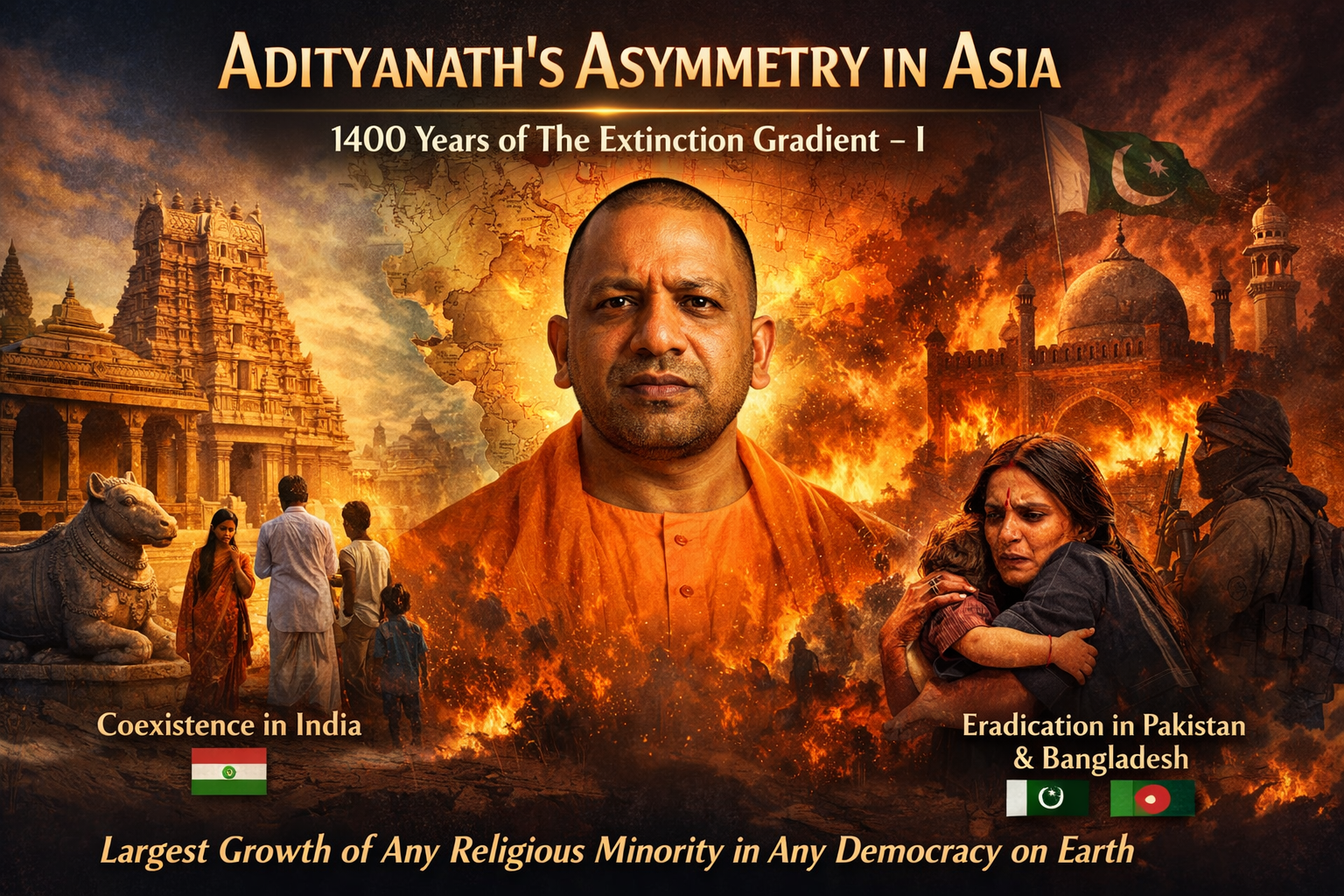
Adityanath’s Asymmetry in Asia — 1400 Years of The Extinction Gradient-I
भारत/ GB
The Question That Crossed Borders
When Uttar Pradesh Chief Minister Yogi Adityanath asked, “A Muslim family is safe among 100 Hindu families — but can 50 Hindu families be safe among 100 Muslim families?” — Indian media called it communalism. Indian courts called it polarisation. Indian academics called it hate speech. Across this series, we tested the question against 14 centuries of Indian history — from Arab traders in Kerala who thrived under Hindu kings to the Sultanate’s systematic jizya and temple destruction, from the Mughal-era safety asymmetry where Muslim minorities prospered in Hindu kingdoms while Hindu majorities faced persecution under Muslim rule, from Partition’s demographic annihilation to the modern-day collapse in Kairana, Mewat, and Malda. Every century confirmed the Adityanath’s Asymmetry in Asia. But if this were only an Indian phenomenon — a product of subcontinental politics, of Hindu-Muslim proximity, of colonial distortion — it would be containable. It would be local.
Thank you for reading this post, don't forget to subscribe!It is not local. The pattern holds globally. And this concluding analysis proves it.
To understand why this question resonates, we must first look at the Asian laboratory. Here, the ‘Adityanath’s Asymmetry in Asia’ is not a theoretical risk but a historical ledger. Across the Indian subcontinent, we see the results of a 14-century experiment: where the Dharmic majority held, the ‘other’ thrived; where the exclusivist doctrine gained sovereignty, the ‘other’ was erased. This section audits the Extinction Gradient across Afghanistan, Pakistan, and Bangladesh, revealing how the ‘Will to Eliminate’ operates when unchecked by state or civilisational resistance.
Here are the specific additions to bridge your content and frame Part I: Adityanath’s Asymmetry in Asia.
Series Archive: Yogi Adityanath’s Asymmetry Thesis
From Sharia & Stark Realities to Local Majority Dynamics—Catch up on the full investigation:
- Part I: The Civilizational Context Behind the Statements
- Part II: Hindu Safety vs. Muslim Safety: The Core Formulation
- Part III: Historical Evidence: Early Islamic Encounters
- Part IV: Political Islam vs. Sanatan Dharma: Lessons from the Mughals
- Part V: Partition’s Demographic Catastrophe: The Statistical Proof
- Part VI: Local Majority Dynamics Analysis: The Tipping Point
The Minority-Status Paradox: When Demographics Constrain Doctrine
The first global pattern to establish is what we term the minority-status paradox: Muslim populations living as small minorities in non-Muslim majority societies are overwhelmingly peaceful, productive and integrated. This is not disputed. It is observable.
In the UAE, a Hindu population of approximately 2 million — roughly 20% of residents — runs businesses, builds temples, and celebrates Diwali openly. Abu Dhabi hosts the BAPS Hindu Mandir, the largest Hindu temple in the Middle East. Qatar hosts Hindu workers who constitute a significant share of the labour force without communal incident. Singapore’s Muslim minority of approximately 15% coexists within a secular state framework that permits no communal assertion by any group.
These examples are routinely cited to counter Yogi Adityanath’s formulation. The argument runs: “See — Muslim minorities are peaceful. The question is bigoted.”
But this argument misses a critical distinction between Constitutional Democracy, Islamized Democracy, and Autocracy. In the UAE or Qatar, peaceful coexistence is a top-down mandate enforced by an absolute ruler; it is transactional and depends entirely on the ruler’s whim rather than a societal doctrine of pluralism.
The danger arises when the demographic balance shifts within a Democracy. Unlike a Dharmic democracy, where the majority’s pluralistic framework protects the minority, an ‘Islamized Democracy’ eventually reflects the exclusivist preferences of the shifting majority. Once a demographic threshold is crossed, the democratic process itself is used to make Sharia-influenced governance politically viable.
In these cases, the safety of the community is no longer guaranteed by a constitution, but becomes subject to the ‘Will of the Ruler.’ History provides two chilling proofs of how administrative capture alters minority safety:
-
The Bengal Precedent (1946): In British India, Bengal was the only province where a Muslim League government held power. It was precisely under this administrative cover that the Great Calcutta Killings and the Noakhali Genocide were orchestrated. When the administrative ‘Will’ is aligned with exclusivist doctrine, the state does not protect; it facilitates.
-
Modern London (2019–Present): In a modern democratic context, we see the same mechanism. Under the leadership of Mayor Sadiq Khan, London has seen instances where radicalized mobs were permitted to attack the Indian High Commission, with police intervention being notably delayed or constrained. When demographic shifts lead to the capture of municipal or state offices, ‘Law and Order’ becomes selective, and minority institutions become targets.
These examples prove that once the demographic balance shifts, the ‘Protection of the Law’ is replaced by the ‘Will of the Majority-Influenced Governance.’ The safety of the community is then no longer a right, but a variable subject to whether the new majority decides to coexist or—as these precedents suggest—to facilitate elimination.
The fundamental difference lies in the source of safety. In the UAE or Qatar, a Hindu’s safety is transactional—contingent on their utility to an authoritarian state. In India, a Muslim’s safety is civilizational—guaranteed by a Hindu-majority ethos that views the ‘other’ as a valid path to truth.
When state power is removed, the Hindu-majority society continues to protect because its doctrine is pluralistic; conversely, when the state constraint is removed or the demographic shifts in a Muslim-majority area, the governance reverts to the default Sharia hierarchy.
The answer is available.
It is available in Afghanistan. In Pakistan. In Bangladesh. In Nigeria’s northern states. In Egypt. In Iran. In Turkey. And now, increasingly, in the suburbs of European democracies.
The Extinction Gradient: What Happens to Non-Muslims Under Muslim Governance
As documented in our Sharia, Safety and Stark Realities analysis, the doctrinal framework is not ambiguous.
Sharia jurisprudence — derived from the Quran, Hadith, and scholarly consensus — creates a sharp hierarchy for non-believers. While ‘People of the Book’ (Christians and Jews) may be categorised as dhimmis—tolerated residents subject to jizya and subordinate status—the framework for Mushrikeen (polytheists/Hindus) is far more absolute.
Under the strict interpretation of the Four Schools of Jurisprudence (Madhabs), Mushrikeen historically faced a binary choice: conversion or the sword.
While some later Islamic rulers in India pragmatically extended a version of jizya to Hindus to ensure tax revenue, the core doctrinal framework remains one where the ‘right to live’ for a polytheist is not a given, but a concession.
In the Indian subcontinent, the ‘convert or perish’ mandate for polytheists was never fully realized, not due to the tolerance of the invaders, but because they could not implement it. Despite centuries of mass killings and systemic torture, the invaders were met with an unparalleled Heroic Tolerance—the iron will of Hindus and Sikhs to endure the furnace, the saw, and the sword rather than surrender their Dharma.
The extens ion of jizya to Hindus was, therefore, a forced pragmatic concession necessitated by the failure of the doctrine to break Indian civilizational resistance. The ‘right to live’ was not a gift from the ruler; it was a hard-won victory of endurance by a people who preferred the pain of the martyr over the ease of conversion. This is the root of the Asymmetry: one side’s will to eliminate was checked only by the other side’s super-human will to endure.
Progressive Muslim scholars challenge this framework, but they remain marginal — as reflected in the near-absence of Muslim-majority nations that have implemented pluralistic governance.
The extinction gradient across Muslim-majority nations follows a remarkably consistent trajectory.
Afghanistan
Hindu-Sikh population: approximately 700,000 in the 1970s. By 1992: approximately 220,000. By 2021: fewer than 50 Hindus remained — all male, families already evacuated. Under Taliban rule, Sikhs and Hindus are forced to dress as Muslims, banned from celebrating festivals publicly, and their temples have been attacked repeatedly — including the 2020 IS-K assault on a Kabul Sikh temple that killed 25 worshippers. A 2024 US State Department report confirmed that remaining Hindus and Sikhs feared persecution and mistreatment under Taliban rule. The trajectory: from 700,000 to under 50 in five decades. That is not decline. That is civilisational erasure.
Pakistan
While the immediate drop in the Hindu population of West Pakistan from approximately 14% to 1.6% between 1947 and 1951 was accelerated by the Partition exodus, the long-term trend reveals a deeper intent. In 1947, combined Pakistan (East and West) was nearly 23% non-Muslim. Today, that figure has been hollowed out to roughly 3%. In contrast, India’s Muslim population has grown from approximately 9.8% in 1951 to over 15% today.
This divergence is the definitive ‘Partition Experiment’ result: it proves that while the Hindu majority chose to expand the space for minorities through constitutional secularism, the neighbors utilized state-sanctioned exclusion, forced conversions, and social pressure to systematically eliminate theirs. By the 2023 census: 2.17% — approximately 5.2 million, concentrated almost entirely in Sindh. Hudson Institute’s comprehensive analysis documents the decline from 23% to approximately 3-4% across all non-Muslim minorities. Forced conversions — particularly of Hindu and Christian girls in Sindh — remain widespread as of 2025. Farahnaz Ispahani, former media advisor to Pakistan’s President, has described this as a “slow genocide.”
🔍 Deep Dive: The Data Behind the Shift
How did India’s Muslim population grow by nearly 60% in demographic share while neighboring non-Muslim populations collapsed? Explore the full statistical breakdown, global fertility comparisons, and the socio-cultural drivers of this transformation.
Bangladesh
Hindus constituted approximately 28-31% of East Pakistan at Partition. After the 1971 Liberation War — in which Hindus were systematically targeted — the proportion fell to approximately 13.5%. By the 2022 census: 7.95%. A decline from nearly a third to under a twelfth in seven decades.
The Indian counter-data
The Indian Counter-Data: Coexistence vs. Elimination: In the same period, India’s Muslim population grew from 9.8% in 1951 to 14.2% in the last official Census (2011). As of 2026, while we await the next official Census, statistical projections—including the 2024 EAC-PM (Economic Advisory Council to the Prime Minister) report and Pew Research—estimate this share has reached 15.5–17%. This represents the largest growth of any religious minority in any democracy on earth.
This creates a 14-century validation found in a stark contrast of “wills.” Under the Dharmic Will of the majority in India, the minority flourishes because the doctrine mandates pluralism. Under the Exclusivist Will in Pakistan and Bangladesh, the Hindu population has been systematically hollowed out—not by accident, but by a consistent intent to eliminate through exodus, forced conversion, and systemic “slow genocide.”
The Partition experiment provides the final verdict: Three nations carved from the same soil, but with two opposite trajectories. One pattern expands the “other”; the other erases them. Yogi Adityanath’s question is not communal; it is an empirical observation of these two competing wills.
The Nehru Series: Normalising Civilisational Surrender
Exposing the Historiography of Omission — Previous Blogs:
- •
Shaping Indian Historiography: The Nehru Narrative - •
Intentional Omissions: The Mathura Massacre - •
The Portrayal of Muhammad Ghori: Omissions Analyzed - •
Glorifying Invaders: The ‘Vigorous and Virile’ Myth
Extended Policy & Legacy Analysis:
Evidence of Adityanath’s Asymmetry in Asia Thesis
The hollowing out of minorities across our borders is the definitive verdict of the ‘Partition Experiment.’ Yet, for decades, this reality was masked within India by a historiography of omission. As seen in our Nehru Series, the founding narratives of post-independence India sought to normalise civilisational surrender by ignoring the very doctrinal patterns that were erasing Hindus next door.
However, the data can no longer be contained within South Asian borders. If the Asian ‘Extinction Gradient’ is a product of history, then how do we explain the identical patterns emerging in the most advanced secular democracies on earth? In the next part of this series, we move from the borders of Bharat to the streets of Stockholm, New York, and Sydney to prove that the Adityanath’s Asymmetry in Asia is not a local peculiarity, but a global law of demographic shift.
Continue to Part II: Adityanath’s Asymmetry in Western Democracies — The Global Tipping Point.
Navigating Three Part Series: Part I | Part II | Part III
Series Navigation: ← Previous: Local Majority Dynamics Analysis: Yogi Adityanath’s Tipping Point (1947-2025) — Part II
Feature Image: Click here to view the image.
Videos
Glossary of Terms
Previous Blogs of the Series:
- https://hinduinfopedia.in/yogi-adityanath-the-civilizational-context-behind-his-most-controversial-statements/
- https://hinduinfopedia.in/yogi-adityanath-on-hindu-safety-vs-muslim-safety/
- https://hinduinfopedia.in/yogi-adityanath-on-coexistence-historical-evidence-early-islamic-encounters/
- https://hinduinfopedia.org/political-islam-vs-sanatan-dharma-yogi-adityanaths-lessons-from-mughals/
- https://hinduinfopedia.org/partition-demographic-catastrophe-yogi-adityanaths-statistical-proof-1800-1947/ https://hinduinfopedia.in/?p=24644
- https://hinduinfopedia.in/yogi-adityanaths-local-majority-dynamics-analysis-ii/ https://hinduinfopedia.org/?p=19344
Follow us:
- English YouTube: https://www.youtube.com/@Hinduofficialstation
- Hindi YouTube: https://www.youtube.com/@HinduinfopediaIn
- X: https://x.com/HinduInfopedia
- Instagram: https://www.instagram.com/hinduinfopedia/
- Facebook: https://www.facebook.com/Hinduinfopediaofficial
- Threads: https://www.threads.com/@hinduinfopedia
[Short URL https://hinduinfopedia.in/?p=25211]