
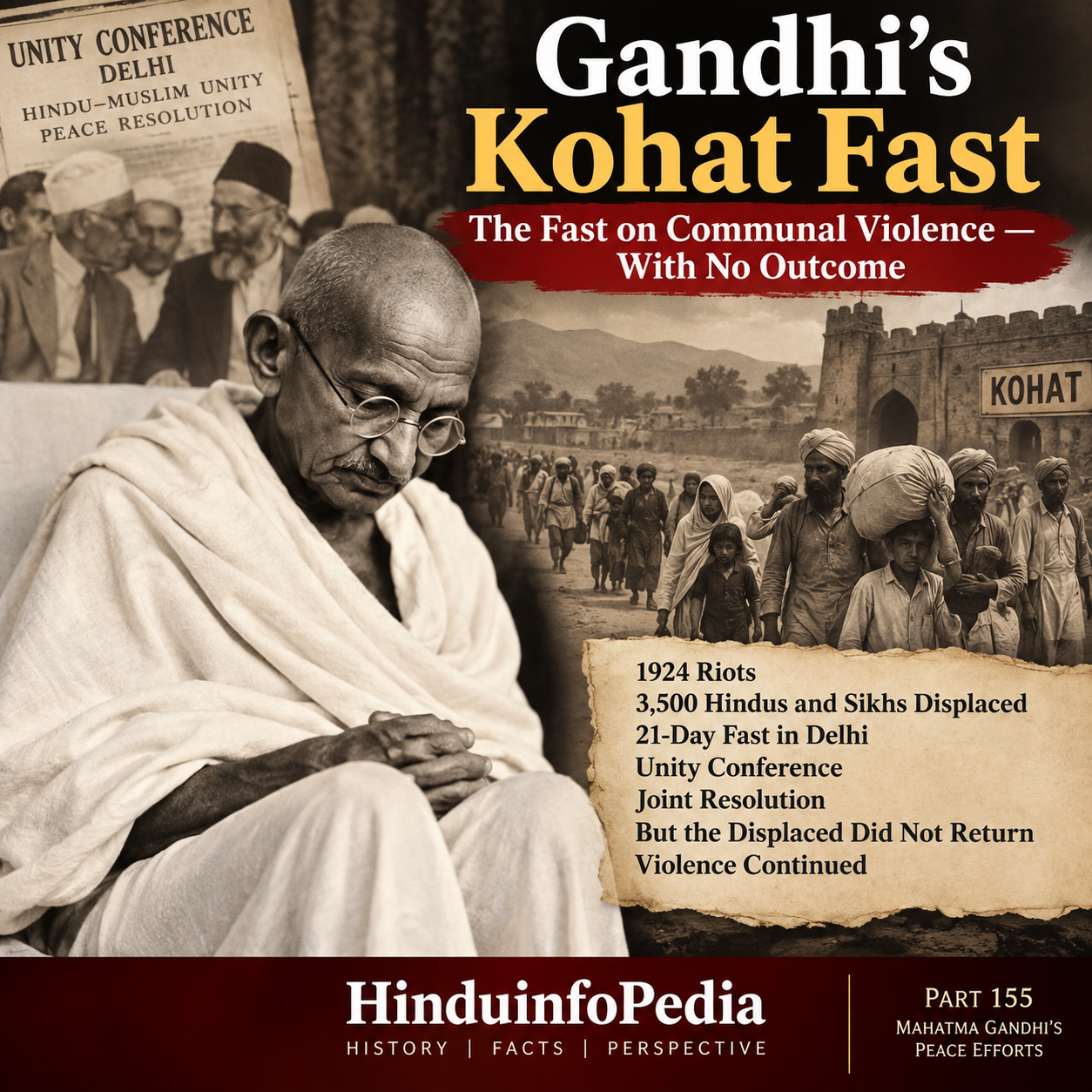
Gandhi’s Kohat Fast: The Fast on Communal Violence — With No Outcome (155)
भारत / GB
Part 155: Mahatma Gandhi’s Peace Efforts | Series Index
The Khilafat arc — established across Blogs 102-152 of this series (The Caliphate and The Khilafat Movement, Khilafat Movement Prosecution Exhibit, The 1922 Suspension Analysis, The Mechanics of Movement, The Settlement Arithmetic, The Khilafat Consequences, The August Episodes, The Asymmetry Arc)— placed the documented consequences of the Khilafat compact before the reader: the documented riot cascade, the Moplah rebellion, the documented communal dispersal. This post, Gandhi’s Kohat Fast, places Gandhi’s documented first major fast on communal violence before the reader — the Kohat fast of September 1924 — and what the documented instrument produced.
Thank you for reading this post, don't forget to subscribe!The Documented Context — September 1924
Gandhi’s Kohat Fast places the documented context of September 1924 before the reader. The Khilafat compact had collapsed in March 1924 when Atatürk abolished the Caliphate — established in Blog 148 of this series. The documented communal landscape Gandhi’s Khilafat-Non-Cooperation platform had left behind was documented in Blog 80 of this series: the documented riot cascade, the documented communal dispersal, the documented fracture between the communities the compact had documented as unified.
The Kohat riots of September 9-11 1924: documented communal violence in Kohat, North-West Frontier Province. The prosecution places the documented sequence before the reader — beginning with what the standard narrative frequently omits: a documented provocation that preceded Jiwan Das’s documented response by three months.
May 1924: A Muslim-run periodical in the Frontier region named Lahaul published documented verse inciting physical action against the documented Hindu minority: “We shall have to burn the Gita of Kirars. We shall break the flute of Krishna. O Muslims! You will have to take up the sword and destroy the existence of Kirars and burn their goddesses.” The documented Hindu community’s response: documented community anger, no documented organised riot, no documented demographic expulsion.
August 1924 (Krishna Janmashtami): Jiwan Das, Secretary of the Sanatan Dharma Sabha, published Krishan Sandesh — a documented retaliatory pamphlet responding to the documented Lahaul verse, containing a documented retaliatory composition sourced from Jammu. Even after Jiwan Das was arrested under documented IPC Sections 153A and 505 and the documented Hindu Sabha issued a documented apology, local documented Muslim elders took a documented “oath of divorce” (talaq) vowing not to cohabit with their wives until revenge was exacted. When Jiwan Das was released on bail on September 8 and ordered to leave the district, local documented clerics announced he had been “let off” — triggering the documented September 9-11 mob action that completely expelled 3,500 documented Hindus and Sikhs from Kohat.
The documented asymmetry of response: when the documented Muslim leadership objected to Krishan Sandesh, the documented response was a documented ultimatum, documented oath of talaq taken by documented agitators, documented mass clerical sermons, and documented demands on the documented British administration. Even after Jiwan Das publicly apologised, was arrested, and was escorted out of the documented district for his documented safety — local documented clerics declared he had been “let off.” The documented mob mobilised. September 9-11 1924: 3,500 documented Hindus and Sikhs were completely expelled from documented Kohat. The documented Hindu and Sikh community did not return to documented Kohat for months.
Gandhi was in Delhi when the Kohat riots occurred. He announced his documented fast on September 17 1924 — at the documented home of Maulana Mohammad Ali in Delhi. The documented location is itself a documented exhibit: Gandhi fasted at the home of the documented Khilafat leader whose documented movement the series has placed before the reader across the Khilafat arc. Mohammad Ali was the documented primary organiser of the documented Khilafat-Non-Cooperation compact of 1920 — the documented movement whose documented organisational presence in Malabar is documented as connected to the documented Moplah rebellion of 1921, established in Blog 64 of this series through Gandhi’s own documented Calicut speech. Gandhi fasted on documented communal violence at the home of the man whose documented movement carried documented documented responsibility for the documented communal violence of three years earlier.
The Documented Fast
Gandhi’s Kohat Fast places the documented 21-day fast before the reader. Gandhi fasted from September 17 to October 8 1924. His documented stated purpose: to bring Hindu and Muslim leaders together in documented dialogue, to demonstrate documented personal suffering as a documented appeal to documented communal conscience.
The documented participants: a documented Unity Conference was convened in Delhi. The documented participants carried a documented structural asymmetry the prosecution places before the reader. C.R. Das, Motilal Nehru, and Hakim Ajmal Khan — documented as Congress leaders operating within Gandhi’s documented Congress framework — attended as the documented counterpart to documented Muslim community leaders from outside the Congress structure. The documented Unity Conference was not between independent documented Hindu community representatives and documented Muslim community leaders. It was between Gandhi’s documented Congress framework — whose documented authority over the Hindu community the series has placed before the reader in Blogs 21–22 — and documented Muslim leaders. The documented joint resolution — the operative documented text placed on the written record — read: “This Conference places on record its deep grief and concern at the unfortunate occurrences in Kohat, involving serious loss of life and property and the forced evacuation of the Hindu and Sikh population from their homes. This Conference appeals to both communities to establish peace and harmony, and strongly condemns all recourse to violence in the name of religion.” The documented resolution neither instituted a documented mechanism for documented refugee return nor held any documented leadership accountable for inciting the documented Frontier mobs.
Gandhi broke his documented fast on October 8 1924. The documented breaking of the fast was accompanied by documented prayers and documented readings from Hindu, Muslim, and Christian scriptures.
The prosecution places one further documented exhibit before the reader. In 1925, the Congress conducted a documented inquiry into the Kohat riots. Gandhi and Maulana Shaukat Ali — brother of Mohammad Ali, at whose documented home Gandhi had broken his fast — were entrusted with the documented inquiry. The documented inquiry found that bribery and coercion had been used by Muslims to convert Hindus. Shaukat Ali refused to acknowledge that money and coercion were involved. Gandhi documented himself as “disappointed” — “a veritable fire was raging within me,” he recorded. The documented Muslim representative who conducted the documented inquiry alongside Gandhi refused to place on the written record what the documented inquiry established.
What the Documented Fast Produced
Gandhi’s Kohat Fast places the documented outcome before the reader.
The documented Unity Conference resolution: documented condemnation of communal violence, documented appeal for peace. A documented joint statement from documented Hindu and Muslim leaders.
The prosecution places one documented exhibit before the reader that preceded the conference. Gandhi published a documented statement in Young India before the Unity Conference convened: “I do not want the Conference to manufacture a patched-up peace merely to save my life. If there is no real change of heart, it is better that my fast takes its course and I perish.” The documented participants — faced with Gandhi’s documented countdown — spent documented days debating comma placements across 33 documented resolutions. The documented actual cause of the fast — 3,500 documented displaced persons living in documented makeshift tents in Rawalpindi — received one documented toothless resolution (“deep grief and concern”) because a documented forensic investigation into documented local guilt would have collapsed the documented conference. The documented patched-up peace Gandhi had documented as warning against was exactly what the documented conference produced.
What the documented fast did not produce: the documented return of Kohat’s documented displaced Hindu and Sikh population to Kohat. The documented communal violence in Kohat was not reversed. The documented displacement of 3,500 documented persons was not remedied by the documented 21-day fast. The documented riot frequency — established in Blog 80 as 72 documented riots in three years after the Khilafat compact — was not halted by the documented fast.
The documented communal violence of 1924-1927 continued after the documented fast. The documented Shraddhanand murder occurred December 23 1926 — two years after Gandhi’s documented Kohat fast.
The documented Gandhi-Shaukat Ali split placed before the reader: in March 1925, Gandhi and Shaukat Ali published documented conflicting statements in Young India on the same documented date — March 26 1925. Shaukat Ali: “The Hindus had deliberately organised themselves and were the first to fire… The Muslim resentment was widespread and spontaneous due to the grave provocation of the pamphlet.” Gandhi: “I have come to the conclusion that the Muslim community was primarily responsible for the looting and burning of the Hindu quarters… But I cannot apportion blame in a legal sense, nor do I want the Hindus to return to Kohat on the strength of British bayonets. They must return only when there is genuine change of heart among the Muslims.” Gandhi’s documented advice to the 3,500 documented displaced persons: do not return unless the documented local majority invited them back unconditionally. That invitation was never documented. The documented demographic clearance of Kohat became documented permanent.
The documented legal consequence the documented fast also did not address: the documented asymmetric machinery of documented street pressure that had produced the documented Kohat expulsion was applied three years later to coerce the documented British administration into enacting Section 295A of the Indian Penal Code in 1927 — documented blasphemy law institutionalised as documented statutory surrender to documented street violence. The documented leader of that documented street pressure campaign was Maulana Mohammad Ali — at whose documented home Gandhi had broken his documented Kohat fast in October 1924.
The Documented Bridge — Khilafat to Post-Khilafat
Gandhi’s Kohat Fast places the documented bridge before the reader. The Kohat fast is the documented first major application of the fast as a documented instrument for communal peace in India. It established the documented template Gandhi would deploy across the documented next two decades:
Documented communal violence → Gandhi’s documented personal suffering → documented appeal to communal conscience → documented joint resolution → documented fast broken → documented violence continued.
The prosecution places this documented template alongside its documented outcomes: Kohat 1924, Calcutta 1947, Delhi 1948. The documented instrument was consistent. The documented outcomes — placed before the reader across this series — are documented in the record.
The Prosecution’s Position
Gandhi’s Kohat Fast places three questions before the reader.
- Does the documented location of the Kohat fast — at the documented home of Maulana Mohammad Ali, the documented Khilafat leader whose documented movement the series has established produced the documented communal dispersal — constitute an exhibit the reader places alongside the documented fast’s stated purpose of Hindu-Muslim unity?
- Does the documented gap between the documented Unity Conference resolution and the documented continued displacement of 3,500 documented Kohat Hindus and Sikhs — who did not return to documented Kohat despite the documented fast — constitute an exhibit the reader places alongside Gandhi’s documented instrument and its documented stated purpose?
- Does the documented template the Kohat fast established — personal suffering, joint resolution, violence continued — placed alongside its documented subsequent applications across two documented decades, constitute an exhibit the reader places alongside the documented series’ full documented record of Gandhi’s documented instruments and their documented outcomes?
The series does not answer. Gandhi’s Kohat Fast places the documented context, the documented fast, the documented outcome, and the documented template before the reader. The reader will examine what the documented first major communal fast established about the documented instrument — and complete the sentence.

Invitation To Defence
The floor belongs to the defense. We now invite them to present their exhibits and challenge the narrative established by the prosecution.
September 1924: Kohat riots — 3,500 documented Hindus and Sikhs displaced. Gandhi fasted 21 days at the home of the documented Khilafat leader. Unity Conference. Joint resolution. Fast broken. Kohat’s documented Hindu and Sikh population did not return. Documented communal violence continued. December 1926: Shraddhanand murdered. The documented template established: personal suffering, joint resolution, violence continued. The prosecution places the documented fast and its documented outcome before the reader. The reader will complete the sentence.
Feature Image: Click here to view the image.
Videos
Glossary of Terms
- Kohat Fast: Gandhi’s 21-day fast from September 17 to October 8, 1924, undertaken in Delhi during the aftermath of the Kohat communal violence.
- Kohat Riots: The documented communal violence in Kohat, North-West Frontier Province, from September 9–11, 1924, during which 3,500 Hindus and Sikhs were expelled.
- Khilafat Compact: The political alliance between Gandhi’s Congress framework and Khilafat leadership that combined Congress infrastructure with Muslim religious mass mobilisation.
- Unity Conference: The Delhi conference convened during Gandhi’s Kohat Fast, involving Congress leaders including C.R. Das, Motilal Nehru and Hakim Ajmal Khan alongside Muslim community leaders.
- Communal Conscience: The moral appeal Gandhi sought to make to Hindu and Muslim communities through personal suffering during the fast.
- Personal Suffering: Gandhi’s use of his own physical suffering through fasting as an appeal intended to influence communal behaviour and promote peace.
- Street Pressure: The documented form of public mobilisation and coercive pressure placed upon the British administration in connection with communal demands.
- Communal Dispersal: The displacement and continued absence of a community from its established locality as a consequence of communal violence.
- Section 295A: A provision of the Indian Penal Code enacted in 1927 concerning deliberate and malicious acts intended to outrage religious feelings.
- Indian Penal Code: The principal criminal law code governing offences in British India and the legal framework within which Section 295A was enacted.
- Khilafat Leader: A leader associated with the Khilafat movement; in this blog, Maulana Mohammad Ali is identified as the leader at whose Delhi home Gandhi undertook and ended the Kohat Fast.
- First Major Application: The blog’s term for the Kohat Fast as Gandhi’s first major application of fasting as an instrument for communal peace in India.
- Documented Instrument: A recurring series term for a specific method or action used by Gandhi, examined alongside its recorded purpose and subsequent outcome.
- Documented Template: The sequence identified in the blog: communal violence → Gandhi’s personal suffering → appeal to communal conscience → joint resolution → fast broken → violence continued.
- Structural Asymmetry: The difference in organisational representation identified at the Unity Conference, where Congress leaders represented Gandhi’s Congress framework while Muslim leaders participated from outside that structure.
#HinduinfoPedia #Gandhi #Kohat #KohatFast #GandhiFast #CommunalViolence #IndianHistory #Khilafat #MahatmaGandhi #History
Scan Through The Entire Series at
Gandhi’s Peace Efforts: The Questions Before the Mahatma (0)