
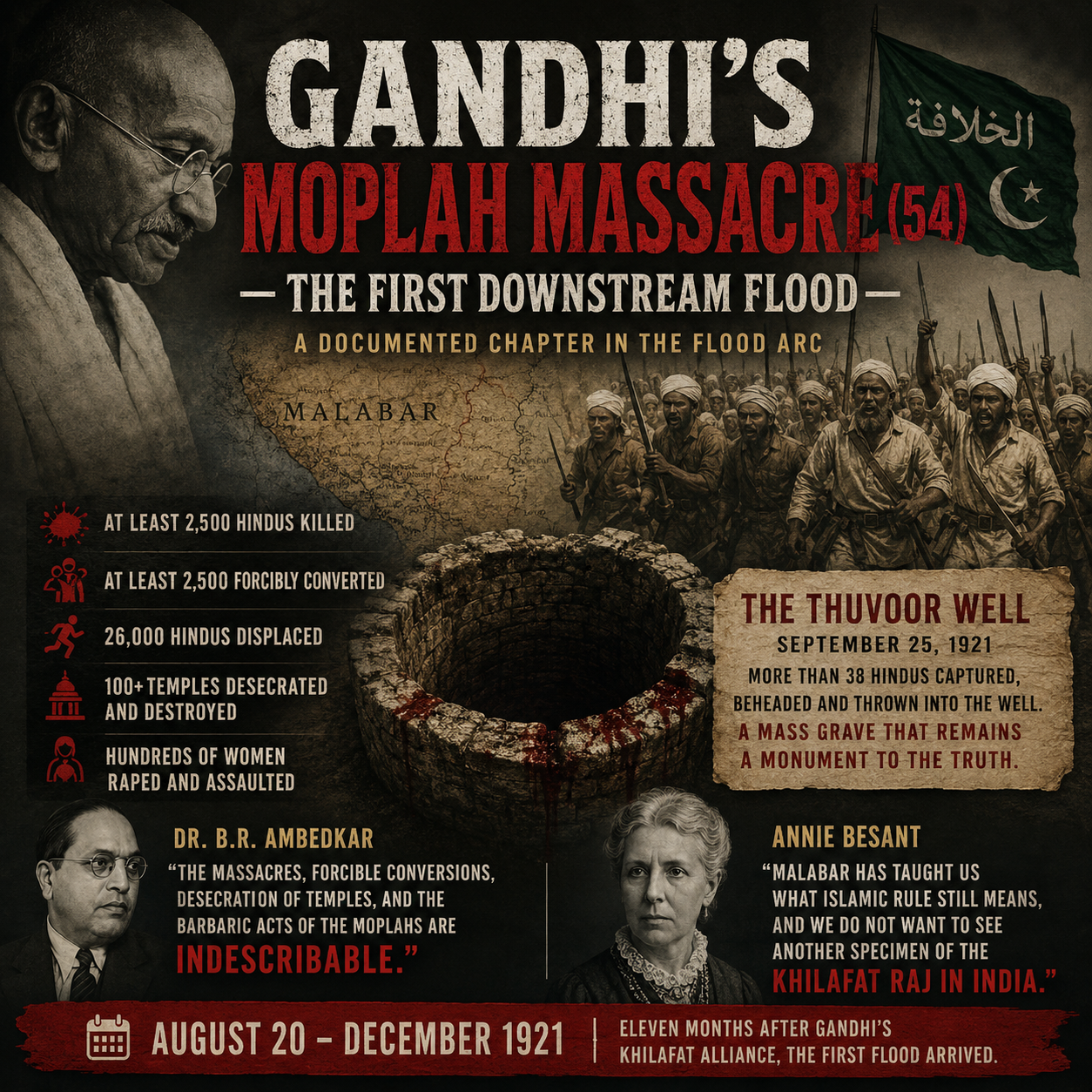
Gandhi’s Moplah Massacre: The First Downstream Flood (54)
भारत / GB
Part 54: Mahatma Gandhi’s Peace Efforts | Series Index
Blog 53 mapped what the prosecution has established across fifty-three blogs and what remains to be documented. The flood documentation begins here. Blog 44 documented the Khilafat injection — what Gandhi chose and why. Blog 48 documented the consolidated Muslim front it created. This post documents the first downstream consequence of that creation — arriving within twelve months of Gandhi’s alliance, in the fields of Malabar, before the Non-Cooperation Movement had even been suspended.
Thank you for reading this post, don't forget to subscribe!The Action Taken: An armed uprising in Ernad and Walluvanad taluks (Aug–Dec 1921) enacted mass killings, temple desecrations, and forced conversions following intense Khilafat mobilization.
Who Paid the Price: Over 2,500 civilian victims, 2,266 official rebel casualties, and over 100,000 displaced Hindu refugees.
The Alternative Bypassed: Vetting political alliances to ensure regional affiliates were committed to non-violent civic action.
Why This Matters: The foundational T2 exhibit: the first catastrophic downstream explosion occurring within twelve months of linking national politics to the Khilafat agitation.
Who the Moplahs Were
Gandhi’s Moplah Massacre begins with the community at its centre — because understanding who the Moplahs were is essential to understanding how Gandhi’s Khilafat alliance reached them and produced the downstream flood the series now documents.
The Moplahs — also called Mappilas — were the Muslim community of the Malabar coast of Kerala. Descendants of Arab traders who had settled in Kerala centuries earlier, they constituted approximately 32% of Malabar’s population by the early twentieth century, concentrated in the southern taluks. They were predominantly tenant farmers and agricultural labourers — the zamindars, the landowners above them, were predominantly upper-caste Hindus.
The Moplah community had a documented history of periodic uprisings against British authority and Hindu landlords going back to the nineteenth century. The agrarian grievance was real — tenant insecurity, rack-renting, the economic subordination of Muslim peasants to Hindu landlords within a colonial framework that protected landlord rights over tenant rights. This grievance existed before Gandhi’s Khilafat alliance and would have continued after it.
What Gandhi’s alliance changed was not the grievance. It was the energy available for its expression.
The Khilafat Connection
The Khilafat Movement gained force in Malabar due to Gandhi’s patronage. The Congress, under Gandhi’s leadership, had formally allied the independence movement with the Khilafat cause in September 1920. The two-platform march had brought Hindus and Muslims onto the same streets — for different destinations.
In Malabar, the Khilafat mobilisation fused with the existing agrarian grievance in ways that Gandhi’s platform had not anticipated — or had chosen not to anticipate. The local Khilafat leadership — particularly Variyankunnath Kunjahammad Haji — transformed the pan-Islamic energy Gandhi had amplified into a specific political programme: the establishment of Khilafat rule in Malabar, the expulsion of the British, and the subordination of the Hindu population to Islamic authority.
The Moplah rebels were armed with knives and ammunition. They had planned their attack. Their stated objective was not merely to protest British policy toward the Ottoman Caliphate — it was to establish an Islamic state in the Malabar region. The Khilafat flags flew over territory they seized. The slogans were directed not only against the British but against the Kafirs — the non-believers — specifically the Malabar Hindus. [References]
Gandhi’s Moplah Massacre is the prosecution’s first documented exhibit in the flood arc — the Khilafat energy Gandhi amplified, arriving at its first downstream consequence eleven months after the alliance. The Moplah uprising began on August 20, 1921 — eleven months after Gandhi formalised the alliance at the Calcutta Special Session.
What Happened — August to December 1921
The uprising began in the Ernad and Valluvanad taluks of Malabar on August 20, 1921. Within days it had spread across the southern taluks. The British imposed martial law. The violence continued for four months.
The documented record — from British administrative reports, district magistrate accounts, police records, Annie Besant’s testimony, Ambedkar’s documentation, and international newspaper reports — establishes the following:
The killing: At least 2,500 Hindus were slaughtered. The total death toll — including Moplah rebels killed by British forces — was approximately 10,000, of which 2,339 were documented rebels. International newspapers reported the scale in real time. The Telegraph on August 21, 1921 carried a report stating: “The Malabar rebellion is primarily a holy war.” An Australian newspaper reported in October 1921: “Calicut is overflowing with refugees reporting that the Moplahs are now not offering the choice of conversion, but are slaughtering Hindus indiscriminately.”
The forced conversions: At least 2,500 Hindus were forcibly converted to Islam. The conversions were not voluntary — Hindus were given the choice of conversion or death. Many converted under duress. Many who refused were killed.
The displacement: 26,000 Hindus fled as refugees — abandoning their homes, their land, and their communities. Many never returned.
The temples: More than 100 Hindu temples were desecrated or destroyed. Some accounts place the number above 300. Diwan Bahadur C. Gopalan Nair documented in his contemporaneous account: “There is hardly a village that has not its temple, in the majority of villages there is more than one, and almost every temple in the rebel area has been desecrated.”
The sexual violence: Hundreds of Hindu women were raped and sexually assaulted. Annie Besant documented in New India in 1921 that a pregnant woman carrying a seven-month baby was cut through the abdomen — her body found on the road with the child protruding from her womb. A six-month-old child was snatched from its mother and cut into two pieces in front of her.
Two Documented Exhibits
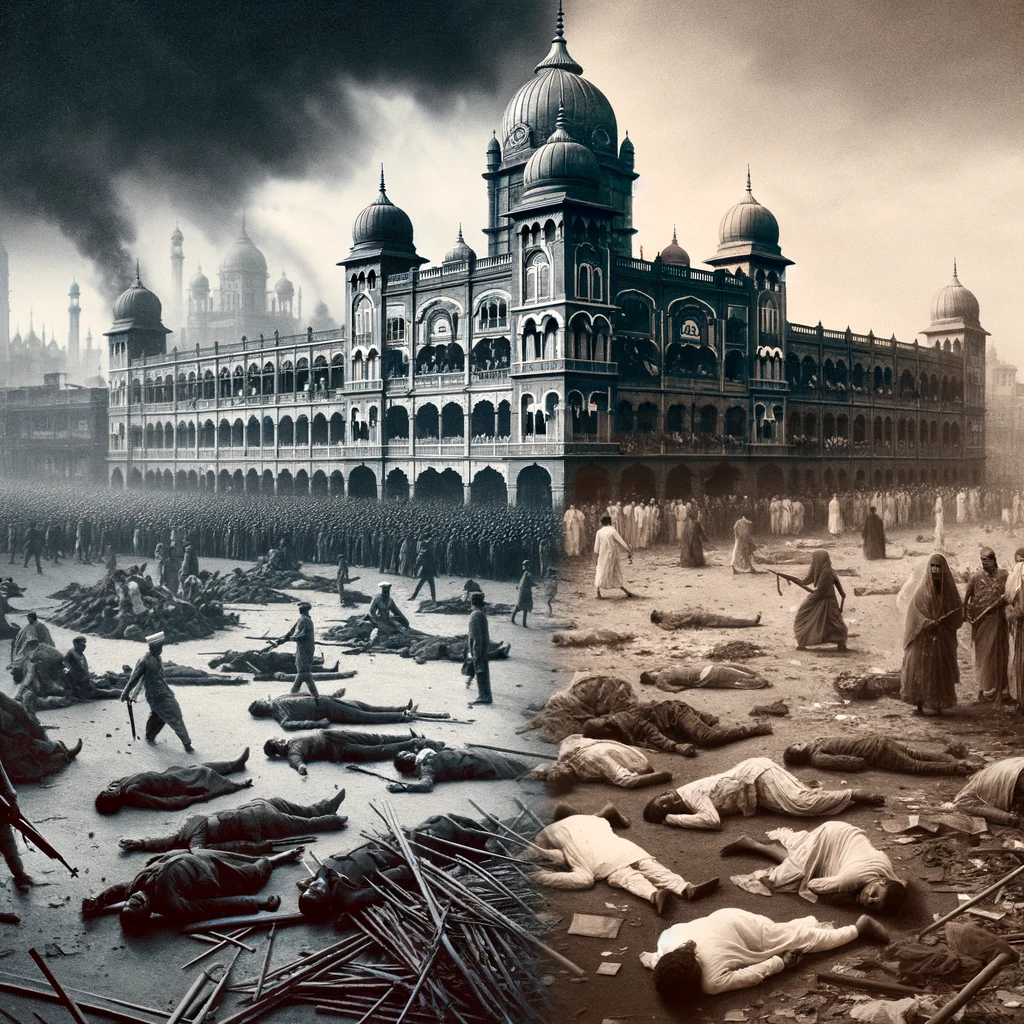
Two specific incidents stand as documented exhibits in their own right — each requiring its own record in the series.
The Thuvoor Well — September 25, 1921: Khilafat leader Chambrassery Imbichi Koithangal held a rally with over 4,000 followers on the barren hillside between Thuvoor and Karuvayakandi. More than 38 Hindus were captured, their hands tied behind their backs, and marched to the local well. They were beheaded. Their bodies were thrown into the well — turning it into a mass grave. The site stands as a documented monument to the first downstream flood.
The Wagon Tragedy: 90 Moplah prisoners were loaded into a closed railway wagon for transport to the Central Prison in Podanur. 70 of the 90 died of suffocation before they arrived. The British administration’s handling of prisoners produced a documented atrocity of its own — within the same event that had produced the massacre of Hindus.
Ambedkar and Besant — The Witnesses
Two of the independence movement’s most significant voices documented the Moplah massacre while it was happening and immediately after.
Dr B.R. Ambedkar described the massacres, forcible conversions, desecration of temples, and the barbaric acts of the Moplahs as “indescribable.” Ambedkar’s documentation is significant not only for its content but for its source — the man who would become independent India’s first Law Minister and the architect of its Constitution placed the Moplah massacre on the record in terms the prosecution can carry without hesitation.
Annie Besant — who had been silenced and marginalised by Gandhi’s Non-Cooperation movement, whose constitutional warnings had been overridden at Nagpur — wrote in her book The Future of Indian Politics: “They murdered and plundered abundantly, and killed or drove away all Hindus who would not apostatize. Somewhere about a lakh of people were driven from their homes with nothing but the clothes they had on, stripped of everything. Malabar has taught us what Islamic rule still means, and we do not want to see another specimen of the Khilafat Raj in India.”
Blog 49 documented how Besant’s warnings were silenced at Nagpur. Her documentation of the Moplah massacre is the record of what the silenced warning produced — written by the woman who had seen it coming.
The Kerala Government’s Response — 1971
The standard historical account of the Moplah massacre requires one additional documented exhibit before the prosecution’s connection to Gandhi can be made.
In 1971, the Kerala government — under Congress influence — recognised the Moplah rebels of 1921 as freedom fighters. The men who had beheaded 38 Hindus and thrown them into a well, who had forcibly converted 2,500 people, who had destroyed 100 temples, were placed on the official list of Indian independence martyrs.
The recognition was contested then and remains contested. The Indian Council of Historical Research has subsequently moved to remove the Moplah rebels from the freedom fighter list. The contest itself is Gandhi’s Moplah Massacre’s most precise exhibit on the historiography question — that a massacre of Hindus conducted under the banner of the Khilafat cause Gandhi had legitimised was subsequently reframed as freedom fighting.
The Prosecution’s Position
Gandhi’s Moplah Massacre is the prosecution’s Exhibit 14 — the first flood document in a series that will document every downstream death in the causal chain Gandhi’s 1920 decision opened. It does not claim Gandhi ordered the killing of Hindus in Malabar. It claims the documented arithmetic of the sequence:
Gandhi formalised the Khilafat alliance in September 1920. The Khilafat movement carried pan-Islamic energy that extended beyond its stated constitutional demand — energy that connected Indian Muslims to a framework of Islamic solidarity that the prosecution has documented across six blogs. Gandhi amplified that energy through the independence movement’s full organisational weight and moral authority.
Eleven months later, in August 1921, that amplified energy — fused with Malabar’s pre-existing agrarian grievance — produced the first downstream flood. At least 2,500 Hindus killed. At least 2,500 forcibly converted. 26,000 displaced. More than 100 temples destroyed. Women raped. Children killed. A well filled with beheaded bodies.
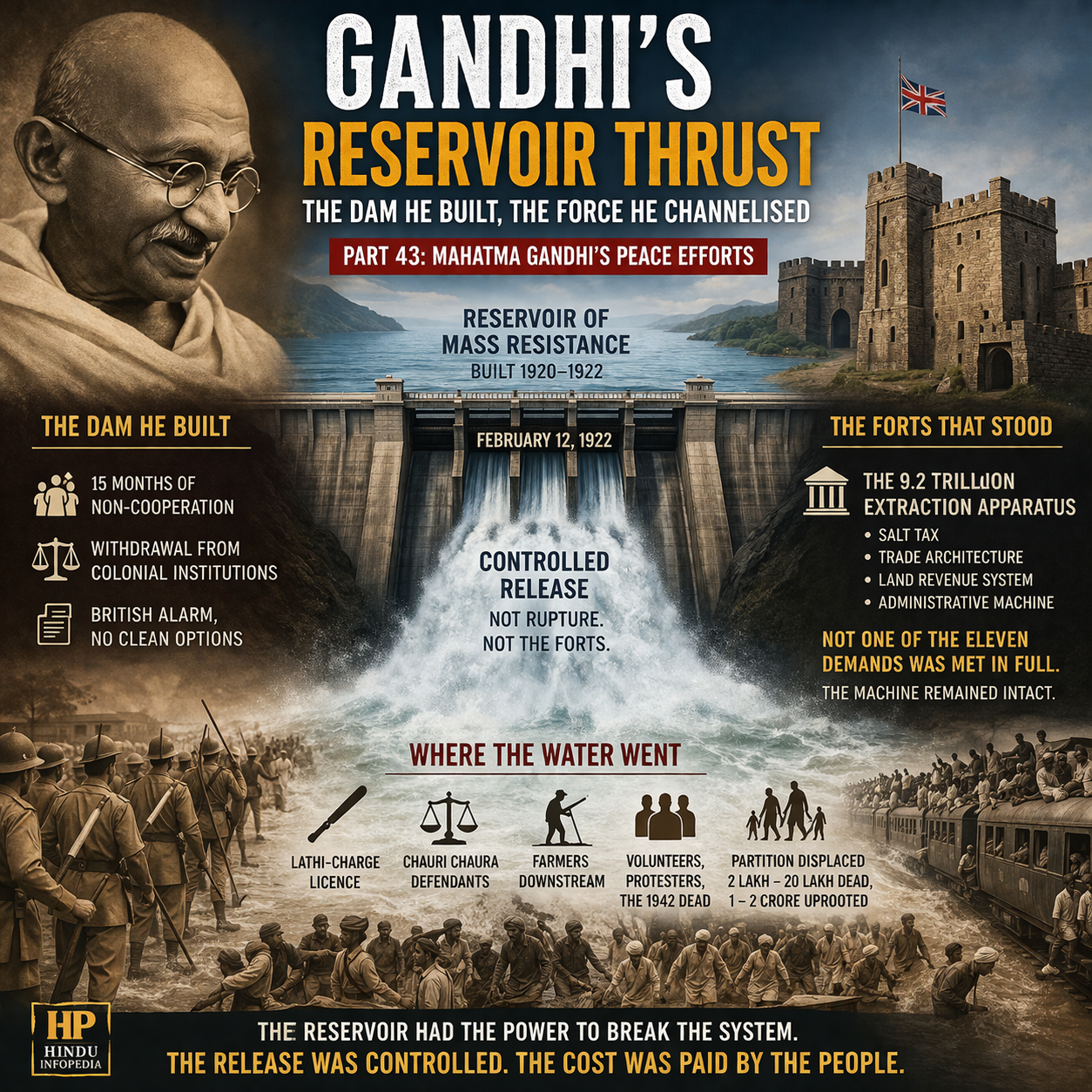
The flood did not go where Gandhi pointed it. Gandhi pointed it at the British forts. It went into the fields of Malabar — where the farmers downstream had no protection from the water the dam-builder had released.
The next post documents what Gandhi said while this was happening — and what he did not say.
Gandhi’s Moplah Massacre — the first downstream flood — began on August 20, 1921. Gandhi had formalised the Khilafat alliance on September 1, 1920. Eleven months separated the alliance from the flood. At least 2,500 Hindus were killed. At least 2,500 were forcibly converted. 26,000 fled. The Thuvoor well was filled with beheaded bodies on September 25, 1921. Ambedkar called it indescribable. Besant said Malabar had taught India what Islamic rule still means. The series places the documented record before the reader. The next post documents the agrarian crisis Gandhi did not address — and the instrument he chose instead.
Feature Image: Click here to view the image.
Videos
Glossary of Terms
- Moplahs / Mappilas: A Muslim community of the Malabar region in Kerala, historically descended from Arab traders and local converts, many of whom were tenant farmers under Hindu landlords.
- Malabar Rebellion of 1921: A violent uprising in August–December 1921 in Malabar involving Moplah rebels, British forces, and Hindu communities, with overlapping agrarian, political, and religious dimensions.
- Khilafat Movement: A pan-Islamic political movement (1919–1924) in British India seeking to preserve the Ottoman Caliphate, later supported by Mahatma Gandhi as part of a broader anti-colonial strategy.
- Non-Cooperation Movement: A mass civil disobedience campaign (1920–1922) led by Mahatma Gandhi urging Indians to withdraw cooperation from British institutions.
- Pan-Islamic Energy: A phrase used in this series to describe the transnational religious-political sentiment connecting Muslims across regions under a shared Caliphate identity.
- Downstream Flood (Series Term): A conceptual term coined in this series to describe unintended consequences arising from a political decision, particularly the spread of mobilised mass energy beyond its original target.
- Khilafat Alliance: The political alignment formed in 1920 between the Indian National Congress and Khilafat leaders to jointly oppose British rule.
- Variyankunnath Kunjahammad Haji: A prominent Moplah leader during the rebellion who established a short-lived parallel administration in parts of Malabar.
- Thuvoor Well Incident: A reported घटना during the rebellion where captured individuals were killed and their bodies disposed of in a well, cited in several contemporaneous accounts.
- Wagon Tragedy: An घटना in 1921 where 70 out of 90 Moplah prisoners died of suffocation while being transported by British authorities in a sealed railway wagon.
- Zamindar System: A land revenue system in colonial India where landlords (zamindars) held rights over land, often leading to tenant exploitation.
- Forced Conversions (Contextual Term): Alleged instances during the rebellion where individuals were compelled to change religion under threat, as reported in some historical accounts.
- Martial Law (Colonial Context): Emergency governance imposed by the British administration during the rebellion, allowing military control over civilian areas.
- Historiography: The study and interpretation of historical writing, including how events like the Moplah rebellion are differently understood over time.
#MoplahRebellion #Malabar1921 #Khilafat #Gandhi #IndianHistory #ColonialIndia #Ambedkar #AnnieBesant #KeralaHistory #HinduinfoPedia
References
- C. Gopalan Nair — Moplah Rebellion 1921 — Special Tribunal Calicut Judgement
- Al Jazeera (September 2021) — independent state documentation
- Insight UK citing contemporaneous accounts — Caliphate flags, Kafir slogans